Himera: Isotope model suggests breastfeeding ended only at around four years
Evidence level 2 of 5 · Single study, peer-reviewed

Key points
- A computational model based on nitrogen isotopes in the bones of 50 children from the Greek colony of Himera (Sicily, 6th to 5th century BC) puts the end of breastfeeding at 3.8 years (95 percent interval 3.0 to 4.7 years).
- According to the model, exclusive breastfeeding ended at 0.3 years in the most likely case; the interval, however, ranges from 0.0 to 2.2 years, and the authors describe large differences between children.
- Only children who died young were examined; the study cannot show whether their dietary course was typical of all children in the city, and according to its developers the model used cannot be checked against known cases.
In the Greek colony of Himera in Sicily, infants apparently often received additional food after just a few months, but still got breast milk for years. This is suggested by an isotope analysis of the bones of children who were buried there in the 6th to 5th century BC. A computational model puts the end of breastfeeding at 3.8 years (95 percent interval 3.0 to 4.7 years) and the end of exclusive breastfeeding at 0.3 years. This second value is very uncertain: its interval ranges from 0.0 to 2.2 years, that is, from birth into the third year of life.
The study comes from Laurie Reitsema of the Department of Anthropology at the University of Georgia and three co-authors from Pennsylvania State University, the cultural heritage authority of Palermo and the University of Northern Colorado. It was published in the "European Journal of Archaeology".
Human skeletal remains were examined, and only those of children who died young. The study cannot show whether they were fed like the children who survived.
A city with more than 13,000 graves examined
Himera existed from the 7th to the 5th century BC. Dorians and Chalcidians founded the colony; it grew into a large city with Greek, Phoenician and native Sicilian influences, for which the paper cites up to 26,000 inhabitants. More than 13,000 burials were examined in the cemeteries. Children lie there in, among other things, clay vessels, clay tubs, wooden coffins and simple pits.
Texts report on breastfeeding in antiquity: writings by the authors Soranus of Ephesus, Galen and Oribasius, as well as wet-nurse contracts from Egypt. According to the paper, however, written sources, art and grave goods are unevenly distributed. Athens is overrepresented; poorer free and enslaved families are underrepresented.
The grave goods of Himera also help only to a limited degree. Almost 500 "baby bottles," so-called guttī, were found in the graves. They could mean that the children buried with them were still being breastfed when they died. Such bottles also lie in the graves of adults, however, and only four were found in the city itself, which speaks rather for a symbolic role. The children's bones offer a different approach.
What bones reveal about breast milk
Carbon and nitrogen in body tissue come from food. Both elements occur in several kinds of atoms, the isotopes. Foods differ in the ratio in which they contain these isotopes, and a person's tissue reflects the mixture of what he or she ate.
The nitrogen value indicates where an organism stands in the food chain. Breastfed infants lie 1 to 3 per mille above their mother or wet nurse; per mille is the unit here for the isotope ratio. When a child gradually receives other food, its value falls until the gap to the mother has disappeared. If one plots the values of many children against their age, a weaning curve results. According to the team, the method is considered the standard for estimating weaning in the past.
The carbon value says less about the amount of milk. It mainly indicates from when carbon-rich complementary food is added, primarily plants; the milk itself shifts it by only about 1 per mille.
That breast milk leaves this trace has been measured in present-day children by other researchers. A team around first author Fuller examined fingernails and hair of mothers and their infants in a paper published in 2006. The five exclusively breastfed children lay about 2 to 3 per mille above their mothers for nitrogen and about 1 per mille for carbon. In two children who received breast milk and formula, the gap was smaller; in the one child fed only formula, it was absent. During weaning, the carbon value fell to the mother's level faster than the nitrogen value. The sample was very small, and a different tissue than bone was measured.
From measured value to age
Reitsema's team took samples from 58 children and adolescents under 18 years from the East and West Necropolis of Himera. 50 of them were younger than ten years; only they enter the model. As a reference value for the mothers, 27 adult women from the same cemeteries serve. Their nitrogen value was 10.3 ± 0.7 per mille; between the two necropolises there was no significant difference.
The researchers estimated the children's age at death from how far the teeth were developed, erupted and worn. Because this only allows an age range to be given, the study works with its midpoint.
The measurement was made on collagen extracted from the bones. Whether a sample is still usable or has changed over time, the team checked using four benchmarks: the carbon content and the nitrogen content, the collagen yield, and the ratio of carbon to nitrogen. Many samples failed here. About a third of the samples used yielded less collagen than the benchmark demands. The team did not exclude them because, according to its statements, the yield in Himera is related neither to other signs of weathering nor to the isotope values.
The real difficulty lies in the bone itself. It is remodeled only slowly, so its collagen reflects the diet over a period before death, not on the day of death. With increasing age this remodeling slows down. Each child also provides only a single measured value; the weaning curve is composed of many children of different ages, not of the course of individual lives.
To obtain age estimates nonetheless, the study uses a Bayesian model called WARN, which the researchers Tsutaya and Yoneda presented in 2013. It takes into account that bone renews itself at different speeds depending on age, and estimates four quantities: when exclusive breastfeeding ended, when breastfeeding as a whole ended, what nitrogen value collagen would have if it were built up from complementary food alone, and how large the gap is between breastfed children and the women. Each most likely value comes with an interval in which the value lies with 95 percent probability under the model's assumptions.
The children are distributed unevenly across the age groups. 15 died in the first year of life, 17 between three and five years, but only 9 between one and three years.
Early complementary food, late weaning
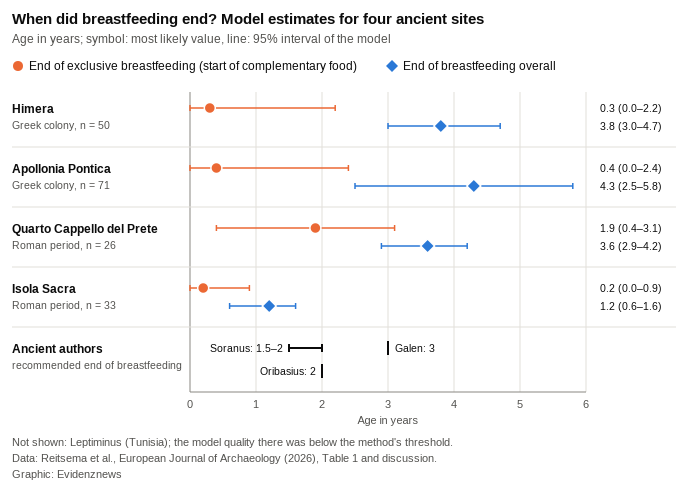
For Himera the model yields two points in time. Exclusive breastfeeding ended, in the most likely value, at 0.3 years (interval 0.0 to 2.2 years), breastfeeding as a whole at 3.8 years (3.0 to 4.7 years). In between lies a weaning period of around three and a half years, in which the children received milk and other food side by side.
The model estimates the gap between breastfed infants and the women at 1.7 per mille (1.3 to 2.2). This lies within the range of 1 to 3 per mille that is expected for breastfeeding. All children under six months lay above the women's reference value in nitrogen. The authors conclude from this that all infants were breastfed; how many children died that young, the text does not state.
The practice was not uniform. The team describes the duration of exclusive breastfeeding as fairly variable and often short, and breastfeeding as a whole also varies widely. As possible reasons for early complementary food, it names the workload of women in agriculture, crafts, at the market or as wet nurses for other people's children. This is an interpretation, not a measurement. The authors also note that solid food from about three months carries risks for infants in a germ-laden environment.
The model also gives a hint about the diet after breast milk. Collagen built up from complementary food alone would have had a nitrogen value of 9.6 per mille (9.2 to 10.2) in Himera. This is slightly below the previously published mean of the adults of 10.3 ± 0.9 per mille. The authors interpret this as a more plant-rich diet of the children; the adults' diet in Himera was based on plants, with animal protein added as a supplement. The difference is small, however: the upper limit of the interval almost reaches the adults' value. According to the model curve, it persists until about nine to ten years of age. The eight older children and adolescents all lie within the adults' range of values. Between eight and ten years, this rests on only two children.
Longer than ancient advice manuals, similar to the Black Sea
Soranus and Galen wrote in the 2nd century AD, that is, centuries after the end of Himera. They recommended breastfeeding infants exclusively for six months and reducing the milk gradually afterward. According to Galen, complete weaning should happen at three years, according to Soranus at one and a half to two, according to Oribasius at two years; Egyptian wet-nurse contracts ran 16 months to three years, mostly two. The most likely value for Himera, 3.8 years, lies above all of these figures. The lower limit of the interval, 3.0 years, does correspond to Galen's recommendation, however. And the texts do not prove what was customary in Himera.
Earlier isotope studies from the Mediterranean region found, according to the paper, mostly an end of exclusive breastfeeding at around six months and an end of breastfeeding between two and four years. According to the authors, the World Health Organization today also recommends six months of exclusive breastfeeding.
For comparison, the team re-analyzed published data from other sites with the same model. Closest to Himera comes a second Greek colony: Apollonia Pontica on the Black Sea, present-day Sozopol in Bulgaria, a foundation of Miletus with about 3,000 inhabitants at its peak. From the data of 71 children, the model calculates there an end of exclusive breastfeeding at 0.4 years (0.0 to 2.4) and an end of breastfeeding at 4.3 years (2.5 to 5.8). The authors call the similarity striking.
Two sites from Roman times deviate more, also from each other. In Isola Sacra near Rome's harbor (33 children), breastfeeding ended according to the model already at 1.2 years (0.6 to 1.6), exclusive breastfeeding at 0.2 years (0.0 to 0.9). In Quarto Cappello del Prete (26 children), breastfeeding ended at 3.6 years (2.9 to 4.2), as late as in Himera, but exclusive breastfeeding only at 1.9 years (0.4 to 3.1). For a fifth site, Leptiminus in Tunisia, the calculation does not meet the method's quality criterion; its value is left out here.
The authors read the closeness of Himera and Apollonia as a possible indication of a shared norm in Greek areas. They concede that the similarity need not have been a conscious decision and that further sites would have to be examined. For Himera itself they see both: a norm, because all infants were breastfed and a weaning curve is recognizable, and room for individual variation, because the curve turns out less clean than, for example, in Isola Sacra and start, end and complementary food vary. The origin and status of the individual children are not known.
What the dead cannot say
The study itself names the biggest limitation. All the children examined died young. Possibly their diet itself contributed to this; in that case it would not be representative of the city. The authors counter that survivors alone do not represent the population either, and therefore direct attention to the range of practice rather than to an ideal weaning. The paper does not examine a connection between weaning and mortality.
Elsewhere, it nevertheless voices a conjecture. According to a demographic analysis of the burials that the paper cites, the mortality of infants and children in Himera was surprisingly low compared with other European sites. Long breastfeeding could underlie this, the authors write. The portal Phys.org also quotes Reitsema with the opposite possibility: the observed behavior could reflect "a specifically unsuccessful strategy." Both readings stand side by side. With the bones of those who died young, one cannot decide between them.
Then there is the method. The developers of WARN themselves write that the model cannot be validated because the true weaning age of archaeological groups is mostly unknown. They nevertheless consider it useful for comparing populations by a uniform yardstick. In 39 archaeological population groups to which they applied it, weaning ended on average at 2.80 ± 1.32 years. A review by the same authors from 2015 notes that each tissue has its own advantages and disadvantages and that trace elements in tooth enamel provide a finer temporal resolution.
What remains open
It remains open whether the pattern of the children who died young was typical of Himera and whether the families' origin or status played a role; the paper does not analyze this. As a next step, the team names studies of teeth from people who survived their childhood. The research found no independent statements from other experts on the study, which is only a few weeks old.
Questions about this article
Comments
Sources
- Primary source Reitsema L, Gancz AS, Vassallo S, Kyle B: A Child-Centred Approach to Cultural Hybridity: Weaning and Childhood Diets in the Greek Colony of Himera. European Journal of Archaeology, First View, S. 1–20 (2026). doi:10.1017/eaa.2025.10023
- Context Fuller, Fuller, Harris, Hedges: Detection of breastfeeding and weaning in modern human infants with carbon and nitrogen stable isotope ratios. American Journal of Physical Anthropology 129 (2006). doi:10.1002/ajpa.20249
- Context Tsutaya, Yoneda: Quantitative Reconstruction of Weaning Ages in Archaeological Human Populations Using Bone Collagen Nitrogen Isotope Ratios and Approximate Bayesian Computation. PLoS ONE 8(8), e72327 (2013). doi:10.1371/journal.pone.0072327
- Context Tsutaya, Yoneda: Reconstruction of breastfeeding and weaning practices using stable isotope and trace element analyses: A review. American Journal of Physical Anthropology 156, Suppl. 59 (2015). doi:10.1002/ajpa.22657
- Context Oster S (Phys.org): Babies in ancient Greek colony started solid food at 3 months but nursed for nearly 4 years, chemical signatures suggest (2026). https://phys.org/news/2026-11-babies-ancient-greek-colony-solid.html