When will nuclear fusion arrive as an energy source?
Nuclear Fusion: Gain Shown in the Lab, Electricity from Fusion Not Yet Demonstrated
Evidence level 3 of 5 · Several independent studies pointing the same way
Key points
- At the US laser facility NIF, an experiment on December 5, 2022 released 3.1 megajoules of fusion energy with 2.05 megajoules of laser energy, 1.5 times as much; according to the researchers involved, the laser facility itself typically consumes a hundred times the laser energy.
- A technical report from the ITER and EUROfusion expert community from 2026 names as unsolved, among other things, the breeding of the fuel tritium in a breeding blanket that has never been built or tested, the durability of materials under neutron bombardment, and continuous operation: today's fusion facilities run less than one percent of the time.
- Years given for fusion power plants are throughout plans in the sources evaluated: according to the 2024 schedule, ITER itself is not to operate with deuterium and tritium until 2039 and is not designed to generate electricity.
Nuclear fusion has crossed a threshold in the lab: An experiment released more fusion energy than the laser energy that hit the target. That is not a power plant. No experiment has so far delivered more energy than the entire facility consumes, and electricity from fusion has not yet been demonstrated. When that will succeed cannot be read from the research; the years that are mentioned are plans.
This text draws on two main sources of very different kinds. One is a peer-reviewed measurement: the report on an experiment at the National Ignition Facility (NIF), a laser facility of the Lawrence Livermore National Laboratory in the US, published in 2024 in "Physical Review Letters." The other is a stocktaking: Chapter 9 of a handbook on the fusion project ITER, published in February 2026 with Gianfranco Federici of the EUROfusion consortium as lead editor and chapter author. It describes what is still missing between ITER and a power plant.
This chapter is a technical report and was not peer-reviewed by a journal. It was written by experts from fusion research, that is, from the community whose project it assesses. It is based on experiments at large facilities and, where future power plants are concerned, on designs and model calculations. It is not a neutral view from outside; but it names many gaps itself.
Two Routes to Fusion
The record experiments at NIF and JET worked with a mixture of deuterium and tritium, and it is the fuel that a fusion reactor would consume. When the two fuse, alpha particles with an energy of 3.5 megaelectronvolts and neutrons with 14.1 megaelectronvolts are produced. The alpha particles heat the fuel further. The neutrons carry the larger part of the energy, leave the fuel and stress the wall of the facility.
For the self-heating to suffice, the product of density, temperature and confinement time of the fuel must exceed a minimum value. There are two approaches to this. Magnetic confinement holds the heated fuel, the plasma, in a magnetic field for a long time; designs include the tokamak and the stellarator. Inertial confinement compresses a tiny fuel capsule with lasers.
NIF works on the second principle. Its 192 laser beams aim into a gold cylinder in which sits a capsule of diamond about two millimeters in size with a frozen layer of deuterium and tritium. In the experiment of December 2022, this fuel weighed 220 micrograms, that is, 220 millionths of a gram. During the shot it is compressed to 1,000 to 2,000 times its density.
What Has Been Measured
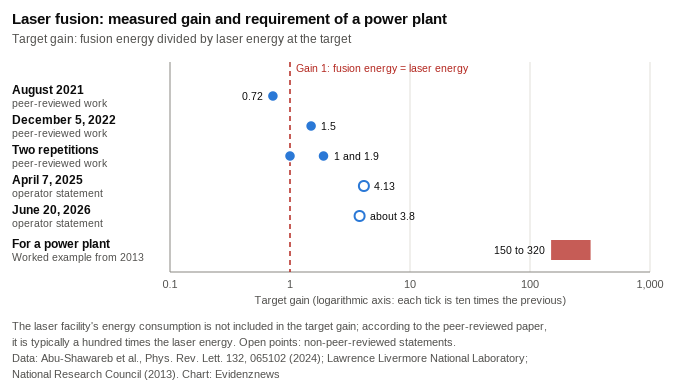
On December 5, 2022, the lasers delivered 2.05 megajoules of energy to the target containing the capsule. 3.1 megajoules of fusion energy were released, with a measurement uncertainty of 0.16 megajoules. The ratio of the two values, the so-called target gain, was 1.5. In the best attempt until then, in August 2021, it had been 0.72. The authors write that the target gain rose by three orders of magnitude in eleven years, that is, by about a factor of a thousand.
The paper mentions two repetitions that reached a target gain of 1.9 and of 1. It also shows how sensitive the method is: Small, uncontrollable fluctuations in laser and capsule can, according to the authors, worsen the result by a factor of two to five.
Since then, the operator reports higher values. On its website, the Lawrence Livermore National Laboratory lists twelve ignition experiments through October 2026. The highest yield, accordingly, comes from April 7, 2025: 8.6 megajoules (measurement uncertainty 0.45) at 2.08 megajoules of laser energy, a target gain of 4.13. Later experiments were lower, for example about 7.9 megajoules (measurement uncertainty 0.4) in June 2026 and 2.2 megajoules (measurement uncertainty 0.1) in October 2026. These figures are statements by the operator and have not been peer-reviewed.
Three Kinds of Gain
The target gain is only one of three quantities that get mixed up in the debate. It compares the fusion energy with the laser energy that arrives at the target. How much electricity the facility needs to produce this laser energy is not included. The NIF authors make this clear themselves: A target gain above one does not mean a net energy gain in the practical sense, because the laser facility typically consumes a hundred times the laser energy. The facility was built for research, not for energy production.
How far the road is is shown by a worked example from a 2013 report of the US National Research Council. An inertial fusion power plant with ten percent recirculating power, that is, power that flows back into its own operation, would accordingly need a target gain of about 150 if its laser has an efficiency of 15 percent, and of about 320 at 7 percent. The report predates the successes of NIF; the mathematical relationship does not depend on them. For a power plant, according to the NIF authors, laser energy, shot rate, robustness of the capsules, compression and costs would also have to be further developed.
The second quantity applies to magnetic-confinement facilities. There, the factor Q compares the fusion power with the heating power fed into the plasma. The JET facility in Great Britain reached a fusion power of 16 megawatts at 24 megawatts of heating power in 1997, that is, a Q of 0.6. In 2023, JET released 69 megajoules over five seconds; the sources do not state a heating energy for this record. According to the ITER chapter, the facility was too small for a high gain.
ITER has ten times the plasma volume of JET and is meant to reach a Q of 10, at around 500 megawatts of fusion power. That, too, would not be a power plant, and here lies the third quantity: the balance of the entire facility. The chapter states explicitly that ITER is designed neither to produce more energy than the entire facility consumes nor to generate electricity. It calls the balance of the entire facility the more meaningful measure.
What Is Missing Before a Power Plant
A central gap concerns the fuel. According to the chapter, a fusion reactor consumes about 55.8 kilograms of tritium per 1,000 megawatts of fusion power per year. Tritium decays with a half-life of 12.32 years; about 5.5 percent of a stock is lost each year. For comparison, the chapter cites nuclear fission reactors: Light-water reactors produce only about 0.5 to 1 kilogram of tritium per year, heavy-water-moderated reactors of the CANDU type about 130 grams per gigawatt of electrical power and full-load year.
Because external sources are scarce, a fusion power plant must produce its own tritium. The breeding blanket is meant to do this, a component that breeds new tritium from lithium in the reactor and at the same time carries off the heat. The chapter calls this self-sufficiency an unavoidable requirement for any facility after ITER. And it states: A fusion blanket has never been built or tested.
A peer-reviewed review paper by Abdou and colleagues from 2021, of which only the abstract was available for this text, reaches a similarly sober judgment. The state of physics and technology is not sufficient for demonstration plants and future power plants to meet the tritium requirements. According to their model calculations, self-sufficiency is impossible if a facility is available less than 10 percent of the time, possible only above 30 percent and with reasonable certainty only above 50 percent, and even then only if the product of fueling efficiency and burn fraction is above 2 percent. The authors themselves call their predictions very uncertain because experiments with burning plasma are lacking.
The second gap concerns materials. Under bombardment with fusion neutrons, steel, according to the chapter, produces 40 times as much helium as in a fission reactor. Irradiation tests in fission reactors may therefore not deliver data that are on the safe side for fusion materials. The European neutron source DONES under construction in Granada is meant to deliver material data, but can irradiate a volume of only at most half a liter. None of the critical problems, according to the chapter, can be fully solved by tests at non-fusion facilities alone.
The third gap is continuous operation. Today's fusion facilities run less than one percent of the time. For a demonstration plant, the chapter considers about 30 percent a defensible goal; power plants today typically achieve an availability of 80 to 90 percent. For blanket failures under fusion conditions there are practically no data, and the statements on availability rest, according to the authors, largely on estimates by experts.
On economic viability, the chapter states that there are no economic feasibility studies for demonstration plants. Between facilities that generate net electricity and economically viable power plants there will be technical gaps.
Plans, Delays and Dispute
How hard it is to keep schedules is shown by ITER itself. According to the plan presented in 2024, operation with deuterium and tritium is to begin in 2039, four years later than under the 2016 plan. The magazine "Physics World" gave 2034 for the start of operation with deuterium plasmas. ITER Director-General Barabaschi put the additional costs at that time at about five billion euros, which the members still had to review; he did not name a total sum. In November 2025, the project announced that it was slightly ahead of the new schedule. That is a self-report.
Alongside it are the plans of further, predominantly private projects. The International Atomic Energy Agency, in its World Fusion Outlook 2026, according to a trade press report, counts 26 planned fusion power plants. Eight of them are to generate electricity by the early 2030s, seven of them privately financed, and nine more by the end of the 2030s. The research could not view the original report; the figures come from an item by the American Nuclear Society. These are deadlines that the projects have set for themselves.
The ITER chapter urges caution here. Using the example of a vanadium alloy for the first wall, whose qualification was estimated around 1993 at about 30 years and 400 million euros in today's money, it warns against overly tight schedules, such as some proponents of new reactor concepts name. At the same time, the chapter concedes that there are considerable differences of opinion worldwide and even among the ITER members on how the gap to a power plant is to be closed.
More fundamental is the skepticism of the physicist Daniel Jassby, who, according to the author note of his piece, worked for 25 years on fusion experiments at the Princeton Plasma Physics Laboratory. In an opinion piece from 2017, that is, before the successes of NIF, he took the position that fusion reactors could not breed enough tritium, their auxiliary systems would permanently consume a lot of electricity, and their operating costs would not be lower than those of fission reactors. That is an individual opinion, not peer-reviewed, and its figures could not be checked for this text. The concern about tritium is, however, also shared by the peer-reviewed paper by Abdou and colleagues.
That fusion facilities are too complex to ever work, the ITER chapter does not accept as a reason for exclusion: The reliability of complex systems grows with each development step, only that in fusion there are few of them before the commercial design.
What Research Cannot Answer Here
The question of when is not one that an experiment decides. Research can say which technical conditions must be met, and it can name which of them have never been tested. Beyond that, the timing depends on money, political decisions, permitting procedures and on what electricity from other sources then costs.
Scenarios also help only to a limited extent. A study by EUROfusion, which the report of the Atomic Energy Agency cites according to the trade press, considers anything between a very small share and up to 20 percent of worldwide electricity generation possible by the year 2100, depending on assumptions. This range is not a prediction but the result of different assumptions.
Two things are thus documented: A target gain above one has been measured in the lab, and essential parts of power plant technology have not yet been tested. A date follows from neither.
Questions about this article
Comments
Sources
- Primary source Federici G, et al.: ITER Engineering Basis Handbook, Vol. 1, Chapter 9: Gaps to fill beyond ITER. ITER Technical Report ITR-IEBH-109 v1.0; Technischer Bericht, nicht in einer Fachzeitschrift begutachtet (2026). https://www.iter.org/sites/default/files/media/2026-02/vol.1_ch.09_ga…
- Context Abu-Shawareb H, et al. (Indirect Drive ICF Collaboration): Achievement of Target Gain Larger than Unity in an Inertial Fusion Experiment. Physical Review Letters 132, 065102 (2024). doi:10.1103/PhysRevLett.132.065102
- Context Achieving Fusion Ignition. Lawrence Livermore National Laboratory, Angaben des Betreibers, nicht begutachtet; jüngster Eintrag vom 18. Oktober 2026. https://lmf.llnl.gov/science/pursuit-of-ignition
- Context Abdou M, Riva M, Ying A, et al.: Physics and technology considerations for the deuterium–tritium fuel cycle and conditions for tritium fuel self sufficiency. Nuclear Fusion 61, 013001 (2021). doi:10.1088/1741-4326/abbf35
- Context National Research Council: An Assessment of the Prospects for Inertial Fusion Energy, Appendix A. The National Academies Press (2013). https://www.nationalacademies.org/read/18289/chapter/8
- Context Michael Banks: ITER fusion reactor hit by massive decade-long delay and €5bn price hike. Physics World, Nachrichtenbericht (2024). https://physicsworld.com/a/iter-fusion-reactor-hit-by-massive-decade-…
- Context Press conference: New baseline to prioritize robust start to exploitation. ITER Newsline 426, Eigenangabe des Projekts; dazu Pressemitteilung zur 37. Sitzung des ITER-Rats vom 20.11.2025 (2024). https://www.iter.org/node/28514
- Context IAEA publishes 2026 World Fusion Outlook. Nuclear Newswire der American Nuclear Society, Fachpresse (2026). https://www.ans.org/news/article-8577/iaea-publishes-2026-world-fusio…
- Context JET's final tritium experiments yield new fusion energy record. UK Atomic Energy Authority, Pressemitteilung des Betreibers (2024). https://www.gov.uk/government/news/jets-final-tritium-experiments-yie…
- Context Daniel Jassby: Fusion reactors: Not what they're cracked up to be. Bulletin of the Atomic Scientists, Meinungsbeitrag (2017). https://thebulletin.org/2017/04/fusion-reactors-not-what-theyre-crack…