Quantum gas on China's space station: equivalent temperature of 9.7 picokelvin
Evidence level 2 of 5 · Single study, peer-reviewed
Key points
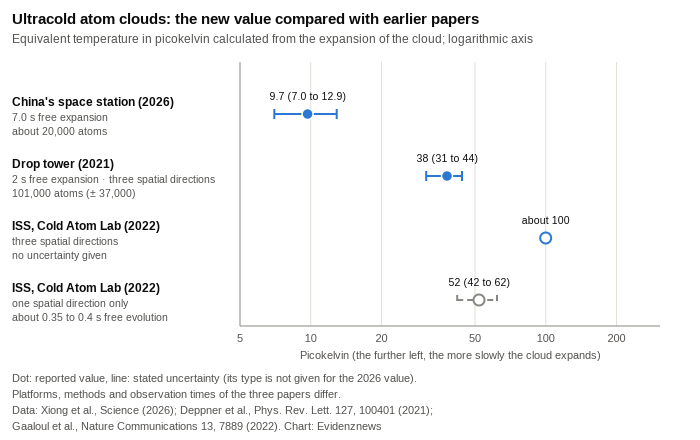
- A team led by Xiong Wei of Peking University reports in the journal Science on a Bose-Einstein condensate of about 20,000 atoms aboard the Chinese space station, for which it gives an equivalent temperature of 9.7 picokelvin at 7.0 seconds of free expansion time (stated range 7.0 to 12.9 picokelvin).
- The equivalent temperature is not a thermometer reading: it is calculated from the speed at which the atom cloud expands after the trap is switched off, and it describes the cloud's kinetic energy, not the temperature of the station or the devices.
- As the previous best value for a system of this kind, the authors give 38 picokelvin at 2 seconds of expansion time; the full text of the new paper was not available for this article, so information on reproducibility and error analysis is missing.
On the Chinese space station, a cloud of about 20,000 atoms, according to a report by "Science News" rubidium, expanded so slowly for seven seconds that the researchers involved attribute an equivalent temperature of 9.7 picokelvin to it. A picokelvin is one trillionth of a kelvin. As the previous best value for a system of this kind, the authors give 38 picokelvin; the new value is about a quarter of that. A thermometer did not measure this temperature: it is calculated from the motion of the atoms.
The paper was published on November 5, 2026, in the journal "Science". It comes from a team led by Xiong Wei (熊炜), Zhou Xiaoji (周小计) and Chen Xuzong (陈徐宗) of Peking University. Also involved are the Shanghai Institute of Optics and Fine Mechanics and the Technology and Engineering Center for Space Utilization, both part of the Chinese Academy of Sciences, as well as Fudan University in Shanghai. The author list comprises 22 names, with Xiong Wei first.
The report describes an experiment on a quantum gas in orbit, not a simulation. For this article, only the abstract of the paper was available, along with the publisher's information on authors, funding and peer review. The full text is behind a paywall, and the research found no freely accessible preprint. All figures on the new result therefore come from the abstract. Details of the experimental procedure that appear only in media reports are left out here.
What an equivalent temperature is
The atoms formed a Bose-Einstein condensate, an ultracold quantum gas. Such a cloud is in thermal equilibrium with no thermometer from which its temperature could be read. Physics therefore takes a detour.
First, a trap holds the atoms in place. Then the trap is switched off, and the cloud expands freely. Camera images show how fast it spreads out. From this speed the kinetic energy of the atoms is obtained, and this energy is converted into the temperature that a gas with the same kinetic energy would have. The more slowly the cloud spreads out, the lower the value.
The number thus describes the expansion energy of the atom sample. It says nothing about the temperature of the space station or the devices, as the report by the Chinese state broadcaster CGTN also notes.
The authors give the uncertainty as plus 3.2 and minus 2.7 picokelvin. The range thus extends from 7.0 to 12.9 picokelvin. What kind of uncertainty is meant, for example a standard deviation, is not stated in the abstract.
Seven seconds of free expansion
The duration of the observation is part of the result. The free expansion lasted 7.0 seconds; for the previous best value it was 2 seconds, according to the authors. The longer a cloud can be observed, the slower the motions that can still be resolved.
On Earth, gravity sets a limit on this duration. CGTN cites Wolfgang Ketterle of MIT, the 2001 Nobel laureate: on Earth the cloud would fall about 250 meters in this time. According to a report by "Science News", experiments in drop towers are limited by the length of the free fall.
The new experiment ran under microgravity, that is, in the weightlessness of the space station. According to the institutions involved, the apparatus is the station's ultracold atom rack, in English Cold Atom Physics Rack, in the Mengtian (梦天) laboratory module, which was launched in 2022. When the measurement took place is not stated in the abstract.
A trap made of laser light
The atoms were held in an optical dipole trap, a trap made of laser light. The previous best value, by contrast, was achieved with magnetic traps on atom chips, according to the authors. In the authors' view, optical traps have two advantages: they offer better optical access, and they can be used to condense both magnetic and non-magnetic atoms.
The abstract states that optical dipole traps had not previously been used to produce such quantum gases under microgravity. An older paper is in tension with this. Condon and colleagues reported in 2019 in "Physical Review Letters" on purely optically produced Bose-Einstein condensates under microgravity, in a three-meter-high facility called the Einstein-Elevator, with expansion times of up to 400 milliseconds and temperatures down to 35 nanokelvin, that is, 35,000 picokelvin. This paper is in the reference list of the new paper. Whether and how its full text qualifies the statement, for example to experiments in orbit, could not be checked. This article therefore does not describe the result as the first purely optically produced condensate under microgravity.
The group had described its plan before the launch. In a 2022 paper, it named a condensate at 100 picokelvin as the goal for the rack and presented a two-stage cooling scheme: first a tight trap for cooling by evaporation, then a wide trap in which the gas is diluted. The value now reported is below this goal. The paper comes from the same team and is therefore not an independent source; because individual figures in the version read are inconsistent, only the target value is given here.
How the value compares with earlier measurements
The comparison value of 38 picokelvin comes from a paper by Deppner and colleagues, published in 2021 in "Physical Review Letters", whose authors include researchers from Hannover and Bremen, among others. In a condensate of 101,000 atoms (plus/minus 37,000), the team lowered the total internal kinetic energy in all three spatial directions to a value corresponding to 38 picokelvin, with an uncertainty of plus 6 and minus 7 picokelvin. It used a magnetic lens to do so. According to the "Science News" report, this is a drop-tower experiment on Earth.
The uncertainty ranges of the two values, 31 to 44 and 7.0 to 12.9 picokelvin, do not overlap. This concerns only the stated measurement uncertainties; it says nothing about other sources of error. In addition, platform and method differ: there, an atom chip with a magnetic lens in a drop tower; here, an optical trap in orbit. Whether the new value, like the older one, is determined over all three spatial directions cannot be read from the abstract. The authors themselves place both numbers side by side.
In reports on the new result, a third value appears: 52 picokelvin, achieved in NASA's Cold Atom Lab on the ISS. It appears in a paper by Gaaloul and colleagues, published in 2022 in the journal "Nature Communications", and applies to only one spatial direction. There, the team briefly switched a trap back on so that it acted like a lens; the method is called delta-kick collimation. With it, the expansion energy of a condensate in one direction fell from 3.6 nanokelvin (plus/minus 0.2), that is, 3,600 picokelvin, to 52 picokelvin (plus/minus 10). In a second direction the value was 200 picokelvin (plus/minus 27). The paper puts the total kinetic energy in three dimensions at about 100 picokelvin.
The observation time there was also different. The free evolution time in the Cold Atom Lab was limited to about 350 milliseconds; elsewhere the same paper gives 400 milliseconds. That is a fraction of the seven seconds of the new experiment.
What experts say and what the institutions say
The research found no critical assessment of the paper, nor an accompanying expert commentary. The voices that are available are approving, but were selected by media or by the institutions involved.
CGTN quotes two experts who are not part of the team. Ketterle calls the result an excellent starting point for advancing atom thermometry and precision measurements. Ernst M. Rasel of Leibniz Universität Hannover points to atom interferometers: they benefit from many atoms and long observation times, and their sensitivity rises with the square of the time the atoms spend in the interferometer; the next step would be interferometers in orbit. The broadcaster does not state where the remarks come from. Rasel is a co-author of the two comparison papers of 2021 and 2022.
The account by the institutions involved goes beyond the paper's abstract. A piece by Peking University, which the newspaper Beijing News (新京报) distributes on its platform, speaks of the coldest artificial matter known to date. The abstract does not say this. It speaks of a record-low temperature, and the comparison is with systems of the same kind. Whether the value is also the lowest in comparison with differently defined temperature figures from the literature has not been clarified by the research.
The authors consider it possible that their result will prompt further experiments with optical traps in space, in quantum simulation and in precision measurements. The abstract does not describe an application.
What remains open
Without the full text, it cannot be said whether the value was measured several times and how much it varies from run to run. It is also open what goes into the stated uncertainty and how sources of error in the image analysis have an effect. The authors' conflict-of-interest statement, the supplementary material and the dataset of the paper were not examined for this article.
The value is the result of a single paper on a single platform. The two comparison papers come from other groups and determine a comparable quantity, but they do not repeat the measurement.
Questions about this article
Comments
Sources
- Primary source Xiong W, Li T, Jin S, et al.: Quantum gases below 10 picokelvin in space. Science, Artikel eaea5324 (2026). doi:10.1126/science.aea5324
- Context Deppner et al.: Collective-Mode Enhanced Matter-Wave Optics. Physical Review Letters 127, 100401; gelesen als Eintrag im Publikationsverzeichnis des DLR (2021). doi:10.1103/PhysRevLett.127.100401
- Context Gaaloul, Meister, et al.: A space-based quantum gas laboratory at picokelvin energy scales. Nature Communications 13, 7889 (2022). doi:10.1038/s41467-022-35274-6
- Context Condon et al.: All-Optical Bose-Einstein Condensates in Microgravity. Physical Review Letters 123, 240402; gelesen als Abstract der Vorabfassung arXiv:1906.10063 (2019). doi:10.1103/PhysRevLett.123.240402
- Context Li et al.: Deep cooling scheme of quantum degenerate gas and ground experimental verification for chinese space station. Frontiers in Physics 10; Vorarbeit derselben Gruppe, nicht unabhängig (2022). doi:10.3389/fphy.2022.971059
- Context Emily Conover: Record-low temperature created on China's space station. Science News, Nachrichtenbeitrag vom 5. November 2026 (2026). https://sciencenews.org/article/lowest-temperature-china-space-station
- Context Chen Yuhe: China's space station sets new atomic cooling record. CGTN, chinesischer Staatssender, Nachrichtenbeitrag vom 6. November 2026 (2026). https://news.cgtn.com/news/2026-11-06/China-s-space-station-sets-new-…
- Context Peking-Universität: 北大方案!人类刷新最冷物质纪录. Beijing News (新京报), 8. November 2026; Beitrag der Peking-Universität auf der Plattform der Zeitung, nicht unabhängig (2026). https://www.bjnews.com.cn/detail/1794107726019899.html