How many studies are false?
Share of false studies unknown; social science research: about half replicable
Evidence level 3 of 5 · Several independent studies pointing the same way
Key points
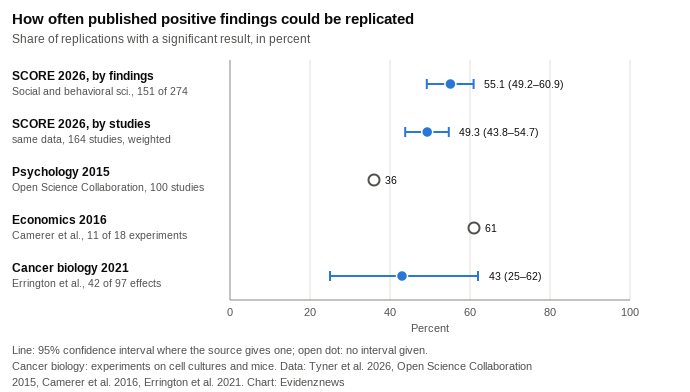
- The SCORE replication project repeated 274 positive findings from 164 studies in the social and behavioral sciences: 55.1 percent of the findings (95 percent confidence interval 49.2 to 60.9) again produced a significant result in the original direction, and the median effect size (correlation coefficient r) fell from 0.25 to 0.10.
- Depending on how success is measured, the rate within the same project lies between 28.6 and 74.8 percent; earlier replication series in psychology, economics and preclinical cancer research (experiments on cell cultures and mice) arrived at 36 to 61 percent.
- None of these numbers measures how many studies are false: the authors stress that a failed replication does not refute the original, and two estimates of the share of false findings, a model calculation from 2005 and an analysis of p-values from 2014, contradict each other.
How many studies are false cannot yet be measured reliably. Something else can be measured: how often a published finding turns up again when a second team repeats the investigation. A large measurement of this kind appeared in April 2026 in the journal “Nature”. Of 274 positive findings from the social and behavioral sciences, 151 showed a statistically significant result in the same direction again on replication, which is 55.1 percent.
The work comes from a team led by Andrew H. Tyner of the Center for Open Science in Washington; researchers from 31 nations took part in the replications. The subject of the investigation was the published literature itself. The replicated studies concern people and their organizations, from individuals through families and firms to political units, and come from psychology, economics, business research, sociology, political science and education research. For medicine, physics or chemistry, the work says nothing. For comparison, this text also draws on a project from preclinical cancer biology further below; it worked with cell cultures and mice, not with humans.
The authors themselves warn against the obvious shortcut. Two subheadings in their paper state: a failed replication does not mean that the original claim was false, and a successful one does not mean that it was true.
Three ways to check a study
The debate suffers from the fact that three different checks are often lumped together. Replicability asks: does the same thing come out when one measures again with new data? Reproducibility asks: does the same thing come out when one recalculates the original data with the original analysis? Robustness asks: does the result hold when the same data are analyzed in a different, equally defensible way?
The work by Tyner and colleagues deals only with the first question. On the other two, two sister papers appeared in the same research program, of which only summaries were available for this text. In the paper on robustness, 74 percent of the reanalyses of 100 studies reached the same conclusion as the original, 24 percent found no effect or no clear effect, and 2 percent found the opposite. On reproducibility, the Center for Open Science reports that for only 24 percent of 600 studies examined were the data available; of 143 studies recalculated, 54 percent could be reproduced exactly and 74 percent at least approximately.
How the project proceeded
The program is called SCORE and was funded by DARPA, the research agency of the US Department of Defense. It began with a random sample of 3,900 studies from 62 journals from the years 2009 to 2018. Of these, 1,500 were suitable for a replication. It was begun for 198 studies and completed for 164. At this point the randomness ends: which studies were actually repeated depended on whether a qualified team could be found and whether time and money were sufficient. The authors call feasibility the most important selection effect.
Only positive findings were replicated, that is, those for which the original had reported a statistically significant association. Significant means, by the usual convention: a result this clear would be expected in fewer than five percent of cases by chance alone. The teams specified the study plan and analysis in writing in advance, had both reviewed, if possible also by someone from the original team, and used the original material where it could be obtained. Some collected new data, others drew on independent existing datasets.
The replications were on average considerably larger than the originals: the median sample was 545 instead of 206. The statistical power, that is, the probability of finding an effect of the size of the original if it exists, was 99.6 percent at the median.
What came out
Of the 274 findings, 151 showed a significant result in the same direction again in the replication, so 55.1 percent (95 percent confidence interval 49.2 to 60.9). 98 replications, 35.8 percent, found no significant effect. 24 replications, 8.8 percent, found a significant effect in the opposite direction.
If one counts not findings but studies, and weights studies with several findings proportionally, the rate falls to 49.3 percent (43.8 to 54.7). Both numbers are correct; they answer slightly different questions.
The result depends even more on what counts as success. The authors calculated with 13 different measures and arrived at rates between 28.6 and 74.8 percent, with a median of 49.3 percent. The highest measure pools the data from the original and the replication and is therefore not independent of the original, which had always turned out positive. According to the authors, there is no generally accepted measure of success.
The decline in effect size is clear. The authors express it as a correlation coefficient, a measure of the strength of an association in which 0 means no association and 1 a complete one. At the median it was 0.25 in the originals (confidence interval 0.21 to 0.27) and 0.10 in the replications (0.09 to 0.13). For 175 of 249 findings for which the value could be calculated, the effect in the replication was smaller than in the original; that is 70.3 percent.
Between fields, the authors found only moderate differences, from 42.5 percent in economics to 63.1 percent in education research. This difference cannot be statistically confirmed, and the case numbers are small: in education research there were 13 studies. The numbers are not suitable for a ranking of fields. For the significance measure, neither the publication year of the originals nor the question of whether the replication used new or existing data made a detectable difference.
Why “not confirmed” does not mean “false”
Part of the decline was to be expected, for purely statistical reasons. The project selected only findings that were significant in the original. Anyone who selects in this way preferentially catches those studies in which chance made the effect look larger than it is. In the replication this chance component drops out, and the effect shrinks. The authors show how strongly the literature is filtered in this direction: in a subsample of 200 studies, 2,747 of 3,066 reported results were significant, which is 89.6 percent.
For a single failed replication, the authors name several possible reasons. The original may have been a chance hit. Equally, the replication may have missed the effect by chance. There may be conditions under which the effect occurs and which differed unnoticed between the two investigations. Or the second team made an error. Conversely, the original and the replication may share the same systematic error and therefore agree.
The authors draw a conclusion from this that goes beyond numbers. The best replication rate is unknown, they say. The problem to be solved is not a lack of replicability as such but exaggerated certainty: published and true are not the same thing.
Earlier measurements
The work is part of a series of similar projects. Its authors summarize the state of affairs as follows: in earlier series, about half of the replications with high statistical power produced a significant result in the direction of the original, and the effects were on average about half as large.
The best-known of these projects appeared in 2015 and replicated 100 studies from three psychology journals. 97 percent of the originals had reported a significant result; among the replications it was 36 percent. In the pooled data from the original and the replication, 68 percent of the effects were significant. The project was organizationally closely tied to the Center for Open Science, that is, to the same environment as the new work.
From an independent group comes a series from experimental economics from 2016. Camerer and colleagues replicated 18 laboratory experiments that had appeared in the journals “American Economic Review” and “Quarterly Journal of Economics”. Eleven of them, 61 percent, again produced a significant effect in the original direction; on average the effect reached 66 percent of the original size. 18 experiments are, however, a narrow basis.
A third project concerns a quite different field and a different model system: preclinical cancer biology, that is, experiments on cell cultures and mice, not on humans. Timothy Errington and colleagues, again from the Center for Open Science, replicated 50 experiments from 23 papers. Of 97 originally positive effects, 42 were significant and in the same direction in the replication, which is 43 percent (confidence interval 25 to 62). At the median, the effect was 85 percent smaller than in the original. 193 experiments had been planned; only 50 could be completed, according to the authors mainly because the original papers had documented their methods inadequately and material was hard to obtain.
What is calculation and not measurement
The statement that most published research findings are false comes from the title of a 2005 paper by Ioannidis. It rests on a model calculation, not on a count. The model asks what share of a field's positive findings is true, and makes the answer depend on several quantities: on the statistical power of the studies, on the significance threshold, on the ratio of actually existing to non-existing associations among the hypotheses tested, on biases, and on the number of teams working on the same question.
Depending on the assumptions, the result turns out very differently. According to a presentation by the statistics professors Lydersen and Langaas in the Norwegian medical journal “Tidsskrift for Den norske legeforening”, the model yields a share of true findings of 85 percent for large randomized studies with high statistical power and of 20 percent for exploratory observational studies. “Most” are thus false only under certain conditions. The prior probabilities with which the model calculates are approximations and subjective.
An empirical counter-calculation was presented in 2014 by Jager and Leek. From 77,430 papers in five major medical journals, they analyzed 5,322 reported p-values, the figures from which significance is read off, and estimated from them the share of false discoveries at 14 percent (standard deviation 1 percentage point). Later, according to the account by Lydersen and Langaas, they conceded that the value was probably too optimistic but, for well-planned studies, was unlikely to exceed 50 percent. Ioannidis responded with a contribution whose title calls the estimate false. The 14 percent also applies only to reported p-values in leading medical journals, not to science as a whole.
What the field disputes
The first dispute is over what the rates mean. Against the 2015 psychology project, the four researchers Gilbert, King, Pettigrew and Wilson objected that it had not drawn its studies at random and had not corrected for this statistically, and that deviations between replication and original introduced additional errors; after a correction, the number of failures was no larger than if all 100 original findings had been true. This is how a report from their own university describes it; the commentary itself was not available for this text. In their response, the project's authors called this reading very optimistic. With their data, optimistic as well as pessimistic conclusions were possible, and neither was so far justified.
The same tension shows in the reactions to the new work compiled by the magazine “The Chronicle of Higher Education”. The Stanford sociologist Robb Willer reportedly found it hard to conclude from the results that everything was fine; at the same time, no field seemed to be completely broken. Paul Novosad (Dartmouth) found the rates higher than many skeptics would have expected. Kyle Saunders (Colorado State) considered the decline in effect size from 0.25 to 0.10 perhaps the more serious result. All three were not involved in the project, and all rely on the same numbers.
In 2021, Lydersen and Langaas drew a sober conclusion from the numbers then available: this was not a failure of research, but it was a reason to rely more on the pooled evidence of several studies than on a single one.
What research cannot answer here
The question of a percentage of false studies has no single answer, for several reasons. The first is the definition. False can mean that the effect does not exist at all, that it was overestimated, that the result cannot be recalculated, or that it is stable but wrongly interpreted. Errington and colleagues point out that a finding can be both replicable and invalid.
The second reason lies in the method. A replication can make a finding more or less probable; it cannot prove or refute it. Even many replications do not change this in principle.
The third reason is scope. The new work applies to quantitative social and behavioral sciences, to positive findings from prominent journals of the years 2009 to 2018, and to studies whose replication was feasible. Whether the rate is higher or lower for less prominent journals, for costly research or for more recent work has not been measured. For most other fields, the sources evaluated here contain no comparable number.
Finally, the new work, the psychology project and the cancer biology project come from the environment of an organization whose stated goal is to make research more open and reliable. A vested interest in the finding that research needs reforms is conceivable. Of the replication series mentioned, only the one from economics is independent of this organization.
Questions about this article
Comments
Sources
- Primary source Tyner AH, Abatayo AL, Daley M, et al.: Investigating the replicability of the social and behavioural sciences. Nature 652, 143–150 (2026). doi:10.1038/s41586-025-10078-y
- Context Open Science Collaboration: Estimating the reproducibility of psychological science. Science 349(6251), aac4716 (2015). doi:10.1126/science.aac4716
- Context Camerer et al.: Evaluating replicability of laboratory experiments in economics. Science 351(6280), 1433–1436 (2016). doi:10.1126/science.aaf0918
- Context Errington TM, Mathur M, Soderberg CK, et al.: Investigating the replicability of preclinical cancer biology. eLife 10, e71601 (2021). doi:10.7554/eLife.71601
- Context Ioannidis JPA: Why most published research findings are false. PLoS Medicine 2(8), e124 (2005). doi:10.1371/journal.pmed.0020124
- Context Jager LR, Leek JT: An estimate of the science-wise false discovery rate and application to the top medical literature. Biostatistics 15(1), 1–12 (2014). doi:10.1093/biostatistics/kxt007
- Context Lydersen S, Langaas M: What proportion of published research findings are false?. Tidsskrift for Den norske legeforening 141, Fachkommentar (2021). doi:10.4045/tidsskr.21.0703
- Context Study that undercut psych research got it wrong. Harvard Gazette, Bericht der Universität der Kritiker über den Kommentar von Gilbert, King, Pettigrew und Wilson in Science 351(6277) (2016). https://news.harvard.edu/gazette/story/2016/03/study-that-undercut-ps…
- Context Anderson et al.: Response to Comment on “Estimating the reproducibility of psychological science”. Science 351(6277), 1037 (2016). doi:10.1126/science.aad9163
- Context Aczel et al.: Investigating the analytical robustness of the social and behavioural sciences. Nature 652, 135–142 (2026). doi:10.1038/s41586-025-09844-9
- Context Large-Scale Collaboration Releases New Findings on Research Credibility. Center for Open Science, Pressemitteilung der beteiligten Einrichtung (2026). https://www.cos.io/about/news/large-scale-collaboration-releases-new-…
- Context Emma Pettit: Lots of Social Science Didn’t Replicate. Does That Mean It’s Bunk?. The Chronicle of Higher Education, Nachrichtenbericht (2026). https://www.chronicle.com/article/lots-of-social-science-wont-replica…