"Fairy Circles" in Northern China: Model Explains Shrub Rings as Result of Grass Competition
Evidence level 2 of 5 · Single study, peer-reviewed
Key points
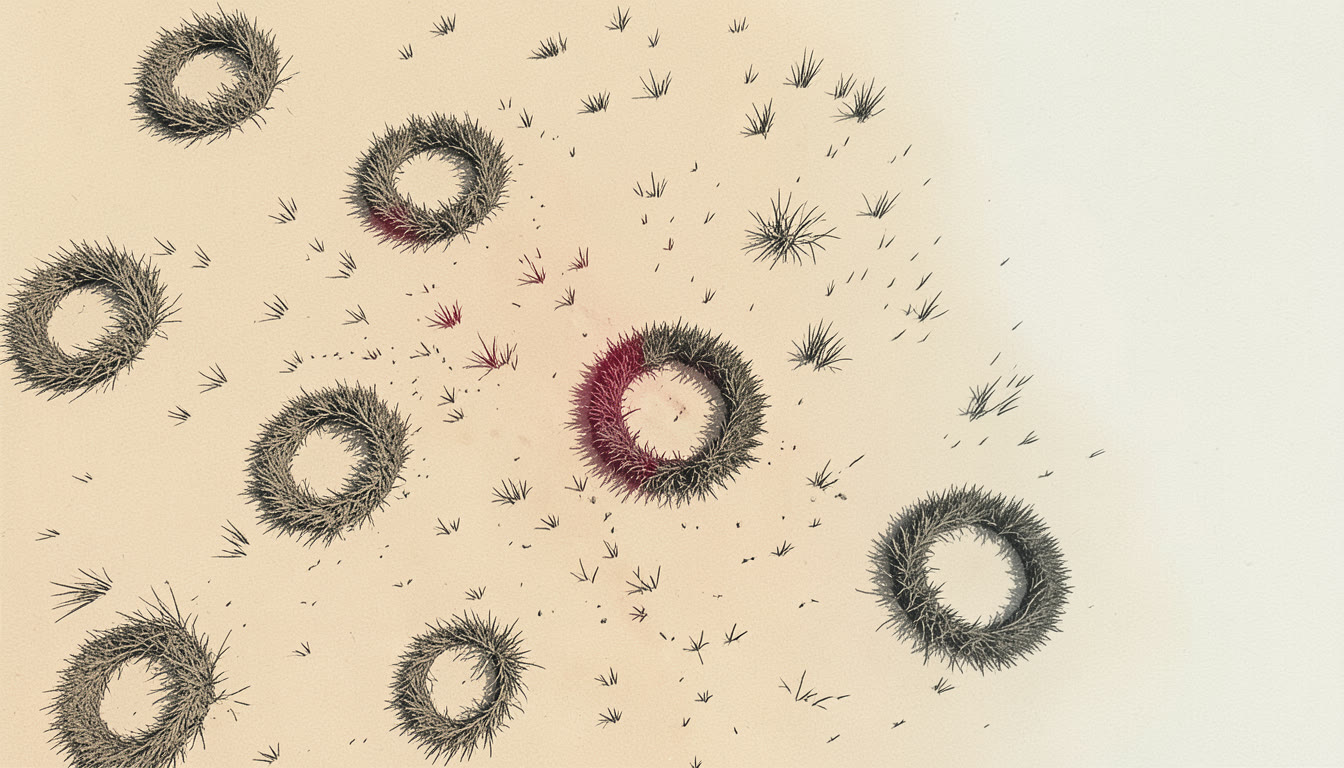
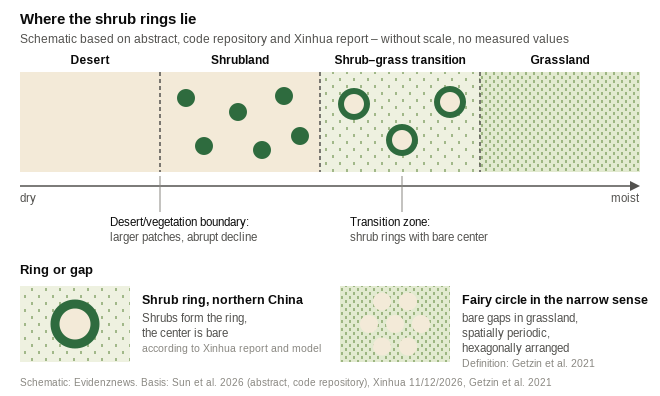
- In the transition zone between shrubland and grassland in the drylands of northern China, a team from the Chinese Academy of Sciences describes so-called fairy circles; according to a report by the news agency Xinhua, they are rings of shrubs with a bare center.
- In a computational model in which shrubs use resources over a wide area and grasses use them intensively, shrubs under grass competition turn into hollow rings when their search radius shrinks; the mechanism is thus simulated, not observed over time.
- According to a technical definition published in 2021, fairy circles are bare gaps in grassland; rings of shrubs would therefore be more likely to be plant rings.
A research team describes in the journal "PNAS" so-called fairy circles in the drylands of northern China, where shrubland gives way to grassland. According to a report by the news agency Xinhua, they are shrubs that grow in rings with a bare center. The group around Sun Jingyao (孙靖尧), Yu Kailiang (余开亮) and Yu Guirui (于贵瑞) of the Institute of Geographic Sciences and Natural Resources Research of the Chinese Academy of Sciences in Beijing explains them with a computer model: in the simulation, shrubs under competition from grasses turn into hollow rings.
Observation and explanation have different foundations. According to Xinhua, the team found the rings on high-resolution drone images and in field surveys, along a precipitation gradient at the edges of sandy areas and deserts. The explanation comes from a simulation with a cellular automaton, a computational model in which the overall picture emerges from local interaction rules. The materials evaluated do not indicate a measurement over time that would substantiate the mechanism.
Evidenznews could not retrieve the openly licensed full text; the basis is the paper's abstract, the team's code repository and the Xinhua report. Figures on sites or ring sizes are therefore missing.
Two strategies, one ring
According to the code repository, the model is based on a trade-off. Shrubs access resources with far-reaching roots: their competitive influence reaches far but is weak, and their survival threshold is higher in the model. Grasses use resources intensively; their competitive influence is strong but narrowly limited, and their threshold is lower. If the radius in which shrubs search for resources shrinks in the simulation, they turn into hollow rings under grass competition.
First author Sun explains this model result, according to Xinhua, as follows: if precipitation increases and grass competition becomes stronger, the center of a shrub patch turns bare from lack of water; the ring collects water and keeps the shrub alive. From the model he also infers that the rings are a "metastable state" (亚稳态) in the competition between shrub and grass.
The authors describe the landscape with a term from physics, the phase transition: desert, shrubland and grassland are regarded in it as phases between which the vegetation changes abruptly. According to the authors, fairy circles are among the special phenomena that occur near such a transition threshold. For the boundary between desert and vegetation, the abstract names other phenomena: an enlargement of plant patches and an abrupt decline.
The team describes the trade-off between the two strategies as empirically tested, using plant traits and the spatial distribution of plant patches. The abstract does not say how extensive this test was.
Ring or gap
Whether the structures should be called fairy circles depends on the definition. Stephan Getzin and two co-authors defined them narrowly in 2021 in the "Journal of Vegetation Science": fairy circles are, according to this, bare gaps in grassland without an insect nest in the center, they form a spatially periodic, hexagonal pattern and occur only in a narrow, dry climatic niche. The term is increasingly used loosely for plant rings as well, which have their own characteristics. Rings of shrubs with a bare center would, by this definition, be more likely to be plant rings. Whether the Chinese rings form such a pattern is not shown by the materials evaluated.
In the Xinhua report, members of the team link the work to ecological early warning at the desert edge. The abstract, however, places the fairy circles in the transition from shrubland to grassland, and according to Sun's description they arise with increasing precipitation. An independent worldwide analysis (Kéfi et al., "PNAS" 2024) found that the spatial structure of vegetation becomes stronger with increasing aridity and, up to a threshold, goes along with preserved soil functions; it regards self-organized patterns as a sign of resilience.
What remains open
It remains open how many rings were mapped at how many sites, which shrub species form them and whether termites, ants or soil differences were ruled out as a cause in the field. Independent assessments of the study by experts were not found by the research as of November 21, 2026.
Questions about this article
Comments
Sources
- Primary source Sun J, Yu K, Li X, Rietkerk M, D’Odorico P, Chen N, Wang Y, Zhang L, Yu G: Phase transition in a dryland shrub–grass ecosystem: Emergence through local trade-offs. PNAS 123(46), e2618656123 (2026). doi:10.1073/pnas.2618656123
- Context ShrubGrassTransition – Code-Ablage der Autoren zur Studie (README) (2026). https://github.com/EcoSunyata/ShrubGrassTransition
- Context Xinhua (新华社): 研究人员首次在中国旱区发现“精灵圈” (2026). https://www.news.cn/tech/20261112/7594bad84b34426c95577fe7fd127699/c.html
- Context Getzin S, Yizhaq H, Tschinkel WR: Definition of “fairy circles” and how they differ from other common vegetation gaps and plant rings. Journal of Vegetation Science 32, e13092 (2021). doi:10.1111/jvs.13092
- Context Kéfi S et al.: Self-organization as a mechanism of resilience in dryland ecosystems. PNAS 121, e2305153121 (2024). doi:10.1073/pnas.2305153121