Mice infected with a parasite attract more kissing bugs in the lab
Evidence level 2 of 5 · Single study, peer-reviewed
Key points
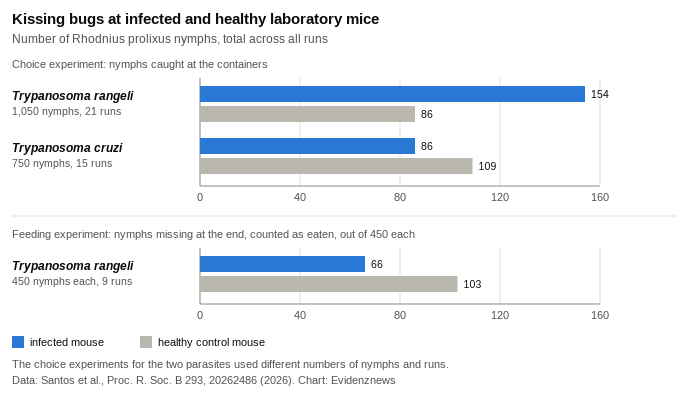
- In laboratory experiments at the Brazilian research institute Fiocruz, 154 of 1,050 young kissing bugs of the species Rhodnius prolixus were caught at containers holding mice infected with the parasite Trypanosoma rangeli, and 86 at containers holding healthy mice.
- Mice infected with Trypanosoma cruzi, the agent of Chagas disease, showed no such attraction; depending on the statistical test, the result was either not significant or marginally significant in favor of the healthy mouse.
- In a second experiment, fewer bugs were missing at the end with infected mice than with healthy ones (66 versus 103 of 450 each), and 20 of 43 examined bugs had taken up the parasite while feeding; whether this promotes transmission in nature was not measured by the study.
Hungry kissing bugs stay near mice infected with the parasite Trypanosoma rangeli more often than near healthy mice. This is shown by laboratory experiments from Brazil: of 1,050 bugs released, 154 were caught at the containers of the infected animals and 86 at those of the healthy ones. With Trypanosoma cruzi, the closely related agent of Chagas disease, the team found no such attraction.
The study comes from Luan F. Santos, Alessandra A. Guarneri and colleagues at the Instituto René Rachou of the Fiocruz research foundation in Belo Horizonte. The Argentine institute INBIOTEC-CONICET in Mar del Plata and the Federal University of Minas Gerais were also involved. It was published online on November 11, 2026, in the "Proceedings of the Royal Society B." All experiments were carried out in the laboratory: with female laboratory mice of the Swiss Webster strain and with young kissing bugs of the species Rhodnius prolixus from a laboratory colony. Humans and free-living animals were not studied.
Two related parasites, the same hosts
According to the authors, the two parasite species studied share their hosts: mammals and blood-sucking kissing bugs. Trypanosoma cruzi causes Chagas disease, which the authors describe as a neglected tropical disease affecting seven million people worldwide. Trypanosoma rangeli, by contrast, is considered not to cause disease in humans. An infection does, however, produce antibodies that also react to Trypanosoma cruzi and can therefore interfere with diagnosis.
According to the paper, the bug Rhodnius prolixus is considered the most important vector of Chagas disease in the Andean region, especially in Colombia and Venezuela, and is highly susceptible to Trypanosoma rangeli.
One arena, two mice, fifty bugs
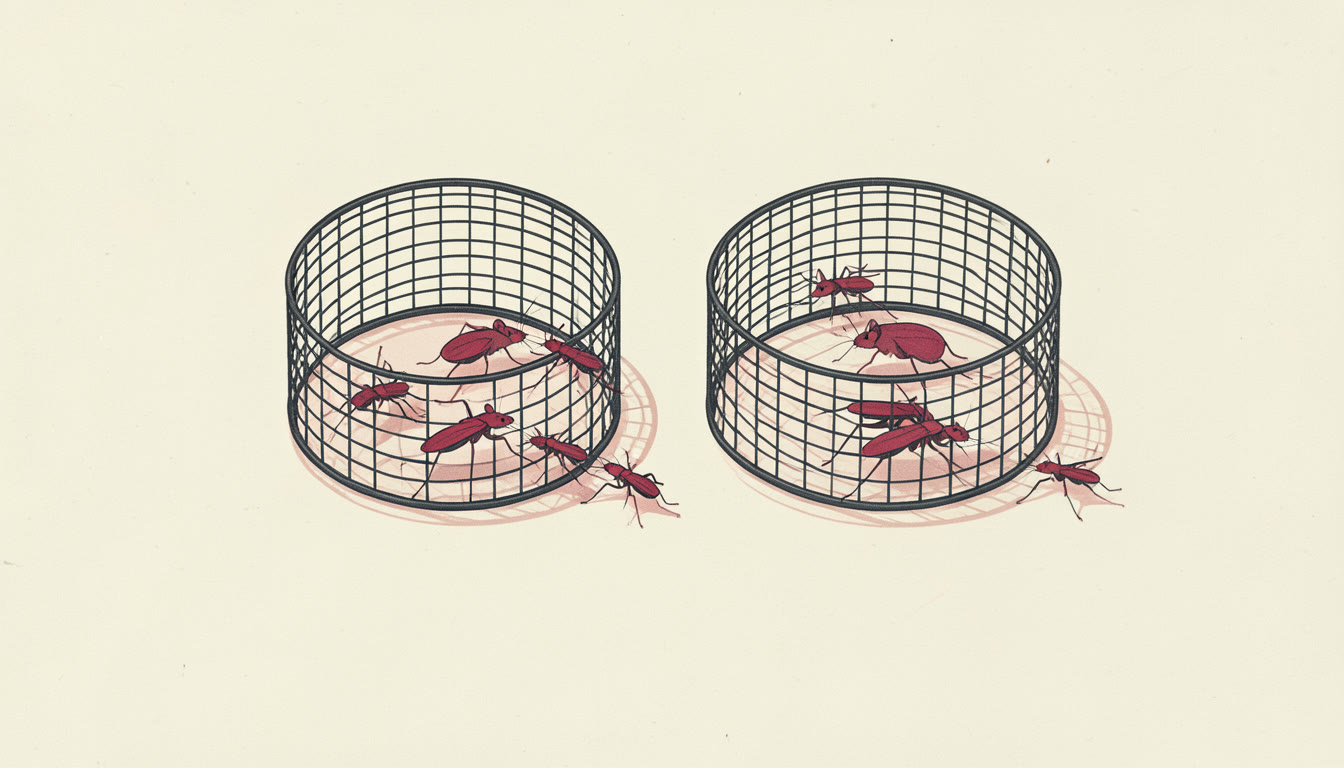
The central experiment is a choice experiment. In a glass arena with a floor area of 50 by 50 centimeters stood two containers with metal mesh, one holding an infected mouse, the other a healthy one. The team added 50 nymphs, that is, young bugs, in the fifth developmental stage, which had gone without a blood meal for about 30 days. Each run lasted 16 hours.
The bugs could not touch the mice. But odor, warmth, moisture and vibrations passed through the mesh. Adhesive strips around the containers held nymphs that approached. In addition, counts were made every 30 minutes; a nymph counted as near if it stayed at least 15 seconds within two centimeters of a container. Between runs, the team swapped the position of the containers. Each replicate used a new pair of mice and new insects.
"Attraction" in this study therefore means: more bugs gathered at one of the two containers. Whether they would also have fed there is not measured by the choice experiment.
A clear difference with Trypanosoma rangeli
For Trypanosoma rangeli there were 21 replicates with a total of 1,050 nymphs. 154 nymphs were caught at the containers of the infected mice, 86 at those of the control mice. By our own calculation from these figures, that is 14.7 and 8.2 percent of all animals released; the majority of the bugs were found at neither container.
The authors tested the difference with three statistical methods, and all three rate it as significant, that is, hard to reconcile with mere chance (p less than 0.0001, p equal to 0.002 and p less than 0.001). A statistical model that takes the individual runs into account estimates the probability that a nymph approaches the infected rather than the healthy mouse at about 62.7 percent. With pure chance it would be 50 percent.
An ambiguous picture with Trypanosoma cruzi
For Trypanosoma cruzi there were 15 replicates with 750 nymphs. Here the healthy mouse was ahead: 109 nymphs at the control containers, 86 at those of the infected animals. 474 of the 750 nymphs, 63.2 percent, stayed in the shelter.
The three tests reach different verdicts in this case. Two rate the difference as not significant (p equal to 0.0995 and p equal to 0.0721). The model arrives at p equal to 0.045, just under the usual threshold of 0.05, and estimates the probability for the infected mouse at about 47.4 percent. In the results section, the authors speak of a slight preference for the control mouse, in the summary of no significant effect. All that is established, then, is that Trypanosoma cruzi did not make the mice more attractive in this experiment. The data do not show that the parasite makes them more repellent.
The comparison of the two parasites also has a weakness that follows from the methods section, even though the authors do not list it as a limitation. Trypanosoma cruzi was injected into the mice's abdominal cavity, and testing took place on the ninth day afterward. Trypanosoma rangeli was transmitted by infected bugs through their bites, and testing took place on day 14. Only one strain of each parasite was used. The two series of experiments therefore differ in more than the parasite species.
Fewer bugs disappeared with infected mice
In a second experiment, with Trypanosoma rangeli only, one mouse each sat in a wire cage with a one-centimeter bar spacing: wide enough that the nymphs could feed and that the mice could also catch bugs that came close to them. Again there were 50 nymphs and 16 hours, in nine replicates per group.
With the healthy mice, 103 of 450 nymphs were missing at the end (22.89 percent), with the infected ones 66 of 450 (14.67 percent). According to the authors' model, the difference is significant (p equal to 0.005). The eating was not observed; the team counted the remaining nymphs and treated the missing ones as eaten. In this experiment too, more nymphs approached the infected mice, measured against the animals available (p equal to 0.034).
For the proportion of nymphs that successfully took blood, and for the amount of blood taken, the team found no significant difference between the groups. A video analysis of ten mice likewise found none: infected and healthy animals rested, moved and ate to a similar extent. Why fewer bugs disappeared with the infected mice is therefore not explained by the study. The authors suspect that sick or weakened animals might defend themselves less well. They did not measure this, and they themselves write that the lower number of bugs eaten need not be an adaptation of the parasite but could be a nonspecific consequence of the illness.
Nearly half of the bugs took up the parasite
Whether the bugs actually became infected on the infected mice was checked by the team under the microscope, as a rule 30 days after the blood meal. Of 43 examined nymphs that had fed on nine mice, 20 carried the parasite, which is 46.5 percent. One of the nine mice infected none of its four examined nymphs; for the other eight, the proportion lay between 25 and 75 percent. Only two to nine nymphs were examined per mouse.
The figure describes the route from the mouse into the bug. Whether the bugs subsequently pass the parasite on to other animals was not tested by the study.
What the authors conclude and what they do not
That the effect appeared in only one of the two species is taken by the authors as an indication that it is not a general consequence of a trypanosome infection. As a possible explanation they name the different transmission routes: Trypanosoma cruzi already has efficient routes, they say, while Trypanosoma rangeli has a harder time. This is an interpretation, not a measured result. The authors also do not rule out that Trypanosoma cruzi can make hosts more attractive under other circumstances.
Which stimulus attracts the bugs was not investigated. The authors point to older literature according to which the body temperature of infected mice rises slightly during the course of the infection, and warmth is an important stimulus for kissing bugs. The team did not measure odor compounds.
The paper names further limits. The experiments ran under controlled laboratory conditions, and the authors urge caution in transferring them to natural cycles. House mice and their relatives are not considered natural hosts of Trypanosoma rangeli. Only females were used. The authors do not see their results as final proof that the parasite deliberately manipulates its host.
Similar findings with other parasites
That infected hosts can be more attractive to blood-sucking vectors is known from other systems. In a 2014 study, mosquitoes of the species Anopheles stephensi were more strongly drawn to mice infected with the malaria agent Plasmodium chabaudi than to healthy ones; the infected animals gave off more volatile compounds overall. The samples were small, and the authors of that work describe the substances found as candidates. A 2021 study found, according to its abstract, that dogs infected with Leishmania infantum were more attractive to sand flies than uninfected ones.
For Trypanosoma cruzi itself, the picture is mixed. A 2016 study with kissing bugs from the species complex Triatoma dimidiata found, in a similar choice experiment, no difference between infected and uninfected mice for two groups of bugs; a third group, hybrid bugs, reached the infected mouse three times as often as the healthy one. Of this study and the dog study, only the abstracts were available for this text.
Our research found no independent comment from other experts on the new work.
What remains open
What is above all open is whether the effect occurs outside the laboratory, in the parasite's natural hosts, in other bug species and with other parasite strains. It is also open whether more approaching and less eating ultimately lead to more transmission; for that, one would have to follow what happens to the infected bugs. On the blinding of the analysis and on the amount of parasite in the mice's blood, the text that was evaluated gives no information. The study says nothing about Chagas disease in humans.
Questions about this article
Comments
Sources
- Primary source Santos LF, Lorenzo MG, de Souza RP, Guarneri AA: Trypanosoma rangeli turns infected mice more attractive to triatomine bugs. Proceedings of the Royal Society B 293(2082), 20262486 (2026). doi:10.1098/rspb.2026.2486
- Context De Moraes et al.: Malaria-induced changes in host odors enhance mosquito attraction. PNAS 111(30), 11079–11084 (2014). https://pmc.ncbi.nlm.nih.gov/articles/PMC4121820
- Context Chelbi et al.: Enhanced attraction of sand fly vectors of Leishmania infantum to dogs infected with zoonotic visceral leishmaniasis. PLOS Neglected Tropical Diseases 15(7), e0009647 (2021). doi:10.1371/journal.pntd.0009647
- Context Ramirez-Sierra, Dumonteil: Infection Rate by Trypanosoma cruzi and Biased Vertebrate Host Selection in the Triatoma dimidiata Species Complex. Journal of Medical Entomology 53(1), 20–25 (2016). doi:10.1093/jme/tjv157