Gas ring around dying star: authors interpret it as a trace of the last pulse
Evidence level 2 of 5 · Single study, peer-reviewed
Key points
- The radio telescope array ALMA shows a thin, shell-like gas ring around the carbon-rich star IRAS 06530-0213, with a radius of roughly 16,375 to 17,515 astronomical units, expanding at 12.4 kilometers per second.
- The team led by Raghvendra Sahai interprets the ring as the first direct evidence of the last thermal pulse before the post-AGB stage; what is measured is the ring's shape, size and velocity, while the pulse itself is an inference from them.
- According to the authors, the progenitor star had 1.6 to 3.4 solar masses; the work does not study Sun-like stars, and the object's distance, at 2.9 to 5.0 kiloparsecs, is only roughly known.
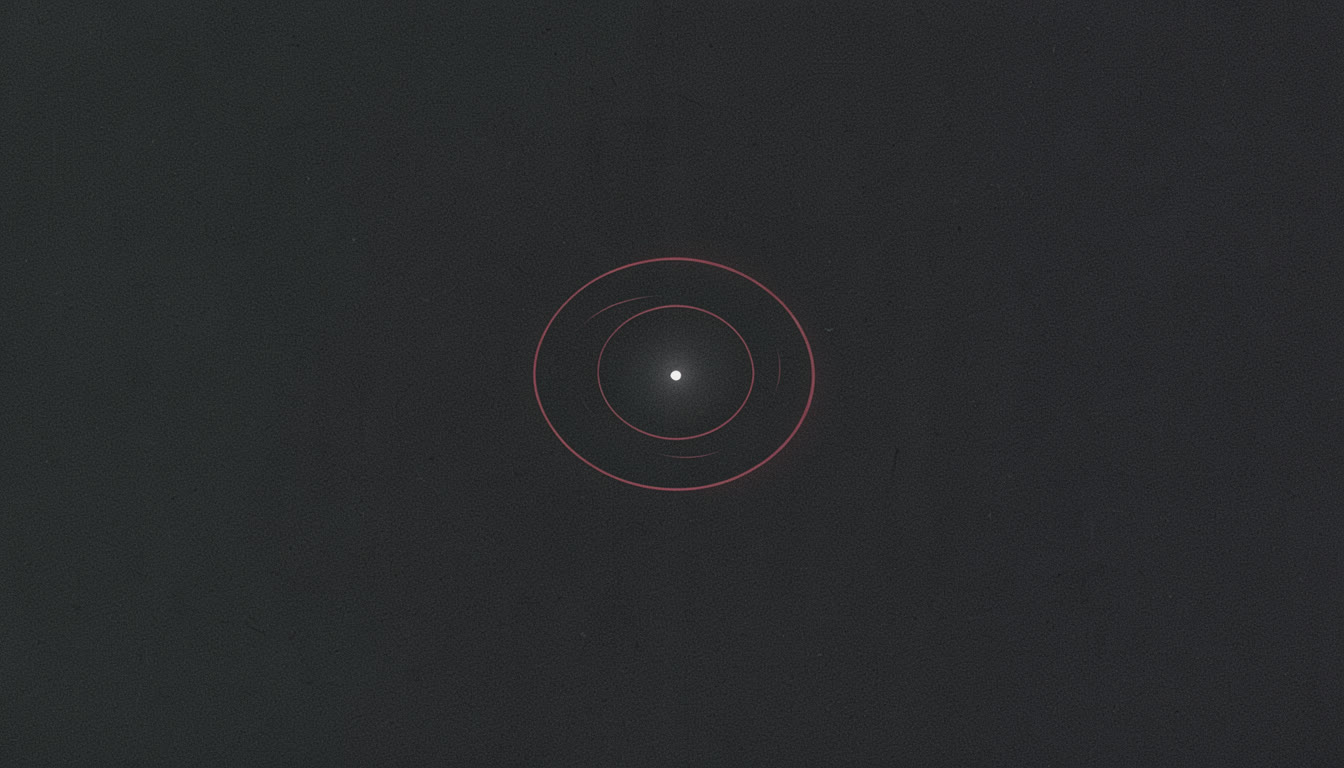
Around the star IRAS 06530-0213 lies a thin ring of gas, about 17,000 times as far from the star as Earth is from the Sun. It expands at 12.4 kilometers per second. A team led by Raghvendra Sahai found it with the radio telescope array ALMA and reads it as the trace of a specific event: the last thermal pulse before the star left its late giant-star stage. According to the authors, this is the first direct evidence of such a last pulse. What is measured is the ring's shape, size and velocity; that a pulse produced it is an inference from these.
The work was published on November 20, 2026, in the journal "The Astrophysical Journal", peer-reviewed and open access. It has 19 authors. The first author Sahai's affiliation is not named consistently in the information available, sometimes as NASA's Jet Propulsion Laboratory, sometimes as the California Institute of Technology. Participants include the Chalmers University of Technology, the Korea Astronomy and Space Science Institute, Macquarie University and the University of Manchester.
This is the observation of a single object. Model calculations appear in the work but serve only to interpret the observation.
A star between two stages
IRAS 06530-0213 is a carbon star, that is, a carbon-rich star, and is in transition to a planetary nebula. The authors call the object a pre-planetary nebula. Behind it lies a late giant-star stage, known in the field as AGB; the period after it is called the post-AGB stage.
What happens inside a star during a thermal pulse is not explained in the work. It presupposes the term, and this text adds no explanation of its own. For understanding the finding, what the authors say about the consequences is enough: rings of a similar kind have already been seen around carbon-rich AGB stars and attributed to thermal pulses. According to them, this had not previously been the case for a star that has already left this stage.
How far away the star is, is only roughly known. The authors calculate 3.8 kiloparsecs, an astronomical unit of distance, and give a range of 2.9 to 5.0 kiloparsecs. The basis is the Gaia DR3 parallax of 0.2412 milliarcseconds with an uncertainty of 0.0742 milliarcseconds, which is almost a third of the value. In light-years, converting ourselves at about 3260 light-years per kiloparsec, that would be about 12,400 light-years, with a range of roughly 9,500 to 16,300. This conversion is not in the work.
The uncertainty runs through all the further numbers. According to the authors, the calculated masses grow with the square of the distance, and ages and mass-loss rates with the distance itself.
How the ring is dated
ALMA observed the object at millimeter wavelengths, with a resolution of about 0.1 to 0.5 arcseconds. Lines of molecules were recorded, including carbon monoxide, as well as the continuum at about 0.44 and 0.88 millimeters wavelength. The data belong to a survey called PANORAMA. In a preliminary overview of this survey, an unreviewed preprint by the same group, the subject is bipolar and multipolar post-AGB objects; in one case it speaks of a thin circular ring.
The ring around IRAS 06530-0213 is thin and resembles a spherical shell. It has two components: a sharp one at 16,375 astronomical units and a broader one at 17,515 astronomical units. An astronomical unit is the mean distance between Earth and the Sun. Converted, the mean radius of about 16,950 astronomical units corresponds to roughly 0.27 light-years, so the diameter is a good half light-year. This too is a calculation for this text and not a statement by the authors.
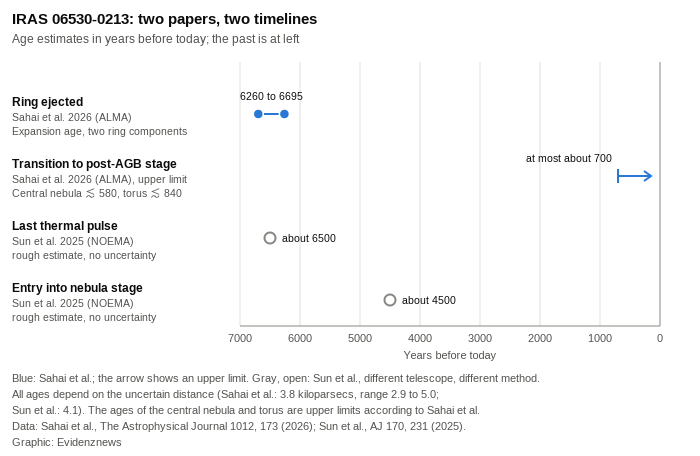
The age follows from size and velocity, that is, from the time gas moving at 12.4 kilometers per second needs for this distance. For the sharp component the authors arrive at about 6260 years, for the broader one at about 6695 years.
They put the gas mass in the ring at 0.033 to 0.066 solar masses. The dust mass of the ring is determined only as a lower limit, and according to the authors dust masses are uncertain by at least a factor of a few.
What happened after the pulse
The authors also reconstruct how the star's mass loss has developed since the pulse. Immediately after the pulse, the mass-loss rate fell, they find. Shortly before the post-AGB stage it rose again; in this phase a region of arc-shaped filaments formed. The work gives time spans and rates for this. They could not be fully checked for this text and are therefore left out.
According to the work, the region of filament arcs contains most of the ejected molecular hydrogen, namely 0.12 to 0.25 solar masses.
At the center lie a bipolar central nebula, that is, a structure with two lobes, and a torus, a dense belt around the middle. For the central nebula the authors give an expansion age of at most about 580 years, for the torus of at most about 840 years. From the mean they conclude that the star moved into the post-AGB stage at most about 700 years ago. In doing so they assume that the two lobes are inclined at most about 10 degrees from the plane of the sky.
According to the authors, this age is significantly shorter than the models predict.
From the luminosity of about 3285 solar luminosities and the age of the detached shell, the authors conclude, in comparison with evolution calculations, that the progenitor star had 1.6 to 3.4 solar masses. The basis has its own uncertainties: they give the total radiation flux with about 15 percent uncertainty, and the literature values of the luminosity contradict one another.
Spiral arcs without a detected companion
The arc-shaped filaments around the center probably form a three-dimensional Archimedean spiral, in the authors' assessment. Such a pattern is usually attributed to a companion star. From the spacing of the arcs, the authors roughly derive that a companion would be 155 to 340 astronomical units from the star.
A companion is thus not detected. At the star's position the authors also found no compact source of the kind a dust disk would give off. They consider it possible that in the past there was a short-lived disk-like structure that drove collimated outflows and thus shaped the two lobes. This is not proven: the team found no fast carbon monoxide gas, and the walls of the lobes move at about 16.5 kilometers per second.
Isotopes that do not fit the standard models
A second finding concerns the composition of the gas. In the torus, compared with the Sun's values, the rare isotopes carbon-13 and oxygen-17 are strongly enriched, and nitrogen-15 moderately. According to the authors, this pattern does not fit the standard models of nucleosynthesis, that is, of nuclear processes, in the AGB stage. As a possible explanation they name explosive nuclear burning. This is a hypothesis; where the enrichment comes from is open.
Why the composition is informative is described in a review article by Ventura, of which only the summary was available: the chemistry of post-AGB stars and planetary nebulae is closely tied to the processes in the AGB stage. This summary says nothing about thermal pulses or carbon stars.
What a second paper on the same star says
Another team has studied the same star with a different telescope. Sun, Zhang and Qin described in 2025, based on observations with NOEMA, a spherical halo around a barrel-shaped torus. They place the last thermal pulse about 6500 years ago and its duration at about 650 years. Both are rough figures.
This fits the new work's ring dating of 6260 to 6695 years. At the transition to the next stage, the figures diverge: Sun and colleagues give about 4500 years for entry into the protoplanetary nebula stage, Sahai and colleagues at most about 700 years for the transition into the post-AGB stage. The two teams base this on different structures and delimitations and do not interpret the halo and the ring in the same way. Sun and colleagues also calculate with a distance of 4.1 instead of 3.8 kiloparsecs, and the solution of their shape model (SHAPE) is not unique.
The older work thus supports the rough dating of the pulse. It contributes nothing to the interpretation of the isotopes. The new work lists it in its references.
What this means for the Sun
The portal Space.com reported on the work on November 24, 2026, and linked it in the headline to the end of the Sun. The work itself does not draw this connection. The Sun appears there, as far as the text was read, only as a reference value for the abundance of isotopes; Sun-like stars are not studied. With 1.6 to 3.4 solar masses, the progenitor of IRAS 06530-0213 had more mass than the Sun.
What models expect for the Sun is stated in another, older work. Schröder and Smith published a peer-reviewed model calculation on the distant future of the Sun in 2008. According to it, the Sun's luminosity in the AGB stage is not sufficient for a final, dust-driven strong wind, and a regular planetary nebula does not form. A last thermal pulse could, however, produce a small shell of a few hundredths of a solar mass. This is a prediction from a model, not a measurement and not a finding on IRAS 06530-0213. The new work does not test it.
Elsewhere too, the work is more cautious in its wording than the report. The report writes that a last pulse was captured for the first time; the work states a first direct evidence, obtained from the interpretation of a ring.
What remains open
The interpretation rests on a single object. The ring cannot be seen in the continuum of ALMA Band 9 and not directly in the 13CO line, carbon monoxide with carbon-13. For some structures the signal is only three to four times as strong as the noise.
The research found no independent expert assessment of the work; the publication was five days old at that point. Space.com quotes only the first author. It thus remains open whether other experts also attribute the ring to the last thermal pulse, whether the companion star exists, and whether a similar ring is found around other stars in this stage.
Questions about this article
Comments
Sources
- Primary source Sahai R, Vlemmings W, Quintana-Lacaci G, et al.: The Last Gasps of a Dying Star: ALMA Observations of the Preplanetary Nebula IRAS 06530-0213. The Astrophysical Journal 1012(2), 173 (2026). doi:10.3847/1538-4357/aeab9a
- Context Sun, Zhang, Qin: Cocoon-to-Butterfly Transformation in Protoplanetary Nebula: Detection of a Spherical Halo and a Barrel-shaped Torus in IRAS 06530-0213. AJ 170, 231; gelesen als Vorabfassung arXiv:2508.19666 (2025). doi:10.3847/1538-3881/adff85
- Context Schröder, Smith: Distant future of the Sun and Earth revisited. MNRAS; Modellrechnung, gelesen als Abstract der Vorabfassung arXiv:0801.4031 (2008). https://arxiv.org/abs/0801.4031
- Context Ventura: The evolutionary path from the AGB to the PN phases: certainties and open issues. IAU Symposium 384; Übersichtsbeitrag, nur Abstract gelesen. doi:10.1017/S1743921324002011
- Context Sahai et al.: High-Speed Outflows and Dusty Disks during the AGB to PN Transition: The PANORAMA survey. arXiv:2409.06038; Preprint derselben Gruppe, nicht unabhängig, nur Abstract gelesen. https://arxiv.org/abs/2409.06038