“Plasticoral”: Plastic Is Stuck in Dead Coral Rubble on Three Beaches in Okinawa
Evidence level 2 of 5 · Single study, peer-reviewed
Key points
- A team from the University of the Ryukyus and the Okinawa Institute of Science and Technology describes pieces of dead coral rubble to which plastic has been fused by heat, and introduces the name Plasticoral for them.
- The pieces were noticed by chance during routine litter surveys on three beaches on the island of Okinawa; the plastic's spectra match polyethylene and polypropylene, and it has penetrated into the pores of the coral skeletons.
- According to the authors, how the pieces form, how widespread they are and what toxic effects they may have remain open; plastic fused with coral fragments was also described in Hawaii in 2014 under the name plastiglomerate.
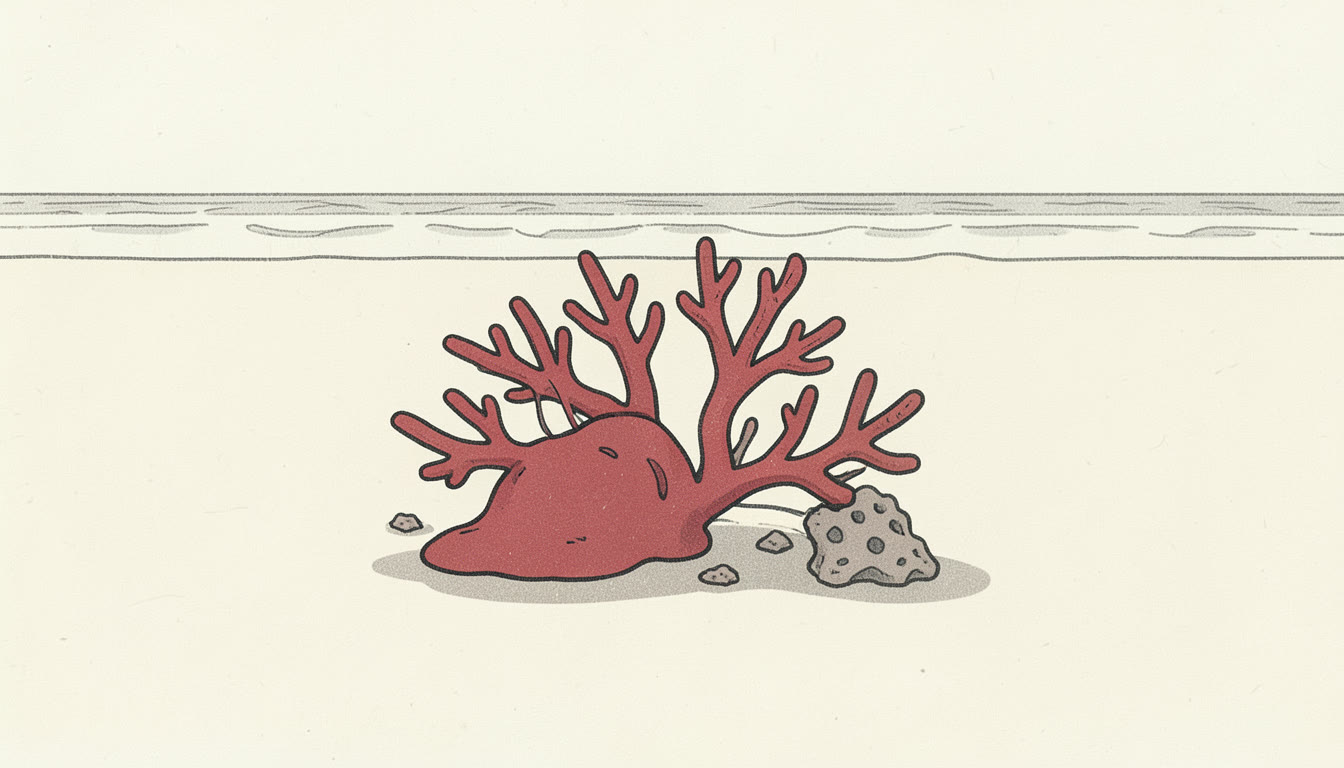
On three beaches on the Japanese island of Okinawa, researchers have found fragments of dead coral to which melted plastic is stuck. The plastic has penetrated into the pores of the coral skeletons. The team gives these finds a name of their own: Plasticoral.
The description comes from a group around Ifenna Ilechukwu and James Davis Reimer of the University of the Ryukyus and the Okinawa Institute of Science and Technology (OIST). It appeared online in September 2026 in the journal “Marine Pollution Bulletin.” The study examined individual finds from the beach, that is, dead coral material. Living corals or other animals were not the subject of the work, and it did not measure any effect on the reef.
Only the study's abstract was available for this article. The full text is freely accessible but could not be retrieved by press time. The abstract does not say how many pieces the team examined.
What was described
Coral rubble consists of fragments of the skeletons of dead corals. In the finds, plastic adheres to this rubble or is baked into it, through heat. The team noticed them by chance, during routine surveys of marine litter. It did not search for them deliberately afterward.
In the laboratory, the team pursued two questions. The first: What plastic is it? To answer it, the team used Raman spectroscopy, a laser-based method for identifying substances. The spectra matched polyethylene and polypropylene. This is not a quantitative statement.
The second question: How does the plastic sit on the coral? Images from the micro-computed tomography scanner, which produces high-resolution X-ray cross-sections, and under the microscope show that it has penetrated into the cavities of the skeleton.
Related to the plastiglomerate of 2014
That plastic fuses with natural material has been known for years. In 2014, a team around Corcoran described a hard composite of rock, sediment and melted plastic from Kamilo Beach in Hawaii and called it plastiglomerate. According to the authors' assessment, it had formed through campfires. Among the enclosed components were, besides basalt, shells, wood and sand, explicitly also coral fragments.
The team from Okinawa distinguishes its find from this: plastiglomerates and related forms form mainly between plastic and non-living substrate, whereas Plasticoral forms on coral rubble, that is, on material that living organisms built. The OIST press release, by contrast, calls Plasticoral a type of plastiglomerate. Whether one speaks of a new category or of a subtype is a question of definition. A review from 2024 already lists a whole series of such terms for burned or otherwise reshaped plastic waste and evaluated 32 scientific articles from the years 1997 to 2023 for this. It found that studies on the toxic effects of such pieces are rare or missing.
Suspected cause: beach fires
The abstract does not say where the heat came from. The press release names beach fires as one likely source and adds that the exact origin remains to be clarified. According to the sources available, this conjecture was not tested.
Two of the beaches where the finds were made, Sosu (楚洲) and Ibu (伊部), lie in Yanbaru National Park in the north of the island, according to OIST press material.
No evidence of harm
The press release grounds its concern for reefs in the role of coral rubble: young corals settle on it, and young fish find shelter in its cavities. Plastic in it could disrupt this. The study did not examine this.
That plastic is regarded as a risk on reefs goes back to other work. An observational study from 2018 on 124,000 corals from 159 reefs in the Asia-Pacific region found: for corals in contact with plastic, the probability of disease was 89 percent; without contact, it was 4 percent. That study concerned plastic touching living corals, not melted plastic in dead rubble, and a statistical association, not a demonstrated mechanism. Nothing follows from it for Plasticoral.
The authors themselves recommend further studies on formation, distribution and possible toxic effects. They also consider it possible that such pieces could serve in future as a time marker in the deposits of tropical reefs: as a layer by which the present could later be recognized. This too is a possibility, not a finding.
The abstract says nothing about frequency. What is documented are individual finds on three beaches. The research for this article found no independent comments from other experts.
Questions about this article
Comments
Sources
- Primary source Ilechukwu I, Stoeltje M, Conn E, et al.: Introducing plasticoral: A biogenic–plastic agglutinate as an emerging indicator of the Plasticene in Okinawa reef environments. Marine Pollution Bulletin 233, 120310 (2026). doi:10.1016/j.marpolbul.2026.120310
- Context Corcoran PL, Moore CJ, Jazvac K: An anthropogenic marker horizon in the future rock record. GSA Today 24(6), 4–8 (2014). doi:10.1130/GSAT-G198A.1
- Context Cyvin JB, Nixon FC: Plastic litter affected by heat or pressure: A review of current research on remoulded plastic litter. Science of the Total Environment 924, 171498 (2024). doi:10.1016/j.scitotenv.2024.171498
- Context Lamb et al.: Plastic waste associated with disease on coral reefs. Science 359, 460–462 (2018). doi:10.1126/science.aar3320
- Context New form of plastic pollution discovered on the shores of vulnerable coral reefs. EurekAlert, Pressemitteilung des OIST, einer der beteiligten Einrichtungen (2026). https://www.eurekalert.org/news-releases/1144522