Are there tipping points in the climate system?
Report finds tipping dynamics well supported for ice sheets and coral reefs, thresholds uncertain
Evidence level 3 of 5 · Several independent studies pointing the same way
Key points
- The Global Tipping Points Report 2025 rates tipping dynamics with high confidence for the Greenland and West Antarctic ice sheets, the marine basins of East Antarctica and warm-water coral reefs, with medium confidence for the Atlantic overturning circulation AMOC, and for the Amazon rainforest with high to low confidence depending on the scale.
- The report's confidence levels say only whether a system can tip under plausible future conditions, not whether or when it will; the thresholds given are wide ranges, for Greenland 0.8 to 3.4 degrees of global warming.
- Independent work disagrees in part: a modeling study in "Nature" considers a collapse of the AMOC this century unlikely, and Kopp and colleagues criticize the term tipping point as imprecise without disputing the phenomena themselves.
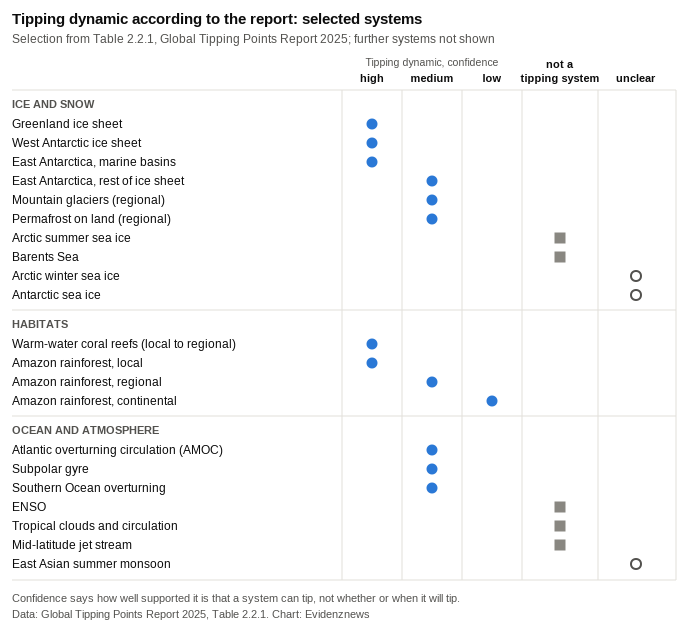
Whether the climate system has tipping points cannot be answered for the whole, only part by part. For the ice sheets of Greenland and West Antarctica, the marine basins of East Antarctica and warm-water coral reefs, a 2025 assessment report by the research community considers a tipping dynamic well supported. For the overturning circulation in the Atlantic, the evidence is weaker and disputed in the field; for the Amazon rainforest, it depends on the scale. For other candidates, such as Arctic summer sea ice, the same report rules out a tipping point.
This text is based on Chapter 2.2 of the Global Tipping Points Report 2025, published in October 2025. The first-named author is David I. Armstrong McKay; the report is published by the Global Systems Institute at the University of Exeter. The chapter contains no measurements of its own. About 38 authors reviewed the scientific literature published since 2023, that is, data from climate history, observations and computer models, and assessed for each system how robust the evidence is.
Two things are worth knowing about this source. It names its reviewers but has not gone through the peer review process of a journal. And it comes from the research community that developed the concept of tipping points. What independent work says about it appears further below.
What is meant by a tipping point
The report defines a tipping point as a threshold beyond which a change becomes self-sustaining. Up to that point, a system responds to external pressure; after it, the system drives itself further, often abruptly, often irreversibly and toward a markedly different state. The cause is reinforcing feedbacks, that is, processes in which a change amplifies its own cause, or dampening feedbacks that grow weaker.
For each system, the authors check whether there is evidence for such feedbacks. The result is a confidence level following the scheme of the Intergovernmental Panel on Climate Change, the IPCC. High means: Several independent lines of evidence consistently show feedbacks that can lead to a change of state, for example strong parallels in climate history and uniform behavior across many models. Medium means: There are several lines of evidence, but timing, strength or feedback are uncertain; for example, the tipping dynamic appears in some models, and observations support it only to a limited extent or are disputed. Low means: There are only isolated lines of evidence, and tipping occurs only in certain models or under narrow assumptions.
What these levels do not say is decisive. According to the authors, they indicate only whether a system can tip under plausible future conditions, within centuries to millennia. They do not say that it will tip. High confidence is not high probability.
Ice sheets: high confidence for Greenland and West Antarctica
The report assigns high confidence for the ice sheets. For the Greenland ice sheet, the West Antarctic ice sheet and the marine basins of East Antarctica, it sees a tipping dynamic with high confidence, and with medium confidence for the rest of East Antarctica. A collapse would lock in a sea level rise of several meters in the long term. The ice of Greenland corresponds to about seven meters of sea level, that of West Antarctica to about five meters.
The report gives the thresholds as ranges. For Greenland they are 0.8 to 3.4 degrees of global warming, for the marine basins of East Antarctica 2 to 6 degrees, for the rest of East Antarctica 6 to 10 degrees. For West Antarctica, the earlier estimate was 1 to 3 degrees. The authors now consider the lower limit of 1 degree possibly too high to be regarded as safe in the long term, and name 0.5 degrees as a precautionary limit; the exact lower bound is hard to determine. The report puts current warming at about 1.4 degrees, citing the World Meteorological Organization. According to its key messages, the ice sheets of Greenland and West Antarctica have been at risk since at least 1 degree of warming.
Tipping in the case of Greenland does not mean that the ice disappears quickly. A collapse of the Greenland ice sheet, if triggered, would according to the report stretch over 1,000 to 10,000 years.
Coral reefs: threshold exceeded according to the report
The report also assigns high confidence for warm-water coral reefs, specifically for tipping at the local and regionally clustered scale. The central estimate for their temperature threshold is 1.2 degrees of global warming, with a range of 1.0 to 1.5 degrees. According to the report, this central value has been exceeded.
The report points to the coral bleaching of 2023 to 2025, by its account the most severe recorded so far and the fourth worldwide. By April 2025, 83.7 percent of corals had been exposed to heat stress that can trigger bleaching; in the 2014 to 2017 event, it was 65.7 percent. According to the report, the figures come from NOAA's Coral Reef Watch program. How many corals worldwide have actually died has not yet been conclusively recorded.
The report itself names two reservations. A 2024 overview found that widely used threshold models indicating higher damage are cited disproportionately often. And laboratory experiments suggest an adaptation potential in some coral species, which has not yet been confirmed in the wild. The authors stick to their rating.
Atlantic and Amazon: medium to low confidence
The report gives the Atlantic overturning circulation, abbreviated AMOC, medium confidence, as it does the subpolar gyre and the overturning in the Southern Ocean. For the AMOC and the subpolar gyre, the report considers tipping possible even at today's warming; how likely it is cannot be said with certainty using the available models and measurement series.
Even the question of whether the circulation has already weakened is answered differently. The report cites studies according to which it may have declined by about 15 percent in 50 years, and early warning signals that suggest a collapse within decades. It contrasts this with a reconstruction from observational data that finds no weakening over 60 years, and points to criticism of the early warning signals. In model analyses that the report cites and that are still under review, nine models show abrupt changes in the AMOC at 1.1 to 3.9 degrees of warming. Such jumps are not necessarily tipping points, however, as long as it has not been shown that the change becomes self-sustaining.
For the Amazon rainforest, the verdict depends on the scale: high confidence for tipping at the local level, medium at the regional level, low for the entire continent. The authors lowered the lower bound of the warming threshold from 2 to 1.5 degrees; they consider the lower end more likely when warming and deforestation come together. How far apart the models lie is shown by a study cited in the report: It found local to regional forest decline in nine of twelve models that run to 2300, with thresholds between 1.5 and 10.2 degrees of global warming.
For permafrost on land and for mountain glaciers as well, the report affirms tipping only regionally and with medium confidence. It rules out global tipping in both cases. For permafrost, there is no uniform global threshold; over large areas it thaws gradually.
Interactions add to this. Of 20 interactions between systems assessed, most are destabilizing according to the report's key messages, and a few possibly stabilizing. The research for this text did not review the corresponding section.
What the report says is not a tipping point
The report explicitly does not classify several candidates from ice, ocean and atmosphere as tipping systems. This applies with high confidence to Arctic summer sea ice, with medium confidence to the circulation pattern ENSO and to tropical clouds and circulation, and with low confidence to the Barents Sea and the mid-latitude jet stream. As unclear, the report lists among others Arctic winter sea ice, Antarctic sea ice and the East Asian summer monsoon.
What the field disputes
The most fundamental criticism is directed at the term. In a 2025 piece in "Nature Climate Change", Kopp and nine coauthors argue that "tipping point" bundles phenomena with very different properties, invites the assumption of a clear-cut threshold and leads to policy temperature targets being confused with properties of the climate system. They recommend more precise terms: abruptness, irreversibility, self-amplification. They do not dispute that the phenomena are real; many are important for the system and worth studying. They describe their thesis that the term is of little use for triggering action as a testable hypothesis; studies on this are rare.
The group bases its criticism on examples. Arctic summer sea ice, the first tipping element ever proposed, appears to be neither irreversible nor self-amplifying. For the AMOC, a recent overview with low confidence gave a threshold somewhere between 1.4 and 8.0 degrees. And in at least some climate models, the circulation sometimes collapses and sometimes does not under an identical greenhouse gas trajectory.
A counterposition on substance concerns the AMOC. A modeling study by Baker and colleagues, published in "Nature" in 2025, examined 34 climate models under extreme forcing by greenhouse gases and freshwater. In all of them the circulation remained weakened but maintained, supported by wind-driven upwelling in the Southern Ocean. The authors conclude that a collapse this century is unlikely. This is a result of simulations, not of measurements. The tipping points report counters that the simulations are short and could show a transitional state, and it points out that according to the IPCC many models currently represent the circulation as too stable. A correction to the "Nature" paper appeared in April 2025, the content of which was not available for this text.
How much a model reveals about tipping points at all is the question raised by a 2026 paper by Angevaare and Drijfhout (KNMI). It catalogs abrupt changes in the climate models of the CMIP6 generation and deliberately speaks not of tipping points but of strong nonlinear surprises: A model run cannot show whether a critical threshold is crossed in the process. The authors consider some of the jumps found to be likely model errors, and by their own account their selection criteria contain an element of subjectivity. Only an excerpt of this paper was available for this text.
The IPCC addressed the topic in 2021 in its Sixth Assessment Report. According to a summary by the outlet Carbon Brief, which cites the report, abrupt responses and tipping points of the climate system cannot be ruled out with high confidence. The AMOC will very likely weaken in the 21st century; that it will not collapse abruptly before 2100 is stated there with medium confidence. That the Amazon will tip into a dry state this century becomes more likely through deforestation and warming, but only with low confidence. The research could not itself check the wording of the IPCC report.
Finally, the 1.5 degree mark is disputed. The 2022 review paper by Armstrong McKay and colleagues, the template for the report's threshold figures, carries it in its title. Its abstract says that several tipping points could be triggered in the range of 1.5 to below 2 degrees, and that the warming of about 1.1 degrees at the time already lay at the lower end of some uncertainty ranges. Kopp and colleagues read the paper this way: Contrary to its title, it did not show that 1.5 degrees is a special threshold; rather, it concluded that the world may already have crossed the tipping points of five processes and that the thresholds are highly uncertain.
What research cannot answer here
An Earth system tipping point cannot be brought about and repeated in an experiment. All statements rest on three kinds of evidence: data from climate history, short measurement series and models with known weaknesses. Where models consistently represent a system as too stable or too unstable, probability statements are not reliable.
For some systems, what may be missing is not only the measurement but the sharp value itself. If in a model a circulation collapses once and not another time under the same conditions, then the threshold is not a number that merely needs to be determined more precisely.
The timing also remains open. Even a triggered collapse of the Greenland ice sheet would, according to the report, unfold over 1,000 to 10,000 years. And the report's confidence levels answer only whether a system can tip. To the question of whether there are tipping points in the climate system, the answer according to these sources is therefore: For some subsystems, a tipping dynamic is well supported according to the report, for others it rules one out, and for still others, including the AMOC, the question is undecided. At what warming a system could tip, the sources give only in wide ranges.
Questions about this article
Comments
Sources
- Primary source Armstrong McKay DI, Buxton JE, Loriani S, et al.: Global Tipping Points Report 2025, Chapter 2.2: Status of Earth system tipping points: What's new?. Global Tipping Points Report 2025 (University of Exeter, Global Systems Institute); Sachstandsbericht, nicht in einer Fachzeitschrift begutachtet (2025). https://global-tipping-points.org/download/1418/
- Context Armstrong McKay et al.: Exceeding 1.5°C global warming could trigger multiple climate tipping points. Science 377(6611), eabn7950 (2022). doi:10.1126/science.abn7950
- Context Kopp, Gilmore, Shwom, et al.: ‘Tipping points’ confuse and can distract from urgent climate action. Nature Climate Change 15, 29–36 (2025). doi:10.1038/s41558-024-02196-8
- Context Baker, Bell, Jackson, Vallis, Watson, Wood: Continued Atlantic overturning circulation even under climate extremes. Nature 638, 987–994 (2025). doi:10.1038/s41586-024-08544-0
- Context Angevaare, Drijfhout: Catalogue of strong nonlinear surprises in ocean, sea-ice, and atmospheric variables in CMIP6. Earth System Dynamics 17, 1081–1115 (2026). doi:10.5194/esd-17-1081-2026
- Context In-depth Q&A: The IPCC’s sixth assessment report on climate science. Carbon Brief, journalistische Zusammenfassung des IPCC-Berichts von 2021. https://www.carbonbrief.org/in-depth-qa-the-ipccs-sixth-assessment-re…