What can quantum computers really do?
Quantum computers: advantages so far only on specialized tasks, practical benefit not shown
Evidence level 3 of 5 · Several independent studies pointing the same way

Key points
- A peer-reviewed review paper from 2026 lists eleven claims of a computational advantage from the years 2019 to 2024: by its classification, two are refuted, four weakly refuted, two contested and three so far unrefuted; all concern tasks that are artificial or of limited practical use.
- In error correction, Google measured in 2024 that the error of a stored logical qubit falls by a factor of 2.14 (uncertainty 0.02) with each increase in the size of the code; the experiment is a memory test with a single logical qubit and without computing operations.
- For useful computations, model calculations in non-peer-reviewed preprints arrive at around one million physical qubits and, by some estimates, a trillion computing operations or more; according to an equally non-peer-reviewed expert perspective, the best of today's devices carry out fewer than ten thousand two-qubit operations.
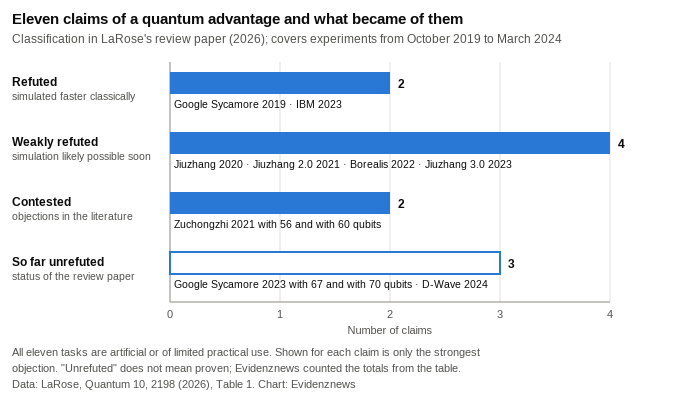
Quantum computers have so far outperformed conventional computers only on tasks that are artificial or of limited practical use. Even this lead often did not last: classical computers later caught up with two of the records, one of them on a laptop, and others are contested. That a quantum computer solves a useful task faster has not been shown so far.
That is the state of affairs compiled by Ryan LaRose of Michigan State University in a review paper. It appeared on September 1, 2026, in the journal "Quantum" and was peer-reviewed. LaRose lists in it the experiments that have claimed a computational advantage and notes what remains of them after later counter-computations. The paper is not a systematic analysis following fixed search rules; it does not describe how the literature was searched. Its table ends in March 2024. What goes beyond that comes in this text from other sources, including a measurement by Google and an assessment by Jens Eisert and John Preskill.
Eleven claims, three so far unrefuted
First, the term. By quantum advantage, LaRose means a computation that runs faster on a quantum computer than on a classical computer, regardless of whether the problem is good for anything. The advantage always applies only to a specific problem. And according to LaRose it is a moving target: because better computing methods are found on both sides, it can shift back and forth between quantum and classical computers.
For the period from October 2019 to March 2024, the paper lists eleven such claims. It assigns a status to each claim. LaRose classes a claim as refuted if a classical simulation finished faster than the quantum experiment. It is weakly refuted if there is a new classical method that could probably reproduce the experiment on a soon-to-be-available, sufficiently powerful computer. He calls cases contested in which later work has improved the classical simulation or cast doubt on part of the experiment.
Counting the table gives: two claims refuted, four weakly refuted, two contested, three unrefuted. The paper itself does not state these totals; they come from the research for this text; for each claim only the strongest objection is given. The tasks belong to three types, and all three are artificial or of limited practical use.
Ten thousand years that shrank to seconds
The first case shows how such a lead is lost. On October 23, 2019, Google reported an experiment with its Sycamore processor and 53 qubits, the building blocks of a quantum computer. The task is called random circuit sampling: the computer runs a randomly assembled circuit and delivers bit strings, that is, chains of zeros and ones, that follow its output distribution. Sycamore drew one million such bit strings in 200 seconds. The authors estimated that the best supercomputer of the time, Summit, would need ten thousand years to simulate it. According to LaRose, the task itself is not useful in any obvious way.
The result was not noise-free. The authors estimated the quality, the so-called fidelity, at 0.2 percent. This measure indicates whether a device delivers signal or noise: the value 1 stands for noise-free, 0 for pure noise.
Then classical computers caught up. In February 2020, an objection estimated the computing time on Summit at 195 days. In March 2021, a group computed one million bit strings in five days on a cluster of graphics processors. In less than 18 months, the estimate had thus fallen from ten thousand years to five days, though with caveats: the bit strings in this computation were correlated with one another. In November 2021, one million independent bit strings were achieved in 15 hours on 512 graphics processors, at a fidelity of 0.37 percent.
In June 2024 came the computation that LaRose counts as the first strong refutation. A team around Zhao generated three million bit strings on 1432 graphics processors with the same fidelity as Sycamore in 86.4 seconds. Sycamore had needed 200 seconds for one million. On energy consumption, LaRose gives 4.3 kilowatt-hours for Sycamore, reported for cooling, and 13.7 kilowatt-hours for the simulation.
Two caveats belong here. The counter-computation is a non-peer-reviewed preprint, of which only the abstract was available for this text; the individual figures come from LaRose's description. And the authors include the first author of the paper on the Chinese Jiuzhang experiment; the computation thus comes from the camp of a competitor of Google. LaRose notes that Google had openly published its data and circuits and that, in his assessment, this considerably sped up such computations.
Photons, a laptop and three open cases
A second kind of experiment works with light. In so-called boson sampling, photons, that is, particles of light, run through a network of beam splitters. How likely a particular measurement result is depends on a mathematical quantity that is hard to compute. The Chinese experiment Jiuzhang from December 2020 worked with 50 photons and measured for 200 seconds. The authors estimated that the supercomputer TaihuLight would need 2.5 billion years for it.
Here too the gap shrank. In 2024, in a paper in "Nature Physics," Oh and colleagues generated ten million samples for the Jiuzhang 2.0 experiment in 62 minutes using classical approximation methods, so-called tensor networks, on clusters of graphics processors; the preparation took a further 9.5 minutes. The experiments themselves had taken a few hundred seconds. LaRose therefore classes the three Jiuzhang experiments and the Borealis experiment by Xanadu from 2022 as weakly refuted.
A claim by IBM fell fastest. In June 2023, the company reported in "Nature" that it had simulated a so-called Ising model on a processor with 127 qubits, with 2880 two-qubit gates, that is, computing steps on two qubits each. The authors argued that a computation of this size lay beyond the reach of classical methods. IBM itself spoke of a utility experiment; LaRose includes it in his list of advantage claims.
Two weeks later, a classical simulation was available. The entire computation ran on a laptop in a few minutes. The paper by Tindall and colleagues of the Flatiron Institute and NYU, who are independent of IBM, appeared in January 2024 in "PRX Quantum." They used a tensor network adapted to the lattice structure. They computed one of the measured quantities on a laptop in under ten seconds, and the more demanding ones that IBM had measured in under four minutes, and by their account that was orders of magnitude more accurate than the quantum processor. Further groups followed between June and September 2023. In LaRose's table, the experiment is listed as refuted.
Three claims had not been caught up with when the review paper was completed. Two again come from Google: experiments from April 2023 with 67 and with 70 qubits, in which seventy million bit strings were drawn each. For the experiment with 67 qubits, the estimate is that the supercomputer Frontier would need around ten thousand years even in the best case. The third comes from D-Wave, from March 2024. For it, LaRose found no literature that directly refutes it; he considers it likely, however, that this will change. Eisert and Preskill write in their more recent assessment that the D-Wave result has been partly reproduced with classical tensor networks.
Why the lead is so shaky
According to LaRose, the biggest hurdle for the experiments is noise, that is, disturbances in the devices. It limits how large a circuit can become, and it can even make classical simulation easier.
There are also two fundamental weaknesses. For many of the experiments, a rigorous proof that the task is hard for classical computers is lacking. The claim of an advantage then rests on the best classical methods known at the time of publication, and a better one can be found later. In addition, the results cannot be verified in a simple way: anyone who wants to check whether the quantum computer got it right needs hard classical computations themselves.
LaRose therefore describes as the actual goal an experiment that runs on today's devices, can be verified easily and for which such a proof exists. As an example of the direction, he cites an experiment on the H2 computer by Quantinuum with 56 qubits and 2044 two-qubit gates: the quantum computer found the sought bit string in under two hours, while the best classical methods solved only circuits up to about 700 such gates within ten hours. This task, too, is not yet useful.
Not only in the lab but also on paper, advantage has already disappeared. In 2014, an advantage was claimed for an optimization method on a particular problem; less than five months later it was lost to a classical method by Barak and colleagues. For recommendation systems, Kerenidis and Prakash described an exponential quantum advantage in 2016. In 2018, Tang presented a classical method whose computing time grows in the same way with problem size. Whether an advantage remains in practice is open.
Even quantum chemistry, which counts as the clearest application, is not secure according to LaRose. For the method envisaged there, an exponential advantage for typical problems has not yet been robustly shown; weaker speedups are not ruled out by this. At a size that could claim an advantage, it has never been demonstrated experimentally.
Error correction: the error falls with size for the first time
The most solid example of an advantage in theory is, according to LaRose, Shor's algorithm, which breaks large numbers into their prime factors. Factoring large numbers into prime factors is the basis of the common encryption method RSA. The algorithm is so demanding, however, that it cannot do without error correction.
Its basic idea is redundancy. A so-called logical qubit, with which computation is to be done, is spread across several physical qubits. In the simplest case there are three, and the majority decides on errors. A figure called the distance describes how many errors such a code can compensate.
The path there was long. In 1998, such a code ran with three qubits. In 2016, a logical qubit lasted longer than the best building block it was made of for the first time, but only by a factor of 1.1. In 2023, Google showed a code of distance 5 with 49 qubits.
The measurement at issue today was published by Google in December 2024 in "Nature." The method used was called a surface code, in three sizes, with distances 3, 5 and 7. With each increase in size, the error of the logical qubit fell by a factor of 2.14, with an uncertainty of 0.02. That is what is meant when error correction is said to be below the threshold: a larger code makes the result better, not worse. It does not mean error-free.
The largest code used 101 physical qubits for a single logical one. Its error was 0.143 percent per correction cycle (uncertainty 0.003 percentage points); one cycle lasts 1.1 millionths of a second. The logical qubit lasted 291 millionths of a second (uncertainty 6), the best physical building block 119 (uncertainty 13). That is 2.4 times as long, with an uncertainty of 0.3.
What the experiment does not show, LaRose and the Google authors say themselves. What was measured was a memory: a single logical qubit that holds its state. No computing was done with it, and for logical computing operations the authors expect additional difficulties.
Google also ran into a limit. With simpler codes that correct only one type of error, the team went up to distance 29. From distance 15 on, the error no longer fell as fast as expected. What remained was an error floor of about one in ten billion per cycle. It is caused by rare error bursts that occur about once per hour and each affect around 30 neighboring qubits. According to the authors, their cause is not yet understood. The floor lies many orders of magnitude above what larger error-corrected computations would need.
There is also progress on other designs. Eisert and Preskill cite 48 logical qubits on an atom device with 280 qubits and 12 logical qubits on an ion-trap device with 56 qubits. Both demonstrations, however, covered only a few correction rounds and discarded runs in which errors were detected. According to their assessment, this cannot be transferred to large computations.
How far it is to a useful machine
Eisert, who works at the Freie Universität Berlin among other places, and Preskill of Caltech quantify the gap in a perspective whose version that was read dates from May 2026, which is available as a preprint and is not peer-reviewed. The best of today's computers accordingly carry out fewer than ten thousand two-qubit operations. A broadly useful, error-corrected computer will, by some estimates, need a trillion operations or more. That is at least a hundred million times as many.
An example calculation by the two shows what this means for hardware. For a thousand logical qubits and a hundred million computing steps, one would need, under their assumptions, around a thousand physical qubits per logical qubit, around one million in total. Google's measurement stands at 101 physical qubits for one logical qubit that only stores. The Google authors extrapolate that an error of one in a million per cycle would require a code of distance 27 with 1457 physical qubits. That is an extrapolation, not a measurement.
The most frequent question concerns encryption. LaRose still cites the older estimate that factoring a 2048-bit RSA number would need 20 million noisy qubits and eight hours. Craig Gidney of Google Quantum AI lowered this figure in May 2025 in a preprint: to fewer than one million qubits, precisely 897,864, and less than a week of computing time, 4.96 days expected. The calculation assumes, among other things, that each operation fails in only one of a thousand cases and that a correction cycle takes one millionth of a second.
This too is a model calculation, not a measurement; it comes from an employee of a manufacturer and is not peer-reviewed. Gidney himself writes that he does not expect computers of this size to exist by 2030. He only wants security not to depend on progress remaining slow, and points to a NIST draft to phase out vulnerable systems after 2030 and to ban them after 2035. Without other physical assumptions, he sees no way to reduce the number of qubits by another order of magnitude.
Which applications could be worthwhile at all was worked out by Hoefler, Häner and Troyer in 2023 in the "Communications of the ACM"; the authors worked at Microsoft. They deliberately assumed favorable values for a future quantum computer, such as 10,000 error-corrected logical qubits. Their result: methods that bring only a quadratic speedup are not enough for a practical advantage. For the input and output of data, they assume 1 gigabit per second for the quantum machine, compared with 10,000 for a present-day classical chip. Promising, they say, are problems with small amounts of data and exponential speedup, above all in chemistry and materials science. Database search, large amounts of data and many ideas for artificial intelligence and weather simulation they call dead ends. The paper is three years old and calculates with a hypothetical machine, not with today's hardware.
What the field disputes
The measured numbers are hardly disputed, but their evaluation is. LaRose writes that the field currently stands exactly at the boundary between quantum and classical computational advantage, and that the status will shift further in the near future. In the long run he considers an advantage reasonably to be expected, namely for problems where the speedup is exponential or strongly polynomial. An advantage is established, however, only once it has been demonstrated in an experiment.
Dominik Hangleiter weighs it differently. In an essay from 2026, a non-peer-reviewed preprint of which only the abstract was available for this text, he takes the position that quantum advantage has been achieved. He compares the present state with the so-called Bell tests of the 1980s; as open loopholes he names scalability and verifiability. That is the position of an expert, not evidence.
Eisert and Preskill write that the random circuit experiments show that today's devices carry out some things that are out of reach for today's supercomputers. That is an important waypoint, they say, but not of great practical interest. They consider a more recent computation by Google with 103 qubits probably classically hard. Practically useful and economically viable computations have not yet been reached, and it is unclear when that will happen. For so-called variational algorithms, an advantage is not firmly established, and for machine learning the possible benefit is largely unknown. They describe the path to error-corrected machines as arduous, expensive and lengthy.
Through all this, the interests involved must be kept in mind. A large part of the key sources comes from companies that build quantum hardware or do research on it: the error-correction measurement and the RSA estimate come from Google, the application calculation from authors at Microsoft, and Preskill is also listed with Amazon Web Services. LaRose, Eisert, and Tindall and colleagues work at universities and research institutes.
What research cannot answer here
Two things no experiment can decide. The first: whether there is, after all, a faster classical method for a task. LaRose notes that this possibility remains. An unrefuted advantage is therefore not proven but so far not caught up with. Whether it can ever be proven that such a method does not exist is not something the sources evaluated provide.
The second is the word "really" in the question. An advantage is defined only for a specific problem, and that can be meaningless. Whether a computation is useful depends, according to Eisert and Preskill, on whether the answer has value for someone. That is a judgment, not a measured quantity.
What is established, then: quantum computers have shown a lead on artificial tasks that was lost again several times, and error correction works on a small scale as a memory. When this will become a machine that computes something useful faster cannot be read from the measurements. Eisert and Preskill explicitly call the time frame uncertain.
Questions about this article
Comments
Sources
- Primary source LaRose R: A brief history of quantum vs classical computational advantage. Quantum 10, 2198 (2026). doi:10.22331/q-2026-09-01-2198
- Context Google Quantum AI and Collaborators: Quantum error correction below the surface code threshold. Nature 638, 920–926; gelesen als Preprint-Fassung (2025). doi:10.1038/s41586-024-08449-y
- Context Eisert J, Preskill J: Mind the gaps: The fraught road to quantum advantage. arXiv:2510.19928, Fassung 3 vom 21. Mai 2026; Preprint, nicht begutachtet (2026). https://arxiv.org/abs/2510.19928
- Context Gidney C: How to factor 2048 bit RSA integers with less than a million noisy qubits. arXiv:2505.15917; Preprint, nicht begutachtet (2025). https://arxiv.org/abs/2505.15917
- Context Tindall J, Fishman M, Stoudenmire EM, Sels D: Efficient Tensor Network Simulation of IBM’s Eagle Kicked Ising Experiment. PRX Quantum 5, 010308; gelesen als Preprint-Fassung (2024). doi:10.1103/PRXQuantum.5.010308
- Context Hoefler T, Häner T, Troyer M: Disentangling Hype from Practicality: On Realistically Achieving Quantum Advantage. Communications of the ACM 66(5), 82–87; gelesen als Preprint-Fassung (2023). doi:10.1145/3571725
- Context Hangleiter D: Has quantum advantage been achieved?. arXiv:2603.09901, Fassung 2 vom 8. September 2026; Essay, Preprint, nicht begutachtet (2026). https://arxiv.org/abs/2603.09901
- Context Zhao X-H, et al.: Leapfrogging Sycamore: Harnessing 1432 GPUs for 7x Faster Quantum Random Circuit Sampling. arXiv:2406.18889; Preprint, nicht begutachtet (2024). https://arxiv.org/abs/2406.18889