Teeth from southern China: Homo erectus documented there later than previously known
Evidence level 2 of 5 · Single study, peer-reviewed
Key points
- Nine teeth from the Naxian and Baxian caves in the southern Chinese region of Guangxi are roughly 324,000 to 184,000 years old, according to two studies in "Nature"; the authors assign eight of them to Homo erectus based on shape, and four of these eight additionally based on a variant in the tooth protein ameloblastin.
- The age range comes from a statistical model of 43 radiometric ages and is well below the roughly 400,000 years of the region's previously undisputed Homo erectus finds; from the chemistry of the teeth, the authors conclude that Homo erectus persisted in closed rainforests.
- The ninth tooth differs in shape from Homo erectus, Neanderthals and modern humans and does not carry the Homo erectus variant; expert commentaries on blogs consider the rainforest setting well supported, but point out that the diet values of the humans themselves come from only three teeth and that the distinction from Denisovans is weakly supported.
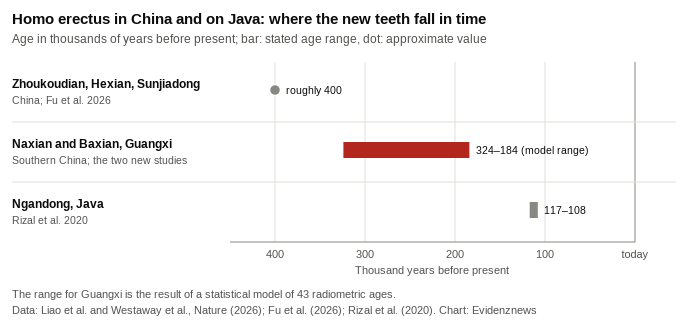
The early human Homo erectus apparently lived in southern China considerably longer than the previously undisputed finds show. Two research teams attribute eight teeth from two caves in the Guangxi region to this species and date them to roughly 324,000 to 184,000 years ago. The region's previously undisputed Homo erectus finds are about 400,000 years old.
The results appear in two related studies published in "Nature" on November 18, 2026. One, with Wei Liao as first author and Frido Welker as one of the corresponding authors, deals with the teeth themselves: their shape and the proteins preserved in them. The other, by a team led by Kira Westaway, provides the dating and clues about the environment. Those involved include Shandong University, the Institute of Vertebrate Paleontology and Paleoanthropology of the Chinese Academy of Sciences in Beijing, the University of Copenhagen and Macquarie University in Sydney.
The basis is nine fossil teeth from the karst caves Naxian and Baxian in the Chongzuo area. Only the abstracts of the two studies were available for this text. The full texts are freely accessible but could not be retrieved by the editorial deadline. What goes beyond the abstracts comes from expert commentaries that evaluate the full text, and is marked as such below.
Proteins instead of genetic material
The teams did not analyze genetic material. The first study works with paleoproteomics, the analysis of proteins that have survived for hundreds of thousands of years in tooth enamel and dentin. Proteins consist of chains of amino acids, and at individual positions in these chains the human forms differ from one another.
The benchmark for Homo erectus comes from an earlier "Nature" study from the same year, in which Qiaomei Fu, one of the corresponding authors of the new work, took part. It had examined tooth enamel proteins from six Homo erectus specimens about 400,000 years old from the Chinese sites Zhoukoudian, Hexian and Sunjiadong. All six carried a variant in the protein ameloblastin that was not known from any other human lineage.
The team assigns eight of the nine teeth from Guangxi to Homo erectus. Two lines of evidence for this exist for only half of them. Five of the nine teeth were examined for proteins, and four of these five carry a Homo erectus variant in ameloblastin that has otherwise been described only from older Chinese fossils of the species. According to the authors, the measured proteins come from the teeth themselves and did not get into them later, which applies to all five samples.
For the four other teeth, the attribution rests on shape alone. The team compared measurements and outlines of the nine pieces; according to its statements, this comparison also supports the attribution of the four teeth with the protein marker. The second study calls the eight teeth determined "morphologically and genetically"; what is meant are the proteins, as genetic material was not read.
The four protein samples do not match the older finds exactly. At another position in ameloblastin they differ from the previously known Homo erectus proteins from China. The authors interpret this as an indication of a separate, previously unstudied group of this species.
The ninth tooth
One tooth stands out. The piece numbered PA1796 is among the five with protein data, but it lacks the Homo erectus marker. The shape comparison also sets it apart, not only from Homo erectus but equally from Neanderthals and modern humans.
The abstract says that Denisovans, who are equated there with the species Homo longi, are "possibly" represented by this tooth. That is not an attribution. Welker told the news agency Reuters that the tooth could come from a Denisovan, but also from something unknown.
43 ages, one range
For the dating, the second team combined 43 radiometric ages from five different methods in a statistical model. Radiometric methods derive the age of a sample from physical processes such as radioactive decay. The result was that Homo erectus was present in southern China between 324,000 and 184,000 years before present.
This range is a model result. It does not mean that a particular tooth is 184,000 years old, and it does not prove continuous settlement over 140,000 years.
Two comparison values are important for putting this in context. Compared with the region's finds of about 400,000 years old, the new range is considerably younger according to the abstract. How much younger depends on which end one takes: from the old end of the range it is less than 100,000 years, from the young end a good 200,000. Reports that the species survived 200,000 years longer in China calculate with the young end. The teeth from Guangxi are not the last Homo erectus at all: from the island of Java, finds are known that a 2020 study dated to 117,000 to 108,000 years.
Indications of rainforest
The second study also examined the chemistry of the teeth: stable isotopes, that is, variants of an element with different weights whose ratio allows conclusions about diet and environment, as well as trace elements. Its conclusion in the abstract: Homo erectus persisted in closed rainforests and was mobile and adaptable there over a long time.
That would contradict the previous picture. The known Homo erectus sites on Java were regarded as open mosaics of woodland and grassland, although according to the authors this view in Asia rested on only a few direct measurements. Dense rainforest was regarded as a habitat that only Homo sapiens opened up.
Two experts who were not involved in the studies responded approvingly in the magazine "National Geographic". Ben Marwick of the University of Washington recalled that rainforests were regarded as a boundary that only modern humans had overcome. Richard Potts of the Smithsonian Institution called the identification of the teeth "really solid".
Where commentators see weaknesses
The research found no published rebuttal a few days after publication. Detailed commentaries appeared on three specialist blogs, which undergo no peer review. Their objections concern the reach of the conclusions more than the find.
The paleoanthropology blogger John Hawks considers the rainforest interpretation "pretty persuasive". He views the attribution of the teeth more critically. The protein signal rests on one to two positions in the amino acid chain, and the shape comparison is poorly designed to separate Homo erectus from Denisovans, because only a single Denisovan fossil entered the comparison. He cannot rule out with certainty that the teeth belonged to Denisovans.
Seth Chagi, who writes on the blog "The Deep History Refuge", considers the rainforest background the most solid part of the work. The data on the diet of the humans themselves, in contrast, are thin: they come from only three teeth from one of the two caves. He calls the interpretation of the ninth tooth as Denisovan a plausible hypothesis, not an established identification.
The blog Anthropology.net points out that the press release on the studies is worded more strongly than the studies themselves. It speaks of genetic signatures where proteins are meant, and only four of the eight teeth carry the protein marker. According to this blog, the dating in the two caves is also secured to different degrees. According to it and Chagi, the bones in the caves were not collected by humans but brought in by porcupines; the studies did not describe stone tools. These statements from the commentaries could not be checked against the full text for this article; the reference list of the second study does at least contain a paper on porcupines as collectors of bones in Asian karst caves.
What remains open
Based on shape, and for four teeth also on proteins, eight of the nine teeth fit Homo erectus, and the dating model places them in the stated period. Whether Homo erectus lived in the rainforest permanently or only used it remains open; Chagi points out that the diet values of the humans themselves come from only three teeth.
It is also open whether Homo erectus encountered other human forms in the region. And the ninth tooth remains without a name for now.
Questions about this article
Comments
Sources
- Primary source Liao W, Zanolli C, Ásmundsdóttir RD, et al.: Evidence for late Middle Pleistocene Homo erectus in mainland East Asia. Nature (2026). doi:10.1038/s41586-026-11271-3
- Primary source Westaway KE, Joannes-Boyau R, Liao W, et al.: Rainforest adaptation in late Homo erectus from southern China. Nature (2026). doi:10.1038/s41586-026-11155-6
- Context Fu et al.: Enamel proteins from six Homo erectus specimens across China. Nature 655, 141–147 (2026). doi:10.1038/s41586-026-10478-8
- Context Rizal et al.: Last appearance of Homo erectus at Ngandong, Java, 117,000–108,000 years ago. Nature 577, 381–385 (2020). doi:10.1038/s41586-019-1863-2
- Context John Hawks: Another rethink of Homo erectus and Denisovans with ancient proteins. Blog, nicht begutachtet (2026). https://www.johnhawks.net/p/another-rethink-of-homo-erectus-and
- Context Seth Chagi: Kings of the Karst Canopy. The Deep History Refuge, Blog, nicht begutachtet (2026). https://deephistory.substack.com/p/kings-of-the-karst-canopy-how-nine
- Context Homo erectus in China's Forests 324,000–184,000 Years Ago. Anthropology.net, Blog, nicht begutachtet (2026). https://www.anthropology.net/p/homo-erectus-in-chinas-forests-324000184000
- Context Homo Erectus May Have Survived in China 200,000 Years Longer Than We Thought. National Geographic, Magazinbericht (2026). https://www.nationalgeographic.com/history/article/homo-erectus-china…
- Context Will Dunham: Reuters-Bericht vom 18. November 2026 mit Aussagen der Studienleiter. Reuters, über Yahoo News (2026). https://www.yahoo.com/news/science/articles/archaic-human-species-hom…