Is there true randomness?
True Randomness: Local Hidden Variables Ruled Out, Interpretation Remains Open
Evidence level 5 of 5 · Broad consensus, established over years
Key points
- Bell's theorem is a mathematical theorem: in any local model the CHSH value is at most 2, while quantum theory predicts 2 times the square root of 2, about 2.83, for two qubits in the singlet state with suitable measurement directions.
- Three experiments from 2015 in Delft, in Vienna and at NIST violated Bell inequalities with the detection loophole and the locality loophole closed, according to the groups, with very different statistical strength: the p-values range from 0.039 in Delft to at most 3.74 times 10 to the power of minus 31 in Vienna and are not directly comparable.
- Local hidden variables are ruled out under the assumption of freely chosen measurement settings, which according to the anchor source and to Shalm and colleagues cannot be proven; Bell tests cannot distinguish between randomness, the nonlocal Bohmian mechanics and superdeterminism.
Whether there is true randomness in nature has so far not been decided by any experiment. A narrower question has been decided: the results of certain quantum measurements cannot be explained by local hidden variables, that is, by common causes of the measurement results that satisfy a precisely defined locality condition. This holds under two assumptions: the measurement settings are chosen freely, and nothing acts faster than light. The basis is so-called Bell tests: experiments that have measured a violation of the Bell inequalities since 1972, and since 2015 also in setups that, according to the groups, close two known loopholes at the same time.
This text draws on sources of two kinds. The anchor source is the review article "Bell nonlocality" by Nicolas Brunner and four coauthors, published in 2014 in the journal "Reviews of Modern Physics". It is peer-reviewed but not a systematic review, and it appeared before the experiments of 2015: it provides the theory, the assumptions and the state of the loopholes up to 2014. It expressly leaves questions of interpretation aside. The measured values in this text therefore come from the original papers of the experiments. What was examined there were quantum systems in the laboratory: photons, electron spins in diamond, atoms and superconducting devices.
A Mathematical Theorem and a Question for Experiment
In a Bell test, two observers carry out measurements at separate stations. Each chooses a measurement setting and obtains a result. Bell's theorem begins with a condition on all conceivable explanations of such results, the locality condition: once all common causes are taken into account, the probability for a pair of results factorizes into a product of two individual probabilities, one per observer. Models that satisfy this condition are called local models in what follows; the common causes are the hidden variables.
The condition implies an upper limit for a quantity, the CHSH value: in any local model it is at most 2. Quantum theory, by contrast, predicts the value 2 times the square root of 2, about 2.83, for two so-called qubits in the singlet state with suitable measurement directions. Both cannot hold at the same time. That is the content of the theorem, and the review calls it a straightforward mathematical theorem.
Two details matter for the question of randomness. First, the locality condition does not presuppose determinism. If the limit is violated, local models in which the results are fixed only with probabilities would also be ruled out. Second, the calculation contains a tacit assumption: the measurement settings can be chosen independently of the hidden variables. This assumption returns below.
Whether nature keeps to the limit of 2 cannot be said by mathematics. It has to be measured.
The Early Tests Left Loopholes
According to the review, the violation of the Bell inequality was first confirmed experimentally in 1972 by Freedman and Clauser, more convincingly in 1982 by Aspect and colleagues, and afterwards in many further experiments. What remained open was whether a local model could still explain the data by exploiting a weakness of the setup. Such weaknesses are called loopholes.
The detection loophole arises when too many particles are not detected. For the CHSH test with a maximally entangled state of two qubits, the detection efficiency must lie above about 82.8 percent; otherwise a local model can be built that reproduces the data. With only partially entangled states, the threshold can fall to two thirds, according to the review; below that, no genuine violation is possible in this test. In 2014 most optical Bell tests were affected by this loophole, because photons were lost and the detectors were only of limited efficiency.
The locality loophole concerns the separation of the two stations. In 1982, Aspect and colleagues switched their polarizers about every 10 nanoseconds. The two switches stood 13 meters apart, a distance for which light takes 43 nanoseconds. The setting thus changed at shorter intervals than light needs to travel from one switch to the other. The switches were, however, driven by periodic generators and were therefore not truly random. In 1998, Weihs and colleagues used two independent quantum random number generators a few hundred meters apart.
Unlike the detection loophole, the locality loophole can never be closed completely, according to the review. The separation of the measurement choices in space and time presupposes that these choices are not themselves determined by earlier events. Even a random number generator that works according to standard quantum theory does not guarantee that the choice is free in this sense. The authors mention the proposal to leave the choice to humans or to photons from distant galaxies; any local explanation would need a conspiracy on an intergalactic scale under this proposal. One can never be certain that measurement choices are truly random or free.
2015: Three Experiments, Three Very Different Numbers
In 2015, three groups reported Bell tests in which, according to them, the detection loophole and the locality loophole were closed at the same time. They worked with different systems.
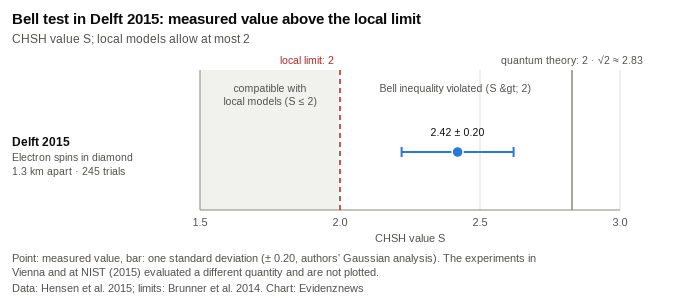
In Delft, Hensen and colleagues entangled the spins of electrons in two diamonds that were 1.3 kilometers apart. A signal from a third station reported each time that the entanglement had succeeded. In 220 hours of measurement time, 245 trials were collected. They yielded a CHSH value of 2.42 plus/minus 0.20 (one standard deviation from the authors' Gaussian analysis), that is, more than the local limit of 2. For the assumption that a local model explains the data, even if it is allowed to remember earlier trials arbitrarily, the authors calculated a p-value of 0.039. The p-value here quantifies the probability that a local model produces a violation at least this large. With the usual analysis, which presupposes independent trials, Gaussian statistics and perfect random number generators, it is 0.019. According to the authors, it was the first experiment to close both loopholes at the same time.
In Vienna, Giustina and colleagues used pairs of photons with entangled polarization. The measurement stations stood about 58 meters apart, superconducting detectors detected the photons, and fast random number generators chose the settings. The system efficiencies were about 78.6 and 76.2 percent. Even without the usual statistical simplifications, that is, without the assumption of independent trials or of Gaussian statistics, the group calculates for a local realistic model a chance of at most 3.74 times 10 to the power of minus 31 of producing the result. That is a number with 30 zeros after the decimal point; it corresponds to 11.5 standard deviations. The authors themselves note that their confidence in the result is limited not by the statistics but by more general sources of error. They estimate the chance of predicting the settings at at most 2.4 times 10 to the power of minus 4, that is 0.00024.
At NIST, Shalm and colleagues likewise worked with entangled photon pairs, at detection efficiencies of 74.7 and 75.6 percent. The two measurement stations and the source were in one building, the stations about 185 meters apart. The smallest p-value is about 6 times 10 to the power of minus 9, that is, about six billionths; the paper gives 5.9 in the abstract and 5.8 times 10 to the power of minus 9 in the text. The group also calculated what changes if the settings were predictable to a small extent. With a cautiously assumed predictability of 0.003, fifteen times the estimated value of about 0.0002, the smallest adjusted p-value is 2.3 times 10 to the power of minus 7. The authors describe the experiment as a trial run of a planned facility intended to certify randomness.
The three p-values cannot be compared directly, because they rest on different analyses. The result from Delft is statistically the weakest of the three. The three papers are not entirely independent: four authors (Abellán, Amaya, Pruneri and Mitchell) appear on all three author lists, and Vienna and NIST share further authors; the setups were separate.
The authors themselves say where the limits lie. Strictly speaking, no Bell experiment can rule out the infinitely many conceivable local realistic theories, write Hensen and colleagues. Those ruled out are the ones that assume that the random number generators produce a free random bit in time and that the results are final once the electronics have registered them. The Vienna group, by its own account, closes the freedom-of-choice loophole up to a natural stopping point, the moment at which the particles are created: anyone who wanted to explain the result through this loophole would have to let the hidden variables arise before the particles were emitted and influence the settings. Shalm and colleagues state that only assumptions remain that could never be removed even in principle. That the random number generators of the two stations are independent cannot be proven without additional assumptions, because their backward light cones intersect.
Around 100,000 People as a Source of Randomness
The BIG Bell Test, published in 2018 in the journal Nature, had humans choose the measurement settings. Around 100,000 participants generated a total of 97,347,490 decisions between two options in an online game; the main measurement day was November 30, 2016. Over twelve hours, the data flow was above 1,000 bits per second. The decisions served as measurement settings in twelve laboratories on five continents for 13 experiments with photons, single atoms, atomic ensembles and superconducting devices. Most of these experiments showed statistically clear violations of their inequalities.
The authors name two limits. Human decisions are too slow to separate the choice spatially from the measurement: the Earth measures only 43 light-milliseconds across. And the participants' sequences show slight patterns; the share of zeros was about 0.5237. The consortium includes members of the groups from Vienna and from NIST.
The authors write that their results show that the independence of the measurement settings supplied by humans stands in strong conflict with causal determinism. This interpretation is disputed. Hossenfelder and Palmer counter that the experiment cannot rule out superdeterminism: freedom of choice cannot be proven by assuming it.
Randomness with a Certificate
According to the review, the violation of a Bell inequality allows one to derive how well an adversary can guess the measurement results. If the CHSH value reaches the quantum maximum of 2 times the square root of 2, the probability of guessing a result is at most one half, as with a fair coin toss; the technical literature speaks of one bit of min-entropy. If the value is 2, the local limit, the bound says only that the probability is at most 1. Randomness cannot then be certified.
The bound of one half presupposes that devices and adversary obey quantum theory; if one demands only that no signals faster than light are possible, it is weaker (at most 0.79). For procedures for generating randomness, the review additionally names: the initial source of randomness is independent of the behavior of the devices, the two devices do not interact during the measurements, and the devices do not leak information to the adversary.
Two experiments have implemented the procedure. In 2018, Bierhorst and colleagues obtained from a loophole-free Bell test with photons 1024 random bits that are uniformly distributed to within one trillionth; this was the best of five new data sets. The group works at the same institution as Shalm and colleagues and used an improved setup of their experiment. The paper is therefore an application, not an independent confirmation. According to the authors, the bits could be predicted only if signals faster than light were possible or the measurement choice were not independent. They themselves describe the requirement of independent choice as ultimately untestable. Their assumptions do not prescribe a particular physics of the devices; the procedure is therefore called device-independent.
Liu and colleagues from Hefei, China, together with Roger Colbeck from York, reported in 2021 in the journal Nature Physics a device-independent randomness expansion against quantum adversaries; according to their account, this had not been achieved before. Expansion means: more randomness is produced than the procedure consumes. At detection efficiencies of 83.40 plus/minus 0.32 and 84.80 plus/minus 0.31 percent, at least 935 million certified random bits were produced in 19.2 hours, about 13,527 bits per second. After subtracting the 677.8 million bits of initial randomness that the procedure consumed, a net gain of 257 million bits remains, at an error parameter of 3.09 times 10 to the power of minus 12. Earlier experiments had consumed more randomness than they produced.
Here too the authors name limitations. The locality loophole was not closed by spatial separation in the main experiment; instead they assume that the devices are well shielded. The bits remain secure only if the devices are not reused.
In these papers, random means: unpredictable for any adversary under the stated assumptions. That is something different from an event without a cause.
What the Field Disputes
How far the conclusion from the experiments extends is formulated differently. The Nobel Prize in Physics 2022 went to Aspect, Clauser and Zeilinger for experiments with entangled photons that establish the violation of Bell inequalities, and for pioneering work in quantum information science. The popular version of the Nobel Committee writes that Alain Aspect closed an important loophole and delivered a very clear result: quantum mechanics is correct, and there are no hidden variables. That is more pointed than the technical sources of this text. There, only local hidden variables are ruled out, and only under the assumption of freely chosen measurement settings; the review also notes that Aspect's switches were not truly random. The committee's scientific background document could not be retrieved for this text.
Hossenfelder and Palmer formulate a counterposition to the usual reading in a paper published in 2020 in the journal Frontiers in Physics. According to their account, a violated Bell inequality shows only that at least one of three assumptions does not hold: the statistical independence of hidden variables and measurement settings, that is, free choice, outcome independence or parameter independence. Quantum mechanics violates outcome independence, they say, superdeterminism violates statistical independence, and Bell tests cannot say which of the two possibilities is the case.
According to Hossenfelder and Palmer, superdeterminism is not an interpretation of quantum mechanics but a more fundamental theory from which it is supposed to arise. The two concede that the idea is widely regarded as settled; it is a minority position. They consider the common objections (conspiracy, fine-tuning, free will) unconvincing, and they consider it possible to test the hypothesis in an almost model-independent way. The parts of their paper read for this text contain no worked-out, testable model. Shalm and colleagues call the notion that all events in the universe are predetermined untestable in principle. Hossenfelder and Palmer also cite the other side: Mateus Araújo considers the assumption of statistical independence necessary in order to do science at all; Tim Maudlin calls it unscientific to give it up. And they cite Bell himself admitting that the impression that something seems implausible is not a convincing argument.
A second alternative is Bohmian mechanics, a deterministic interpretation of quantum mechanics with nonlocal hidden variables. In the description of Shalm and colleagues, nonlocal means: hidden variables at one place can change their values instantly because something happens at a distant place. Bell tests do not rule out this interpretation. According to the Stanford Encyclopedia of Philosophy, whose entry was evaluated for this text only via a summary and not checked verbatim, it violates parameter independence but permits no faster-than-light signaling. The same source names further routes: many-worlds approaches deny that measurements have unique results; collapse models are compatible with the violation of the Bell inequalities; retrocausal approaches reject the independence of the measurement settings.
What No Experiment Can Decide
The assumption that the measurement settings are chosen freely cannot be proven in principle, according to the sources evaluated. The review, Shalm and colleagues, and Hossenfelder and Palmer agree on this. Experiments with light from distant quasars rule out, according to Hossenfelder and Palmer, only that the correlations were caused locally by events in the distant past; they refute superdeterminism as little as the BIG Bell Test does.
Which assumption of Bell's theorem is violated is likewise not decided by Bell tests. The interpretations named and superdeterminism are compatible with the data and do not differ essentially in Bell tests. It is also open whether quantum mechanics is incomplete and will be replaced by a deeper theory. Hossenfelder and Palmer consider it incomplete; that is their position.
The initial question thus remains without an experimental answer. The measurements show that local hidden variables do not predetermine the results, and they make it possible, under named assumptions, to certify random bits that no adversary can predict. They do not refute a deterministic description that is nonlocal or superdeterministic.
Questions about this article
Comments
Sources
- Primary source Brunner N, Cavalcanti D, Pironio S, Scarani V, Wehner S: Bell nonlocality. Reviews of Modern Physics 86, 419–478 (2014). doi:10.1103/RevModPhys.86.419
- Context Hensen B, et al.: Experimental loophole-free violation of a Bell inequality using entangled electron spins separated by 1.3 km. Nature 526, 682–686 (2015). doi:10.1038/nature15759
- Context Giustina M, et al.: Significant-loophole-free test of Bell’s theorem with entangled photons. Physical Review Letters 115, 250401 (2015). doi:10.1103/PhysRevLett.115.250401
- Context Shalm LK, et al.: A strong loophole-free test of local realism. Physical Review Letters 115, 250402 (2015). doi:10.1103/PhysRevLett.115.250402
- Context The BIG Bell Test Collaboration: Challenging local realism with human choices. Nature 557, 212–216 (2018). doi:10.1038/s41586-018-0085-3
- Context Bierhorst P, et al.: Experimentally generated randomness certified by the impossibility of superluminal signals. Nature 556, 223–226 (2018). doi:10.1038/s41586-018-0019-0
- Context Liu W-Z, et al.: Device-independent randomness expansion against quantum side information. Nature Physics 17, 448–451 (2021). doi:10.1038/s41567-020-01147-2
- Context Hossenfelder S, Palmer TN: Rethinking Superdeterminism. Frontiers in Physics 8, 139 (2020). doi:10.3389/fphy.2020.00139
- Context Myrvold, Genovese, Shimony: Bell’s Theorem. Stanford Encyclopedia of Philosophy, Fachenzyklopädie; Fassung vom 25. Januar 2024 (2024). https://plato.stanford.edu/entries/bell-theorem/
- Context Royal Swedish Academy of Sciences: The Nobel Prize in Physics 2022 – Popular science background: How entanglement has become a powerful tool. Populärfassung des Nobelkomitees, nicht begutachtet (2022). https://www.nobelprize.org/prizes/physics/2022/popular-information/