Why do we age?
Aging: twelve hallmarks, shown mainly in worms, flies and mice
Evidence level 3 of 5 · Several independent studies pointing the same way
Key points
- A much-cited review from 2023 lists twelve hallmarks of aging, from damage to the genome and shortened chromosome ends to chronic inflammation; the authors themselves call their classification inevitably arbitrary.
- Interventions that extend life are described in mice and other model organisms; in humans, a randomized trial of 220 adults on calorie restriction showed only small effects on one of several blood measures; it provides no evidence of a longer life or less disease.
- Critics regard the hallmarks as a useful checklist but not as an explanation of the causes; only a minority affirms that aging is partly genetically programmed.
Research gives two different answers to the question of why living things age. One comes from evolutionary biology and explains why evolution has not eliminated aging. The other comes from cell biology and describes what happens in the body. The first is regarded as the majority view in the field. The second rests on experiments done mainly in yeast, worms, flies and mice. In humans, it has so far mostly rested on correlations, rare hereditary diseases and surrogate measures.
The main source of this text is a review published in 2023 in the journal Cell. It was written by Carlos López-Otín of the University of Oviedo, Maria Blasco of the Spanish National Cancer Research Centre CNIO, Linda Partridge of University College London and the Max Planck Institute for Biology of Ageing in Cologne, Manuel Serrano of the IRB Barcelona institute and the company Altos Labs, and Guido Kroemer of the Université de Paris. It sorts aging into twelve "hallmarks."
There are three things to know about this source. It is a narrative review, not a systematic review: the authors state no search strategy. It comes from the authors who themselves shaped the framework with the first version in 2013. And several of them hold shares in aging-research companies or patents in this field.
The answer from evolutionary biology
Kowald and Kirkwood summarize the evolutionary explanation in a review from 2016. The core was laid down by Medawar: because of unavoidable hazards from the environment, selection acts ever more weakly on late years of life. What harms the body only in old age is therefore hardly weeded out. Kowald and Kirkwood call this the basis of the field's majority view.
The review names three theories that build on this idea. According to the first, harmful genetic variants that act only late in life accumulate. According to the second, there are genes that are beneficial early in life and harmful late; specialists call this antagonistic pleiotropy. According to the third, an organism divides its resources between maintaining the body and reproduction, and the most favorable level of maintenance does not prevent aging completely.
All three count as non-programmed theories: in them, aging is not a purpose-built program. Kowald and Kirkwood have examined the counterproposals according to which dedicated genes actively bring about aging. Their verdict: "not a single one withstands close scrutiny."
This is not undisputed. Mitteldorf argues against it in a paper from 2018. Some mechanisms of aging have been preserved since the Cambrian explosion, the processes sometimes look like programmed self-destruction, and there are indications of an epigenetic clock of aging. He concedes that his explanation presupposes a form of selection between groups that is controversial. His position is that of a minority.
Two findings from comparisons between species show that the simple rule "the older, the higher the risk of death" does not hold everywhere. A study by Jones and colleagues compared in 2014 the courses of mortality and fertility in 46 species, including 11 mammals, 12 other vertebrates, 10 invertebrates, 12 vascular plants and one green alga. It found no uniform pattern, neither among short-lived nor among long-lived species: the courses of mortality and fertility rise with age in some species, in others they stay the same or fall, and some are hump-shaped or curved. The authors see this as a challenge to the theory.
The second finding concerns the naked mole-rat. An analysis of more than 3000 historical lifespan data points from animals in captivity found that their risk of death did not rise with age, not even in animals that had reached 25 times their age at sexual maturity. The authors, who work at the company Calico Life Sciences, speak of a "non-aging mammal." This refers to the risk of death. The study does not say that the animals show no age-related changes at all; it itself writes of attenuated age-related declines.
The answer from cell biology: twelve hallmarks
The review in Cell defines aging as a decline in the functions of an organism in adulthood. A process counts as a hallmark for the authors if it meets three conditions: it appears with increasing age. If it is intensified experimentally, this accelerates aging. And if one intervenes against it, aging can be slowed, halted or reversed. They call the third condition the decisive one.
The 2013 version listed nine hallmarks, the 2023 one twelve. They are: genomic instability, shortening of telomeres (the ends of chromosomes), epigenetic changes, loss of protein quality control, disabled macroautophagy (the breakdown of cell components), deregulated nutrient sensing, mitochondrial dysfunction, cellular senescence, stem cell exhaustion, altered communication between cells, chronic inflammation and dysbiosis, a disturbance of the gut flora. Newly added are disabled macroautophagy, chronic inflammation and dysbiosis.
The authors themselves qualify their list. The classification is "inevitably arbitrary" because the hallmarks influence one another: anyone who strengthens or weakens one experimentally usually changes others as well.
They arrange the twelve in three levels. At the bottom lie damages that accumulate over time, such as those to the genome and the telomeres. Above them lie the body's responses to this damage, whose role is not uniform. At the top stand consequences such as stem cell exhaustion and chronic inflammation, which arise when the damage can no longer be compensated. This is an organizing model by the authors, not a measured chain of cause and effect.
At one point the two answers touch. The network by which cells sense nutrients and control growth is called by the authors a prime example of antagonistic pleiotropy: it promotes development into young adulthood and does harm afterward. Moreover, not everything that increases with age is merely damage. According to the review, senescent cells can, in limited numbers and in narrowly confined places, suppress the emergence of cancer and improve wound healing.
What has been shown in which organism
What matters is where the evidence comes from. In 2013, according to the authors, a large part of the findings on interventions against aging was limited to yeast, roundworms and fruit flies. Since then, experiments in mice and in part in monkeys have, they say, confirmed most of the hallmarks for mammals.
Genome. In humans, healthy esophageal tissue, according to a study cited in the review, already carries hundreds of mutations per cell at a young age, and in middle age there can be more than 2,000. Mice with defective DNA repair age faster, and such defects underlie several human hereditary diseases with premature aging. Nevertheless, the authors state: there is no clear evidence that the normal rate of lasting mutations causes aging.
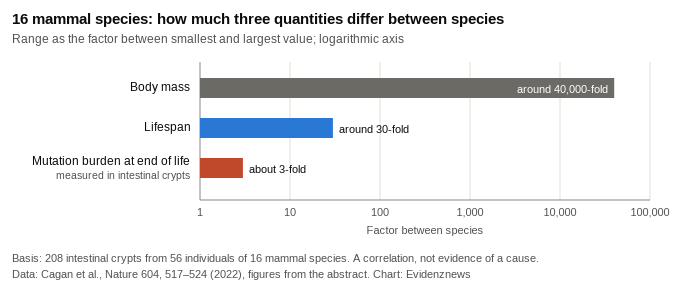
A comparative study by Cagan and colleagues from 2022 fits this restraint. Using genome sequencing, it examined 208 samples from the intestine, so-called intestinal crypts, from 56 individuals of 16 mammal species. The shorter the lifespan of a species, the more mutations were added per year. At the end of life, the mutation burden of the species was therefore close together: it differed only by about a factor of three. The lifespan of the species examined, by contrast, spanned a range of around 30 to 1, their body mass around 40,000 to 1. The authors conclude that the mutation rate could contribute to aging. This is not proof of causation.
Telomeres. In humans and mice, the chromosome ends shorten in the course of normal aging. Mice with shortened telomeres live shorter lives, mice with lengthened ones longer; the premature aging of mice lacking the enzyme telomerase could be reversed when the enzyme was genetically switched back on. In humans, a lack of telomerase is associated with early-onset diseases such as pulmonary fibrosis. These are hereditary diseases, not normal aging.
Blood. In mice, the blood of old animals triggers signs of aging in young animals within a few days. If the blood of old mice is diluted with a saline solution containing albumin, several tissues show signs of rejuvenation. A transfer to humans has not been demonstrated.
Reprogramming. A brief so-called reprogramming of cells with certain factors, abbreviated OSKM in the field, rejuvenates aging markers in mice and improves tissue repair. In mice with premature aging, this extended lifespan. For ordinary mice, such an extension had not been reported at the time of the review.
Calorie restriction. In male mice of the laboratory strain C57BL/6J, a 30 percent reduction in calorie intake extended lifespan by 10 to 30 percent according to a table in the review; the table does not give the baseline value. In rhesus monkeys, two studies have run side by side since the end of the 1980s. One, at the University of Wisconsin, found a statistically significant survival benefit, the other, at the National Institute on Aging, found no significant one. A later comparison of the two datasets cites differences in study design as a possible cause.
In humans, there is a randomized trial of this called CALERIE. 220 adults without obesity were assigned for two years either to a 25 percent reduction in calorie intake or to a free diet. A post hoc analysis found: according to a computational method called DunedinPACE, which estimates a "pace of aging" from DNA methylation in the blood, calorie restriction slowed this pace. For other methylation clocks, including PhenoAge and GrimAge, nothing significant changed, and the effects were small according to the authors. The analysis provides no evidence of a longer life or less disease. The authors stress that a conclusive test needs long follow-up and endpoints such as disease incidence and mortality.
The review in Cell draws the same line. Aging is so far not a recognized target for drug development or for treatments; first trials in humans would therefore have to measure age-related diseases rather than aging itself.
Another figure concerns human genes. Earlier estimates put the heritability of lifespan at about 15 to 30 percent. An analysis of pedigree data concluded in 2018 that the value was inflated because people choose partners with similar traits. After correction, the heritability for birth cohorts of the 19th and early 20th centuries was "well below 10%," that is, clearly below 10 percent. This does not mean that genes play no role. It means that the differences in lifespan in these cohorts are mostly not explained by genes. The authors work mostly at the companies Calico Life Sciences and Ancestry.
What the field disputes
A fundamental criticism of the hallmarks comes from Gems and de Magalhães. It appeared in 2021 and is directed at the 2013 version with nine hallmarks, not at the new one. The two regard the list as useful, as a checklist and as a shared overview. But it does not provide an explanatory model for the causes of aging, unlike the model from cancer research that served as its template.
Their objections: that damage to cells is the common main cause is presupposed and uncertain. The selection of hallmarks is in part arbitrary. And how the later consequences arise from the assumed primary causes is often unproven. Added to this is the model system: the hallmarks of aging rest largely on transfers from animal experiments, especially on short-lived species, which may not be representative of human biology. Gems and de Magalhães propose understanding aging as the result of several different primary causes of late-life diseases.
A paper by Keshavarz and Ehninger from 2025 points in a similar direction. According to its abstract, mortality is often determined by a few life-limiting diseases and not by a uniform decline. A longer life could therefore result from one disease starting later, without aging as a whole being slowed. Many studies on which the hallmarks rest did not cleanly distinguish between a general shift in body values and a real change in the rate of aging.
A third review, by Biga and colleagues, examined in 2025 how well the twelve hallmarks are supported across the animal kingdom. The evidence was largely limited to humans and a few model organisms; for many animal groups there are no data.
What research fundamentally cannot answer here
Four limits lie in the subject itself. The first two and the last are an assessment by this editorial team, not a statement by any single source.
First, evolutionary history cannot be repeated. Evolutionary theories of aging are tested with models and with comparisons between species, not with an experiment that reenacts the course of events.
Second, research answers the why only as an explanation: how selection and biology lead to aging. Whether aging has a purpose is not a question that can be decided with its methods.
Third, the boundary between normal aging and disease is a question of definition. Even the authors of the review in Cell call the distinction between normal and pathological aging debatable.
Fourth, a test of whether an intervention extends human life would take decades. Studies therefore make do with surrogate measures, whose informative value is itself disputed.
What remains open
Whether aging is a unified process or the sum of different late-life diseases has not been settled. Neither has which of the twelve hallmarks are cause and which are consequence in humans. The authors of the review write that their field could stand or fall with the outcome of the first randomized, double-blind phase 3 trials.
Questions about this article
Comments
Sources
- Primary source López-Otín C, Blasco MA, Partridge L, Serrano M, Kroemer G: Hallmarks of aging: An expanding universe. Cell 186 (2), 243–278; Übersichtsarbeit, gelesen als Autorenmanuskript in Teilen (2023). doi:10.1016/j.cell.2022.11.001
- Context Gems D, de Magalhães JP: The hoverfly and the wasp: A critique of the hallmarks of aging as a paradigm. Ageing Research Reviews 70, 101407 (2021). doi:10.1016/j.arr.2021.101407
- Context Keshavarz, Ehninger: Beyond the hallmarks of aging: Rethinking what aging is and how we measure it. Genomic Psychiatry 2 (1), 21–34; nur Zusammenfassung gelesen (2025). doi:10.61373/gp025i.0119
- Context Biga et al.: Hallmarks of aging: A user's guide for comparative biologists. Ageing Research Reviews 104, 102616; nur Zusammenfassung gelesen (2025). doi:10.1016/j.arr.2024.102616
- Context Kowald A, Kirkwood TBL: Can aging be programmed? A critical literature review. Aging Cell 15 (6), 986–998 (2016). doi:10.1111/acel.12510
- Context Mitteldorf J: Can Aging be Programmed?. Biochemistry (Moscow) 83 (12), 1524–1533; nur Zusammenfassung gelesen (2018). doi:10.1134/s0006297918120106
- Context Jones et al.: Diversity of ageing across the tree of life. Nature 505, 169–173; nur Zusammenfassung gelesen (2014). doi:10.1038/nature12789
- Context Ruby JG, Smith M, Buffenstein R: Naked Mole-Rat mortality rates defy gompertzian laws by not increasing with age. eLife 7, e31157; nur Zusammenfassung gelesen (2018). doi:10.7554/eLife.31157
- Context Cagan et al.: Somatic mutation rates scale with lifespan across mammals. Nature 604, 517–524; nur Zusammenfassung gelesen (2022). doi:10.1038/s41586-022-04618-z
- Context Ruby et al.: Estimates of the Heritability of Human Longevity Are Substantially Inflated due to Assortative Mating. Genetics 210 (3), 1109–1124; nur Zusammenfassung gelesen (2018). doi:10.1534/genetics.118.301613
- Context Mattison et al.: Caloric restriction improves health and survival of rhesus monkeys. Nature Communications 8, 14063; nur Zusammenfassung gelesen (2017). doi:10.1038/ncomms14063
- Context Waziry et al.: Effect of long-term caloric restriction on DNA methylation measures of biological aging in healthy adults from the CALERIE trial. Nature Aging 3 (3), 248–257; nur Zusammenfassung gelesen (2023). doi:10.1038/s43587-022-00357-y