Umbilical cords of 130 species: model predicts differences in heat removal
Evidence level 2 of 5 · Single study, peer-reviewed
Key points
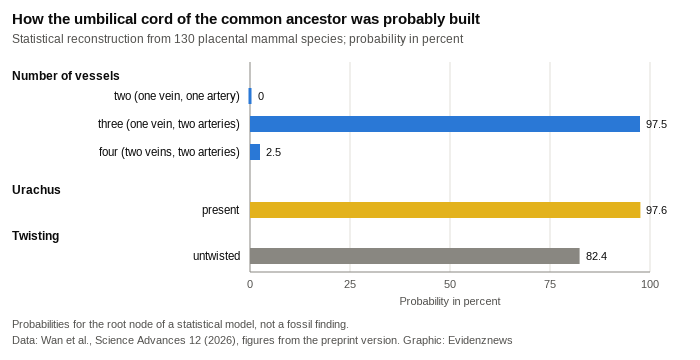
- According to a statistical reconstruction across 130 placental mammal species, the umbilical cord of the common ancestor had three vessels with a probability of 97.5 percent, a urachus with 97.6 percent, and was untwisted with 82.4 percent.
- In a physical computational model, long, strongly twisted or poorly perfused umbilical cords remove less of the fetus's heat, while oxygen is not lost to any notable degree in any design; neither was measured.
- The study shows the triple helix of the human umbilical cord, in which no vessel forms the central axis, in a single specimen; that it supports cooling of the fetus is a hypothesis of the authors.
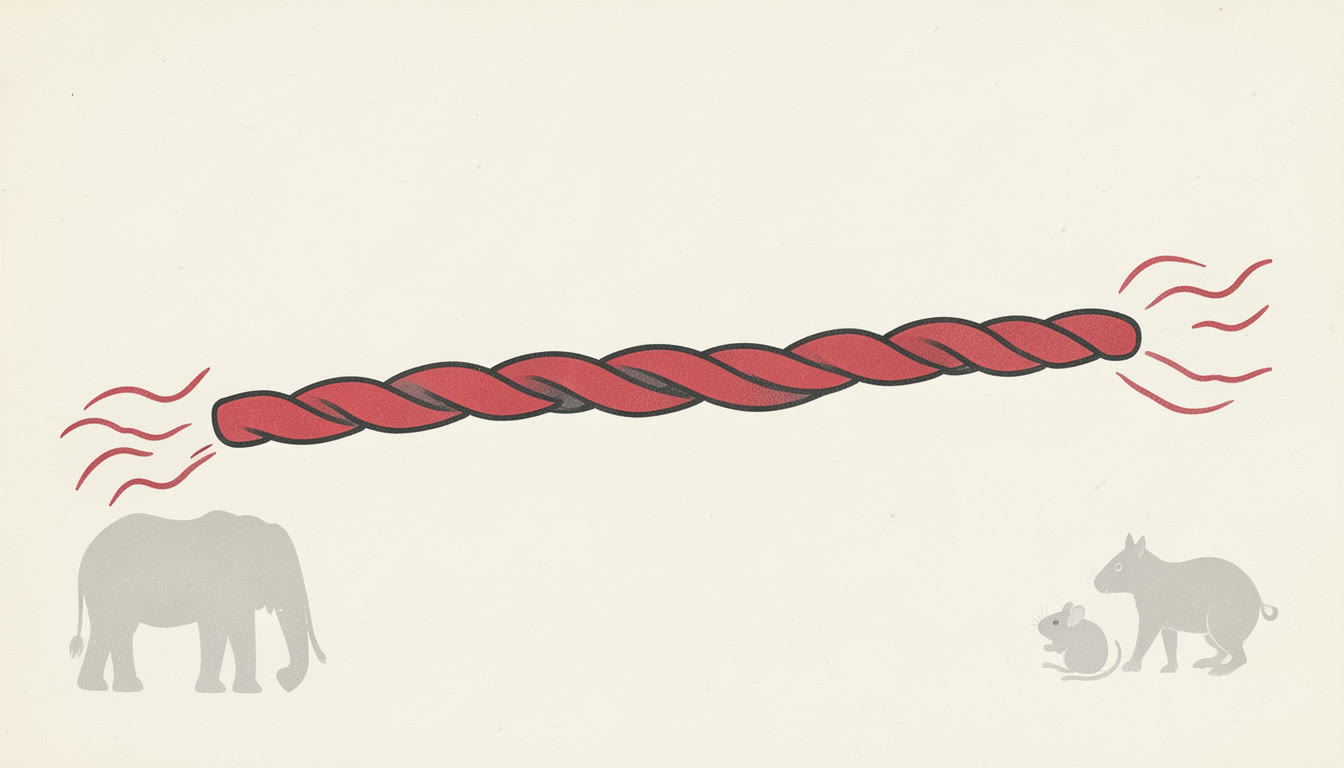
In the umbilical cord, vessels with opposite flow directions lie close together. Heat that the fetus needs to get rid of could therefore flow back into its own blood along the way. According to a computational model, how strong this backflow is depends on the structure of the umbilical cord, and that differs considerably between mammals. This is reported by a team from the Universities of Manchester and Southampton, which compared the umbilical cords of 130 species. In the calculation, long, strongly twisted or poorly perfused umbilical cords remove less heat; for oxygen, by contrast, nothing notable is lost in any design.
The work was published on November 25, 2026 in the journal Science Advances and peer-reviewed; the first author is Tianran Wan. Institutions in Malaysia and Singapore were also involved. What matters for interpreting it is the method: the statements on heat and oxygen are predictions of a computational model. Neither quantity was measured. Only the structure and geometry of the umbilical cord were observed: through literature data on animals including birth weight, through ultrasound images of 29 pregnancies and in a single specimen. The authors themselves write that their heat predictions are "qualitative trends rather than precise estimates", that is, tendencies and not exact estimates.
For this text, the freely accessible preprint of the study was read; the publisher's page could not be accessed.
Why a fetus has to get rid of heat
The metabolism of a fetus produces heat, and it has to flow off to the mother. A 1997 review that relies mainly on experiments in sheep gives the orders of magnitude: the temperature of the fetus is about half a degree above that of the mother, within a range of 0.3 to 1 degrees Celsius. Probably around 85 percent of fetal heat reaches the mother via the placenta, carried by the blood of the umbilical arteries. The new study starts from the same assumption: the placenta is the main route of cooling. According to its figures, the heat production of fetuses ranges from about 1 watt in rodents to a kilowatt in large mammals.
The route to the placenta leads through the umbilical cord. In it, a vein brings oxygen- and nutrient-rich blood to the fetus, and arteries carry blood back to the placenta. Because the vessels with opposite flow directions lie close beside each other, heat could pass directly from the arteries into the vein and return to the fetus instead of reaching the mother. The study calls this a countercurrent short circuit. Its question is how strong this short circuit is depending on the structure.
130 species, three features
For the comparison, the team used an online collection on the placenta of different animal species and selected the 130 placental mammal species for which complete data were available. Three features differ between the species.
The first is the number of vessels. Mammals have two, three or four: one vein and one artery, one vein and two arteries, or two of each. The second is the urachus, a small tube that connects the fetus to the so-called allantoic sac. In most species it is present, in rodents it is reduced or absent, and in humans it is closed by the middle of pregnancy. The third is twisting: some umbilical cords are coiled, others are not.
From these data and a phylogenetic tree of mammals, the team statistically reconstructed what the umbilical cord of the common ancestor is likely to have looked like. According to this, it had three vessels with a probability of 97.5 percent, a urachus with 97.6 percent, and was untwisted with 82.4 percent. These are probabilities from a statistical model, not a fossil finding.
The human design, three vessels, twisted and without a urachus, is rare in the dataset: it occurs in about 3 percent of the 130 species, throughout in great apes and Old World monkeys. The figure applies to this dataset, not to all mammals.
Several features arose independently multiple times according to the reconstruction. Four vessels evolved at least five times, among others in even-toed ungulates including dolphins, in seals and in feliform carnivores. Two vessels arose only once, in mouse-related rodents. The urachus was lost at least three times, and twisting arose at least four times: in hippopotamuses, camels and their relatives, horses and great apes. The authors call this count cautious and consider a denser sample necessary.
The team found associations between the features and birth weight. Species with four vessels give birth to heavier young than species with three, and species with a urachus to heavier young than species without. Between twisted and untwisted umbilical cords, no difference in birth weight showed up; at the same birth weight, however, twisted ones are longer. These are correlations across species. The study does not show that heat removal shaped the structure in evolution.
What the model predicts
In the computational model, the umbilical cord is a straight cylinder with arteries and veins, between which heat and oxygen can travel through the tissue. The result is a transfer metric that is 1 when nothing is lost along the way.
For oxygen, this metric approaches the value 1 in all designs. The supply of the fetus therefore remains nearly maximal in the calculation, however the umbilical cord is built.
For heat, the picture is different. For the human umbilical cord, the calculation yields in the typical case a metric of at least about 0.5. If the umbilical cord is unusually long or blood flow is reduced, according to the model only up to about half of the additional fetal heat is removed via the placenta. Particularly strong twisting increases the exchange between the vessels and lowers the value further. At the twisting typical for humans, this effect is only moderate according to the authors.
Across species, the model predicts that heat removal improves with birth weight. In the largest species, whales and elephants, the metric approaches the value 1. Smaller species and those with several young per litter lie clearly below; the authors name dogs, rabbits and mice as examples. The reason in the calculation: blood flow in the umbilical cord grows roughly in step with weight, heat production more slowly.
This prediction rests on a narrow basis. The team found measurements of blood flow in the umbilical cord in the literature for only four species: human, sheep, pony and guinea pig. From them it derived a rule of thumb and extrapolated it to all other species. For whales or elephants, there is no measurement.
The triple helix and the ultrasound images
For humans, the team additionally examined the position of the vessels in cross-section. In the model, there are arrangements in which particularly little heat passes between the vessels. Ultrasound images of 29 pregnancies from Manchester, including 9 controls, 10 with fetal growth restriction and 10 with preeclampsia, showed: most umbilical cords lie in regions with low calculated exchange. There was no significant difference between the groups. The authors write that with this small sample, no clinical conclusions can be drawn.
The work shows the triple helix of the human umbilical cord in a single specimen from an uncomplicated birth at term, recorded with a micro-computed tomography scanner. In this specimen, the three vessels wind around one another without any one forming the central axis. According to the authors, this calls into question the idea that the arteries wrap around a straight vein. That this arrangement limits heat backflow and could thus support the temperature regulation of the fetus, they formulate as a possibility. This is supported by the model and the geometry, not by a heat measurement.
What the study does not show
The authors name the limitations themselves. The model captures neither the fine structure of the placenta in the individual species nor the ability of the vessels to actively regulate their width. Data on blood flow are sparse across mammals. And the predictions have not yet been tested experimentally.
The work does not establish consequences for medicine. That long, strongly twisted or poorly perfused umbilical cords could impair cooling, for example during fever of the mother or in heat, is a hypothesis from the model. The authors themselves point out that reports on the effect of heat on blood flow to the uterus in animals and on birth weight in humans are contradictory. A systematic review in the journal BMJ from 2020, which evaluated 70 mostly observational studies, found an association between high temperatures and preterm births, with, according to its authors, relatively small effects, high heterogeneity of the studies and possible confounders. This review says nothing about the umbilical cord.
The follow-up report by the portal Phys.org, which is based on the press release, goes further than the study in several places. It calls the work the largest of its kind, which is not substantiated in the version read. And it holds out the prospect of applications for healthy and complicated pregnancies, where the study formulates hypotheses that still need to be tested.
The research found no independent assessment of the work by other experts.
Questions about this article
Comments
Sources
- Primary source Wan T, Laundon D, Saw SN, Cheng N, Lee HK, Johnstone ED, Jensen OE, Lewis RM, Chernyavsky IL: Umbilical cord structure shapes feto-maternal heat transfer across mammals. Science Advances 12 (48); gelesen als Preprint-Fassung bei bioRxiv, Version 2 (2026). doi:10.1126/sciadv.aeg5645
- Context Schröder HJ, Power GG: Engine and radiator: fetal and placental interactions for heat dissipation. Experimental Physiology 82 (2), 403–414; Übersichtsarbeit, überwiegend zum Schaf; nur Zusammenfassung gelesen (1997). doi:10.1113/expphysiol.1997.sp004035
- Context Chersich MF et al.: Associations between high temperatures in pregnancy and risk of preterm birth, low birth weight, and stillbirths: systematic review and meta-analysis. BMJ 371, m3811 (2020). https://pmc.ncbi.nlm.nih.gov/articles/PMC7610201