Do animals have consciousness?
Animal consciousness: evidence extends to octopuses and crabs, no direct proof
Evidence level 3 of 5 · Several independent studies pointing the same way
Key points
- A report published in 2021 assesses the sentience of cephalopods and decapod crustaceans using eight criteria and more than 300 studies. For octopuses, the authors have high or very high confidence for seven of the eight criteria; for true crabs, for five. These are ratings based on a rule of thumb by the authors, not measured values.
- The New York Declaration on Animal Consciousness of April 19, 2024, with 617 signatures as of November 23, 2026, sees conscious experience in mammals and birds as strongly supported scientifically, and as at least a realistic possibility in all vertebrates and many invertebrates, including insects. It is an expert opinion, not a measurement.
- The neuroscientist Hakwan Lau counters that the cited evidence concerns flexible behavior, which in humans also occurs without conscious experience. An established theory of consciousness is lacking, and according to the report's authors, feelings cannot in principle be observed directly.
Whether an animal experiences anything cannot be observed directly by anyone. Research therefore collects indications from behavior and the nervous system, and these indications extend beyond mammals and birds: a report from 2021 finds very strong evidence of sentience in octopuses and strong evidence in true crabs. Whether such evidence shows felt experience or flexible behavior without experience is disputed in the field.
The report is the main source of this article. It was written by Jonathan Birch of the London School of Economics and four other researchers; it was published in November 2021 through LSE Consulting. It did not appear in any journal; according to the acknowledgments, two anonymous external reviewers commented on it. It contains no measurements of its own; it evaluates published studies on animals. It covers two groups of invertebrates: cephalopods, which include octopuses, cuttlefish and nautilus, and decapod crustaceans, such as crabs, lobsters and shrimp. And it asks about sentience, not about consciousness in the philosophical sense. For this article, the report was read in parts; the section on decapod crustaceans was not among them. What is stated here about mammals, birds, fish and insects comes from other sources, each of which is named.
Several of these sources are connected. Birch is also a co-author of an article in the journal "Science" from 2025, a review article from 2020 and an encyclopedia entry on the subject. Independent of him are, among others, the critics who are quoted further below, and a review of birds from Ruhr University Bochum. The agreement between the sources therefore partly traces back to the same circle of authors.
Sensing is more than a reflex
The report defines sentience as the ability to have feelings, positive and negative, such as pain, hunger or joy. It separates this from nociception: a nervous system detects a harmful stimulus, and that can happen without experience. The authors give an everyday example. The hand pulls back from the hot stove before the pain is felt. If an animal shows such a reflex, it would not be convincing evidence of pain in their view.
According to the authors, sentience is closely linked to consciousness, because feelings are conscious experiences in the most elementary sense.
In humans, researchers rely on what the people affected report. In animals, comparison remains: how similar are brain structure and behavior? According to the report, for mammals there is almost complete agreement that they are sentient, and for birds broad agreement. For fish, some express skepticism, which others strongly dispute. According to the report, invertebrates are separated from humans by more than 500 million years. But one must not conclude from a different brain structure that sentience is absent.
Markers instead of theory
How the field proceeds is described by Andrews, Birch and Sebo in their "Science" article, which was available for this article in a manuscript version from July 2024. According to it, there is no established theory of consciousness: the version speaks of more than 200 theories, and most experts consider each of them uncertain.
Research therefore proceeds in three steps. It takes up a single dimension of experience, for example pain. It names observable signs that accompany it in humans, so-called markers. Then it looks for corresponding signs in other species. The authors regard a single marker as at most very weak evidence, and many together as strong evidence. In animals whose brains are built differently, such as octopuses and bees, behavior becomes more important as evidence.
As examples, the article mentions, among others, lame broiler chickens that selectively take a painkiller, and hermit crabs that are less likely to leave high-quality shells after an electric shock. According to a 2022 study, bees weigh heat against a sugar reward. The underlying studies were not read for this article. The authors concede that research relies too heavily on pain markers; other aspects of experience, such as joy, have hardly been studied.
Eight criteria for octopuses and crustaceans
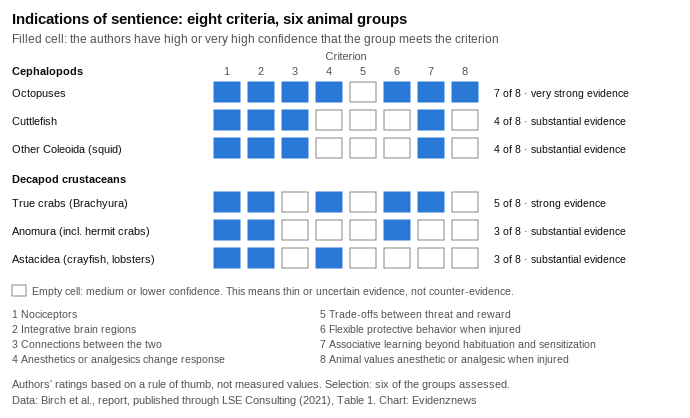
The 2021 report examines cephalopods and decapod crustaceans using a fixed catalog and, by its own account, draws on more than 300 studies. The authors set eight criteria in advance. The first four ask whether the animal has nociceptors, whether it has integrative brain regions, whether the two are connected, and whether local anesthetics, analgesics or the body's own messenger substances change its responses. The remaining four ask whether the animal trades off between threat and reward, whether it protects itself flexibly when injured, whether it learns associatively, beyond habituation and sensitization, and whether its behavior shows that it values an anesthetic or analgesic when injured.
For each criterion and each animal group, the authors stated how confident they are that it is met: from very high confidence, where the amount of evidence leaves no room for reasonable doubt, through high, medium and low, to very low or none. From this they derived a rough rating. They call seven or eight criteria with high or very high confidence very strong evidence, five or six strong, three or four substantial, and two some evidence. With zero or one criterion, sentience is considered unknown or unlikely.
The authors expressly describe this grid as a rule of thumb. They refrained from numerical weights because such weights would be arbitrary. No single criterion proves sentience; the first, nociceptors, could also be met by an animal that feels nothing.
Octopuses reach high or very high confidence for seven of the eight criteria; only for trading off between threat and reward does it remain medium. The report speaks of very strong evidence. For cuttlefish and for the squid, which the report lists among the other Coleoida, it is four criteria each, which yields substantial evidence. Nautiloids have hardly been studied.
Among the decapod crustaceans, true crabs reach high or very high confidence for five criteria; the report speaks of strong evidence. For the Anomura, which include hermit crabs, and for the Astacidea, the group of crayfish and lobsters, it is three criteria each and thus substantial evidence. For penaeid shrimp the evidence is very low according to the report. For another shrimp group, the Caridea, the report is not quite consistent with itself: the text calls the evidence substantial, while in the table they reach high or very high confidence for only two criteria, which according to the grid would be some evidence.
The phrase "very strong evidence" is a judgment by the authors about the state of the evidence, not a measured value. Conversely: in the report, low confidence expressly does not mean that an animal probably feels nothing, but that the evidence is thin or weak in both directions. In no case did the authors have high or very high confidence that a group fails a criterion. How much evidence there is also depends on how much research has been done on a group. Only very few of the roughly 750 species of cephalopods and the roughly 15,000 species of decapod crustaceans have been studied, and the evidence concerns adult animals.
The two groups were examined because they are regarded as plausible candidates. For jellyfish, the authors suspect, they might have concluded with very high confidence that the criteria are not met.
What is measured in such experiments
Two experiments reproduced in the report show what the ratings are based on. The original studies were not read for this article.
The first is a 2021 study by Crook with octopuses of the species Octopus bocki, an experiment with three chambers. First it was determined which chamber the animals preferred. Then eight animals were injected under the skin with dilute acetic acid and seven control animals with a saline solution, and all were afterwards placed in that chamber. The animals in the acid group avoided the chamber afterwards. After a local anesthetic, their preference shifted to the chamber in which the anesthetic was active. The control animals did not change their preference. Recordings from the nerve cords that connect the arms to the brain showed sustained activity, which the anesthetic suppressed. The report rates the study as high quality but notes that it is a single study, and therefore assigns high rather than very high confidence; it gives no statistical values.
In the second experiment, published in 2004, cuttlefish learned to avoid their favorite prey after it had been made bitter with quinine. In the test 24 or 72 hours later, 26 of 32 animals treated in this way avoided the originally preferred prey, while 26 of 34 control animals attacked it. The report calls the study high quality and its sample good. But it itself qualifies that simple forms of such learning can occur unconsciously in humans, and therefore treats learning findings as only one part of the overall picture.
Not every finding counts. In squid, an arm injury led to long-lasting hypersensitivity, but not to the animals tending or protecting the wound. According to the report, such sensitization also occurs in animals without a central nervous system; the authors do not count it as evidence.
In crows, nerve cells follow the reported perception
For birds there are findings from the brain. Gianmarco Maldarelli and Onur Güntürkün of Ruhr University Bochum summarize them in a peer-reviewed review from 2025. In experiments published in 2020 and 2024, carrion crows were to indicate whether they had seen a faint stimulus. When the stimulus was at the perceptual threshold, they reported it in about half of the cases. The activity of individual nerve cells in the nidopallium caudolaterale, a brain region considered the functional counterpart of the prefrontal cortex, followed the crow's report and not the actual stimulus. The review calls this the first evidence of a brain area in birds that is linked to subjective experience.
What was measured was what the crow indicates about its perception, not a feeling such as pain. And the Bochum authors draw limits: the data could be explained by each of the three theories of consciousness they discuss, and did not allow a clear decision in favor of any one of them. In the mirror test with a mark, which concerns self-recognition, magpies and Indian house crows showed behavior directed at the mark, while many other corvids, including carrion crows, failed. The authors see this as limits of the test itself. Overall, the findings so far did not allow a strong conclusion; they argued for understanding consciousness as a graded, multidimensional process.
In 2020, Birch, Alexandra Schnell and Nicola Clayton proposed describing consciousness in animals not on a single scale of more or less, but in five dimensions, including the richness of perception and self-awareness. Corvids, for example, remember what they hid where and when. For cephalopods there is no convincing evidence that they recognize themselves. The profiles that the article shows for elephants, corvids and cephalopods are, the three say, conjectures; numerical measures are not yet possible. They see an emerging consensus that the evidence supports consciousness in mammals, birds and at least some cephalopods. At the same time they call the field young and marked by fundamental disagreement over criteria and methods.
A declaration with 617 signatures
The New York Declaration on Animal Consciousness was published on April 19, 2024. It contains three statements. First, there is strong scientific support for attributing conscious experience to mammals and birds. Second, the empirical evidence shows at least a realistic possibility of conscious experience in all vertebrates, including reptiles, amphibians and fish, and in many invertebrates, at least cephalopods, decapod crustaceans and insects. Third, it is irresponsible to ignore this possibility in decisions that affect such an animal.
On November 23, 2026, the declaration's page counted 617 signatories, who according to the page act in a personal capacity. The declaration is an expert opinion with a list of signatories. It is not a measurement and not peer-reviewed in a journal; its wording was available for this article as an excerpt. Its second statement is carefully chosen: it speaks of a realistic possibility, not of probability, and it does not call insects conscious. Andrews, Birch and Sebo write that the statement could be replaced in the future by a more certain one, in one direction or the other.
What the field disputes
Clear criticism of the declaration comes from Hakwan Lau, a neuroscientist at Sungkyunkwan University, in an opinion piece from November 2024. He considers even the first statement, the strong support for mammals and birds, overstated. His argument: the declaration's background document is about phenomenal consciousness, the experienced what-it-is-like. But the cited evidence concerns flexible behavior such as learning, memory and problem solving, and the two can come apart. As an example he cites people with blindsight: they report seeing nothing, yet guess stimuli, avoid obstacles and learn threats. There are no agreed markers in the brain from which consciousness could be read off.
Lau does not claim that animals have no experience. He writes that he believes many probably have it; the evidence, however, is not clear-cut. According to his account, Birch concedes in personal correspondence that phenomenal consciousness and flexible behavior are conceptually distinct, but considers it possible that the two are empirically identical or closely related. Lau also points to skeptics such as Joseph LeDoux, including with regard to rodents, and asks what broad agreement the declaration means. According to the entry on the subject in the Stanford Encyclopedia of Philosophy, LeDoux regards verbal reports as the gold standard and warns against drawing conclusions from nonverbal behavior. LeDoux's own work was not available for this article.
This encyclopedia entry, which Birch co-authored, states that there is considerable disagreement even about the first markers of conscious experience once language is set aside. It is disputed whether pain markers show experience or reflexes, whether consciousness requires a neocortex, and how far complex mental abilities allow conclusions about consciousness.
Two older, pointed counterpositions concern individual animal groups. Brian Key of the University of Queensland argued in 2016 that fish lack the cellular architecture, the circuits and the connections that are necessary for the sensation of pain in the human brain; they therefore could not feel pain. The journal published comments from experts on this. In his reply, Key conceded that their weight was predominantly against his argument, and countered that science does not decide by majority. Among the objections was that of Braithwaite and Droege, that it is not enough to take human brain structures alone as the prerequisite. Of these texts, only the abstracts were available; how the debate about fish has developed since is not worked up here.
Shelley Adamo responded in the same year in a short commentary on an essay by Barron and Klein on insects and the origins of consciousness. The two, she said, had defined consciousness very narrowly as a form of information processing; under this definition, some autonomous robots would also be conscious. Insect brains are small, and insects are under selection pressure to save brain costs. Without the word consciousness, her conclusion went, the findings of the two are uncontroversial. The bee study cited in the "Science" article is more recent than this commentary.
A review by Bayne and colleagues from 2024, of which only the abstract was available, asks how consciousness can be demonstrated at all, in humans and beyond. Their assessment: with most of the proposed tests one gets only limited distance, and precisely where a test would be especially needed, it is in many cases still missing altogether.
Criticism of a different kind comes from Liv Baker, Barbara J. King and William S. Lynn in a short ethics report, which was available here only in excerpts. They complain that the declaration condemns neither captivity nor invasive experiments in the search for markers, and call for research in the natural habitat with noninvasive methods. They do not put forward a counter-thesis about which animals have consciousness.
What research cannot answer here
The report's authors themselves name the first limit. Feelings cannot be observed directly, and for any pattern of behavior and nervous system it remains conceivable that it arises without sentience. The question can therefore be settled neither with certainty nor beyond reasonable doubt. Research can shift the weight of the evidence, nothing more.
The second limit is the dispute between Lau and Birch: whether flexible behavior and felt experience belong together is unresolved, as is how that could be tested.
The third limit is not one of measurement. The report ends with a recommendation: all cephalopods and all decapod crustaceans should be considered sentient in British animal welfare law. The authors justify this partly with the principle of acting without complete certainty when there are serious risks to animal welfare. Whether and how the recommendation was implemented was not checked in the research for this article. How much evidence suffices to protect an animal is an ethical decision and not an empirical question.
Questions about this article
Comments
Sources
- Primary source Birch J, Burn C, Schnell A, Browning H, Crump A: Review of the Evidence of Sentience in Cephalopod Molluscs and Decapod Crustaceans. Bericht, veröffentlicht über LSE Consulting; nicht in einer Fachzeitschrift begutachtet, laut Danksagung von zwei anonymen externen Gutachtern kommentiert (2021). https://researchonline.lse.ac.uk/id/eprint/115994
- Context The New York Declaration on Animal Consciousness. Positionserklärung von Forschenden mit Unterschriftenliste, nicht in einer Fachzeitschrift begutachtet; 19. April 2024 (2024). https://sites.google.com/nyu.edu/nydeclaration/declaration
- Context Andrews, Birch, Sebo: Evaluating animal consciousness. Science 387(6736), 822–824; Perspektiv-Beitrag, gelesen als Manuskriptfassung (2025). doi:10.1126/science.adp4990
- Context Hakwan Lau: Premature declarations on animal consciousness hinder progress. The Transmitter, Meinungsbeitrag, nicht begutachtet; 18. November 2024 (2024). https://www.thetransmitter.org/consciousness/premature-declarations-o…
- Context Maldarelli G, Güntürkün O: Conscious birds. Philosophical Transactions of the Royal Society B 380(1939), 20240308 (2025). doi:10.1098/rstb.2024.0308
- Context Birch J, Schnell A, Clayton N: Dimensions of Animal Consciousness. Trends in Cognitive Sciences 24(10), 789–801 (2020). doi:10.1016/j.tics.2020.07.007
- Context Bayne, Seth, Massimini, et al.: Tests for consciousness in humans and beyond. Trends in Cognitive Sciences 28(5), 454–466; nur Abstract gelesen (2024). doi:10.1016/j.tics.2024.01.010
- Context Brian Key: Why fish do not feel pain. Animal Sentience 1(3), Positionsartikel mit offener Kommentierung; dazu die Antwort des Autors (DOI 10.51291/2377-7478.1070) und der Kommentar von Braithwaite und Droege (DOI 10.51291/2377-7478.1041); jeweils nur Abstract gelesen (2016). doi:10.51291/2377-7478.1011
- Context Shelley Anne Adamo: Consciousness explained or consciousness redefined?. PNAS 113(27), E3812; Kommentar (2016). doi:10.1073/pnas.1606942113
- Context Baker L, King BJ, Lynn WS: Rethinking Animal Consciousness Research to Prioritize Well-Being. Cambridge Quarterly of Healthcare Ethics 34(2), 280–284; Kurzbericht, nur in Auszügen gelesen (2025). https://www.cambridge.org/core/product/AD99F37CA07DDBF7010DC4751584C9…
- Context Birch J, Trestman M: Animal Consciousness. Stanford Encyclopedia of Philosophy, Nachschlagewerk; jüngste inhaltliche Überarbeitung 13. Januar 2026, nur in Auszügen gelesen (2026). https://plato.stanford.edu/entries/consciousness-animal/