Culex mosquitoes: roughly 280 to 1,400 meters on average, depending on species and study design
Evidence level 4 of 5 · Systematic review or meta-analysis
Key points
- A meta-analysis of 206 field experiments from 57 studies and 15 countries estimates the mean distance traveled for four Culex species at 283 to 1,404 meters; for Culex tarsalis, the species with the largest value, the 95 percent confidence interval ranges from 865 to 2,281 meters.
- No other factor was as consistently associated with the estimated distance as the radius of the study area; experiments with high recapture efficiency yielded shorter distances.
- The figures describe how far away marked mosquitoes were found again in the respective experiments, not how far the animals can fly; according to the paper, individual recaptures were more than 20 kilometers from the release site.
How far mosquitoes of the genus Culex move away from their starting point can only be put into a single number with reservations. A meta-analysis of 57 field studies arrives at mean distances between 283 and 1,404 meters for four species. At the same time, it shows that these values depend on the design of the studies: above all on how large the area was in which the researchers searched for the mosquitoes.
The paper is by Thomas C. Moore and two other researchers at the University of Arizona in Tucson, as well as Luigi Sedda of Lancaster University in the United Kingdom. It was published in the "Journal of Medical Entomology." Field experiments on mosquitoes were evaluated; the paper contains no data from humans.
The reason the question concerns experts has to do with pathogens: the viruses transmitted by Culex mosquitoes include West Nile virus and Japanese encephalitis virus. Many field studies have measured how far the animals get, with very different results, depending on where, how and with which analysis the work was done.
For this text, the abstract was available verbatim, whereas the full text was available only in summarized form.
Mark, release, recapture
Field studies that report flight distances in numbers were included. The basic principle is called mark-release-recapture: mosquitoes are marked, released at one location and later caught again. According to the paper, fluorescent powder and fluorescent paint, spray dye, and radioactive and non-radioactive isotopes were used as markers. The distance between the release site and the trapping site shows how far a mosquito has gotten. As a second method, the paper names the analysis of blood meals.
The measure of the meta-analysis is the mean distance traveled, in English "mean distance traveled": the mean of the distances between release site and recapture site. It describes how far away mosquitoes were found again in the respective experiment. It is not a biological maximum performance of the animals.
The team searched six literature databases for English-language papers through the end of 2025. Of 81,101 hits, after removal of 20,844 duplicates, 60,257 titles and abstracts remained to be screened; 560 papers were checked in full text. What remained were 57 studies with 206 experiments from 15 countries. According to the paper, they were published between 1934 and 2025 and concern 14 Culex species on six continents. The estimates for individual species were based on 119 experiments.
In the main analysis, the experiments do not count equally: the team weighted them by the number of recaptured mosquitoes. According to the paper, the alternative, weighting by inverse variance, produced wider confidence intervals and could not be calculated for several species.
Four species, four values
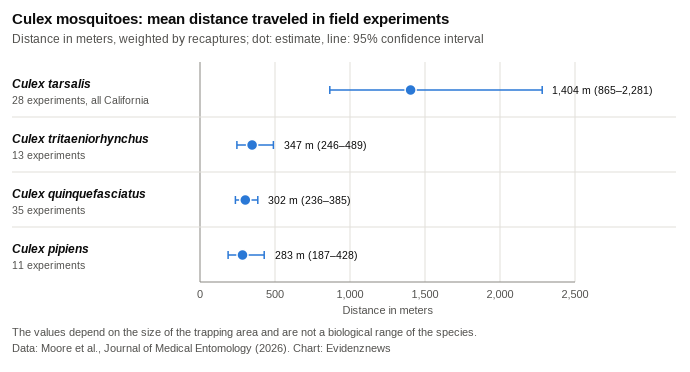
The mean distance was largest for Culex tarsalis: 1,404 meters, with a 95 percent confidence interval of 865 to 2,281 meters. Next come Culex tritaeniorhynchus at 347 meters, Culex quinquefasciatus at 302 meters and Culex pipiens at 283 meters. These four values appear in the abstract.
The confidence intervals of the three smaller values are given only in the full text: 246 to 489 meters for Culex tritaeniorhynchus (13 experiments), 236 to 385 meters for Culex quinquefasciatus (35 experiments) and 187 to 428 meters for Culex pipiens (11 experiments). The 28 experiments on Culex tarsalis all come from California.
How strongly the method of calculation shifts the result is shown by Culex quinquefasciatus. According to the full text, without weighting the result is 188 meters (84 to 424), weighted by recaptures 302 meters (236 to 385), weighted by inverse variance 413 meters (158 to 1,076). For Culex tarsalis, the values are 1,626 meters without weighting (1,032 to 2,561) and 1,238 meters weighted by inverse variance (467 to 3,278).
The longest individual distances are to be distinguished from these means. According to the paper, the farthest documented one is 25,347 meters: a Culex tarsalis, recaptured two nights after release in California's Sacramento Valley. The authors consider it possible that the wind carried it. For Culex pipiens, the paper gives a maximum of 22,531 meters after four days, for Culex annulirostris 12,000 and for Culex quinquefasciatus 11,000 meters. The smallest maximum, 550 meters, belongs to Culex poicilipes.
The trapping area helps determine the result
Two properties of the studies shaped the estimate. The first is the radius of the study area: no other factor was as consistently associated with the mean distance. The second is recapture efficiency. Experiments in which it was high yielded shorter distances.
Another finding from the full text fits the first association. In 27.0 percent of the 174 experiments for which the trapping radius was reported, mosquitoes were still caught at the outermost possible distance. The actual dispersal there could therefore have been greater than the experiment was able to capture.
This also affects the comparison of species. According to the paper, the experiments on Culex tarsalis had significantly larger study radii than those on Culex quinquefasciatus. When the researchers included study radius as a covariate in the comparison of species, the differences between them were no longer statistically significant. It does not follow from this that all species fly equally far. The available data simply cannot separate real species differences from differences in study design.
Environment and method had different effects depending on the species. The abstract names the origin of the mosquitoes, the time of release, temperature and built-up development. For Culex pipiens, for example, a rural setting was associated with longer distances than an urban one, according to the full text.
What other studies show
How much the method determines the result is shown by an older single study from Chicago. In a study published in 2014, a team led by Hamer enriched nine catch basins in the southwest of the city with the stable nitrogen isotope 15N, so that Culex pipiens developing there carried the marker. Among 2,442 mosquito samples tested, twelve were enriched. The mean dispersal distance was 1.15 kilometers, the greatest flight distance 2.48 kilometers; according to a distribution model, 90 percent of the females stayed within 3 kilometers of their breeding site.
That is clearly more than the meta-analysis's 283 meters for the same species. It is not a formal contradiction, because the two papers use different measures and methods. Possible reasons for the gap: the Chicago study measures dispersal from the breeding site, the meta-analysis the distance after a release, and the trap networks and marking methods differ.
A data collection from 2014 fits the second influencing factor, recapture efficiency. A team led by Guerra compiled 774 experiments with marked females of 58 mosquito species. In the genus Aedes, 8 percent of the animals were recaptured, in Anopheles 4 percent and in Culex 1 percent. For Culex, recapture numbers are thus low.
What remains open
The authors name as limitations the heterogeneity of the studies, low recapture numbers, missing genetic information and the limited coverage by the traps. The estimate for Culex pipiens is based on 11 experiments. A formal statistic on heterogeneity and a test for publication bias, that is, for whether certain results were more likely to be published, were not found in the text evaluated.
The authors see the usefulness of their numbers in planning: those who monitor or control mosquitoes could delimit areas more precisely with values for the respective species. Whether measures become more effective as a result was not tested by the paper. Independent comments from other experts were not found by the research on the day of publication.
Questions about this article
Comments
Sources
- Primary source Moore TC, Sedda L, Ernst KC, Brown HE: Estimating Culex species (Diptera: Culicidae) flight range: meta-analysis. Journal of Medical Entomology 63(6) (2026). doi:10.1093/jme/tjag182
- Context Hamer et al.: Dispersal of adult Culex mosquitoes in an urban West Nile virus hotspot: a mark-capture study incorporating stable isotope enrichment of natural larval habitats. PLoS Neglected Tropical Diseases 8(3), e2768 (2014). doi:10.1371/journal.pntd.0002768
- Context Guerra et al.: A global assembly of adult female mosquito mark-release-recapture data to inform the control of mosquito-borne pathogens. Parasites & Vectors 7, 276 (2014). doi:10.1186/1756-3305-7-276