Closest relatives of poxviruses are widespread in the gut of humans and animals
Evidence level 2 of 5 · Single study, peer-reviewed

Key points
- In public sequence data from gut and environmental samples, a team found a previously undescribed group of large DNA viruses, which it calls Egoviruses and classifies as the closest relatives of the poxviruses.
- The marker genes of the Egoviruses occurred almost exclusively in the gut microbiomes of vertebrates; they were detectable in more than 2 percent of the human gut microbiomes analyzed, and many times more often in buffaloes.
- The work is a purely computational analysis of existing sequence data; which cells the viruses infect and whether they play a role for health has not been shown.
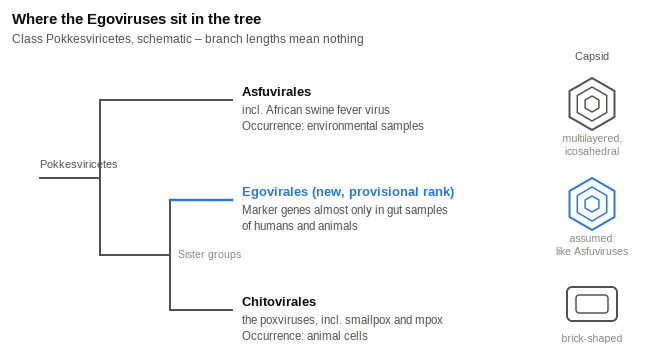
The closest known relatives of the poxviruses are widespread in the digestive tract of humans and animals. An international team led by Morgan Gaïa and Tom O. Delmont of the Genoscope of the research centers CEA and CNRS in Évry describes in "Nature" a previously undescribed group of large DNA viruses, which it calls Egoviruses. Also involved in the work were Shinichi Sunagawa and Hans-Joachim Ruscheweyh of ETH Zürich, A. Murat Eren of the Helmholtz Institute for Functional Marine Biodiversity in Oldenburg, Eugene V. Koonin of the US National Institutes of Health and Mart Krupovic of the Institut Pasteur.
No one has seen these viruses yet. The work is a purely computational analysis of sequence data that other research groups published long ago: metagenomics, that is, decoding all the genetic material in a sample without growing the organisms in it individually. There is no culture, no microscope image and no infection experiment.
A marker gene in 85,123 datasets
The team searched 85,123 publicly available metagenomic assemblies – assembled genetic fragments from environmental as well as gut samples – for the marker gene of the largest subunit of the viral RNA polymerase. This yielded almost two million hits, from which the new group could be filtered out. The researchers assembled 12 complete, non-redundant Egovirus genomes, linear DNA strands 160,000 to 360,000 base pairs in length, plus more than 200 further genomes assembled from metagenomes.
According to the phylogenetic tree analyses, the Egoviruses form their own order within the class Pokkesviricetes, which also includes the poxviruses and the causative agents of African swine fever. They are thus the closest relatives of the animal-infecting poxviruses. The taxonomic rank is explicitly marked as provisional in the paper.
Almost only in the gut
Marker genes of the Egoviruses were found in 864 of the assemblies searched, overwhelmingly from gut microbiomes of vertebrates; in environmental samples they hardly occurred. This is unusual, because large viruses of this group of relatives had until now been considered typical of environmental samples and had only rarely been found in the digestive tract of animals.
For an abundance estimate, the team analyzed 11,788 gut metagenomes from 26 bioprojects. Egoviruses were detectable in more than 2 percent of the human gut microbiomes analyzed. In animals the proportions were higher, highest in buffaloes: in the subset that was sequenced particularly deeply, 2.7 percent in humans compared with 29 percent in buffaloes. Which reference value applies to the other percentages is not unambiguously worded in the paper. From the metagenome signal and United Nations population statistics, the authors extrapolate that Egoviruses occur in the digestive tract of about 180 million people – an extrapolation, not a measurement. A single human-specific lineage occurred on several continents.
The host question remains open
Which cells the Egoviruses infect has not been demonstrated. The viruses do, however, carry genes that also occur in certain single-celled gut inhabitants: in ciliates, which make digestion easier for ruminants, and in Parabasalia, a group of single-celled organisms that influence the immune system and gut ecology. From this the authors infer that the Egoviruses probably infect these single-celled organisms – not the animals themselves. That such gut protists were long overlooked in microbiome research, even though they shape immune defense and gut ecology, is noted by an independent review article from 2025.
That such a common group of viruses could remain undiscovered is surprising only at first glance: according to a review article from 2021, the largest part of the sequence data in virome studies remains unclassified. Simon Roux of the Joint Genome Institute, who was not involved in the study, rates the data and analysis as convincing in an accompanying commentary in "Nature".
No disease risk follows from the relationship to poxviruses and mpox viruses: the work says nothing about relevance to health. The authors themselves write that cultures and microscope images are lacking and that experiments are needed to grow the viruses together with the presumed hosts.
Questions about this article
Comments
Sources
- Primary source Gaïa M, Guyet U, Ruscheweyh H-J, Eren AM, Sunagawa S, Koonin EV, Krupovic M, Delmont TO: Closest relatives of poxviruses prevail in human and animal guts worldwide. Nature (2026). doi:10.1038/s41586-026-11283-z
- Context Poxviruses probably evolved in the digestive system of animals (Research Briefing mit Einschätzung von Simon Roux). Nature (2026). doi:10.1038/d41586-026-03436-x
- Context Gerrick ER, Howitt MR: The Lost Kingdom: commensal protists in the gut microbiota. Trends in Microbiology 33, 603–618 (2025). doi:10.1016/j.tim.2025.01.008
- Context Liang G, Bushman FD: The human virome: assembly, composition and host interactions. Nature Reviews Microbiology 19, 514–527 (2021). https://europepmc.org/articles/PMC8008777