Eggshells from Patagonia: Titanosaurs probably nested far in the south as well
Evidence level 2 of 5 · Single study, peer-reviewed
Key points
- A Japanese-Argentine-Canadian team examined 255 eggshell fragments from the Chorrillo Formation in southern Patagonia and assigned them to the egg genus Fusioolithus, which probably comes from titanosaurs; in the Late Cretaceous the site lay at an estimated 55 to 60 degrees south latitude.
- From the number and size of the pores, the team estimates a high porosity of the shells; a statistical comparison with other eggs places them in nests in which the eggs lay completely buried in nesting material.
- Where the incubation heat came from remains uncertain, according to the authors: they consider heat from rotting plants plausible, but it was not measured, and the assignment of the shells to titanosaurs is indirect.
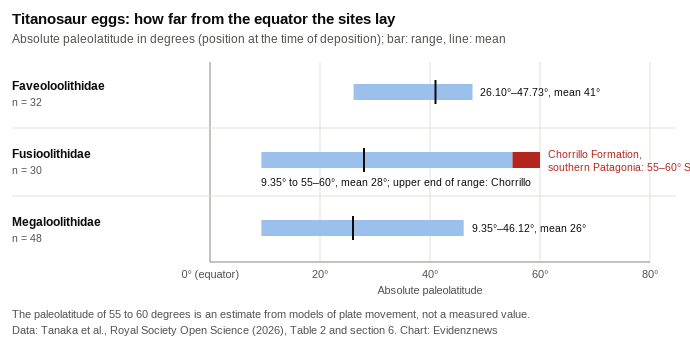
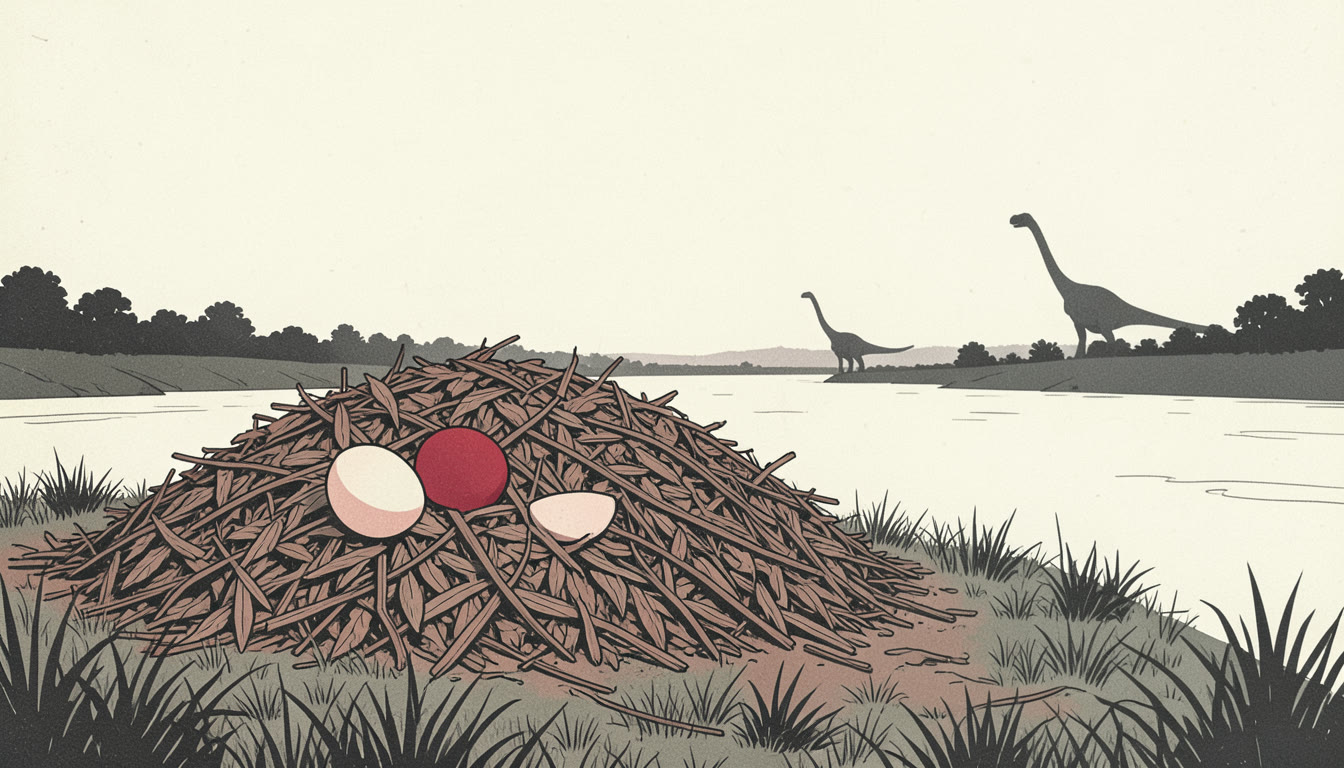
Titanosaurs, a group of large long-necked dinosaurs, probably also nested far in the south at the end of the Cretaceous. This is supported by 255 fragments of eggshells from southern Patagonia. At the time, the area lay at an estimated 55 to 60 degrees south latitude, as far from the equator as any other site of eggs attributed to this group of animals.
The shells were described by a team led by Kohei Tanaka of the University of Tsukuba in Japan. Also involved were the National Museum of Nature and Science in Tsukuba, two Argentine institutions in Buenos Aires and the University of Calgary in Canada. The paper appeared in September 2026 in the journal "Royal Society Open Science."
The basis is exclusively fragments of fossil shells. The team found no whole eggs, nests or embryos. The researchers infer how the eggs were incubated from the structure of the shell, from a model calculation and from comparison with living crocodiles and megapodes.
A site near El Calafate
The shells come from the Chorrillo Formation, a layer sequence about 500 meters thick that rivers deposited. The site lies about 29 kilometers southeast of El Calafate in the Argentine province of Santa Cruz. The fragments were embedded in layers of mudstone and siltstone, which the team interprets as deposits of a waterlogged or swampy environment. They were collected during fieldwork in 2020 and 2024.
The site is not entirely new. As early as 2019, a group led by Fernando Novas, who also co-authored the new paper, reported eggshells from there. What is new are the detailed description, the estimate of porosity and the classification by geographic latitude.
The layers belong to the Maastrichtian, the last stage of the Cretaceous. The paper does not give an age in millions of years in its text, and it is not consistent about whether the early or the late part of this stage is meant. Reports on the study give 66 to 69 million years.
Today the site lies at about 50.5 degrees south latitude. Because the continents drift, it lay elsewhere at the time of deposition. Geoscientists calculate this earlier position, the paleolatitude, from models of plate movement. For the find region the team arrives at 55 to 60 degrees south. The range expresses the uncertainty of the estimate.
By today's standards it was not cold there. Reconstructions from pollen and fossil soils, on which the team relies, yield a temperate to warm, seasonally humid climate with a mean annual temperature of 13.4 degrees Celsius (range 12.1 to 14.5 degrees) and about 1,150 millimeters of precipitation per year (plus or minus 108 millimeters).
What the shells reveal
The fragments are small; the largest measures 133 square millimeters. Their thickness ranges from 0.63 to 1.78 millimeters, with a mean of 1.17 millimeters. The outer surface bears nodes averaging 0.66 millimeters in diameter. Tube-shaped pore canals run through the shell, with openings of about 0.15 to 0.40 millimeters. On average, the team counted a good three pores per square millimeter. In one fragment that was scanned in the micro-computed tomograph, only two of 47 pore canals were branched.
Fossil eggs get their own names. Because it is rarely possible to determine which animal laid an egg, paleontologists sort them into egg genera and egg families according to the structure of the shell. Based on thickness, surface pattern and pore system, the shells from Patagonia belong to the egg genus Fusioolithus. A more precise determination down to the species was not possible.
The authors consider it probable, not certain, that Fusioolithus eggs come from titanosaurs. Skeletal remains of titanosaurs are known from the same formation, and titanosaur teeth lay at the same site as the shells. There is no direct link, such as an embryo in the egg. The authors write only that the eggs could have been laid by the titanosaurs that are documented by bones.
In some well-preserved pieces, remains of the shell membrane and organic cores at the base of the shell units were found. The team interprets this as an indication that the eggs were quickly covered by sediment.
From pores to nest type
Through the pores of an eggshell, the embryo exchanges gases and water vapor with its surroundings. In living animals, how permeable a shell is relates to the type of nest. The study distinguishes two types. In a covered nest, the eggs lie completely buried in soil or plant material, as in crocodiles and megapodes. In an open nest, they lie at least partly exposed and are usually warmed by a brooding parent, as in almost all birds today.
As a measure, the team uses porosity: the total pore area of an egg, divided by the length of the pores, that is, the shell thickness. It measured pore area and pore density on five thin sections. The area of a shell can only be calculated, however, if the size of the egg is known, and whole eggs are missing. The researchers therefore calculated with the smallest and the largest diameter known from Fusioolithus eggs at other sites: 110 and 230 millimeters. According to a formula for bird eggs, that would correspond to an egg mass of about 730 grams and just under 6.7 kilograms, respectively.
For the small egg, this gives a porosity of 821 millimeters, for the large one 3,585 millimeters. For comparison: other titanosaur eggs that are considered to have been incubated buried reach 287 to 2,125 millimeters. The values from Patagonia thus lie within this range or above it. The authors regard them as minimum values, because they measured the pore area in the middle of the shell, at the narrowest point of the canals.
A statistical method, discriminant analysis, assigns new cases to a group on the basis of known comparison data. Here it placed the eggs from Patagonia with very high probability among the covered nests, and for both assumed egg sizes. The eggs therefore probably lay completely in nesting material.
Where the heat came from is not established
A buried egg is not warmed by a parent. As heat sources, the paper discusses solar heat, geothermal heat and the heat that microorganisms produce when decomposing plant material, similar to a compost pile.
The summary and conclusion of the paper name rotting plants as the heat source. In the discussion section, the authors are more cautious: the heat source of the eggs from the Chorrillo Formation remains uncertain, but microbial decomposition of nesting material is plausible. It was not measured.
The reasoning is a process of elimination. Solar heat is considered unreliable at high latitudes. For geothermal heat there is no preserved evidence in the area, unlike at another Argentine nesting site, for which hydrothermal activity has been described. Geothermal heat is thus not ruled out. A statistical test did not help: of nine known clutches of this egg family, seven lay in fine-grained and two in coarse-grained sediment, which could not be distinguished from a random distribution (p = 0.096).
The assumption rests on an earlier paper in which two of the authors took part, so it is not an independent confirmation. In it, Tanaka and colleagues compared nests of living crocodiles and megapodes in 2018. Nests that use microbial heat were on average 7.26 degrees warmer than the air, nests with solar heat 3.93 degrees. Sun-warmed nests were found mainly within 30 degrees of latitude of the equator. Mound nests of present-day species reach up to 37 degrees; in captivity, however, megapodes also bred successfully in the climate of Frankfurt. As the minimum temperature for successful incubation in living archosaurs, the group to which crocodiles and birds belong, the paper gives 28 degrees.
For Patagonia, at the estimated mean annual temperature of 12 to 14.5 degrees, the authors consider it likely that temperatures made such nests possible during part of the year. This remains an inference by analogy from living to extinct species.
As far south as no other find
For the classification, the team compiled the paleolatitudes of all sites of three egg families attributed to titanosaurs. On average they lay at about 31 degrees. For the egg family Faveoloolithidae, the highest known find is at about 48 degrees, and earlier sites of sauropod eggs in Argentina lay between 26 and 48 degrees south. The shells from the Chorrillo Formation, at 55 to 60 degrees, lie clearly above this.
To the authors' knowledge, they are the first direct evidence that titanosaurs nested at comparatively high latitudes at the end of the Cretaceous, and the closest-to-the-pole unambiguous find of dinosaur eggs in the Southern Hemisphere. Skeletal remains of titanosaurs are known from southern Patagonia, Antarctica and Australia; unambiguous dinosaur eggs are so far missing from Antarctica and Australia. In the Northern Hemisphere, egg finds of dinosaurs extend farther toward the pole: to about 57 to 60 degrees in Canada and 70 to 75 degrees in Siberia.
That titanosaurs buried their eggs had already been concluded in 2015 by another research group from Argentina, from nesting sites around the world. The team led by Hechenleitner compared the nesting behavior of the animals with that of present-day megapodes. That paper said nothing about high latitudes.
The broadcaster CNN asked two experts who were not involved in the study. The paleobiologist Paul Upchurch of University College London said there that it had been assumed that sauropods migrated to high latitudes only in warm summers. The eggs now suggested that they might have stayed there all year ("might have stayed there all year") or at least reproduced there in the warm season. Steve Brusatte of the University of Edinburgh called the find important because it meant that some of the largest animals in Earth's history had laid eggs at high latitudes. Neither questions the finding; the research found no published expert criticism of the study.
An explanation that does not appear in the study itself comes from the same report. The co-author Darla Zelenitsky told CNN that a brooding titanosaur would have crushed its clutch because of its size; mounds of plants and earth were most likely.
What remains open
The shells show that eggs lay at this place, and their structure speaks for buried clutches. Much else is assumption. Which species laid the eggs is unknown. So is how large they were: the porosity values depend on egg sizes taken from other sites. Nobody has found a nest; the mound of plants is an interpretation.
Also open is the question that Upchurch raises: the eggs alone do not decide whether the animals lived in the south all year or came only to nest. And the heat source remains uncertain, as the authors themselves write.
Questions about this article
Comments
Sources
- Primary source Tanaka K, Novas FE, Manabe M, Sakata C, Garcia Marsà JA, Zelenitsky DK: Titanosaur eggshells from the latest Cretaceous of Patagonia, Argentina: implications for nesting at high latitude. Royal Society Open Science 13(9), 260333 (2026). doi:10.1098/rsos.260333
- Context Hechenleitner EM, Grellet-Tinner G, Fiorelli LE: What do giant titanosaur dinosaurs and modern Australasian megapodes have in common?. PeerJ 3, e1341 (2015). doi:10.7717/peerj.1341
- Context Tanaka K, Zelenitsky DK, Therrien F, Kobayashi Y: Nest substrate reflects incubation style in extant archosaurs with implications for dinosaur nesting habits. Scientific Reports 8, 3170 (2018). doi:10.1038/s41598-018-21386-x
- Context Katie Hunt: Fossilized eggs of the largest known dinosaurs have been unearthed in an unexpected place. CNN, Nachrichtenbericht vom 9. September (2026). https://krdo.com/cnn-other/2026/09/09/fossilized-eggs-of-the-largest-…