Dolphins: Group Size Rises, Then Falls, and Varies Less With Age
Evidence level 2 of 5 · Single study, peer-reviewed
Key points
- A team led by Kelley C. Meehan of the University of Queensland statistically analyzed 64,914 observations of 457 wild Indo-Pacific bottlenose dolphins from 1988 to 2025; the work has been published after peer review in PLOS Biology.
- According to the model, an animal has on average more and more companions around it until early adulthood, and fewer afterward, with a steeper decline in males; at the same time, an animal's group size varies less around its own average as it gets older.
- Both trajectories are associated with age at last sighting; the work contains no survival analysis, the team speaks of disappearance and not of proven death, and the interpretation as growing social competence was not tested.
Among the dolphins of Shark Bay in Western Australia, the number of conspecifics an animal has around it changes over the course of its life. Until early adulthood, an animal has more and more companions around it; after that, there are fewer. At the same time, an animal's group size varies less around its own average over the years. This is the result of a statistical analysis of 64,914 observations of 457 wild Indo-Pacific bottlenose dolphins (Tursiops aduncus).
Both trajectories are associated with the age at which an animal was last sighted. If the mean group size declined earlier, the animal also apparently disappeared from the population earlier, according to the analysis. In animals that were sighted up to an older age, the number of companions increased for longer, and the variation declined most strongly in them. Whether one causes the other, the study leaves open.
The work comes from a team led by Kelley C. Meehan of the University of Queensland. Researchers from Ludwig-Maximilians-Universität München, the University of Alberta, Georgetown University and Texas A&M University at Galveston also took part. It was published after peer review on November 24, 2026, in the journal PLOS Biology, as a short report. It is an observational study of wild animals of a single population, without intervention and without an experiment.
Counted from a boat
The data come from the Shark Bay Dolphin Research Project, which has existed since 1984; the study site lies off Monkey Mia in eastern Shark Bay. Observations from 1988 to 2025 went into the analysis. The animals are recorded from a boat, with scan samples at five-minute intervals.
A group here is defined as a chain: a dolphin belongs to it if it is at most ten meters from at least one other group member. The study's measure is the number of companions, that is, the group size without the observed animal itself. It serves as a proxy for sociability. It does not capture how close the relationships between animals are.
Only one sighting per animal and day counts, and animals with fewer than 40 sightings were left out. The data set comprises 228 males and 229 females with an average of 142 observations per animal; the range runs from 40 to 942. On average, an animal was sighted over 17.3 years, at minimum over 2 and at maximum over 35. At the time of the observations, the animals were between 0 and 52.7 years old. For 2,320 of the 64,914 observations, which is less than four percent, no exact group size was available; there the team used range estimates.
The work describes the dolphins of Shark Bay as a fission-fusion society: individual animals can change the composition of their group five to six times per hour. According to the work, males form multilevel alliances with unrelated animals of the same age in order to gain access to females ready to mate. Females give birth to a calf at about age 13 and nurse it for 2.5 to 8 years, on average 4 years. Lifespans of more than 52 years are documented. The work takes these figures from earlier literature; they were not individually checked for this text.
Two quantities in one model
The team examined two quantities. The first is the average number of companions at a given age. The second it calls predictability: how little the group size of an individual animal varies from sighting to sighting around its own average. This quantity says nothing about an animal's intent or intelligence.
Both are estimated by a joint statistical model, a Bayesian double-hierarchical generalized linear model. It has two parts: one describes the mean number of companions, the other the dispersion around that mean. The predictors are sex, age, age at last sighting and reproductive status, distinguished as newborn, calf and no calf. Age enters the mean part with a quadratic term and the dispersion part linearly. In addition, the model accounts for differences between individual animals, between observation years and between observation days.
The team reports the results as medians with a 95 percent credible interval, the uncertainty measure of this method. The coefficients of the mean part are on a logarithmic scale and cannot be read directly as a number of companions. The intervals follow in parentheses after the estimate.
First more companions, then fewer
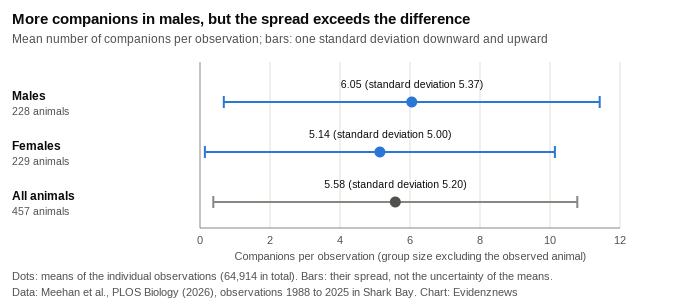
Across all observations, a dolphin had on average 5.58 companions. For males it was 6.05, for females 5.14. The standard deviation is 5.20 for all animals, 5.37 for males and 5.00 for females. It describes how far apart the individual observations lie, not the uncertainty of the means. The gap between the sexes is thus smaller than the spread of the individual observations.
In the model the difference remains: the coefficient for males is 0.14 (0.10 to 0.19). According to the work's abstract, males travel in larger and more predictable groups than females in all life stages.
Over the course of life, the mean number of companions follows an arc. In the model this is represented by a quadratic age term of minus 16.20 (minus 21.53 to minus 10.99); its interval does not include zero. The linear age effect alone, at 2.98 (minus 3.71 to 9.59), cannot be distinguished from zero. In males the pattern is more pronounced, and the decline is steeper; the interaction of sex and the quadratic age term is minus 13.24 (minus 19.47 to minus 7.06). At what age the peak lies, the text of the work does not say.
Reproductive status is also associated with group size. There was the most company when a newborn was present, somewhat less with older calves. The smallest groups were formed on average by juveniles and adults without a calf. Compared with the reference category calf, the coefficient for newborns is 0.12 (0.05 to 0.19), for the category no calf minus 0.06 (minus 0.09 to minus 0.04). Groups with newborns were also more predictable.
Less variation with the years
The second quantity develops differently from the first. Predictability increases with age: an animal's group size varies less around its average. The age coefficient in the dispersion part is 0.05 (0.03 to 0.08); according to the work's methods section, larger values mean higher predictability. The coefficient for male sex is 0.55 (0.38 to 0.72) there: males were more predictable than females in the model.
This holds on average, not for every animal. In some males predictability decreased with age, in others no change was visible. The team suspects that changes of partners in the alliances could be behind this, for instance after the death of a partner. It did not test this.
Positively and closely, the two quantities are related only at the level of individual animals. Dolphins with larger groups on average were also more predictable; the correlation of these individual effects is 0.93 (0.89 to 0.96). At the level of individual observation days, the association is negative: on days with larger groups on average, group size was less predictable, the correlation is minus 0.38 (minus 0.43 to minus 0.32). Between observation years, no association was found (0.16; minus 0.24 to 0.52).
Last sighting instead of lifespan
The title of the work links social aging with longevity. In the analysis, however, lifespan is not a separate result; the work contains no survival analysis. What goes into the model is how old each animal was at its last sighting. There this value serves explicitly as a control for what the work calls selective disappearance.
The team speaks of disappearance, not of proven death. How well age at last sighting reflects actual lifespan, the work does not explain in more detail. An animal may have died or emigrated, it may no longer have been sighted, or it may still have been alive when the data series ended in 2025.
With this caveat, the work reports two associations. The first concerns mean group size: in animals whose mean number of companions declined early, the sightings also ended earlier. In animals that were seen up to old age, by contrast, the number rose for longer. The team words this cautiously: the earlier decline seems to precede the earlier disappearance. In the model, this is represented by the interaction of age and age at last sighting at 12.85 (6.29 to 19.58). The corresponding interaction with the quadratic age term is compatible with zero (3.53; minus 0.26 to 7.41).
The second concerns variation: predictability increased most in the animals that were sighted up to the oldest ages. The interaction of age and age at last sighting in the dispersion part is 0.05 (0.03 to 0.08).
Interpretations without their own test
Why an animal's group size varies less over the years, the team did not investigate. It interprets the increase in predictability as a possible sign of growing social competence and an increasingly selective choice of particular groups. According to its own statement, this was not tested. A causal link between social competence and what biology calls fitness is expressly not claimed by the team ("we cannot explicitly state a causal link").
For the decline in the number of companions later in life, the work names several possible causes that could act together and were not tested separately: growing social selectivity, social and physical aging, and the loss of preferred conspecifics. Animals that disappear earlier than expected might have health problems. This also makes the reverse direction conceivable: weakened animals could form smaller and less predictable groups and disappear earlier.
What earlier work shows
Associations between social behavior and survival have been described in this population before. A work published in PLoS ONE in 2012 found that a measure of the social network of male calves, eigenvector centrality, predicted their survival. A 2021 work in Communications Biology analyzed the same long-term data for 179 animals with 40,523 observations from 1988 to 2019. The number of companions, the time spent alone and the time in large groups were, according to it, individually stable from early childhood into old age; the new work builds on this one. Its authors note that the data come from a single, particularly social population and that transferability to other species is unclear. The two works are not independent of the new study: Janet Mann is involved in all three, Celine Frère in the 2021 work and in the new one.
Another research group examined epigenetic age, a measure of biological age, in male dolphins of Shark Bay in 2025. Stronger bonds were significantly associated there with a lower epigenetic age, while a larger group was significantly associated with a higher one. The authors conclude that the effect of the bonds is not due solely to living in a group. This stands in tension with the reading that more company means a longer life. The two studies cannot be compared directly: the 2025 work measures biological age and not lifespan, and the strength of bonds is a different measure from the number of companions. But it shows that group size and the quality of bonds are not the same thing.
In wild chimpanzees, a work published in Science in 2020 described that older males had more mutual friendships and were more often alone, but interacted more with important partners. Social selection can thus be hidden behind a declining group size. The dolphin study hints at something similar without measuring it.
A review from 2022 in Biology Letters proposes three groups of explanations for late-life changes in the social behavior of mammals: consequences of senescence, that is, aging, adaptations that mitigate senescence, and positive age effects and demographic changes. The interpretations of the dolphin study fit into this scheme.
The broader framework is described by a review from 2020 in Science. In humans, the social environment is, according to it, among the strongest predictors of the risk of illness and death. Long-term studies of other social mammals show similar associations, and experiments demonstrate that social interactions can causally influence physiology, disease risk and lifespan. For the dolphins of Shark Bay, no cause is thereby demonstrated: the new study is an observation, not an experiment. Of the work on epigenetic age, the chimpanzee study, the two reviews and the 2012 work, only the abstract was read for this text in each case.
What remains open
It is open whether group size and predictability influence lifespan or whether, conversely, an animal's condition shapes both. It is also open how well age at last sighting reflects lifespan.
The study counts companions and does not measure bonds. Whether more company is itself beneficial or the quality of relationships is decisive, it cannot answer. The data come from a single population in one bay; whether the patterns can be transferred to other dolphin populations or other species is untested.
Two tables in the work contain inconsistencies: in one, an estimate lies outside its own interval, probably a typesetting error, and in another the scale of the values is unclear. This text does not give the affected numbers.
An assessment by independent experts was not available one day after publication, and a press release on the work was not found. The discussion portal PubPeer could not be checked.
Questions about this article
Comments
Sources
- Primary source Kelley C. Meehan, Barbara Class, Shinichi Nakagawa, et al.: Distinct trajectories and predictability of individual grouping patterns in dolphins link social ageing to longevity. PLOS Biology 24(11), e3004022 (2026). doi:10.1371/journal.pbio.3004022
- Context Gerber L, Peters KJ, King SL, et al.: Social bonds decrease epigenetic age in male bottlenose dolphins. Communications Biology 8; nur Zusammenfassung gelesen (2025). doi:10.1038/s42003-025-09227-w
- Context Evans T, Krzyszczyk E, Frère C, Mann J: Lifetime stability of social traits in bottlenose dolphins. Communications Biology 4, 759; gleiche Population, zwei gemeinsame Autorinnen mit der Primärquelle (2021). doi:10.1038/s42003-021-02292-x
- Context Stanton MA, Mann J: Early social networks predict survival in wild bottlenose dolphins. PLoS ONE 7(10), e47508; gleiche Population, eine gemeinsame Autorin mit der Primärquelle; nur Zusammenfassung gelesen (2012). doi:10.1371/journal.pone.0047508
- Context Rosati AG, et al.: Social selectivity in aging wild chimpanzees. Science 370(6515), 473–476; nur Zusammenfassung gelesen (2020). doi:10.1126/science.aaz9129
- Context Siracusa ER, Higham JP, Snyder-Mackler N, Brent LJN: Social ageing: exploring the drivers of late-life changes in social behaviour in mammals. Biology Letters 18(3); Übersichtsarbeit, nur Zusammenfassung gelesen (2022). doi:10.1098/rsbl.2021.0643
- Context Snyder-Mackler N, et al.: Social determinants of health and survival in humans and other animals. Science 368(6493); Übersichtsarbeit, nur Zusammenfassung gelesen (2020). doi:10.1126/science.aax9553