Bees: Early warning signals from hive temperature barely better than guessing
Evidence level 1 of 5 · Single finding, not peer-reviewed
Preprint: This work has not yet been reviewed by independent experts. The results may change.
Key points
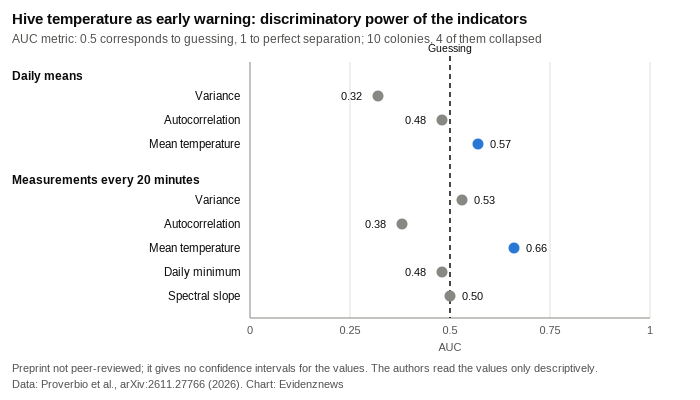
- In a preprint that has not been peer-reviewed, the classic early warning signals, rising variance and autocorrelation of hive temperature (how strongly one measurement depends on the previous one), separated bee colonies that later collapsed from survivors about as well as or worse than chance (AUC metric between 0.32 and 0.53, where 0.5 corresponds to guessing).
- Mean temperature reached 0.57 and 0.66; the authors do not consider even that a reliable basis, given the small sample of ten colonies, four of them collapsed.
- In the authors' model calculations the signals do appear, but only in time series several years long; a peer-reviewed study from 2025, by contrast, considers temperature a usable early warning signal.
Temperature sensors in the beehive are considered candidates for an early warning system: fine changes in temperature are supposed to show that a colony is heading toward collapse. A team from Trento, Utrecht and Udine has tested this on data from ten colonies. The result: the statistical signals that a widespread theory predicts before such a tipping over barely distinguished colonies that later collapsed from those that survived. Only the falling mean temperature did somewhat better than chance, and the authors do not want to rely on that either.
The work is a preprint: it has been on the arXiv server since November 20, 2026 and has not been peer-reviewed. The first author is Daniele Proverbio of the University of Trento; the universities of Utrecht and Udine are also involved. The finding rests on two legs. One is model calculations and simulations. The other is measurements on real honey bee colonies, though only ten of them, from a single year and a single region.
The idea: A system becomes sluggish before it tips
Behind the early warning signals is an idea that experts call critical slowing down. The closer a system comes to a tipping point, the more slowly it recovers from small disturbances. Two consequences can be measured. The current state depends more strongly on the preceding one; the measure for this is autocorrelation. And fluctuations last longer, which raises the variance, that is, the spread of the measured values.
A widely cited review article from 2009 in the journal Nature held out the prospect that such signals could warn of a tipping over in very different systems, from ecosystems to financial markets to the climate. The preprint tests this promise on a practical case.
The authors separate three questions for this. Can the system show such a transition at all? Can the signal be found in noisy, finite time series? And does it reliably and promptly indicate the later collapse? A signal can rise without a collapse following; it is then a false alarm.
What the models say
The authors take the first step on the computer. They examine three published mathematical models of bee colonies. In all three, the collapse proceeds in the same way: the number of bees falls steadily to zero when the death rate of the forager bees reaches a critical value. A sudden jump, as the literature on tipping points often assumes, is not what happens. Early warning signals are in principle possible with this kind of transition, but have different properties.
Simulations of one of these models showed how much data would be needed. In time series one year long, no persistently significant warning trend was found at any of the measurement frequencies tested, neither in the variance nor in the autocorrelation. Only in idealized series of 10,000 days did the signals become significant, with sufficiently frequent measurement after about 1,600 days. That is roughly four years. These figures come from simulations under simplified assumptions, not from measurements.
Ten colonies in northern Italy
The measurement data come from a field trial in 2018 that three of the authors from Udine had previously carried out for another study. In northern Italy, ten colonies stood in two apiaries of five each, four kilometers apart. One apiary remained untreated and was infested by the varroa mite naturally. The other was treated with anti-mite agents.
A sensor in the center of each hive measured the temperature every 20 minutes from August to November. The team estimated how strong a colony was about once a month. A collapse was defined as no bee being left in the hive; this was checked twice, before winter and in the following spring.
The outcome: all treated colonies survived; of the untreated ones, all but one did not. This yields four collapsed and six surviving colonies; this count is derived from the information in the preprint. Infestation and collapse thus nearly coincide, which the authors themselves name as a limitation. The trial was designed to compare infested with treated colonies, and the analysis assumes that the mite is the cause of the collapse.
In summer, bees keep their hive at about 35 degrees Celsius. In the data, the temperature in summer and early fall was 34 to 35 degrees and then fell. In each of the ten colonies, a statistically detectable kink in the course was found, mostly around mid-October, in colonies that later collapsed as in healthy ones. It is therefore not suitable as a sign of weakness. Nor did the temperature reliably follow colony strength: it could remain stable while the colony shrank, or fall while the colony stayed stable or grew.
The result: close to guessing
The authors computed their indicators on expanding time windows, without looking into the future. How well an indicator separates colonies that later collapsed from surviving ones, they summarized in a metric called AUC in the field. The value 0.5 corresponds to guessing, the value 1 to perfect separation.
For the daily means, the result was: variance 0.32, autocorrelation 0.48, mean temperature 0.57. For the measurements at 20-minute intervals: variance 0.53, autocorrelation 0.38, mean temperature 0.66, daily minimum 0.48. A fifth indicator, the spectral slope, reached 0.50. The text that was read gives no uncertainty ranges for these values.
The authors summarize that only the mean temperature is better than chance; most indicators did as well as or worse than a random procedure. They also place the best value, 0.66, in cautious context: with so few colonies, it does not support reliable conclusions for practice. The values should be read descriptively, not as a validated predictive performance.
That the mean temperature comes out ahead fits the models. With the type of collapse described there, the mean falls steadily the closer the critical point gets. According to the authors, this does not protect against false alarms, because in some colonies that never collapse, the temperature can decline similarly.
The authors see a further explanation for the weak signals in the noise in the data. The temperature fluctuations are not uniform random noise; the spectral analysis yields so-called red noise in all colonies. Such noise can mask early warning signals.
What speaks against this and what fits it
The preprint contradicts a peer-reviewed study. Colin and colleagues reported in 2025 in the journal Ecological Informatics, according to the abstract of their work, that the temperature regulation of failing colonies differs enough from that of healthy ones in three datasets to recognize them before death. The daily minimum, which the earlier work had proposed as a promising indicator according to the preprint's account, reached only 0.48 here. The authors suspect differences in environment, stressors or measurement methods, but have not tested this. For this article, only the abstract of the 2025 work was read; a comparison of the datasets was therefore not possible.
The preprint fits other findings. An analysis of plankton data from lakes, published in 2023 in Nature Communications, found, according to its abstract, few cases of true critical transitions, and most early warning indicators there did no better than chance. And as early as 2012, Boettiger and Hastings showed that common warning statistics produce too many false alarms if, looking back, one examines only systems known to have tipped. The preprint also evaluates in hindsight, but has the surviving colonies as a comparison group.
The authors themselves draw a limited conclusion. Early warning signals could be present in a system's dynamics without being useful predictors in the measurements, at least in their case study. They warn against treating such indicators as general predictors of ecological collapse. They do not call temperature measurement useless: it can reveal the state of a colony. Healthy colonies kept the temperature stable until about October, weakened ones showed more strongly fluctuating and falling values, and collapsed ones approached the outside temperature. Even an imprecise alarm might perhaps be worthwhile, they write, if it leaves a month of lead time and prevention is possible in that time.
What remains open
Ten colonies, one year, one region: that the signals barely separated here does not mean they must fail in larger datasets. Whether the finding is repeated, whether it also holds for causes other than the varroa mite, and how it fits with the 2025 work is open. The exact times of the collapses are not known, because colony strength was recorded only about monthly; lead times therefore cannot be given. The authors did not test methods that combine several measured variables. And the work has not been peer-reviewed; the authors have deposited data and code publicly.
Questions about this article
Comments
Sources
- Primary source Proverbio D, Weinans E, Frizzera D, Annoscia D, Nazzi F, Giordano G: Critical slowing down in hive temperature does not provide actionable early warnings of honey bee colony collapse. arXiv:2611.27766, Preprint, Version 1, nicht begutachtet (2026). doi:10.48550/arXiv.2611.27766
- Context Colin, Dakos, Barron, Meikle, Altmann, Latty: Temperature as an early warning signal of honeybee colony failure. Ecological Informatics 92, 103445; nur Zusammenfassung gelesen (2025). doi:10.1016/j.ecoinf.2025.103445
- Context O'Brien et al.: Early warning signals have limited applicability to empirical lake data. Nature Communications 14, 7942; nur Zusammenfassung gelesen (2023). doi:10.1038/s41467-023-43744-8
- Context Boettiger, Hastings: Early warning signals and the prosecutor's fallacy. Proceedings of the Royal Society B 279, 4734–4739; nur Zusammenfassung gelesen (2012). doi:10.1098/rspb.2012.2085
- Context Scheffer et al.: Early-warning signals for critical transitions. Nature 461, 53–59; nur Zusammenfassung gelesen (2009). doi:10.1038/nature08227