How likely is a large asteroid impact?
Asteroids over 1 km: model puts mean impact interval at about 640,000 years
Evidence level 3 of 5 · Several independent studies pointing the same way
Key points
- The population model NEOMOD 3 estimates 830 ± 60 near-Earth objects over 1 km and 20,000 ± 2,000 over 140 m in diameter, and derives mean impact intervals of 570,000 to 660,000 years and 19,000 to 24,000 years, respectively.
- Depending on the source, the catalogs are considered 87 to 95 percent complete for kilometer-sized objects; for objects over 140 m, the studies reviewed give values from around 35 to just over 55 percent.
- In 2022, the DART probe shortened the orbital period of the asteroid moon Dimorphos by 33.0 ± 1.0 minutes; this is a single test on a single object, and deflecting an object from a real impact trajectory has never been tested.
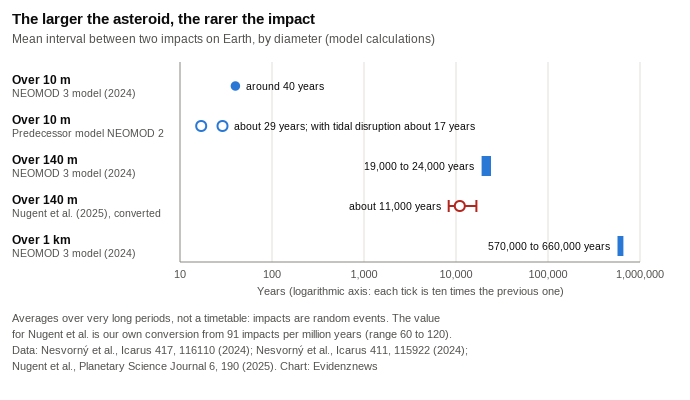
How likely a large asteroid impact is depends first of all on what one calls large. For objects more than one kilometer in diameter, a 2024 computational model arrives at an average of one impact every 570,000 to 660,000 years. For objects over 140 meters it is 19,000 to 24,000 years, and for those over 10 meters around 40 years.
Nobody has measured these intervals. No impacts of large objects occurred during the observation period; the figures are extrapolated from telescope data. The smaller the objects, the further apart the estimates of different research groups lie, and the fewer of them have been discovered at all.
Where the numbers come from
The basis of this text is the model NEOMOD 3, published in 2024 in the journal "Icarus." The first author is David Nesvorný; according to the acknowledgments, four of the twelve authors worked on it at the Jet Propulsion Laboratory under a NASA contract. The model describes near-Earth objects, abbreviated NEOs: how many there are of each size and how often they hit Earth.
The study contains no original observation of the sky. It evaluates existing data, above all ten years of observations from the Catalina Sky Survey, covering 2013 to 2022. Because such a survey does not find all objects, the model removes its selection effects and infers the entire population from the objects found.
There is a difficulty here: a telescope first supplies the brightness of an object, not its size. How large an object is at a given brightness depends on whether its surface is dark or bright. This property is called albedo. What is new in NEOMOD 3 is that it incorporates albedo values from NEOWISE observations, 428 detections in total. The authors describe the distribution as a mixture of a dark and a bright group; according to the summary, smaller objects tend to have a higher albedo than larger ones. Diameter follows from brightness and albedo, and the impact rate from the orbits.
The authors estimate the error arising from this albedo assignment at under 10 percent for objects over 100 meters; they themselves call this a cautious estimate. Below 100 meters they are less certain, because NEOWISE has seen only a few objects that small and the albedo distribution there has to be extended from the data of larger objects.
Three size classes, three answers
For the largest class, objects over one kilometer, the model estimates a population of 830 ± 60. This yields 1.51 to 1.74 impacts per million years, that is, on average one every 570,000 to 660,000 years; in their summary the authors give about 640,000 years.
For objects over 140 meters, the model estimates 20,000 ± 2,000. The rate is 42 to 52 impacts per million years, the mean interval 19,000 to 24,000 years.
For the smallest class considered here, objects over 10 meters, the study gives a mean interval of around 40 years. The asteroid that exploded in the atmosphere over Chelyabinsk in 2013 was of this order of magnitude: an analysis in "Nature" puts its diameter at about 19 meters, with a range of 17 to 20 meters.
Such intervals become easier to grasp when related to a human lifetime. For this text, the research converted the model's rates to 71 years, the value another study uses for a lifespan. By that calculation, the probability that an object over 140 meters hits somewhere on Earth during this time is around 0.30 to 0.37 percent, about 1 in 270 to 1 in 330. For an object over one kilometer it is around 0.011 to 0.012 percent, about 1 in 8,000 to 1 in 9,000. These values are our own calculation under the assumption of a constant rate; they do not appear in the study.
An average is not a timetable
A mean interval of 20,000 years does not mean that the next impact is 20,000 years away or that one might be overdue. Impacts are random events. The model's rates are averages over very long periods and not a forecast for a particular date.
A figure from the predecessor model NEOMOD 2 by the same group is therefore more illustrative: the probability that an object of the class over 140 meters hits Earth within the next 1,000 years is about 4.5 percent.
How many asteroids have already been found
A mean rate applies to the entire population, including undiscovered objects. For known objects, by contrast, orbits can be calculated in advance. The second important quantity is therefore the completeness of the catalogs: what share of the objects has already been discovered?
For kilometer-sized objects the share is high. A 2023 study by Fuentes-Muñoz and colleagues gives around 95 percent, the NEO Surveyor mission team around Grav 87 to 88 percent, and NEOMOD 2 about 91 ± 4 percent. The differences also stem from the groups assuming different total populations: Fuentes-Muñoz and colleagues rely on an estimate of 962 objects, while NEOMOD 3 arrives at 830 ± 60. A 2019 NASA explainer already noted that by 2010 more than 90 percent of the estimated 1,000 near-Earth asteroids of one kilometer or larger had been discovered.
For this size class there is a concrete statement with a time frame. The usual impact monitoring reaches about 100 years ahead, and in this period, according to the summary of Fuentes-Muñoz and colleagues, no kilometer-sized object threatens Earth. The group also calculated the orbits over 1,000 years and ranked the objects by how likely a flyby closer than the distance to the Moon is. This is a ranking of close flybys, not a prediction of impacts. The authors themselves name the limits: orbital motion is chaotic, and after a few centuries the uncertainty can span the entire orbit.
For objects over 140 meters the picture is different. According to NEOMOD 3, only around 35 percent of the objects down to the brightness limit corresponding to about 140 meters are known so far. Grav and colleagues arrive at about 38 percent (as of late 2022), NEOMOD 2 at 44 to 49 percent depending on the place in the paper, and a further estimate by Harris and Chodas is, according to a later study, just over 55 percent. The values are not strictly comparable, because the groups set the 140-meter limit at different brightness values. Grav and colleagues also point out that the objects in the catalog may on average be listed as somewhat too bright.
The catalog is growing. At the beginning of June 2023, according to Grav and colleagues, it contained around 32,100 near-Earth asteroids of all sizes, with 3,189 added in 2022 alone. NEO Surveyor, a NASA mission, is expected, by the mission team's calculation, to find about 66 percent of the objects over 140 meters on its own in five years, raising completeness to around 76 percent. The authors call their model a "simple first-order model," and they belong to the mission team.
Small objects: model and fireballs do not match
The lower end of the scale is the most uncertain. For objects over 10 meters there is a second data source besides telescopes: observations of fireballs in the atmosphere. The value from NEOMOD 3 is about a factor of 4 below the estimates derived from such observations. According to the excerpt evaluated for this text, the authors themselves name this as a problem. They consider it possible that their albedo values for objects around 10 meters are too high.
The predecessor model shows how strongly individual assumptions shift the result. For objects of this class, NEOMOD 2 arrived at 0.034 ± 0.002 impacts per year, that is, about one every 29 years. When the authors approximately accounted for the fact that objects can be torn apart by tidal forces during close flybys of planets, the value rose to 0.06 ± 0.01 per year, about one every 17 years, and was thus closer to the fireball data.
A counter-position comes from observation. The group around Brown, which analyzed the airburst over Chelyabinsk, concluded in 2013 that asteroids a few tens of meters in diameter could be about ten times more common than other estimates assume. This is a conclusion from a single event, and only the abstract of this study was available for this text.
A compilation by Chow and colleagues, available as a preprint and, according to a note, accepted by a journal, shows how short the warning time for small objects has been so far. According to it, as of January 1, 2026, eleven asteroids were known that were discovered in space before they hit Earth. All were very small, with diameters of about 0.44 to 5 or 6 meters, and all were found less than a day before impact. For the Vera C. Rubin Observatory, the authors expect from a simulation that it could discover around one to two impacts per year of objects in the meter range and larger in advance, a median of about 1.57 days beforehand. The study says nothing about warning time for objects over 140 meters.
What the field disagrees about
Even at 140 meters the rate is not settled. A group around Nugent recalculated it in 2025 by a different route: it simulated 5 million near-Earth objects, calculated their orbits for 150 years and counted the hits. There were three. From this follows a rate of 91 impacts per million years, with a range of 60 to 120. That is about twice as much as for the modeling team around Nesvorný. Converted to 71 years, it would be about 0.65 percent, again our own calculation.
The figure is rough. It rests on only three simulated impacts, and according to the information evaluated, the study originated as a semester project with six students. It also builds on NEOMOD 2, even though a different group did the calculation. It does not serve as a consensus value, but it does indicate how wide the range is.
A table in the same study shows how wide. It lists eight estimates for objects over 140 meters side by side, ranging from about 10 to 500 impacts per million years, including one from 1941. Nugent and colleagues argue that the estimates have stayed roughly the same over about 80 years, even though the number of discovered objects has risen sharply.
In their summary, the authors write that the impact of an asteroid over 140 meters in size is more likely than a single person being struck by lightning. The comparison, however, sets an event affecting the planet as a whole beside a risk to one individual. It says nothing about the personal risk of dying from an impact.
NEOMOD 3 also deviates from older calculations. According to the authors, its estimate for objects over one kilometer is around 15 percent below that of a 2020 study by Morbidelli and colleagues, which arrived at around 1,000 objects and a mean impact interval of about 750,000 years. The authors explain the deviation by different population estimates and different impact probabilities.
Nugent and colleagues see a gap in long-period comets. They are poorly characterized, and they hit Earth about three times as fast as asteroids, which at equal mass corresponds to up to about nine times the kinetic energy. NEOMOD 3 includes comets in the model by its own account. These two statements have not been tested against each other.
How a suspicion turns into an all-clear
For a single, known object, a different kind of probability applies than for the whole population. It expresses how precisely the orbit is known, and it changes with every new observation. One example is the asteroid 2024 YR4, which NASA describes as about the size of a 15-story building.
In February 2025, NASA put the probability that it hits Earth on December 22, 2032 at 0.004 percent and saw no notable danger to Earth. The value had fallen because further observations had reduced the uncertainty of the orbit. For the Moon, the probability of a hit was at one point 3.8 percent (as of April 2, 2025) and 4.3 percent. Webb observations of February 18 and 26, 2026 also ruled out a lunar impact, as ESA announced on March 5, 2026.
DART: orbital period of an asteroid moon shortened by 33 minutes
On the question of whether an asteroid can be deflected, the sources evaluated contain one test. On September 26, 2022, at 23:14 UTC, the DART probe hit the asteroid moon Dimorphos, which orbits the asteroid Didymos. Before the impact, Dimorphos took 11.92148 ± 0.00013 hours for one orbit, afterward 11.372 ± 0.017 hours. The orbital period shortened by 33.0 ± 1.0 minutes; the uncertainties are each given at three standard deviations (3 sigma). This is how Thomas and colleagues report it in 2023 in "Nature," based on light curves and radar.
A second study in the same volume, by Cheng and colleagues, derives from this how much momentum the impact transferred. The velocity of Dimorphos along its orbit changed by 2.70 ± 0.10 millimeters per second (1 sigma). Important here is the factor beta: the ratio between the momentum the asteroid moon received and the momentum the probe brought. The values found are above 1. This fits what Thomas and colleagues conclude from the large change in orbital period: ejected material contributed considerable momentum.
Exactly how large beta is depends on the density of Dimorphos, which has not been measured. If one assumes the same density for Dimorphos as for Didymos, 2,400 kilograms per cubic meter, the result is 3.61, with an uncertainty of +0.19 and −0.25 (1 sigma). Over the range of possible densities from 1,500 to 3,300 kilograms per cubic meter, beta ranges from 2.2 to 4.9, and at the stricter error limit of 3 sigma from 1.9 to 5.5. The authors call the impact "highly effective."
The limits of this test are part of the picture. A single object was hit, the moon of a binary asteroid. Whether the method works the same way on asteroids of other density, structure and size is open; deflecting an object from a real impact trajectory has never been tested. Moreover, only the change in velocity along the orbit has been determined, and according to Cheng and colleagues, different material properties can yield similar values for beta in simulations. According to the study, ESA's Hera mission is to narrow down the value more precisely.
What research cannot answer here
When the next large impact will come, none of the calculations can say. A mean rate describes a random event over a very long time, not the time of the next hit. For the large objects, the rate also cannot be checked by repetition: it is derived from models and from observations of smaller and medium-sized objects.
This text does not answer what an impact would do. The sources evaluated do not themselves document the consequences but refer to damage models, which were not examined for the research.
And whether a probability of about 0.3 percent over a lifespan is a lot or a little, research cannot decide. That is a question of judgment, not of measurement. To the question of how likely a large asteroid impact is, the answer according to these sources is: for kilometer-sized objects, an impact is very rare according to the models, most of these objects are known, and for the next roughly 100 years the orbit analysis evaluated names no threat. For objects over 140 meters, according to the more recent calculations, the rate lies between about 40 and 91 impacts per million years, and a large share of these objects has not yet been discovered.
Questions about this article
Comments
Sources
- Primary source Nesvorný D, Vokrouhlický D, Shelly F, et al.: NEOMOD 3: The Debiased Size Distribution of Near Earth Objects. Icarus 417, 116110 (2024). doi:10.1016/j.icarus.2024.116110
- Context Nesvorný et al.: NEOMOD 2: An Updated Model of Near-Earth Objects from a Decade of Catalina Sky Survey Observations. Icarus 411, 115922 (2024). doi:10.1016/j.icarus.2023.115922
- Context Nugent, Andersen, Bauer, et al.: Placing the Near-Earth Object Impact Probability in Context. Planetary Science Journal 6(8), 190 (2025). doi:10.3847/PSJ/adf0e3
- Context Grav, Mainzer, Masiero, et al.: The NEO Surveyor Near-Earth Asteroid Known Object Model. Planetary Science Journal 4(12), 228 (2023). doi:10.3847/PSJ/ad072e
- Context Fuentes-Muñoz, Scheeres, Farnocchia, Park: The Hazardous km-sized NEOs of the Next Thousands of Years. The Astronomical Journal 166(1) (2023). doi:10.3847/1538-3881/acd378
- Context Brown et al.: A 500-kiloton airburst over Chelyabinsk and an enhanced hazard from small impactors. Nature 503, 238–241 (2013). doi:10.1038/nature12741
- Context Chow, Jurić, Jones, et al.: Predictions of Imminent Earth Impactors Discovered by LSST. arXiv:2603.05587; laut Vermerk im Preprint zur Veröffentlichung in The Astrophysical Journal angenommen (2026). https://arxiv.org/abs/2603.05587
- Context Thomas et al.: Orbital period change of Dimorphos due to the DART kinetic impact. Nature 616, 448–451 (2023). doi:10.1038/s41586-023-05805-2
- Context Cheng et al.: Momentum transfer from the DART mission kinetic impact on asteroid Dimorphos. Nature 616, 457–460 (2023). doi:10.1038/s41586-023-05878-z
- Context Asteroid 2024 YR4. NASA Science, Seite und Blogbeitrag vom 24.02.2025; dazu Meldung des ESA NEOCC vom 05.03.2026. https://science.nasa.gov/solar-system/asteroids/2024-yr4
- Context 10 Things You Should Know About Planetary Defense. NASA/JPL, Erklärtext vom 11.04.2019 (2019). https://www.jpl.nasa.gov/news/10-things-you-should-know-about-planeta…