Mariana Trench: Volcanic Rubble Rocks Recovered From Below 6,000 Meters
Evidence level 2 of 5 · Single study, peer-reviewed
Key points
- A team led by Robert Stern of the University of Texas at Dallas used the remotely operated vehicle Jason/Medea at Challenger Deep in the Mariana Trench in late 2024 to collect rock samples from the seafloor; the analysis was published on November 23, 2026, in the journal Frontiers in Earth Science.
- Among the samples are pyroclastic rocks, that is, rocks made of fragments of the kind formed during explosive volcanic activity, from a water depth of more than 6,000 meters; the authors describe them as the deepest known deposits of this kind and consider an eruption under supercritical fluids likely.
- According to the authors, the interpretations are preliminary: the amount of sample material is very small, the eruption sites and the age of the rocks are unknown, and for the great depth of Challenger Deep they name several factors that still need to be tested.
From a water depth of more than 6,000 meters, a remotely operated vehicle at Challenger Deep in the Mariana Trench has brought volcanic rubble rocks to the surface. The study's authors call them pyroclastic rocks, rocks made of fragments of the kind formed during explosive volcanic activity, and describe them as the deepest known deposits of this kind. At this depth the pressure exceeds 600 bar; according to the authors, explosive volcanism at such high pressure has not been reported before.
The paper was published on November 23, 2026, in the journal Frontiers in Earth Science. The first author is Robert Stern of the University of Texas at Dallas; the twelve researchers include members of the Woods Hole Oceanographic Institution, the Scripps Institution of Oceanography and the Geological Survey of Japan. The basis is rock samples from the seafloor, that is, field observations. How the rocks formed and why the trench is so deep at this location, the authors have, according to the excerpts evaluated, neither measured nor investigated with a model calculation of their own. These are interpretations and hypotheses from the discussion section.
The full text of the paper is freely accessible. For this article, however, it was evaluated only in excerpts; only the abstract and the metadata were read directly. The division of the study area into two parts, the find from more than 6,000 meters, the classification as the deepest known deposits and the interpretation involving supercritical fluids come from the abstract. All other details of the study come from the excerpts.
Seven Dives at Challenger Deep
According to the study, Challenger Deep lies 10,935 meters below sea level. In the Mariana Trench, the Pacific Plate descends beneath the Philippine Sea Plate. Experts call the process subduction and the descending piece the slab.
The team studied not the trench floor but the forearc: the part of the upper plate between the trench and the volcanic arc. At Challenger Deep it is narrow, according to the paper, and there is no distinct volcanic arc there.
The samples come from Expedition TN438 of the research vessel Thomas G. Thompson in late November and early December 2024. The vehicle used was Jason/Medea, a remotely operated vehicle whose diving limit is 6,500 meters. Of ten dives, seven went to the section that the authors call the Challenger Deep Forearc Segment. From these seven dives, 155 rock samples are recorded. The robotic arm took them from the seafloor; they were described on deck and partly analyzed in the laboratory. Some of the analyses are still under way.
The vehicle does not reach the trench floor. According to the authors, what lies deeper, down to more than 10,000 meters, can only be investigated with dredges, that is, towed collecting devices, or with crewed submersibles.
Two Unequal Halves
The authors divide the section into two parts. In the east, older rocks of the mantle, peridotites, are exposed; they interpret this as an indication that the section was stretched mechanically there. In the west, younger volcanic rocks predominate, which they read as an indication of magmatic extension. Reality is more complex than this division into two, they stress themselves.
The pyroclastic rocks come from the western part. On three dives, the vehicle recovered them there from a water depth of more than 6,000 meters. According to the excerpts, they include welded tuffs with layering and rocks that the authors call "double breccia" and interpret as a trace of fragmentation in two stages.
Why Explosions Are Not Expected at This Depth
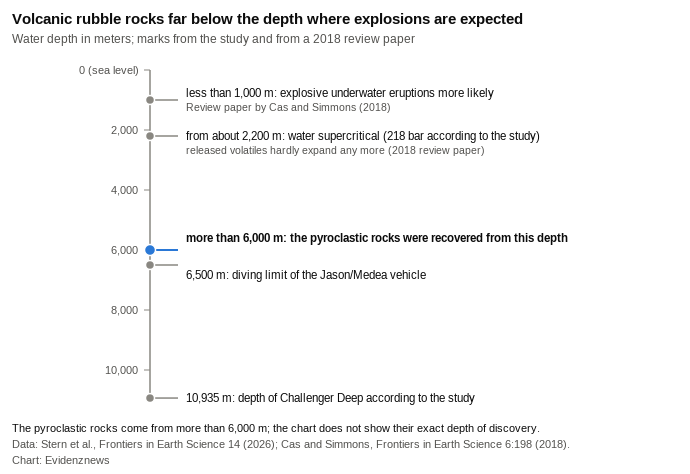
At high pressure, water behaves differently than at the surface. Above the so-called critical point, there is no longer any difference between liquid and vapor; such a supercritical fluid hardly expands. For water, according to the paper, this point lies at 218 bar, which corresponds to a water depth of about 2,200 meters, and for carbon dioxide at 73.8 bar or about 730 meters.
What follows from this for volcanoes on the seafloor is described in a review paper by Cas and Simmons from 2018. According to it, magmas release less gas at great water depth. From about 2,200 meters, the volatiles released are supercritical; they hardly expand any more and, according to the review, do not produce explosive fragmentation through growing gas bubbles. According to it, explosive eruptions are more likely at water depths of less than 1,000 meters, and weak explosions are possible between 500 and 1,500 meters.
If these thresholds are taken as a basis, rocks from an explosive eruption would not be expected at a depth of more than 6,000 meters.
The Authors' Interpretation: A Muted Eruption
Stern and his team consider it likely that the rocks formed during an eruption under supercritical fluid conditions. According to the abstract, such an eruption should be less explosive than one at low pressure. The hypothesis has not been tested. According to the excerpts, the authors did not measure the temperature and water content of the magma; they rely on example calculations and on water contents as generally reported for magmas at volcanic arcs.
The 2018 review also mentions ways in which rubble rocks form without an explosion, for example through rapid quenching. According to the excerpts evaluated, the new paper does not explicitly address this alternative interpretation. The authors assume that supercritical fluids also fragment the magma, but more gently than in eruptions under lower pressure. According to the magazine Science News, Stern himself said that whether the eruptions were actually explosive cannot yet be answered.
In addition: the vents or volcanoes from which the material originates have not yet been found, and there are no radiometric age determinations for the pyroclastic rocks.
According to Science News, the geologist William Chadwick of Oregon State University, who is not among the study's authors, called even the idea of such an eruption at this depth "pretty mind-boggling". According to the report, he considers it possible that Challenger Deep is the only place on Earth where the conditions for explosive volcanism in the extreme deep sea are met.
Volcanism Close to the Trench
According to the excerpts, it is also unusual how close the volcanism lies to the trench. In the section studied, the trench and the axis of the so-called back-arc spreading center are only about 100 kilometers apart. The volcanic rocks in the west lie 40 to 100 kilometers north of the trench, the pyroclastic rocks, according to the text, still considerably closer to it. The excerpts evaluated give no exact distance.
The authors explain it this way: because the southernmost part of the Mariana Trough is stretching, mantle material, the asthenosphere, rises. It meets water from the descending plate, and the mantle partially melts. This too is a hypothesis.
Several Reasons for the Great Depth
The paper does not answer why Challenger Deep is so deep with a single cause. According to the excerpts, the authors name several factors that act together: a tear in the descending plate, the history of the Pacific Plate, which is very old there but, in the authors' interpretation, was probably rejuvenated later, and weak coupling between the plates. In addition there is an unusually tight bend in the descending plate. For this, the authors rely on data from another paper, which was not read for this article, and on the reasoning that narrow pieces of plate bend more under the same load. The bend does not appear in the abstract, and the authors describe their hypotheses as still to be tested.
Science News places the bend at the center of its report, as a hypothesis that at least partly explains the depth. In the paper it is one of several factors.
The explanations build on earlier work. A study by Fryer and colleagues from 2003 linked the depth to a tear in the descending plate, which drives the so-called rollback of the plate and produces greater depths in the south of the trench than elsewhere. Only a fragment of the summary of this paper was available for this article.
In 2004, Gvirtzman and Stern put forward the idea that narrow pieces of plate bend down into the mantle more easily than wide ones. At Challenger Deep, moreover, the zone in which the two plates adhere to each other is exceptionally narrow. Because the descending plate is therefore braked little, it can sink steeply; the two saw in this the reason for the great depth. This account is documented here only via a press release from Stern's university. The new paper continues this line. This is not independent confirmation, because Stern is involved in both papers.
What Remains Open
The authors call their conclusions preliminary because they rest on a very small amount of sample material. According to them, the identification of some rocks on deck, for example as basalt, is partly not supported by the ongoing investigations.
It is open where the pyroclastic rocks come from, how old they are and whether they formed in explosions. It is also open how much the plate bending contributes to the depth compared with the other factors. Which rocks lie on the trench floor at more than 10,000 meters is unknown.
The paper was one day old on November 24, 2026. Until then, the research found no comments by independent experts in journals, no criticism and no follow-up studies; the discussion portal PubPeer could not be queried.
Questions about this article
Comments
Sources
- Primary source Stern RJ, Pujana I, Anderson MK, et al.: ROVing in the deep: tectonic and magmatic complexities of the Challenger Deep forearc segment, Southern Mariana convergent margin. Frontiers in Earth Science 14 (2026). doi:10.3389/feart.2026.1929806
- Context Cas und Simmons: Why deep-water eruptions are so different from subaerial eruptions. Frontiers in Earth Science 6:198 (2018). https://www.frontiersin.org/journals/earth-science/articles/10.3389/f…
- Context Fryer et al.: Why is the Challenger Deep so deep?. Earth and Planetary Science Letters 211, 259–269 (2003). doi:10.1016/S0012-821X(03)00202-4
- Context Gvirtzman und Stern: Bathymetry of Mariana trench-arc system and formation of the Challenger Deep as a consequence of weak plate coupling. Tectonics 23, TC2011; hier nur über die Pressemitteilung der University of Texas at Dallas von 2004 ausgewertet, Stern ist Mitautor, keine unabhängige Quelle (2004). https://news.utdallas.edu/science-technology/geoscientists-from-israe…
- Context Bericht von Science News über die Studie (Carolyn Gramling), 23. November 2026. Science News; Nachrichtenmedium, hier nur für die Einschätzung eines Fachmanns, der nicht zu den Autoren gehört, und für eine Aussage des Erstautors (2026). https://www.sciencenews.org/article/ocean-deepest-spot-explained-challenger