Fine particulate matter above WHO guideline value: 222,000 premature deaths estimated in the EU
Evidence level 3 of 5 · Several independent studies pointing the same way
Key points
- The European Environment Agency estimates that in 2024, 222,000 premature deaths in the 27 EU countries were attributable to long-term exposure to fine particulate matter (PM2.5) above 5 micrograms per cubic meter; this is a statistical attribution from a model calculation, not a count of individual deaths.
- Within the newly recalculated time series, the figure has fallen by 57.2 percent since 2005; according to the agency, the EU target of at least 55 percent by 2030 was reached for the first time in 2023, but because of year-to-year fluctuations this is not permanently secured.
- Because the agency now uses a higher relative risk (1.10 instead of 1.08 per 10 micrograms per cubic meter) and includes adults from age 25 instead of 30, the new values are not comparable with earlier editions, for example with the 182,000 for 2023.
The European Environment Agency (EEA) attributes 222,000 premature deaths in the European Union in 2024 to long-term exposure to fine particulate matter. Only fine particulate matter designated PM2.5 is counted, and only the portion of exposure above 5 micrograms per cubic meter, the guideline value of the World Health Organization (WHO). Compared with 2005, the figure has fallen by 57.2 percent according to the same calculation.
The 222,000 is the result of a model calculation for the population of the 27 EU countries and not a count: nobody established individual deaths for it. The EEA, based in Copenhagen, updated the indicator on November 23, 2026, and changed its method in doing so. The new value therefore cannot be compared with figures from earlier editions.
A calculation, not a count
The agency combines several inputs: modeled fine particulate matter concentrations, population figures and death rates. To these it applies a relative risk taken from meta-analyses of cohort studies, that is, from pooled evaluations of observational studies.
This relative risk is 1.10 per 10 micrograms of PM2.5 per cubic meter, with a 95 percent confidence interval of 1.06 to 1.13. The EEA explains the assumption this way: the risk of dying prematurely rises by 10 percent if the annual mean fine particulate matter concentration is 10 micrograms per cubic meter higher. The calculation applies this to the portion of exposure above 5 micrograms per cubic meter and includes adults aged 25 and older.
This does not yield an absolute risk for individual people; the material evaluated for this article does not allow such a statement.
What the calculation yields are attributable deaths: a statistical attribution under the assumption that fine particulate matter causally increases mortality. These deaths cannot be assigned to individual persons. Which people would not have died without air pollution remains unknown.
The EEA justifies the limit of 5 micrograms by saying that the curve linking concentration and effect is linear and more certain above this value. At the same time, the agency makes clear that there is no evidence of a threshold below which air pollution has no effect on health. The 222,000 is thus neither the total number of deaths from fine particulate matter nor an unavoidable remainder.
New method, recalculated time series
The 2026 edition is the first to follow an updated method recommendation of the WHO Regional Office for Europe from 2025. It goes by the abbreviation HRAPIE-2.
Two changes affect the fine particulate matter figure. The relative risk for all-cause mortality rose from 1.08 (95 percent confidence interval 1.06 to 1.09) to 1.10 (1.06 to 1.13). In addition, the calculation now includes adults aged 25 and older instead of 30 and older as before. Both raise the absolute figure for all years.
The EEA has therefore recalculated the entire time series from 2005 to 2024 with the new method and new input data. In an explanation, it expressly warns against directly comparing the new values with previously published values for the same years. Apparent changes probably reflect the new methodology and not a real change in disease burden. Only years within the new series can be compared.
This affects, for example, a figure from the previous edition: there, the EEA had given 182,000 deaths for 2023 under the old method. That 222,000 is now given for 2024 therefore does not indicate an increase compared with 2023.
According to the EEA, the percentage decline since 2005 remains more or less unaffected by the change, because the whole series from 2005 onward was recalculated. The previous edition had reported a decline of 57 percent for 2005 to 2023. The texts read do not give the absolute figure for 2005.
Other quantities have also changed. The EEA no longer calculates mortality from asthma, and for deaths from individual causes the new relative risks are mostly lower than before. Only for all-cause mortality is the new value higher.
The decline since 2005 and the target for 2030
The decline of 57.2 percent is measured against a political target. The EU's Zero Pollution Action Plan provides that the number of these premature deaths falls by at least 55 percent by 2030; the EEA measures this against the year 2005. According to the agency, the mark was reached for the first time in 2023, and the values for 2024 confirm this.
The agency qualifies this itself. The estimated figures fluctuate from year to year, and it is not a given that the target will remain permanently achieved. The text read does not say what causes the fluctuations. For the 2050 goal, an air quality without harm to health, the measures would have to be continued.
The target is measured solely by PM2.5 above 5 micrograms per cubic meter. The EEA press release speaks more generally of premature deaths from air pollution; nitrogen dioxide and ozone, however, do not count toward the target.
Concentrations have also fallen over this period. The population-weighted PM2.5 concentration in the EU fell from 19.4 micrograms per cubic meter in 2005 to 10.1 in 2024. These are modeled values, not measurements from individual stations, and the value for 2024 is still about twice the WHO guideline value. In 2024, 95.1 percent of the urban population in the EU was exposed to concentrations above this guideline value.
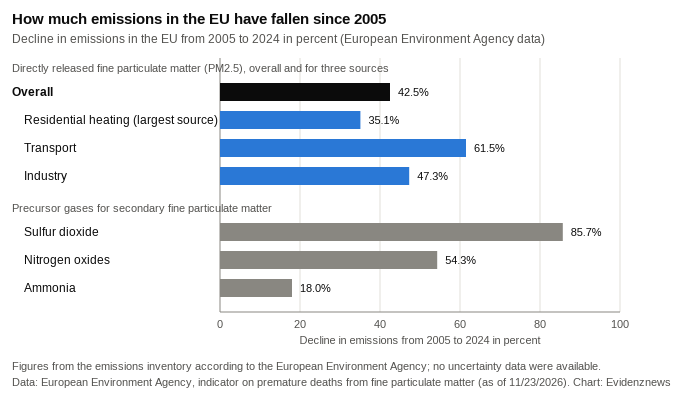
Emissions also declined. Directly released fine particulate matter PM2.5 decreased by 42.5 percent in the EU from 2005 to 2024. For residential heating, according to the EEA the largest source, emissions fell by 35.1 percent, in transport by 61.5 percent and in industry by 47.3 percent.
Fine particulate matter also forms from gases, the precursor gases; this is then called secondary fine particulate matter. Here, emissions of sulfur dioxide fell by 85.7 percent, of nitrogen oxides by 54.3 percent and of ammonia by 18.0 percent.
The EEA attributes the decline in deaths to policy measures. This is an assessment by the agency and was not separately verified. How much is due to measures and how much to other influences, such as death rates or population structure, the texts read do not break down.
Differences between countries
For individual countries, the indicator gives deaths per 100,000 inhabitants. This value fell between 2005 and 2024 in all EU member states, in 22 of them by more than 55 percent. The range runs from a decline of 38.1 percent in Poland to 97.3 percent in Estonia.
Among the 13 countries outside the EU that are covered, the range runs from 23.1 percent in Bosnia and Herzegovina to nearly 100 percent in Iceland. In ten of these 13 countries, it was more than 55 percent.
The EEA continues to see the most severe health consequences of air pollution in Eastern and Southeastern Europe and gives the high pollutant concentrations there as the reason. A topic page of the agency names heating with low-quality solid fuels in inefficient stoves as a cause.
New figures for Germany, Austria and Switzerland were not available for this article: the EEA's data tables were not accessible at the time of research on November 24, 2026. As background, the values from the previous edition remain, calculated under the old method for the year 2023 and for adults aged 30 and older. The country fact sheets of that edition gave 21,640 attributed deaths in Germany (95 percent confidence interval 16,432 to 24,196), 2,608 in Austria and 1,357 in Switzerland. These figures are not comparable with the new series.
How robust the figure is
For the 222,000, the EEA texts read give no confidence interval. According to the agency, the main uncertainty lies in the calculation of the health risk, that is, in the relative risk. Further uncertainties, for example in estimating exposure, are not quantified according to the EEA's 2025 report.
The EEA takes the relative risk of 1.10 from the WHO recommendation HRAPIE-2. This gives concentrations of 5 to 70 micrograms per cubic meter as the range of application; the underlying meta-analysis counts 52 studies. A systematic review by Orellano and colleagues published in 2024 in the International Journal of Public Health, an update of the meta-analysis for the WHO air quality guidelines, arrives, from 53 estimates from 52 studies for all-cause mortality, at a relative risk of 1.095 per 10 micrograms of PM2.5 per cubic meter (95 percent confidence interval 1.064 to 1.127). One of its authors is employed at the WHO Regional Office for Europe. The work is thus close to the WHO, but does not come from the EEA.
The individual studies differ greatly. The heterogeneity measure I² in the review is 99.6 percent, which indicates very large differences between the studies. The 80 percent prediction interval of the pooled effect there runs from 0.966 to 1.241 and thus includes the value 1, which stands for no increased risk. In the WHO compilation, individual estimates lie clearly below 1, for example 0.784 in a Dutch study using administrative data, while others are far above, for example 1.664.
The WHO nevertheless does not downgrade the evidence. It regards the association as causal, relying on earlier causality assessments, including those of the US agency EPA.
The figure also depends strongly on the chosen reference threshold. This is shown by a calculation from the previous edition, under the old method and for the year 2023: with the limit of 5 micrograms per cubic meter, the EEA arrived at 182,000 deaths in the EU. If all concentrations from zero were counted, it would be 346,000. If only concentrations above 10 micrograms per cubic meter were counted, the EU limit value applying from 2030, it would be 55,000. For the recalculated series, no such calculation is present in the texts read.
What remains open
The confidence interval of the 222,000 and the absolute values of the individual years were not available for this article, nor were the new country figures. Evidence for concentrations below 5 micrograms per cubic meter was not evaluated.
A comparison with other estimates was not read. In its 2025 report, the EEA writes on this only in general terms that its figures could differ from others because of concentration maps, demographics, relative risks and reference thresholds. The research found no assessment by independent experts of the 2026 edition; only the methodological foundations, the WHO recommendation and the review are independent of the EEA.
With the indicator, the EEA assesses a political EU target using its own data. The indicator has not been peer-reviewed by a journal.
Questions about this article
Comments
Sources
- Primary source Europäische Umweltagentur (EEA): Premature deaths due to exposure to fine particulate matter in Europe. EEA-Indikator AIR007, Datenstand 2005 bis 2024, mit Pressemitteilung vom 23. November 2026 und Erläuterung zu den Methodenänderungen 2026; Behördenbericht, nicht von einer Fachzeitschrift begutachtet (2026). https://www.eea.europa.eu/en/analysis/indicators/health-impacts-of-ex…
- Context WHO-Regionalbüro für Europa: Health risks of air pollution in Europe: HRAPIE-2 project. Updated guidance on concentration-response functions for health risk assessment of air pollution in the WHO European Region. Methodenempfehlung einer Fachorganisation (2025). https://www.who.int/publications/i/item/9789289062633
- Context Orellano P, Kasdagli M-I, Pérez Velasco R, Samoli E: Long-Term Exposure to Particulate Matter and Mortality: An Update of the WHO Global Air Quality Guidelines Systematic Review and Meta-Analysis. International Journal of Public Health 69, 1607683 (2024). doi:10.3389/ijph.2024.1607683
- Context Europäische Umweltagentur (EEA): Harm to human health from air pollution in Europe: burden of disease status, 2025. Behördenbericht, Vorgängerausgabe derselben Reihe (Daten bis 2023, alte Methode) (2025). https://www.eea.europa.eu/en/analysis/publications/harm-to-human-heal…
- Context Europäische Umweltagentur (EEA): Air pollution quick country facts. Faktenblätter 2025, Länderdaten der Vorgängerausgabe (Daten für 2023, alte Methode) (2025). https://www.eea.europa.eu/en/topics/in-depth/air-pollution/air-pollut…