British survey: 16- to 44-year-olds report having sex less often than in 1990
Evidence level 2 of 5 · Single study, peer-reviewed

Key points
- According to the authors' press release, the reported frequency of sex among 16- to 44-year-olds in Great Britain fell from four times in four weeks (1990) to three (2010) to two (2022 to 2024).
- Among 16- to 24-year-olds, 38 percent of women and 28 percent of men said they had never had sex; previously it was about one in five people.
- The response rate of the address-based sample was 24 percent after 57.7 percent in the previous round, and an analysis by the study team found indications that the bias in the reported answers has changed since 2010.
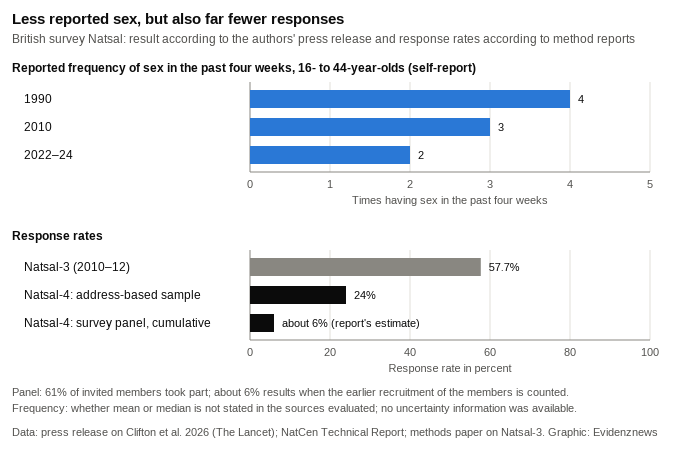
People aged 16 to 44 in Great Britain report having sex less often today than a little over three decades ago. In 1990 they reported sex four times in the previous four weeks, in 2010 three times, and in the most recent survey from 2022 to 2024 twice. This is how the press release on the fourth round of the British survey Natsal summarizes it; the results were published on November 24, 2026 in the journal "The Lancet".
Natsal stands for "National Surveys of Sexual Attitudes and Lifestyles". The work is carried out by a team led by first author Soazig Clifton; University College London, the London School of Hygiene & Tropical Medicine, the University of Glasgow and the National Centre for Social Research (NatCen) are involved.
Two things belong here right away. First, nobody measured behavior: this is a survey, and all figures are self-reports. Second, the full text of the Lancet paper was not available for this article. The result figures come from the authors' press release, which lacks uncertainty information such as confidence intervals. By contrast, how the survey was carried out is well documented, because the study's technical reports are detailed. And they in particular show why the comparison across the decades should be read with caution.
What respondents reported
According to the press release, 77 percent of 16- to 59-year-olds had sex in the past year and 89 percent at least once in their lives. Respondents reported about five sexual partners in their lifetime.
According to the authors, the decline in frequency also shows among 35- to 44-year-olds who had sex: they reported two times a month instead of three times as a decade earlier. Whether the frequency figures are means or medians is not stated in the sources evaluated.
One figure stands out most among the youngest. Of 16- to 24-year-olds, 38 percent of women and 28 percent of men said they had never had sex. Previously it was about one in five people. According to a report by ORF science, this share largely explains the decline in frequency in this age group. How the questionnaire defines "sex" is unclear without the full text.
According to the press release, the share of 16- to 44-year-olds who report same-sex experience at some point in their lives has risen: among women from 7 to 14 percent, among men from 4 to 12 percent. Whether "experience" means sex, attraction or identity is not stated in the sources evaluated. The figure therefore says nothing about how many people consider themselves gay or bisexual.
A survey that went differently than planned
For Natsal-4, a random sample of residential addresses with about 10,000 participants was planned. Then came the COVID pandemic. According to NatCen's technical report, interviewers were lacking and willingness to participate fell. Of eight planned survey waves of the address-based sample, only four took place; by March 2023, only about 1,050 of roughly 2,500 targeted interviews had been conducted.
The team therefore restructured the study. In the end, Natsal-4 consisted of four parts:
- the address-based sample with 2,019 interviews, in person or by telephone, supplemented by a self-completion section;
- a telephone survey with 2,426 interviews and
- an online survey with 2,274 interviews, both in a survey panel run by NatCen, whose members were originally selected at random for another survey, the British Social Attitudes Survey;
- an online quota sample with over 12,000 participants aged 18 to 59 from Ipsos and six other commercial panels, surveyed from March to April 2024.
The first three parts are based on random selection and together come to 6,719 interviews. The fourth part is not: there, participants were put together so that they match the population by age, sex, region and social class. It is meant to supplement the random samples, not replace them. In total, about 19,000 people took part.
The press release speaks of about 6,700 randomly selected respondents, which corresponds to the three random-based parts; it does not mention the quota sample. Which parts went into which trend figure cannot be said without the full text.
Those who do not respond are missing from the picture
The response rate indicates what share of those selected actually take part. In the address-based sample of Natsal-4 it was 24 percent. In the previous round, Natsal-3 (2010 to 2012), it had been 57.7 percent with 15,162 interviews.
The NatCen report places the figure alongside two other British surveys from 2022 and 2023: the Family Resources Survey with 25 percent and the English Housing Survey with 32 percent. Within Natsal-4, people in the most deprived neighborhoods responded less often (23 percent) than in the best-off ones (33 percent).
In the survey panel, 61 percent of the invited members took part, 4,700 of 7,764. But this figure covers only the last stage, because the members had previously been recruited via the British Social Attitudes Survey. If this earlier recruitment is included, the report estimates the response rate across all stages at about 6 percent. According to the report, the panel consists of people who in general like to take part in surveys and differ in this from the overall population. It does not include 16- and 17-year-olds.
The sample is also skewed by sex: in the three NatCen parts, 61 percent of respondents were women and 38 percent men before weighting. The analysis weights the answers and adjusts them for non-participation using sociodemographic characteristics. According to the report's assessment, this probably does not compensate for all biases.
The study team itself warns against the time comparison
The NatCen report explicitly advises caution when making comparisons over time. The questionnaire was revised, new sampling methods and new survey modes were added, and their influences cannot be separated from one another. Sensitive behaviors could also be underreported. Examining changes over time is possible, especially with the address-based sample and with sufficient statistical power, but requires additional checking.
How justified the warning is shows in the study team's own analysis, led by Luke Muschialli, in the journal "Sexually Transmitted Infections". It compared people from the same birth cohorts, 1964 to 1980 and 1981 to 1994, in Natsal-3 and Natsal-4, using answers that should actually no longer change. In Natsal-4, more people reported same-sex sex before 2010 than the same cohorts in Natsal-3. Fewer men reported sex with the other sex before age 16, and fewer women a first pregnancy and live birth before 2010.
The shift was clearest in the 1964 to 1980 cohorts: women and men in this group more often said in the new round that they had never had sexual experience or sex. Within a cohort, this share can logically only fall, never rise. The authors conclude that the bias has changed between the two rounds, through different participants or different response behavior, and that changes can therefore be over- or underestimated.
How large these shifts are is not stated in the abstract that was evaluated. The analysis also concerns older cohorts, not today's 16- to 24-year-olds. It therefore does not prove that their 38 and 28 percent are too high; it only shows that caution is warranted precisely with this kind of answer.
What experts outside the team say
The UK Science Media Centre collected assessments. Otilia Mårdh of the ECDC calls the clearly lower response rate compared with Natsal-3 an important limitation; differences in participation and reporting could affect the comparisons between the rounds.
Kaye Wellings of the London School of Hygiene & Tropical Medicine describes Natsal as an extremely reliable source of data. But it has become hard to reach response rates that allow representative results, and the topic makes the survey especially prone to biased answers. It is possible that how people report on their sex lives has changed more than behavior itself. Wellings does research at one of the participating universities and states that she has no conflicts of interest; whether she was herself previously part of the Natsal team is not stated on the Science Media Centre page.
The research did not find an expert counterposition on the direction of the finding. The criticism concerns the extent and comparability.
A similar direction in the US and Germany
Two surveys from other countries point in a similar direction but measure something different. In the General Social Survey of the US, between 2000 and 2018 the share of 18- to 24-year-old men with no sex in the past year rose from 18.9 to 30.9 percent (adjusted odds ratio for the trend 1.20; 95 percent confidence interval 1.04 to 1.39). Among women of the same age it rose from 15.1 to 19.1 percent, with no statistically established trend (1.03; 0.89 to 1.18). The response rates of this survey ranged between 59.5 and 71.4 percent. The dataset is independent of Natsal, the analysis not entirely: coauthor Catherine Mercer is a co-lead of Natsal.
For Germany, there is an analysis of two representative surveys that looks only at women. In 2005 there were 1,314 women (response rate 53 percent), in 2016 1,345 (65 percent). The share with sexual activity in a partnership in the past year fell from 67 to 62 percent. The authors attribute this mainly to fewer women having a partner, and point out that such snapshots without long-term follow-up of the same individuals can only be interpreted to a limited extent.
What remains open
Above all, the why is open. Coauthor Wendy Macdowall of the London School of Hygiene & Tropical Medicine says, according to the press release, that surveys like Natsal can document changes but not explain what drives them. As possible factors she names, according to the report by ORF science, more public debate about consensual sex, mental illness, less alcohol consumption, living with parents for longer, the pandemic and the online world. These are conjectures; whether and how strongly each of these factors has an effect was not examined by the study.
It is also open how much of the reported decline is due to changed behavior and how much to who takes part in such surveys today and how openly they answer. According to the study's website, the data are to become accessible via the UK Data Archive in early 2027. Independent verification is still pending.
Questions about this article
Comments
Sources
- Primary source Clifton S et al.: Prevalence and trends in sexual behaviour in Britain from 1990 to 2024: findings from the repeated cross-sectional National Surveys of Sexual Attitudes and Lifestyles (Natsal). The Lancet (2026). doi:10.1016/S0140-6736(26)01766-6
- Context National Centre for Social Research (NatCen); Ipsos; Natsal-Team: Natsal-4: Technical Report (NatCen), Technical Report zur Online-Quotenstichprobe (Ipsos) und Übersicht zur Datenerhebung (2026). https://www.natsal.ac.uk/
- Context Muschialli L et al.: Measuring sexual and reproductive health in Britain: changes in bias between Natsal-3 and Natsal-4. Sexually Transmitted Infections, online vorab (2026). doi:10.1136/sextrans-2026-056955
- Context Science Media Centre UK: Expert reaction to NATSAL-4, as published in The Lancet (2026). https://www.sciencemediacentre.org/expert-reaction-to-natsal-4-as-pub…
- Context Methodenpaper zu Natsal-3 (PubMed Central, PMC3933071). https://pmc.ncbi.nlm.nih.gov/articles/PMC3933071/
- Context Ueda P, Mercer CH, Ghaznavi C, Herbenick D: Trends in Frequency of Sexual Activity and Number of Sexual Partners Among Adults Aged 18 to 44 Years in the US, 2000-2018. JAMA Network Open 3(6), e203833 (2020). doi:10.1001/jamanetworkopen.2020.3833
- Context Burghardt J, Beutel ME, Hasenburg A, Schmutzer G, Brähler E: Declining Sexual Activity and Desire in Women: Findings from Representative German Surveys 2005 and 2016. Archives of Sexual Behavior 49, 919–925 (2020). doi:10.1007/s10508-019-01525-9
- Context ORF science: Zunehmend weniger Sex (2026). https://science.orf.at/stories/3238348/