Climbing beans in the lab: merely touching the support does not trigger twining
Evidence level 2 of 5 · Single study, peer-reviewed
Key points
- In laboratory experiments with common beans (Phaseolus vulgaris, variety Helda), the circling shoot pushed a rod suspended as a pendulum with a force that rose and fell sinusoidally; in 164 encounters, the force amplitudes ranged from 0.1 to 2.7 millinewtons, according to the preprint version of the study.
- 106 of the 164 encounters ended in twining and 58 in slipping off: the proportion of twining rose sharply with the resistance of the support when the shoot tip extended more than 1 centimeter beyond the point of contact; with an overhang of 1 centimeter or less, it stayed at about 0.2.
- The authors conclude that touch alone does not trigger twining but that a mechanical threshold must be reached; the deformation of the shoot, which they name as the likely trigger, could not be measured directly in the experimental setup, and only one bean variety was studied, in the lab.
As it grows, the shoot of a climbing bean slowly circles through the air until it hits a support. Whether it then twines around it or slips off again does not depend on touch alone, according to laboratory experiments by a team at Tel Aviv University. The shoot pushes the support with a force that rises and falls regularly, and according to the measurements it twines mainly when the support offers enough resistance and its tip extends far enough beyond the point of contact.
Amir Ohad, Amir Porat and Yasmine Meroz published the work on November 27, 2026, in the journal Science Advances; for Porat, the Sainsbury Laboratory of the University of Cambridge is listed as an affiliation in addition to Tel Aviv University. A single species in one variety was studied: common beans (Phaseolus vulgaris) of the variety Helda, grown in the lab and observed under constant LED lighting. In addition there are computer simulations and a physical model. The measured values in this text come from the version that the team had published in advance on the bioRxiv server on March 18, 2026.
How a bean searches for support
That the shoots of climbing plants circle was described in detail by Darwin. His work on the movements and habits of climbing plants appeared on June 12, 1865, in the Journal of the Linnean Society. By his own account, what drew him to the subject was a short paper by Asa Gray from 1858 on the movements of the tendrils of cucurbits. Specialists call the circling movement circumnutation.
Darwin also noted what it serves in part: it helps the shoot find a support. According to his description, the shoot circles day and night, and the circle widens as the shoot gets longer. When it meets a support, the movement is halted at the point of contact while the free part keeps circling and brings the next point to the support; this is how the shoot twines upward. Darwin compared this to a rope swung around the head: if the end hits a stick, it wraps around it.
Darwin also measured the circling times. For the common bean he noted an average of 1 hour and 57 minutes over three revolutions; some plants in his work needed 24 hours for one revolution. The beans in Tel Aviv needed 98 minutes on average, with a standard deviation of 11 minutes. The values cannot be compared directly, because variety, temperature and light differ.
A good deal depends on the search for the plant. According to a review from 2015, climbing plants that find a suitable support have higher performance and fitness than those that stay on the ground.
How the team measured the force of a shoot
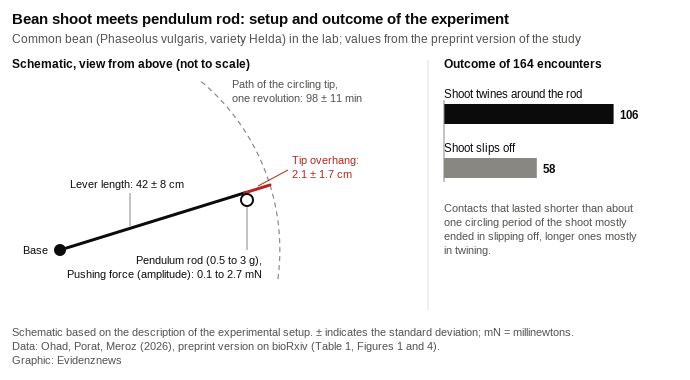
For the measurement, the team hung a light rod as a pendulum next to the plant. When the circling shoot hits the rod, it deflects it. Two cameras, one from above and one from the side, record rod and shoot, and the researchers calculate the force with which the shoot pushes from the deflection angle. The shoot is not tied down anywhere. The pendulums weighed 0.5 to 3 grams; in addition there were experiments with 0.08 grams and with a fixed rod.
In 164 such encounters, the force amplitudes ranged from 0.1 to 2.7 millinewtons. For context: one newton corresponds to the weight force of about 102 grams, so 2.7 millinewtons to that of just under 0.3 grams and 0.1 millinewtons to that of around 10 milligrams. The course was regular. The force rose and fell again like a sine curve; if time and force are scaled to the respective period and amplitude, all 164 traces fall onto a common curve. A simulation with a rod model reproduces this pattern.
The team then determined the radius and elastic modulus of the shoot segments, a measure of stiffness. The tip is softest; further down, the shoot becomes thicker and stiffer. For what happens at the support, the authors propose an image from mechanics: the shoot behaves like a cantilever, a beam clamped at one end, acted on by a rotating load. The external torque, that is, force times lever arm, and the internal bending moment of the stem balance each other.
In the simulation, the maximum force rises linearly with the stiffness of the stem and falls with a longer lever arm. In the measurements on the plants, the same trends appear, but weaker. In the experiment, the balance of torques holds only over a middle range of contact points. If the contact point is far from the tip, the torque no longer rises; according to the authors, this could reflect an upper limit to the force the plant can produce.
When the shoot twines and when it slips off
Of the 164 encounters, 106 ended with the shoot twining around the rod and 58 with it slipping off. The outcome was related, on the one hand, to the resistance of the support: the more resistance the rod offered, the larger the proportion of plants that twined. It was highest with a fixed rod, for which 17 encounters are available.
On the other hand, geometry matters. If the tip extended 1 centimeter or less beyond the point of contact, the proportion of twining stayed at about 0.2, that is, about one fifth, and hardly depended on the resistance. With an overhang of more than 1 centimeter, it rose sharply with resistance. By their own account, the authors chose the limit of 1 centimeter arbitrarily. On average, the overhang was 2.1 centimeters (standard deviation 1.7 centimeters), and the lever length from the base of the shoot to the point of contact was 42 centimeters (standard deviation 8 centimeters). The overhangs differed clearly between twining and slipping off (Kruskal-Wallis test, p = 7 × 10⁻¹⁰).
The maximum external torque also differed clearly between the two outcomes (p = 2 × 10⁻⁶). The authors read this as an indication of a deformation threshold that the shoot must reach before it twines. The deformation itself could not be measured directly in the experimental setup; the threshold is inferred from the measured external torque.
The duration of the contacts fits this. Contacts that were shorter than about one circling period of the respective shoot mostly ended in slipping off, longer ones mostly in twining (p = 8 × 10⁻¹⁷). The time until slipping off grew with the overhang. According to the team's observations, twining begins when the shoot reaches an angle of about 45 degrees to the pendulum.
What the turntable experiment showed
In another experiment, the team intervened in the circling movement. A plant stood on a motor-driven turntable in front of a fixed rod. When the turntable turned in the circling direction of the shoot or against it, the effective circling frequency relative to the rod changed.
With faster effective rotation, twining set in earlier, even within minutes, and thus much faster than without intervention. Slower rotation delayed twining. When the rate was below 0.25 revolutions per hour, twining failed to occur for several hours or altogether; after the motor was switched off, it set in again. For comparison: the circling period of 98 minutes on average corresponds to about 0.6 revolutions per hour.
The authors summarize this in a curve according to which the time until twining scales inversely with the effective circling rate. The fit to the data points, however, has a low coefficient of determination (R² = 0.53). From these experiments, the authors conclude that touch alone is not enough to trigger twining.
Why the authors speak of embodied sensing
The authors call the process "embodied". This means that body structure and material properties encode functions and responses without central control; in robotics this is called morphological computation. A plant has neither a brain nor a nervous system. In the bean, according to the team's interpretation, it would look like this: the tip is softest and too short to grasp, and further down the shoot becomes stiffer. This gradation could indicate whether a support can be grasped and how much resistance it offers, without a central decision being necessary. That form and stiffness were tuned to this task over the course of evolution is only proposed by the authors; they have not tested it.
The team compares the plant's approach with the active sensing of cats and rodents, which use their whiskers for it. Active sensing is a term from animal research: according to a review article from 2011, active sensory systems are goal-directed and seek information, mostly by moving the sensor, such as antennae, whiskers or fingertips. The transfer to the bean is an interpretation by the authors, not a measurement result.
The authors distinguish stem twiners from tendrils. Tendrils respond to local touch: in thigmotropism, a directed growth movement in response to touch, the touched side grows more slowly, the plant bends toward the object and sometimes coils around it. Stem twiners, by contrast, commit only when a critical mechanical threshold is reached at the level of the whole organ, according to the team's conclusion. Tendrils and stem twiners were not compared in the experiment.
Darwin had already tested whether twining stems respond to touch. He rubbed many shoots harder than is necessary to make a tendril move, and he tied a forked twig to shoots of hop and three other plants, which circled along and pressed on one side only. He saw no effect. He concluded that twining stems are not irritable, but did not want to claim that they never are. The new work asks something different: not whether the stem responds to rubbing, but at which forces and which geometry twining sets in.
How the finding fits earlier work
Other groups have already dealt with the mechanics of twining, but for the phase after contact. A model by Goriely and Neukirch from 2006 describes the twining shoot as a growing elastic rod. It found that the contact pressure generates tension in the stem, as is observed, and that there is a maximum radius of the pole that a twiner can climb. The review from 2015 describes what happens on supports that are too thick: herbaceous twining plants that come upon a very thick trunk wind up on themselves instead of twining around it. Darwin had already pointed to this problem.
That climbing plants take properties of a support into account during the search is also supported by a study from the University of Padua from 2023, with a different species and a different method. Pea plants, whose movement was recorded in three dimensions, moved differently depending on whether one or two supports were offered, and preferred thin over thick supports.
How far the bean values can be transferred is open. A comparative study from the University of Montpellier from 2022 examined 190 searcher shoots of 29 climbing plant species from 21 families; the maximum reach of the shoots ranged from 0.1 to 2.5 meters depending on the species. There, stem twiners had lighter, more slender and less bending-stiff shoots than tendril climbers, with relatively stiff material.
What remains open
One species in one variety was studied in the lab, with a pendulum rod as the support. The team did not measure in the field or on other species.
The suspected trigger was not measured directly. The authors infer the deformation of the shoot from the external torque and call it the likely mechanical trigger. The setup records the force only in the image plane, and the model neglects growth as well as differences in radius, stiffness and intrinsic curvature along the shoot.
The measurements support the model less well than the simulation does. Where the simulation yields straight lines with a coefficient of determination of 0.99, the measured data reach 0.4 to 0.5. The simulations also use elastic moduli of 10, 50 and 100 megapascals, while the bean stems at the point of contact had an average of 2.6 megapascals; the simulated stems are thus about 4 to 38 times as stiff. The authors call the values of the same order of magnitude but not identical, and justify the choice with shorter computing time. They have made data and analysis programs openly available.
Questions about this article
Comments
Sources
- Primary source Ohad A, Porat A, Meroz Y: Embodied mechanical sensing through self-generated motion in climbing plants. Science Advances 12(48), eaej2582 (2026). doi:10.1126/sciadv.aej2582
- Context Ohad A, Porat A, Meroz Y: Circumnutations drive embodied mechanical sensing and support selection in twining plants. bioRxiv, Version 1 vom 18.03.2026; Vorabfassung der Science-Advances-Arbeit (2026). https://doi.org/10.64898/2026.03.16.712031
- Context Darwin C: On the movements and habits of climbing plants. Journal of the Linnean Society (Botany) 9, 1–118; Volltext bei Darwin Online (1865). https://darwin-online.org.uk/converted/published/1865_plants_F834a.html
- Context Gianoli E: The behavioural ecology of climbing plants. AoB Plants 7, plv013; Übersichtsarbeit (2015). doi:10.1093/aobpla/plv013
- Context Hattermann T, Petit-Bagnard L, Heinz C, Heuret P, Rowe NP: Mind the Gap: Reach and Mechanical Diversity of Searcher Shoots in Climbing Plants. Frontiers in Forests and Global Change 5, 836247; Vergleichsstudie (2022). doi:10.3389/ffgc.2022.836247
- Context Goriely A, Neukirch S: Mechanics of climbing and attachment in twining plants. Physical Review Letters 97, 184302; Modellstudie (2006). doi:10.1103/PhysRevLett.97.184302
- Context Wang Q, Guerra S, Bonato B, Simonetti V, Bulgheroni M, Castiello U: Decision-Making Underlying Support-Searching in Pea Plants. Plants 12(8), 1597 (2023). doi:10.3390/plants12081597
- Context Prescott TJ, Diamond ME, Wing AM: Active touch sensing. Philosophical Transactions of the Royal Society B 366, 2989–2995 (2011). doi:10.1098/rstb.2011.0167
- Context Thigmotropism. Wikipedia (englisch), Lexikoneintrag. https://en.wikipedia.org/wiki/Thigmotropism
- Context Newton (Einheit). Wikipedia (deutsch), Lexikoneintrag. https://de.wikipedia.org/wiki/Newton_(Einheit)