Four Teeth from Southern China: One Denisovan-Related Lineage and One Unresolved
Evidence level 2 of 5 · Single study, peer-reviewed
Key points
- According to a study in Nature, four individual teeth from the caves Chuanshandong and Longchuandong in the southern Chinese region of Guangxi are more than 100,800 years old and 104,500 to 42,600 years old, respectively; a team led by Song Xing examined their shape, their age and, for three of the teeth, proteins from the tooth enamel.
- The two teeth from Longchuandong closely resemble the Denisovans from the Altai in shape and carry a protein variant that fits Denisovans; the same variant also occurs in East Asian Homo erectus, however, and the authors speak of a population related to Denisovans.
- The tooth examined from Chuanshandong does not carry this variant, but rather an ancestral one that Homo antecessor and great apes also have; the authors present the find as an unresolved archaic form of the genus Homo and call the family-tree placement from the limited protein data preliminary.
According to a new study, four individual teeth from two caves in the southern Chinese region of Guangxi come from two different human lineages. The two teeth from Longchuandong Cave closely resemble the Denisovans from the Siberian Altai in shape and carry protein variants that fit them. The two teeth from Chuanshandong Cave show no clear affinity to the Denisovans; the authors present them as an unresolved archaic form of the genus Homo.
The study was published on November 25, 2026, in the journal Nature. The first author is Song Xing of the Institute of Vertebrate Paleontology and Paleoanthropology (IVPP) of the Chinese Academy of Sciences in Beijing, who is also affiliated with the Spanish research center CENIEH in Burgos; the corresponding author is Qiaomei Fu of the IVPP. It is a descriptive fossil study: the team compared the tooth shapes, determined the age of the teeth and analyzed proteins from the tooth enamel. No DNA is available from the teeth.
Where the Teeth Come From and How Old They Are
The caves Chuanshandong and Longchuandong are located in the counties of Long'an and Luzhai, which belong to the cities of Nanning and Liuzhou. According to the CENIEH, surveys by the IVPP and the Guangxi Institute of Cultural Relics Protection and Archaeology led to the finds. In 2021, two premolars were recovered in Chuanshandong, and one premolar and one molar in Longchuandong.
According to the CENIEH, the region is rich in Pleistocene mammal fossils, but remains of human forms from that time are hardly known there. No stone tools were found with the teeth.
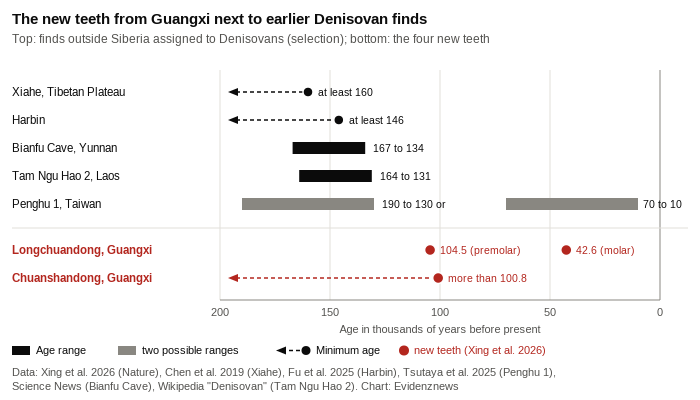
The team determined the age using the uranium-series method on the teeth themselves; in Chuanshandong it also dated the find layer by luminescence. For Chuanshandong, the study gives more than 100,800 years. The two premolars from there could come from a single individual. In Longchuandong, the results were 104,500 years for the premolar and 42,600 years for the molar. According to the authors, there can be a gap between the age of a tooth and the time at which it was embedded in the cave floor.
How Shape and Proteins Were Evaluated
For the shape comparison, the team used calipers, a scoring system for dental features, and micro-computed tomography. Among other things, the outline of the tooth crown and the interface between enamel and dentin were evaluated. Homo erectus, archaic human forms of East Asia, Denisovans, Neanderthals and Homo sapiens served as comparisons.
Because the warm, humid climate of southern China makes the preservation of ancient DNA difficult, the team relied on paleoproteomics, the analysis of preserved proteins. Enamel proteins could be obtained from three of the four teeth: from both teeth from Longchuandong and from the right premolar from Chuanshandong. At individual positions of the protein sequence, human groups differ in one amino acid. Such variants carry much less information than a genome, however, as the paleoanthropologist John Hawks notes in his blog, in paraphrase.
All three teeth examined come from male individuals, according to the team. The team infers this from peptides that occur only in the Y-chromosomal form of the protein amelogenin, abbreviated AMELY.
What Points to an Affinity with the Denisovans
According to the CENIEH, the molar from Longchuandong strikingly resembles a fossil from Denisova Cave in the Altai. Both teeth from the cave resemble archaic human forms of the Late Middle Pleistocene in East Asia in shape.
Then there are the proteins. Both teeth carry a variant called 273V in the protein abbreviated AMBN. According to the study, their variants match those of Denisovans from Harbin, Penghu, Bianfu Cave and the Altai.
This variant is not an unambiguous marker, however. In an earlier study, the same research group had found it in six Homo erectus teeth from China that were about 400,000 years old. The authors consider it very likely that the variant found in Denisovans was inherited from Homo erectus. The assignment therefore rests on the combination of tooth shape and protein variants, and the authors speak of a "Denisovan-affinity population".
In shape, the molar also cannot be clearly separated from Neanderthals. This need not point to admixture, the authors write; the features might have only limited diagnostic value. The premolar and other features separated Denisovans from Neanderthals.
Why the Teeth from Chuanshandong Do Not Fit the Picture
The premolar examined from Chuanshandong does not carry the variant 273V. Instead, the team found two others. One, in the protein AMELY, is an ancestral variant: the tooth shares it with Homo antecessor from the Sierra de Atapuerca in Spain and with great apes, and it is absent in Neanderthals, Denisovans and Homo sapiens. The other, in the protein AMBN, occurs in late East Asian Homo erectus.
In the family tree that the team calculated from the protein sequences, the tooth stands as a sister group of the common ancestor of Neanderthals, Denisovans and Homo sapiens. The authors call this conclusion from the limited protein data preliminary.
The shape, too, fits no known group. According to the study, the two premolars retain features that are typical of Homo erectus and rare in Neanderthals or Homo sapiens, and alongside them show derived features of later human forms. They cannot be assigned to any known East Asian human form.
The authors suggest that the human from Chuanshandong may belong to an ancestral lineage that could have survived in a geographic refuge area into the Late Pleistocene. As plausible explanations for the unusual combination of features, they also name an admixture of archaic human forms in southern China or gene flow from Homo erectus. These are interpretations, not measurement results.
How the Finds Fit the Previous Picture of the Denisovans
The first find of the Denisovans was a finger bone of a juvenile, discovered in 2008 in Denisova Cave in the Siberian Altai. It was recognized as a separate group in 2010 on the basis of mitochondrial DNA. Until 2019, the cave was the only known source of Denisovan remains. Traces of the group are found in the genomes of present-day humans; one estimate gives about 5 percent in Melanesians, Australian Aboriginal people and Philippine Negritos, another around 2.0 percent in Oceanians.
The first find outside the Altai was a mandible from Xiahe on the Tibetan Plateau, at least 160,000 years old and identified via proteins. Added to this were the skull from Harbin, at least 146,000 years old and previously described as a separate species, Homo longi, and the mandible Penghu 1 from the Taiwan Strait, for which two age ranges are possible: 130,000 to 190,000 or 10,000 to 70,000 years. In Bianfu Cave in the southwestern Chinese province of Yunnan, protein and micro-CT analyses document at least three Denisovans who lived about 167,000 to 134,000 years ago.
The research group around Tsutaya, which examined Penghu 1, concluded from this that Denisovans also lived in warm and humid regions. One week before the new study, on November 18, 2026, two papers appeared in Nature on nine teeth from the caves Naxian and Baxian, which are also in Guangxi. They are dated to roughly 324,000 to 184,000 years ago; the authors assign eight of them to Homo erectus based on shape.
Xing and his coauthors summarize that in subtropical China, different human populations could have lived in the Middle and Late Pleistocene, among them one related to Denisovans and another, unresolved archaic form.
What Remains Open
The assignment of the teeth from Longchuandong hinges on a protein variant that also occurs in Homo erectus. John Hawks had objected to the earlier study by the same group that, with only two informative amino acid changes, the conceivable scenarios could not be told apart; proteins alone could not reliably identify the group. His objection did not concern the new study.
For Chuanshandong, it is open whether the teeth come from a separate, ancestral lineage or whether admixture and gene flow explain the features. The statements rest on four individual teeth from two caves. They say nothing about body build and lifestyle, and whether both lineages lived at the same time is not documented.
The age value for Chuanshandong is a minimum age. No DNA that could test the assignment is available. According to the CENIEH, the researchers consider further fossil finds and molecular evidence necessary.
Questions about this article
Comments
Sources
- Primary source Xing S, Rao H, Xie G, et al.: Middle–Late Pleistocene Denisovans and unresolved Homo in southern China. Nature (2026). doi:10.1038/s41586-026-11341-6
- Context Tsutaya et al.: A male Denisovan mandible from Pleistocene Taiwan. Science 388, 176–180 (2025). doi:10.1126/science.ads3888
- Context Fu et al.: Enamel proteins from six Homo erectus specimens across China. Nature 655, 141–147; gleiche Arbeitsgruppe (2026). doi:10.1038/s41586-026-10478-8
- Context John Hawks: Rethinking Homo erectus and Denisovans with ancient proteins. Blog, 15.05.2026, nicht begutachtet (2026). https://www.johnhawks.net/p/rethinking-homo-erectus-and-denisovans
- Context Chen et al.: A late Middle Pleistocene Denisovan mandible from the Tibetan Plateau. Nature 569, 409–412 (2019). doi:10.1038/s41586-019-1139-x
- Context Fu et al.: The proteome of the late Middle Pleistocene Harbin individual. Science 389, 704–707 (2025). doi:10.1126/science.adu9677
- Context Newfound fossils are spilling Denisovan secrets. Science News, Magazinbericht (2026). https://www.sciencenews.org/article/new-fossils-denisovan-secrets-china
- Context Denisovan. Wikipedia (englisch), Lexikonartikel. https://en.wikipedia.org/wiki/Denisovan
- Context Denisovan remains and an unknown archaic human lineage discovered in southern China. Pressemitteilung des CENIEH, Wiedergabe bei Phys.org, 27.11.2026 (2026). https://phys.org/news/2026-11-denisovan-unknown-archaic-human-lineage.html
- Context Liao et al.: Evidence for late Middle Pleistocene Homo erectus in mainland East Asia. Nature (2026). doi:10.1038/s41586-026-11271-3