Copenhagen: Semen Quality of Young Men Barely Changed From 1996 to 2022
Evidence level 2 of 5 · Single study, peer-reviewed
Key points
- In annual examinations from 1996 to 2022, the median sperm concentration among 8320 young men from the Copenhagen area was 45 million per milliliter; the authors speak of slight changes.
- Between the years 1996 to 2000 and 2017 to 2022, the median rose from 44 to 49 million per milliliter; dispersion and a significance test were not available for this comparison, and the authors caution that it could be random fluctuation.
- 36 percent of the participants had at least one semen value below the reference values of the World Health Organization; the study did not measure fertility.
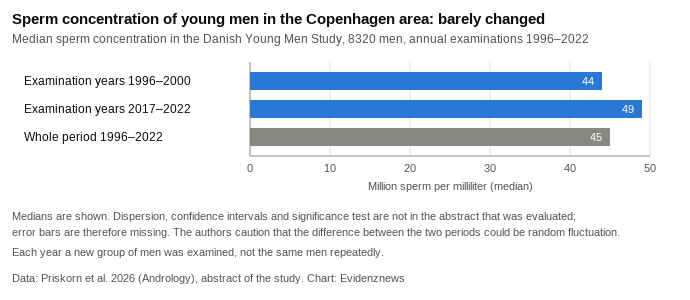
The semen quality of young men in the Copenhagen area changed only slightly between 1996 and 2022. This is reported by a team led by Lærke Priskorn of the Copenhagen University Hospital Rigshospitalet in the journal "Andrology." Over the whole period, the median sperm concentration was 45 million per milliliter. The median is the value that divides a group into two equal halves.
The researchers found no decline in these 26 years. They still do not give the all-clear: in their abstract they describe semen quality as persistently low, with fluctuations over time. Even the title of the paper speaks of slight changes, not of proof that there is no decline.
For this article, only the abstract of the study was available. The full text is freely licensed, but was not reachable at the time of retrieval. Information from tables and figures, such as measures of dispersion, significance tests and the participation rate, is therefore missing.
Each year a new group at the conscription examination
The data come from the Danish Young Men Study. It is an observational study in humans. The participants were recruited in connection with the compulsory military conscription examination and came from the general population. In total there were 8320 men.
The men provided semen, urine and blood samples, filled out a questionnaire and were physically examined. This took place in every year from 1996 to 2022, each time with a new group. The study therefore does not follow the same men over time. The trend it describes is a comparison of successive cohorts. Whether there was a trend over the examination years was tested by the team with linear regression, a method that fits a straight line through the measured values.
Four measures, small shifts
Several measures were evaluated. Sperm concentration states how many sperm a milliliter of ejaculate contains. Total sperm count refers to the entire ejaculate; its median was 141 million. In addition there are the proportion of sperm that move forward, median 61 percent, and the proportion with normal shape, median 6.5 percent. How the study defines these categories exactly is not stated in the abstract.
According to the authors, these values remained relatively stable over the years. For the most recent period they report a moderate improvement: in the years 2017 to 2022 the median sperm concentration was 49 million per milliliter, in the years 1996 to 2000 it was 44 million. That is a difference of 5 million per milliliter between two medians. Dispersion, confidence interval and significance test for this comparison are not given in the abstract. Whether the difference is statistically reliable cannot be read from it.
The authors themselves urge caution. As a possible explanation they name more favorable environmental or lifestyle factors, possibly in connection with the Covid-19 period. They have not tested this assumption, and they explicitly write that the improvement could also be random fluctuation.
One third below at least one reference value
Over the 26 years, 36 percent of the participants had at least one semen value below the reference values of the World Health Organization (WHO). The authors' assessment that semen quality is persistently low rests on this comparison. Which edition of the WHO reference values they used is not apparent from the abstract.
A value below a reference value does not mean that a man is infertile. The study recorded neither the fertility of the participants nor pregnancies. M. Carroll of Manchester Metropolitan University, who was not involved in the study, points out in a scientific commentary that sperm count alone does not determine fertility.
In addition, the team arranged sperm concentration by birth cohort. From the earliest cohorts (1976 to 1980) to the latest (2001 to 2004) it rose slightly. This coincides in time with the incidence of testicular cancer among Danish men no longer increasing after an earlier rise. The authors see in this a correspondence between the two courses. What is shown is a parallel in time, not a causal connection.
How this fits with the thesis of a worldwide decline
The debate into which the finding falls revolves mainly around two meta-analyses by a team led by H. Levine. A meta-analysis statistically combines many individual studies. The more recent one, published online in November 2022, evaluated 223 studies with samples from the years 1973 to 2018. It fits a straight line through the means of the individual studies over the survey years.
For men from all continents who were not selected for their fertility, this model found: mean sperm concentration fell by 1.17 million per milliliter per year (95 percent confidence interval 0.68 to 1.66), total sperm count by 4.70 million per year (2.83 to 6.56). From this the authors calculate for the period from 1973 to 2018 a decline of 51.6 percent in concentration and of 62.3 percent in total count. These percentages are relative figures, based on model values; absolute starting and end values are not given in the abstract of the meta-analysis. After the year 2000, the decline is said to have accelerated. The predecessor paper of 2017 with 185 studies and 42,935 men had reported a decline for Western countries, and no significant trends for South America, Asia and Africa.
The Copenhagen series does not refute these analyses. It begins in 1996, that is, only in the second half of the period covered by the meta-analysis, and it covers a single region, one age group and a single selection route. For this group it shows no decline in the years 1996 to 2022. What happened earlier or what is happening elsewhere, it cannot show.
The two papers are not independent of each other in any case: Niels Jørgensen, last author of the Danish study, is a coauthor of the 2022 meta-analysis. An earlier analysis of the same cohort for the years 1996 to 2016 also reported an unchanged average sperm count in its title.
Dispute over the measurement methods
Whether the worldwide decline is real is disputed in the field. This is shown by statements that the British Science Media Centre collected on the meta-analysis in 2022. Allan Pacey of the University of Sheffield expressed doubts about the data quality of the underlying papers; in his assessment, better training in counting and quality controls in the laboratories could explain a large part of the trend. Richard Sharpe of Edinburgh, by contrast, considered the decline likely to be worldwide. Two further voices counter the methodological objection: Channa Jayasena of Imperial College London said that the established methods by which sperm counts are reported had hardly changed over the period, and Sarah Martins da Silva of Dundee pointed out that all studies had used the same counting method.
This year, M. H. Dahan of McGill University in Montreal followed up. In an essay that is an argument and not a new measurement, he considers the evidence for a long-term decline to be considerably weaker than its prominence suggests. The apparent decline is, to a large extent, a consequence of methodologically non-equivalent data being compared: manual and computer-assisted analyses, changing WHO criteria, different laboratory standards, differently selected participants and abstinence times. This does not show that there was no decline, but calls into question whether it has been cleanly demonstrated.
A series collected by a single research group over 26 years could be less affected by such comparison problems. Whether the laboratory in Copenhagen worked consistently over the years, however, is stated in the full text, which was not available for this article. In his commentary, Carroll concludes that newer studies such as the Danish one cannot simply override the large worldwide analyses, but show why caution is warranted in interpretation.
What remains open
The study does not settle the question of whether sperm counts are falling worldwide. It is also open whether the slight rise of recent years will last, whether the results hold beyond the Copenhagen area and beyond men at conscription examinations, and how many of those examined actually participated. Why the values are what they are, the study did not investigate.
Questions about this article
Comments
Sources
- Primary source Priskorn L, Baslund-Storch C, Hansen LS et al.: Marginal Changes in Semen Quality Over Three Decades (1996-2022) Among 8320 Men in the Danish Young Men Study (DYMS): Cohort Profile and Trends. Andrology, online vorab (2026). doi:10.1111/andr.70383
- Context Levine H, Jørgensen N, Martino-Andrade A, Mendiola J, Weksler-Derri D, Jolles M, Pinotti R, Swan SH: Temporal trends in sperm count: a systematic review and meta-regression analysis of samples collected globally in the 20th and 21st centuries. Human Reproduction Update 29(2), 157 (2023). doi:10.1093/humupd/dmac035
- Context Levine H et al.: Temporal trends in sperm count: a systematic review and meta-regression analysis. Human Reproduction Update (2017). doi:10.1093/humupd/dmx022
- Context Science Media Centre: Expert reaction to study of sperm counts over time (2022). https://www.sciencemediacentre.org/expert-reaction-to-study-of-sperm-…
- Context Dahan MH: Methodological heterogeneity as a confounding variable in reported trends in human sperm parameters: a critical reappraisal. Reproductive BioMedicine Online 53(6), 105975 (2026). doi:10.1016/j.rbmo.2026.105975
- Context Carroll M: Sperm counts may be falling, but humans are unlikely to run out. The Conversation, hier in Zweitveröffentlichung (2026). https://www.nationaltribune.com.au/sperm-counts-may-be-falling-but-hu…
- Context Priskorn L et al.: Average sperm count remains unchanged despite reduction in maternal smoking: results from a large cross-sectional study with annual investigations over 21 years. Human Reproduction 33(6) (2018). doi:10.1093/humrep/dey090