Long-term antidepressants: three drugs ahead of fluoxetine, thin evidence
Evidence level 4 of 5 · Systematic review or meta-analysis

Key points
- A network meta-analysis in the journal The Lancet Psychiatry evaluated randomized, double-blind trials of 21 antidepressants in adults with major depression that lasted longer than twelve weeks; in total 115 trials with 30,428 participants.
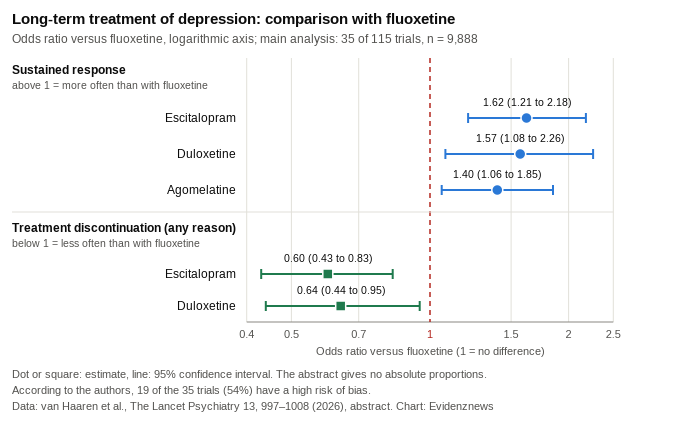
- In the main analysis (35 trials, 9,888 participants), the odds ratio for sustained response compared with fluoxetine was 1.62 for escitalopram (95 percent confidence interval 1.21 to 2.18), 1.57 for duloxetine (1.08 to 2.26) and 1.40 for agomelatine (1.06 to 1.85); absolute proportions are not given in the abstract.
- According to the authors, 19 of the 35 trials (54 percent) have a high risk of bias; which drug is suitable for an individual person cannot be derived from the analysis.
In the long-term treatment of depression, an improvement that had been achieved was maintained more often with three drugs than with the comparator drug fluoxetine: with escitalopram, duloxetine and agomelatine. This is the result of an analysis of randomized trials published on November 10, 2026, in the journal The Lancet Psychiatry. The authors qualify their result themselves: the certainty of the evidence and the risk of bias of the trials could limit reliability.
The first author is Paul van Haaren, the last author Henricus Ruhé, both of Radboud University Medical Center in Nijmegen. The 14 authors include researchers from Amsterdam, Oxford, Bern and Japan, among them Toshi Furukawa (古川壽亮) and Aran Tajika (田近亜蘭) of Kyoto University. The team did not treat any patients of its own but pooled published trials in adults with major depression, at the level of whole trials.
For this article, only the freely readable summary of the paper was available, the abstract. The full text is behind a paywall.
115 trials, but 35 for the main result
The team searched several literature databases and regulatory agency websites up to March 27, 2026. Included were randomized, double-blind trials that compared one of 21 antidepressants with another antidepressant or with placebo for longer than twelve weeks. From 54,231 records, 115 trials with 30,428 participants remained. Their mean age was 45.3 years, and 66 percent were women.
The main results, however, rest on a smaller part: on 35 trials with 9,888 participants. These are the trials in which drugs were tested directly against each other, in technical terms with a continuation or continuation-extension design. The remaining trials follow a different pattern, the so-called enrichment design: first the participants are stabilized on a medication, then they either continue it or switch to placebo. These trials entered only a check calculation, the sensitivity analysis, by a computational detour, a chain of comparisons.
A network meta-analysis combines direct comparisons from individual trials with indirect ones that only emerge computationally from the network of all trials. Fluoxetine, not placebo, served as the reference point for the comparisons here.
Two outcomes were measured. The first is sustained response. An earlier paper from the group around Furukawa describes it like this: someone responds to the acute treatment and does not suffer a depressive relapse in the subsequent maintenance phase. The second outcome is discontinuation of treatment for any reason; it is considered a measure of how well a drug is accepted. The team had already specified both outcomes in 2019 in a published and registered protocol.
What came out
The results are given as odds ratios. This measure compares odds; a value of 1 means no difference from the reference drug. For sustained response, the odds ratio compared with fluoxetine was 1.62 for escitalopram (95 percent confidence interval 1.21 to 2.18), 1.57 for duloxetine (1.08 to 2.26) and 1.40 for agomelatine (1.06 to 1.85).
The confidence interval gives the range in which the true value plausibly lies according to the data. For duloxetine and agomelatine, it extends close to 1.
An odds ratio is not a ratio of probabilities. A value of 1.62 therefore does not mean that sustained response would be 62 percent more likely. How many participants actually achieved it under fluoxetine and under the other drugs is not stated in the abstract. Without these absolute proportions, it is impossible to say how large the difference is for those affected.
For discontinuation of treatment, the abstract reports a more favorable result than for fluoxetine for two drugs: the odds ratio was 0.60 for escitalopram (0.43 to 0.83) and 0.64 for duloxetine (0.44 to 0.95). Values below 1 mean less frequent discontinuation here. The absolute rates are also missing from the abstract on this point.
For bupropion and reboxetine, the abstract reports a lower sustained response than for four other antidepressants; which ones these are is not stated there. With reboxetine and milnacipran, participants discontinued treatment more often than with six and four other drugs, respectively. According to the authors, the check calculation with the enrichment trials confirmed the results; the abstract contains no figures on this.
How robust this is
Of the 35 trials in the main analysis, the authors classified 19 as trials with a high risk of bias, which is 54 percent. They call for more trials that test drugs directly against each other. Their conclusion is correspondingly cautious: antidepressants can differ in how well they maintain an improvement and how well they are accepted. The findings could support shared decision-making by patients, prescribers and relatives.
There is also the matter of duration. According to the Kyoto University press release of November 11, most trials lasted 24 to 52 weeks; comparative data beyond one year are limited. "Long-term" in this analysis therefore mostly means months, not years.
The Kyoto University press release is more definite than the paper. Its title says, in essence, that long-term efficacy has been clarified; it emphasizes the 115 trials and does not mention the 35 trials of the main analysis. The press release of Radboud University Medical Center points out that agomelatine carries a risk of liver failure. This point is not in the abstract.
Since November 19, 2026, a correction to the paper has been recorded. Its content was not viewable for this article; whether it changes any figures is open. The odds ratios in the abstract match those in the press release of November 11.
Two expert voices, two readings
Sameer Jauhar of Imperial College London told the British Science Media Centre that the paper is a comprehensive overview of an important clinical question. At the same time, he urged caution: the main analysis comprises only 35 trials with about 10,000 people, more than half of them at high risk of bias, and follow-up is typically about six months. Statements about efficacy over several years should therefore be made with caution. Indirect comparisons limit the reliability of rankings, and bupropion did not differ statistically significantly from fluoxetine in the main analysis. Which drug is best for an individual person, he said, the study cannot tell.
Jauhar also gives absolute figures, though for a different comparison: when an antidepressant was continued, the improvement was maintained in about 62 percent according to him, compared with about 45 percent after a switch to placebo. These figures are not in the abstract. Jauhar was one of the reviewers of the paper and reports personal fees from Recordati, Boehringer Ingelheim, Lundbeck and Janssen, among others.
Eduard Vieta of Barcelona is markedly more critical in remarks to the Spanish Science Media Centre. He considers the study methodologically flawed. His main objection is bias due to the reason for treatment, in English confounding by indication: the severity of the illness was not controlled, so the results cannot be attributed to the drugs. Vieta states that he collaborates with Angelini, Janssen and Lundbeck on research and study design. According to the abstract, the paper evaluates only randomized trials. The contradiction cannot be resolved at this point.
That such comparisons depend on the question and the method is shown by an earlier network meta-analysis from 2023 by another Japanese group around Kishi. It evaluated 34 trials with an enrichment design and 9,384 patients on 20 antidepressants and compared the drugs with placebo, not with each other. It highlighted desvenlafaxine, paroxetine, venlafaxine and vortioxetine as balanced, that is, different drugs from those named now. The authors there rated the certainty of the evidence as very low for most comparisons.
What remains open
Above all, the size of the difference in absolute numbers is unknown. It is also open whether the differences persist beyond one year. How antidepressants compare with psychotherapy or with a combination of both was not examined in the paper.
Finally, the funding is unresolved. The abstract in the journal states no funding. The Kyoto University press release, by contrast, says the study was partly funded by the Dutch research organization ZonMw and the Swiss National Science Foundation. The abstract contains no information on the authors' conflicts of interest.
The analysis does not allow a statement about which antidepressant is suitable for an individual person.
Questions about this article
Comments
Sources
- Primary source van Haaren PCF, van Gaalen JM, Ostinelli EG, et al.: Comparative efficacy and acceptability of antidepressants in the long-term treatment of major depressive disorder: a systematic review and network meta-analysis. The Lancet Psychiatry 13(12), 997–1008 (2026). doi:10.1016/S2215-0366(26)00326-3
- Context Studienprotokoll der Netzwerk-Metaanalyse (PROSPERO CRD42018114561). BMJ Open (2019). doi:10.1136/bmjopen-2018-027574
- Context Correction to Lancet Psychiatry 2026; 13: 997–1008. The Lancet Psychiatry (2026). doi:10.1016/S2215-0366(26)00370-6
- Context Kishi T et al.: Antidepressants for the treatment of adults with major depressive disorder in the maintenance phase: a systematic review and network meta-analysis. Molecular Psychiatry 28, 402–409 (2023). https://pmc.ncbi.nlm.nih.gov/articles/PMC9812779
- Context Furukawa TA et al.: Initial treatment choices to achieve sustained response in major depression: a systematic review and network meta-analysis. World Psychiatry 20, 387–396 (2021). https://europepmc.org/articles/PMC8429344
- Context Science Media Centre UK: Expert reaction (Sameer Jauhar), 11.11.2026. https://www.sciencemediacentre.org/?p=58733
- Context Science Media Centre España: Some antidepressants may be more effective than others in the long term (Eduard Vieta), 11.11.2026. https://sciencemediacentre.es/en/node/8252
- Context Pressemitteilung des Radboud-Universitätsklinikums bei EurekAlert, 10.11.2026. https://www.eurekalert.org/news-releases/1150667
- Context Pressemitteilung der Universität Kyoto (japanisch), 11.11.2026. https://www.kyoto-u.ac.jp/ja/research-news/2026-11-11