Type 2 Diabetes and Alzheimer's: Meta-Analysis Finds an Association, Cause Remains Open
Evidence level 4 of 5 · Systematic review or meta-analysis

Key points
- A systematic review with meta-analysis in the journal Alzheimer's Research & Therapy evaluated 40 observational studies in humans on type 2 diabetes and Alzheimer's disease; 23 studies provided data on the incidence rate, and 26 provided an adjusted relative risk.
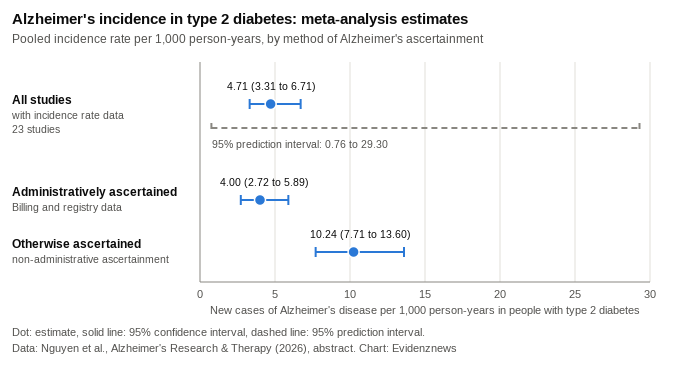
- Among people with type 2 diabetes, the pooled incidence rate of Alzheimer's disease was 4.71 per 1,000 person-years (95 percent confidence interval 3.31 to 6.71); the adjusted relative risk was 1.53 (1.38 to 1.70).
- The studies are highly inconsistent (95 percent prediction interval of the incidence rate 0.76 to 29.30 per 1,000 person-years), and their design does not allow conclusions about cause and effect; an analysis of genetic studies from 2025 found no evidence of a causal relationship between genetically predicted type 2 diabetes and Alzheimer's disease.
Type 2 diabetes is associated with a higher risk of Alzheimer's disease: In a meta-analysis of observational studies in humans, the risk of Alzheimer's disease was 53 percent higher in people with type 2 diabetes than in people without it (relative risk 1.53). In absolute numbers, the study estimates about five new cases of Alzheimer's disease per 1,000 people with type 2 diabetes per year. This establishes an association, not a cause; studies of this kind cannot clarify whether diabetes contributes to Alzheimer's disease.
The paper was published on November 9, 2026, in the journal "Alzheimer's Research & Therapy" and is freely accessible. The first of the ten authors is Thi Thu Huong Nguyen of the Curtin School of Population Health at Curtin University; the information on the institution comes from the press release on the paper.
This article is based on the abstract of the journal version and on the full text of the preprint, which appeared on medRxiv on July 9, 2026. The full text of the journal version could not be accessed by press time. Information that could only be taken from the preprint is marked as such below; the peer-reviewed version may differ from it.
Narrower in scope than earlier reviews
According to the authors, earlier summaries of the literature often mixed inconsistent definitions of diabetes and dementia. The new paper considers only studies with clearly defined type 2 diabetes and with Alzheimer's disease as the endpoint, so neither mixed forms of diabetes nor dementia in general. According to the authors, it is also new that, in addition to the relative risk, they pool an absolute incidence rate.
The team searched four literature databases (MEDLINE, CINAHL, Embase and Scopus) up to April 2026 and found 9,431 articles. 40 studies were included in the analysis. The meta-analysis combines the results of these individual studies into joint estimates.
All 40 studies are observational studies. According to the preprint, 38 of them were cohort studies, along with one case-control study and one cross-sectional study. According to the preprint, the data come from twelve countries, and the mean or median age in most studies was between 55 and 75 years.
Together, the studies amount to 27,102,559 data points. According to the authors, this is an unadjusted sum of the sample sizes, so not a number of distinct individuals; multiple counting is possible, for example when studies use the same registries. The press release distributed via the service EurekAlert, by contrast, speaks of 27 million participants.
Not every study provided both of the quantities at issue: 23 contained data on the incidence rate, and 26 an adjusted relative risk, that is, one statistically corrected for other influencing factors.
About five new cases per 1,000 people per year
The authors give the incidence rate per 1,000 person-years. Pooled across 23 studies, it was 4.71 new cases of Alzheimer's disease per 1,000 person-years among people with type 2 diabetes. The 95 percent confidence interval, the statistical range of uncertainty of this estimate, runs from 3.31 to 6.71.
The authors speak of roughly five. In concrete terms, this means: among 1,000 people with type 2 diabetes, the studies saw on average about five new cases of Alzheimer's disease in one year, which works out to about 0.47 percent per year.
This figure applies to people with type 2 diabetes. The abstract of the paper does not state what the incidence rate was in the comparison group without type 2 diabetes.
The comparison is provided by the adjusted relative risk. Pooled from 26 studies, it was 1.53 (95 percent confidence interval 1.38 to 1.70): the risk of Alzheimer's disease was 53 percent higher in people with type 2 diabetes than in people without it. A relative risk is a ratio; it does not say how large the rates themselves are.
How many additional cases of Alzheimer's disease there are per 1,000 people with type 2 diabetes cannot be cleanly calculated from the two figures. The studies they come from are too different for that.
An average across very different studies
The 4.71 is an average across studies whose results lie far apart. This is shown by the 95 percent prediction interval, which the paper additionally reports: it runs from 0.76 to 29.30 new cases per 1,000 person-years.
The measure I², with which the authors express the inconsistency of the studies, so-called heterogeneity, is 99.99 percent for the incidence rate and 99.60 percent for the relative risk according to the preprint. The average therefore applies neither to a particular person nor to a particular population.
The values differ markedly depending on how Alzheimer's disease was ascertained. In studies with administrative ascertainment, that is, via billing and registry data, the incidence rate was 4.00 per 1,000 person-years (95 percent confidence interval 2.72 to 5.89). In studies with non-administrative ascertainment it was 10.24 (7.71 to 13.60), more than double.
According to the preprint, the authors suspect that administrative data under-ascertain milder cases. They have not shown this. According to the preprint, 28 of the 40 studies ascertained Alzheimer's disease administratively and twelve exclusively non-administratively; 25 studies ascertained type 2 diabetes administratively.
By world region, too, the values in the preprint lie far apart: 7.54 new cases per 1,000 person-years in North America (95 percent confidence interval 4.94 to 11.51), 5.81 in East Asia and the Pacific (4.08 to 8.28) and 1.17 in Europe and Central Asia (0.94 to 1.45). These figures do not appear in the abstract of the journal version; whether the peer-reviewed paper contains them unchanged could not be checked for this article.
Figures by sex, conversely, are given only in the abstract of the journal version; no such analysis appears in the text of the preprint. The incidence rate was numerically higher in women than in men, 3.62 versus 2.76 per 1,000 person-years. The adjusted relative risks were similar: 1.73 in women and 1.76 in men. Confidence intervals for these were not available for this article. Both values are above the overall value of 1.53; the selection of studies may differ from one analysis to another.
How stable the figures are
The authors consider their results stable, and the preprint gives figures for this: when one study at a time was removed from the calculation, the relative risk lay between 1.50 and 1.57; in subgroups between 1.40 and 1.66, without significant differences.
The Egger test, a statistical test for this, found no indications of small-study effects; the preprint gives p-values of 0.977 for the incidence rate and 0.895 for the relative risk.
The authors assessed the quality of the individual studies with the Newcastle-Ottawa Scale. According to the preprint, they rated the risk of bias as low in 38 of the 40 studies and as moderate in two. The scale assesses how a study was conducted, not whether it supports a conclusion about cause and effect.
Why the association does not establish a cause
Because all included studies are observational studies, a conclusion about cause and effect is not possible according to the authors in the preprint. Confounders that are not fully accounted for in the studies remain possible. Shared causes of both diseases are conceivable, for example vascular risks, obesity, education or lifestyle.
In the preprint, the authors name further limitations. A reverse direction of cause and effect cannot be entirely ruled out. In several large population-based studies, the diagnosis of Alzheimer's disease relied on diagnosis codes, the ICD codes, or on medications as a proxy. Duration and severity of diabetes, medications, genotype and mortality risks were reported inconsistently or not taken into account. The studies span several decades, come predominantly from high-income countries and defined diabetes inconsistently. Considerable heterogeneity remained overall.
In the discussion of the preprint, the authors themselves address genetic studies. More recent work suggested that the hereditary predisposition to type 2 diabetes alone is probably not sufficient to cause Alzheimer's disease. The association does not follow a simple architecture of shared genetic risks; it could be driven mainly by metabolic and vascular factors or by factors of treatment.
Genetic analysis sees no evidence of a cause
A genetic analysis on this question appeared on April 30, 2025, in the journal "Biomedicines"; its authors are Han, Lelieveldt, Sturkenboom, Biessels and Ahmadizar. It uses Mendelian randomization, a genetic method. This starts not from the disease but from the hereditary predisposition: it tests whether genetically predicted type 2 diabetes is associated with Alzheimer's disease.
The paper pools eight such studies. They had 68,905 to 788,989 participants, all of European ancestry. The pooled estimate was an odds ratio, likewise a ratio measure, of 1.02 (95 percent confidence interval 1.00 to 1.04; p = 0.129). The authors see in this no evidence of a causal relationship between genetically predicted type 2 diabetes and Alzheimer's disease. They concede that modifiable clinical or environmental factors could contribute to neurodegenerative processes.
In its own analysis with two datasets, the team arrived at odds ratios of 0.989 (0.901 to 1.085) and 0.99 (0.97 to 1.02). After adjustment for outliers, the estimate in the first of the two datasets was 1.049 (1.010 to 1.089; p = 0.013). This value does not appear in the paper's conclusion.
This is not a refutation of the observational studies. The genetic predisposition measures a lifelong exposure, not the timing or duration of the disease, and it does not capture its consequences such as treatment or vascular damage. All participants were of European ancestry. The second dataset also includes Alzheimer's cases that were ascertained via information about the parents, which can bias the estimate toward "no effect." How the genetic findings and the observational studies fit together has not been clarified.
An earlier systematic review with meta-analysis on the same question, also published in "Biomedicines" in 2022, treats type 2 diabetes as a risk factor for Alzheimer's disease. Only its abstract was available for this article, and it gives no effect estimates.
What the authors conclude and what remains open
In the abstract, the authors write that their finding supports the case for integrating the prevention of cognitive risks into diabetes care. This is an assessment by the authors. The paper did not test a treatment or a prevention program. Whether diabetes medication or good management of the disease changes the risk of Alzheimer's disease was also not the subject of the paper.
The press release on the paper puts the 53 percent higher risk in the headline and, according to the excerpt available, uses the verb "raises." This reads like a statement about a cause; the paper itself establishes an association. The press release does not mention limitations or the inconsistency of the studies.
The central question remains open: whether type 2 diabetes contributes to causing Alzheimer's disease, or whether shared causes, medication or a reverse direction explain the association. It is also open how much more often Alzheimer's disease occurs in absolute numbers than in people without type 2 diabetes, and which value applies in which population. According to the authors in the preprint, low-income countries are barely represented in the data.
According to the preprint, the paper's protocol is registered in PROSPERO. The entry could not be accessed; whether the reported analyses correspond to the protocol could therefore not be checked.
Questions about this article
Comments
Sources
- Primary source Thi Thu Huong Nguyen, Asa Auta, Emmanuel Agada David, et al.: Incidence and risk of Alzheimer’s disease in individuals with type 2 diabetes: a systematic review and meta-analysis. Alzheimer's Research & Therapy; Vorabfassung: medRxiv, 9. Juli 2026, doi 10.64898/2026.07.08.26357542 (2026). doi:10.1186/s13195-026-02254-7
- Context Han S, Lelieveldt T, Sturkenboom M, Biessels GJ, Ahmadizar F: Evaluating the Causal Association Between Type 2 Diabetes and Alzheimer’s Disease: A Two-Sample Mendelian Randomization Study. Biomedicines 13(5), 1095 (2025). doi:10.3390/biomedicines13051095
- Context Athanasaki A, et al.: Type 2 Diabetes Mellitus as a Risk Factor for Alzheimer’s Disease: Review and Meta-Analysis. Biomedicines 10(4), 778 (2022). doi:10.3390/biomedicines10040778