Turmeric for knee osteoarthritis: barely more pain relief than placebo
Evidence level 4 of 5 · Systematic review or meta-analysis
Key points
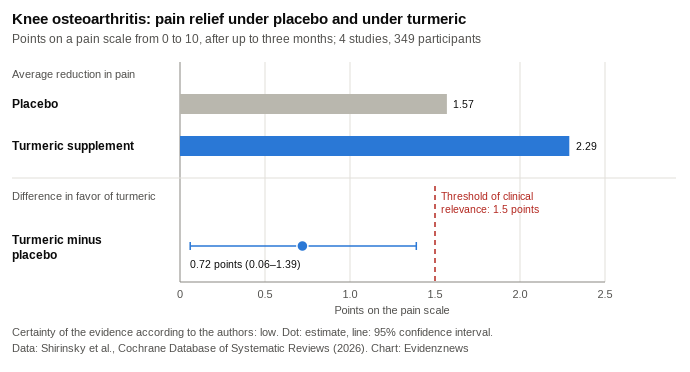
- A Cochrane review of nine randomized trials with 1,245 people with knee osteoarthritis finds, in the comparison with placebo (four studies, 349 participants), 0.72 points more pain relief on a scale from 0 to 10 for turmeric supplements after up to three months (95 percent confidence interval 0.06 to 1.39); the authors set the threshold of clinical relevance at 1.5 points.
- 191 of 1,000 participants on turmeric reported treatment success by their own assessment, compared with 107 of 1,000 on placebo; this figure rests on two studies with 170 people.
- The authors rate the certainty of the evidence as low, and as very low for side effects; only supplements taken by mouth, only knee osteoarthritis and only periods of up to three months were studied.
Turmeric supplements relieve pain in knee osteoarthritis only slightly more than a sham preparation. This is the conclusion of a new Cochrane review that analyzed nine studies with 1,245 participants. On a pain scale from 0 to 10, the advantage over placebo after up to three months was 0.72 points. The authors consider only a difference of 1.5 points to be clinically meaningful.
The review comes from a team led by Ivan Shirinsky of the Research Institute of Internal and Preventive Medicine in Novosibirsk; researchers from Beijing, Stockholm, Guangzhou and Hamilton as well as from Ulster University were also involved. It was published on November 19, 2026, in the "Cochrane Database of Systematic Reviews". The results come from studies in adults with knee osteoarthritis. For this article, the abstract and the plain-language summary of the review were available; the full text is behind a paywall.
The studies examined extracts of the plant Curcuma longa and curcuminoids derived from it, taken by mouth. The review is not about turmeric as a spice in food.
Nine studies, four of them with placebo
A systematic review gathers all studies on a question according to fixed rules and combines their results statistically. For this purpose, the team searched several literature databases and two study registries up to November 7, 2025, without restriction by language or year of publication. Only randomized controlled trials were admitted, that is, trials in which chance decides who receives the preparation and who receives the comparison treatment.
Nine studies with a total of 1,245 people with knee osteoarthritis remained. The mean age was between 52 and 62 years depending on the study, and 67 percent of the participants were women. The studies were conducted in Australia, Belgium, India and Thailand and lasted four weeks to three months.
Four studies with 379 participants compared turmeric with placebo. Four others, with 673 participants, compared it with nonsteroidal anti-inflammatory drugs (NSAIDs), a group of anti-inflammatory medicines, and one with 193 participants compared it with paracetamol. The freely accessible summary reports only the comparison with placebo; all numbers in this article refer to it.
The preparations were inconsistent. The curcuminoid content of the standardized extracts and rhizome extracts ranged from 23 to 88 percent. Two studies used an extract with essential oils, and only one used a preparation intended to improve the absorption of the active ingredient into the body. The team had excluded combinations with other active plant substances.
What came out
For pain, it first becomes clear how much it had already improved under the sham preparation. In the placebo groups, pain fell on average by 1.57 points on the scale from 0 to 10, in the turmeric groups by 2.29 points. The difference of 0.72 points is the estimated additional effect of the preparation. This calculation rests on four studies with 349 participants.
The 95 percent confidence interval ranges from 0.06 to 1.39 points. This interval indicates the range in which the true value plausibly lies according to the data. It narrowly excludes zero: a small effect is thus statistically detectable. At the same time, even the upper end lies below the threshold of 1.5 points, above which the authors speak of clinical relevance, that is, a difference that matters to those affected.
For two further outcomes, a benefit cannot be distinguished from a chance result. Physical function, measured on a scale from 0 to 100, improved by 5.42 points under placebo and by 8.92 points under turmeric. The confidence interval for the difference of 3.5 points ranges from an advantage of 7.29 points to a disadvantage of 0.29 points. Quality of life rose on a scale from 0 to 100 by 9.83 points under placebo and by 12.02 points under turmeric; the interval for the difference of 2.19 points ranges from a disadvantage of 1.56 points to an advantage of 5.94 points. This value is based on three studies with 291 participants.
A fourth outcome turned out more favorably for turmeric: the question of whether participants themselves rated their treatment as a success. 107 of 1,000 people under placebo and 191 of 1,000 under turmeric said yes, that is, 84 more. The relative risk is 1.78 (95 percent confidence interval 1.19 to 2.67). However, this rests on only two studies with 170 people.
Side effects: very uncertain data
Adverse events of any kind were reported by 224 of 1,000 participants under placebo and 226 of 1,000 under turmeric (relative risk 1.01; confidence interval 0.68 to 1.51). Because of adverse events, 46 of 1,000 people under placebo dropped out of the study and 66 of 1,000 under turmeric (relative risk 1.45; confidence interval 0.61 to 3.43; three studies, 321 participants).
Both intervals are so wide that they allow for both fewer and considerably more events under turmeric. The authors write that they are very uncertain about the effect on side effects. The numbers are not evidence of safety, nor are they evidence of harm. In three studies, no serious events occurred; one study reported two in the placebo group that were unrelated to the study.
Why the certainty is low
Cochrane reviews assess not only the result but also how far it can be trusted. For pain, function, quality of life and treatment success, the verdict here is: low certainty. For all data on side effects, it is: very low.
The authors name two reasons for the downgrading. The first is publication bias, that is, the suspicion that studies with certain results were more likely to be published than others. The second is indirectness: the available studies fit the question the review wants to answer only to a limited extent. For side effects, the imprecision of the estimates is added.
The design of the individual placebo studies was less to blame. The team rated three of the four as having a low susceptibility to bias for pain, function and quality of life, and two of four for the safety data.
In their summary, the authors acknowledge that the studies were small and short and that the preparations differed. Future studies should run longer than three months and also include hand and hip osteoarthritis.
Earlier reviews judged more favorably
The review contradicts a number of older analyses. A meta-analysis by Dai and colleagues from 2021 pooled ten randomized trials with 783 patients and found turmeric extract significantly superior to placebo for pain and function; according to the authors, the effects exceeded the threshold of the minimal clinically important difference. A 2025 meta-analysis by Hidayat and colleagues with ten studies and 786 patients likewise found a benefit for pain over a period of four to six weeks. Both papers point to the inconsistency of their data.
A German-language overview in the "Zeitschrift für Phytotherapie" from 2022, which evaluated nine systematic reviews, also saw preparations containing curcuminoids as a safe and clinically effective treatment option compared with placebo; its authors noted that large, high-quality studies are needed. A systematic review from Cuba and Spain from 2025 with seven studies and 798 patients concluded that oral curcumin reduces pain. According to the description on the journal's page, it does not report an assessment of the risk of bias.
The numbers from these papers cannot be placed directly alongside those of the Cochrane review: scales, time points and selection criteria differ.
In a statement about the review, Cochrane gives possible reasons for the difference, above all the selection of studies. Older papers had often included a broader range, such as preparations that are not taken by mouth, or combinations with other active ingredients, and had not separately checked the trustworthiness of the studies. The new review did so with a screening tool developed by another Cochrane group; if there were concerns, a study was left out. According to the statement, ten studies were flagged in this way. They are on hold until their authors clarify the open points. What was objected to is not spelled out in the freely accessible sources. This does not mean that these studies are flawed.
Whether the stricter selection actually explains the difference is an interpretation by Cochrane, the publisher of the review, and is not backed by a counter-calculation in the sources consulted. Independently of this, there is an indication of weaknesses in the older literature: a team led by Chen assessed nine earlier reviews and meta-analyses on turmeric in osteoarthritis in 2022 and rated only one of them as high quality using the AMSTAR-2 assessment tool. Of 59 individual results assessed, none reached high certainty. The authors of that work nevertheless regarded turmeric as a possibly effective and safe supplement.
The Cochrane statement, incidentally, is worded somewhat more sharply than the review itself. It speaks of no clear clinical benefit; the numbers in the abstract, by contrast, show a small pain effect whose confidence interval narrowly excludes zero, and a possible advantage in self-rated treatment success.
What remains open
The review answers a narrow question: knee osteoarthritis, adults, supplements taken by mouth, three months at most. For longer periods, for other joints and for long-term safety, there are no reliable data after this analysis. It is also open whether certain preparations perform better than others; there are too few studies, and they are too different.
The main comparisons rest on four studies with fewer than 400 participants. The authors word it cautiously: compared with placebo, turmeric may bring little to no improvement in pain, function and quality of life. This is not proof that the preparations have no effect. How the comparisons with NSAIDs and paracetamol turned out and who funded the individual studies is not stated in the freely accessible part of the review. The authors' declarations on conflicts of interest appear only in the paywalled full text.
Questions about this article
Comments
Sources
- Primary source Shirinsky I, Shirinsky V, Filatova K, et al.: Curcuma longa (turmeric) or its active ingredients for osteoarthritis. Cochrane Database of Systematic Reviews, Issue 11, CD014683 (2026). doi:10.1002/14651858.CD014683.pub2
- Context Dai et al.: Effectiveness of Curcuma longa extract versus placebo for the treatment of knee osteoarthritis: a systematic review and meta-analysis of randomized controlled trials. Phytotherapy Research (2021). doi:10.1002/ptr.7204
- Context Hidayat et al.: Efficacy of Curcuma longa in relieving pain symptoms of knee osteoarthritis patients: a systematic review and meta-analysis of clinical trials. Journal of Rheumatic Diseases (2025). doi:10.4078/jrd.2024.0062
- Context Bittel, Klose, Langhorst: Kurkuma- und Curcuminoid-Behandlung bei Gonarthrose. Zeitschrift für Phytotherapie 43(6), 243–249 (2022). doi:10.1055/a-1924-9460
- Context Sánchez Lozano, Martínez Pizarro: Eficacia de la curcumina oral para reducir el dolor en pacientes con osteoartritis de rodilla. Revisión sistemática. Revista Cubana de Reumatología 27, e1392 (2025). https://revreumatologia.sld.cu/index.php/reumatologia/article/view/1392
- Context Chen et al.: Quality of Evidence Supporting the Role of Curcuma Longa Extract/Curcumin for the Treatment of Osteoarthritis: An Overview of Systematic Reviews. Evidence-Based Complementary and Alternative Medicine (2022). doi:10.1155/2022/6159874
- Context New evidence questions benefits of turmeric for knee arthritis. Cochrane, Meldung der Herausgeberin des Reviews (2026). https://www.cochrane.org/about-us/news/new-evidence-questions-benefit…