Frozen shoulder: shock wave therapy probably relieves pain in the short term
Evidence level 4 of 5 · Systematic review or meta-analysis

Key points
- A network meta-analysis in the journal BMJ pooled 189 randomized trials with 12,988 adults with frozen shoulder (adhesive capsulitis) and compared 59 treatments and treatment combinations.
- Extracorporeal shock wave therapy reduced pain in the first three months by 1.97 points on a scale from 0 to 10 compared with usual care (95 percent confidence interval 0.97 to 2.97; eight trials, 464 participants); the authors rate the certainty of this evidence as moderate.
- Depending on the outcome, 71 to 72 percent of the trials had a high risk of bias, only 30 of the 189 trials reported adverse events in a form that could be analyzed, and according to the authors the analysis does not support a definitive ranking of the treatments.
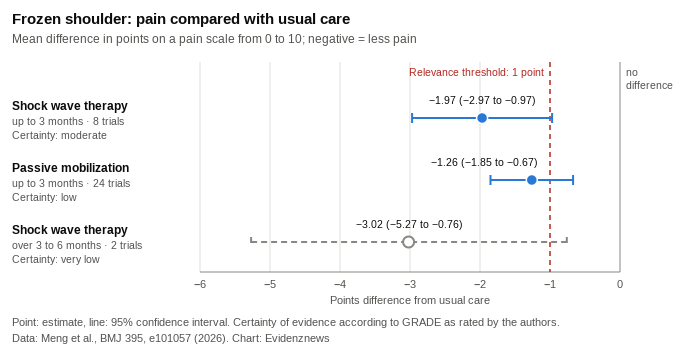
In frozen shoulder, shock wave therapy probably reduces pain more than usual care in the first three months, on average by 1.97 points on a scale from 0 to 10. This is one of only two main findings whose evidence the authors rate as moderate certainty, in an analysis of 189 randomized trials with 12,988 adults. For most of the other treatments examined and for the period of more than three to six months, they rate the evidence as low or very low.
The paper was published on November 4, 2026, in the journal BMJ. The first author is Jiahao Meng, a doctoral student at the orthopedic department of the Xiangya Hospital of Central South University in Changsha, China; the corresponding author Shuguang Gao also works there. The 34 authors include researchers from Manchester, Porto, Freiburg, Milan, and other places. The analysis covered published studies in adults with clinically diagnosed frozen shoulder, not data on individual patients.
Frozen shoulder, known in medical terminology as adhesive capsulitis, begins, according to the authors' description, with shoulder pain that sets in gradually; the joint becomes increasingly difficult to move, both actively and passively. According to them, about two to five percent of the population are affected, mostly at ages 40 to 60, women more often than men. The authors take these figures from older literature.
A network of direct and indirect comparisons
There are many treatments for frozen shoulder, and by no means all of them have been tested directly against each other in a trial. A network meta-analysis tries to close this gap statistically. It combines direct comparisons, in which two treatments were tested against each other in the same trial, with indirect ones: If two treatments were never tested against each other but each against a common third one, a comparison can be derived from both results.
The team searched five literature databases up to May 1, 2025, and updated the search in November 2025. Of 21,228 hits, 6,694 titles and abstracts remained after duplicates were removed, and 297 papers were checked in full text. In the end, 189 trials remained. Excluded were, among others, publications that did not appear in English and trials with fewer than ten participants per group.
Two clinical experts assigned the treatments to 59 groups, the nodes of the network. Combinations formed their own nodes; the number therefore does not stand for 59 fundamentally different therapies. "Usual care" served as the reference point for all comparisons.
Four outcomes were measured: pain, shoulder function, range of motion, and adverse events. Because the trials used different questionnaires and scales, the team converted pain to a scale from 0 to 10 and function to a scale from 0 to 100; higher values in each case mean more pain or worse function. Everything up to three months after the start of treatment counted as short term, the time after that up to six months as medium term.
In advance, the authors specified the point from which they regard a difference as clinically meaningful: one point for pain and ten points for function. For range of motion there is, according to them, no threshold validated in patients; they pragmatically set ten degrees. How far a result can be trusted was rated according to the GRADE scheme, which grades the certainty of evidence from high through moderate and low to very low.
What came out for pain
At the start, pain across all trials had a median of 7.1 on the scale from 0 to 10. Compared with usual care, extracorporeal shock wave therapy, that is, therapy applied from outside the body, reduced pain in the first three months by 1.97 points. The 95 percent confidence interval, the range in which the true value plausibly lies according to the data, extends from 0.97 to 2.97 points. The figure is based on eight trials with 464 participants. The authors rate the certainty of the evidence as moderate; in GRADE terms, this means: The treatment probably reduces pain.
The estimate lies above the relevance threshold of one point. The lower end of the interval, at 0.97 points, lies just below it. An effect that hardly matters for those affected is therefore compatible with the data.
For passive mobilization, a reduction of 1.26 points resulted (confidence interval 0.67 to 1.85; 24 trials, 1,302 participants), but with low certainty. For the other treatments, the evidence on short-term pain was low or very low.
For the period of more than three to six months, the paper reports a difference of 3.02 points for shock wave therapy (confidence interval 0.76 to 5.27). This value is based on two trials with 162 participants and exclusively on sparse indirect comparisons; the certainty is very low. It is not suitable as evidence that the effect increases later. Not a single medium-term pain comparison was supported by high or moderate certainty.
Function and range of motion: contradictory signals
For shoulder function, shock wave therapy performed 11.42 points better on the scale from 0 to 100 than usual care in the short term (confidence interval 6.15 to 16.68; twelve trials, 663 participants). The certainty here is low, and the reason is instructive: The direct comparisons showed little or no meaningful difference, and only the indirect ones yielded a clinically meaningful benefit. The two ways of calculating clearly contradicted each other. The value also reacted more sensitively to sensitivity analyses, for example when only trials with a lower risk of bias were included.
Similarly for range of motion. Under shock wave therapy, flexion improved by 22.42 degrees (confidence interval 12.99 to 31.84; eight trials, 365 participants) and abduction, the spreading of the arm away from the body, by 18.62 degrees (8.09 to 29.14; eleven trials, 550 participants). Here too, direct and indirect comparisons did not fit together, and the certainty is low. The authors warn against reading these figures as a reliable improvement.
For range of motion, moderate certainty was reached only by an invasive procedure, manipulation under anesthesia. Together with a steroid injection into the joint, it improved flexion in the short term by 33.29 degrees (11.19 to 55.39; three trials, 336 participants), alone by 26.16 degrees (8.19 to 44.13; five trials, 554 participants). The authors stress that this does not imply a preference for invasive over less invasive treatments: For pain, function, long-term course, and harms, the evidence is limited or uncertain.
Hardly any data on harms
Only 30 of the 189 trials reported adverse events in a way that allowed statistical analysis. These trials included 2,658 participants and 23 treatments. All comparative estimates on safety have very low certainty of evidence, and the confidence intervals were mostly extremely wide. The authors state: Missing reports of harms are not evidence that there are none.
Why the results should be read with caution
The trials on which the analysis rests are small. The median number of participants was 60, and most trials ran at a single center. 78 percent were conducted in Asia, and 87 percent predominantly included people with the primary form of the condition. Whether the results apply to the secondary form, to people with diabetes, or to late stages is uncertain, according to the authors.
The risk of bias weighs more heavily. In 103 of 146 trials with pain outcomes (71 percent), the authors rated it as high, in 108 of 149 trials on function (72 percent), and in 104 of 146 trials on range of motion (71 percent). Frequent reasons were lack of blinding of participants or assessors, deviations from the planned treatment, and concerns about the measurement of outcomes. The pain finding on shock wave therapy remained similar in several sensitivity analyses but fluctuated more when trials with a high risk of bias were excluded. By how much is not stated in the text of the paper but in an appendix that was not analyzed for this article.
There is also the yardstick for comparison. "Usual care" is not a sham treatment but a collective term: sometimes an exercise program, sometimes physiotherapy, sometimes pain medication, sometimes minimal or unspecified care. 60 trials had such an arm, 51 of them from Asia. The authors point out that a treatment can appear more effective compared with minimal care than compared with a structured exercise or physiotherapy program.
A network meta-analysis also assumes that the trials are similar enough to each other to be compared via indirect routes. According to the authors, this could not be verifiably confirmed, because disease duration, stage, prior treatment, and accompanying pain medication were reported incompletely or inconsistently. Converting different questionnaires to a common scale also does not make the instruments equivalent.
Earlier analyses set different priorities
The authors see their results as largely in line with earlier indications of a short-term benefit of shock wave therapy. However, they rate the certainty of evidence for many treatments lower than earlier rankings suggested. Seven older network meta-analyses covered, by their count, 17 to 92 trials and examined narrower groups of treatments.
Three older reviews show how much the picture depends on the method; only their abstracts were available for this text. An analysis by Challoumas and colleagues from 2020 with 65 trials and 4,097 participants concluded that in the short term only corticosteroids injected into the joint were superior both statistically and clinically. On shock wave therapy, its abstract says nothing. A network meta-analysis by Zhang and colleagues from 2021 with 92 trials and 5,946 patients placed shock wave therapy at the top for function and capsular distension for pain. This ordering is based on a ranking, not on relevance thresholds and an assessment of certainty.
A meta-analysis from 2022 was devoted solely to shock wave therapy as an addition to routine treatment. It pooled 20 trials and found a short-term pain difference of 0.72 points (confidence interval 0.50 to 0.94). The direction agrees with the new finding, but the effect is smaller. The figures cannot be placed directly side by side, because comparison, scale, and time window are not the same. The authors of that paper note that the quality of the trials was impaired by their heterogeneity. The research found no independent expert commentary on the new BMJ paper by the editorial deadline.
What remains open
The analysis ends after six months. According to the authors, the condition can last one to two years or longer. An early improvement therefore cannot be equated with complete recovery or lasting benefit, and it does not show that a treatment changes the natural course.
It is also open how shock wave therapy performs compared with a sham treatment and whether its pain effect persists when only methodologically robust trials count. The estimates for many other treatments, such as corticosteroid injections, appear in figures and appendices that were not analyzed for this article.
The authors themselves draw a cautious conclusion: Their analysis does not support a definitive ranking of the treatments. The paper contains no recommendation on which treatment is suitable in an individual case.
Questions about this article
Comments
Sources
- Primary source Meng J, Liu P, Gomes NS, et al.: Interventions for adhesive capsulitis: systematic review and network meta-analysis of randomised controlled trials. BMJ 395, e101057 (2026). doi:10.1136/bmj-2026-101057
- Context Challoumas D, Biddle M, McLean M, Millar NL: Comparison of Treatments for Frozen Shoulder: A Systematic Review and Meta-analysis. JAMA Network Open 3(12), e2029581 (2020). doi:10.1001/jamanetworkopen.2020.29581
- Context Zhang J et al.: Comparative Efficacy and Patient-Specific Moderating Factors of Nonsurgical Treatment Strategies for Frozen Shoulder: An Updated Systematic Review and Network Meta-analysis. American Journal of Sports Medicine 49(6), 1669–1679 (2021). doi:10.1177/0363546520956293
- Context Zhang R et al.: Extracorporeal Shockwave Therapy as an Adjunctive Therapy for Frozen Shoulder: A Systematic Review and Meta-analysis. Orthopaedic Journal of Sports Medicine 10(2), 23259671211062222 (2022). doi:10.1177/23259671211062222