Intellectual disability: cannabidiol no better than placebo in trial
Evidence level 2 of 5 · Single study, peer-reviewed
Key points
- At three Australian children's hospitals, 131 children and adolescents aged 6 to 18 years with intellectual disability and severe behavioral problems were randomly assigned to receive either cannabidiol or a placebo for eight weeks; 84.0 percent of them also had autism.
- At the end of treatment, the mean irritability score reported by parents was 21.7 points with cannabidiol and 19.2 points with placebo, after 32.2 and 30.0 points at the start; the mean difference was 2.4 points (95 percent confidence interval minus 1.5 to 6.3).
- At least one adverse event occurred in 41 of 65 participants with cannabidiol (63.1 percent) and 40 of 66 with placebo (60.6 percent); the abstract of the paper does not state the type or severity of the events.
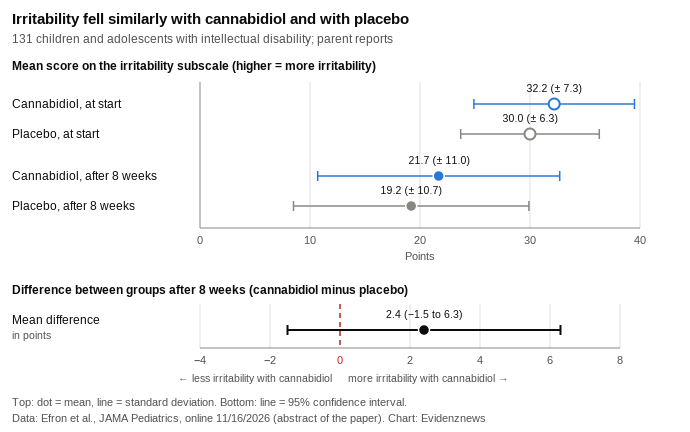
Cannabidiol did not relieve severe behavioral problems in children and adolescents with intellectual disability any more than a sham preparation in a clinical trial. After eight weeks, the irritability score reported by parents averaged 21.7 points in the cannabidiol group and 19.2 points in the placebo group. The difference of 2.4 points cannot be statistically distinguished from zero: the 95 percent confidence interval ranges from minus 1.5 to 6.3 points.
The paper was published online on November 16, 2026 in the journal JAMA Pediatrics. It comes from a team led by Daryl Efron of the Murdoch Children's Research Institute in Melbourne, Australia; the institutions involved include the University of Melbourne, Monash University, the University of Sydney and UNSW Sydney. It is a study in humans: 131 children and adolescents aged 6 to 18 years took part. For this article, only the abstract of the paper and the study's entry in the ClinicalTrials.gov registry were available. The full text is behind a paywall and was not read.
The abstract itself gives the reason for the study: interest in cannabidiol, or CBD, is high for this group, but evidence is lacking.
Two groups, assigned at random
The study ran from May 11, 2021 to May 8, 2025 at three children's hospitals in Australia: the Royal Children's Hospital and the Monash Children's Hospital in Melbourne and the Children's Hospital Westmead in Sydney. According to the registry, children and adolescents with an intelligence quotient below 70 and limitations in daily life were enrolled. Their behavioral problems had to reach a minimum level: at least 18 points on the irritability scale that later also provided the primary outcome, and at least moderate severity on a clinical global impression scale.
On average, the participants were 11.2 years old (standard deviation 3.1). Of them, 98, or 74.8 percent, were male, and 110, or 84.0 percent, also had autism. Nevertheless, the study is not about autism in general but about young people with intellectual disability and severe behavioral problems.
Chance decided, in a one-to-one ratio, who received what. 65 participants received a cannabidiol isolate in an oil to be taken by mouth, and 66 received a placebo. One further person had been assigned in error and was excluded. According to the registry, the placebo was an oil made of medium-chain triglycerides, which also served as the carrier for the investigational product, and was indistinguishable from it in appearance, smell and taste.
The study was double-blind. The registry specifies who was not supposed to know which oil a child received: the participants, their caregivers, the investigators and the analysts. Treatment lasted eight weeks, followed by four weeks of follow-up.
The primary outcome is listed in the registry
Success was measured by a single number: the score on the irritability subscale of the Aberrant Behavior Checklist. According to the registry, the subscale consists of 15 items rated by the parents; higher scores stand for more irritability. The decisive value was the one at the end of the eight-week maintenance phase, on day 64 according to the registry.
This outcome is listed in the trial registry, and the entry there was created before the start of the study. It was submitted on March 25, 2021, and the study start is given as May 11, 2021. The registry and the abstract of the publication list the same primary outcome, and no subsequent change is apparent. It cannot be ruled out entirely from here, however: the registry was last updated on August 31, 2025, that is, after data collection, and its earlier versions were not reviewed for this article.
According to the registry, 140 participants were planned; 132 were enrolled.
In both groups the score was lower at the end
At the start, the mean irritability score was 32.2 points (standard deviation 7.3) in the cannabidiol group and 30.0 points (standard deviation 6.3) in the placebo group. At the end of treatment, it was 21.7 points (standard deviation 11.0) with cannabidiol and 19.2 points (standard deviation 10.7) with placebo. Data on the primary outcome were available for 61 participants in the cannabidiol group and 63 in the placebo group; for seven, the end value was missing. How the analysis handled these missing values is not stated in the abstract.
From the means, it can be roughly estimated that the score fell by about 10 to 11 points in both groups. This is a rough calculation of our own for this article, not a figure given by the authors; the starting and end values may come from slightly different subgroups. But it leads to the core of the finding: even among the participants who received oil without active ingredient, the score was markedly lower at the end. An improvement alone is therefore no proof that a drug works; only the comparison with the placebo group provides information about that. Why the placebo group also improved is not apparent from the abstract.
What the confidence interval says
The difference between the groups at the end was 2.4 points. The abstract does not explicitly state in which direction it was calculated. From the group means, it follows that the value of the cannabidiol group was above that of the placebo group. The difference between the two rounded means would be 2.5 points; why the paper gives 2.4 is not stated in the abstract.
The estimate thus lies on the side of higher irritability under cannabidiol. It does not follow from this that cannabidiol increases irritability. The 95 percent confidence interval, the range of differences compatible with the data, extends from minus 1.5 to 6.3 points and includes zero.
At the same time, the interval shows what the study does not rule out. In the most favorable case compatible with the data, the value at the end would be 1.5 points lower with cannabidiol than with placebo. The data largely rule out a larger benefit. Strictly speaking, then, the study does not prove that cannabidiol has no effect. It found no benefit, and it leaves little room for one that is more than small.
The authors conclude from this that cannabidiol was not effective for severe behavioral problems in young people with intellectual disability. The results suggested not using it for this group. This is the conclusion of the study authors.
Adverse events similarly frequent in both groups
At least one adverse event occurred in 41 of 65 participants in the cannabidiol group (63.1 percent) and in 40 of 66 in the placebo group (60.6 percent). The authors describe the proportions as similar.
Which events these were, how severe they were and whether any were serious is not stated in the abstract. The two figures therefore do not serve as evidence of good tolerability. They say only that in both groups more than six in ten participants had at least one event.
The preliminary study included eight children
The study was preceded by a pilot study by the same group, published in 2021. It randomly assigned eight children aged 8 to 16 years to cannabidiol or placebo. All eight completed the full study protocol, there were no dropouts and no serious adverse effects, and the authors reported an efficacy signal in favor of the active ingredient.
However, the pilot study was designed to test feasibility. According to the entry in the ANZCTR trial registry dated November 14, 2018, which matches this pilot study in participant number and data, the primary outcomes were the recruitment rate, the acceptance of the study procedures and protocol adherence; ten participants were targeted. It was paid for by the Murdoch Children's Research Institute from an internal funding scheme. The efficacy signal was therefore not what the pilot study was planned to measure, and it rested on eight children. In the larger study, it was not confirmed for the primary outcome.
A similar pattern in autistic boys
A study from the University of California San Diego, independent of the Australian group and published online in May 2025, examined autistic boys aged 7 to 14 years with severe behavioral problems. It was also double-blind and placebo-controlled but designed differently: as a crossover study in which the participants received a plant-derived cannabidiol preparation and a placebo for eight weeks each, separated by a four-week washout phase.
For two of the three primary outcomes, scores improved in both phases, with no significant difference between cannabidiol and placebo. The third improved only under placebo; this difference disappeared when concomitant medications were taken into account. The authors speak of a strong placebo effect and do not consider cannabidiol clearly effective for these broad measures. At the same time, they report that blinded clinical impressions showed an improvement under cannabidiol in just under two thirds of the participants; in the remaining third, there was no change or an improvement under placebo.
This is not a confirmation of the Australian study. A different group was examined (autism, not intellectual disability), with a different design and different outcome measures. For this article, only the abstract of that paper was available; how many boys took part is not known for this article.
What a review contributes
A systematic review with meta-analysis, published in 2026 in the journal Lancet Psychiatry, summarized randomized trials of cannabinoids for mental disorders and substance use disorders. It includes 54 studies with 2,477 participants and a median age of 33.3 years. 24 of the studies, or 44 percent, had a high risk of bias, and the certainty of the evidence was low for most outcomes.
For autism spectrum disorders, the analysis found a small reduction in autistic features under cannabinoids. The standardized mean difference was minus 0.36 (95 percent confidence interval minus 0.66 to minus 0.07), with low overall quality of evidence. Cannabinoids were associated with more adverse events, but not with more serious ones. The authors consider routine use for the conditions examined rarely justified at present.
This result cannot be transferred directly to children with intellectual disability. The review mainly concerns adults and other outcomes. Which cannabinoids and how many studies lie behind the autism result is not known, because for this article only a summary on the University of Bath research portal was evaluated. The review's literature search extended to May 13, 2025; the new study cannot be included in it.
What remains open
The abstract says nothing about whether individual subgroups responded differently, such as children without autism, certain age groups, or children who took no other psychotropic drugs. A single cannabidiol isolate at one dose level over eight weeks was tested. The result does not necessarily apply to other doses, other preparations, extracts with additional ingredients, or longer use.
The primary outcome rests on the judgment of the parents. How well their blinding succeeded is not known. Nor is it apparent from the material reviewed at how many points a difference on the irritability scale counts as clinically meaningful.
The registry lists further outcomes, including the other four subscales of the checklist, anxiety, sleep, quality of life, parental burden and cost-effectiveness. The abstract reports none of them, nor the results of the follow-up. Whether the full text contains them was not checked.
Without the full text, little can be said about funding and possible conflicts of interest. The registry names the Murdoch Children's Research Institute as sponsor and THC Pharma as manufacturer of the investigational product; it names no funder. No results have so far been posted in the registry. It announces that anonymized data, protocol and analysis plan will be made available six months after publication of the primary outcome, accessible via the institute and with an agreement.
Questions about this article
Comments
Sources
- Primary source Efron D, Taylor K, Freeman JL, et al.: Cannabidiol for Severe Behavioral Problems in Youths With Intellectual Disability: A Randomized Clinical Trial. JAMA Pediatrics, online veröffentlicht am 16.11.2026 (2026). doi:10.1001/jamapediatrics.2026.5152
- Context Eintrag der Studie im Register ClinicalTrials.gov, Nummer NCT04821856. ClinicalTrials.gov, Studienregister. https://clinicaltrials.gov/study/NCT04821856
- Context Efron D, et al.: A pilot randomised placebo-controlled trial of cannabidiol to reduce severe behavioural problems in children and adolescents with intellectual disability. Br J Clin Pharmacol 87(2), 436–446 (2021). doi:10.1111/bcp.14399
- Context Eintrag der Pilotstudie im Studienregister ANZCTR, registriert am 14.11.2018 (Eintrag Nummer 376331). ANZCTR, Studienregister. https://www.anzctr.org.au/Trial/Registration/TrialReview.aspx?id=376331
- Context Trauner D, et al.: Cannabidiol (CBD) Treatment for Severe Problem Behaviors in Autistic Boys: A Randomized Clinical Trial. J Autism Dev Disord, online veröffentlicht am 24.05.2025 (2025). doi:10.1007/s10803-025-06884-y
- Context Wilson J, et al.: The efficacy and safety of cannabinoids for the treatment of mental disorders and substance use disorders: a systematic review and meta-analysis. Lancet Psychiatry 13(4), 304–315 (2026). doi:10.1016/S2215-0366(26)00015-5