Does the placebo effect really work?
Placebo: small effect on reported symptoms, hardly any on measured values
Evidence level 4 of 5 · Systematic review or meta-analysis
Key points
- The Cochrane review by Hróbjartsson and Gøtzsche (published 2010, literature search up to March 2008) analyzed 202 randomized trials on 60 health problems and generally found no clinically important placebo effects; for patient-reported outcomes the effect was larger (standardized mean difference −0.26, 95 percent confidence interval −0.32 to −0.19) than for observer-reported outcomes (−0.13, −0.24 to −0.02).
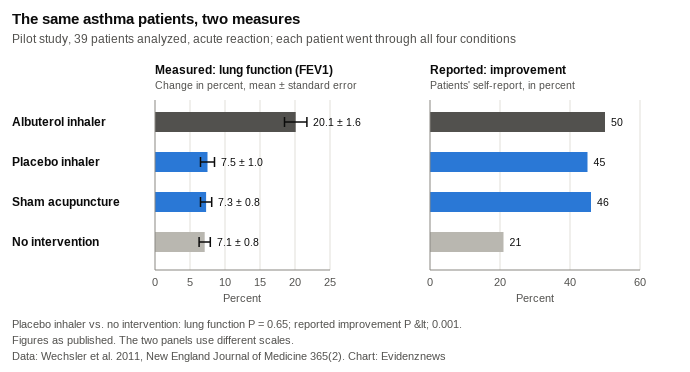
- In an asthma pilot study with 39 patients analyzed, 45 percent reported an improvement after a placebo inhaler and 21 percent with no intervention; the measured lung function changed almost equally in both cases (7.5 versus 7.1 percent), and by 20.1 percent with the active drug.
- Even placebos that participants know are placebos showed a small effect on self-reported outcomes in a 2025 meta-analysis (0.39; 0.30 to 0.49), but no demonstrable effect on objective measures (0.09; −0.12 to 0.29); whether self-reports reflect genuine relief or biased reporting cannot be decided by this study design.
A sham treatment changes mainly what patients report about their symptoms, and hardly anything that can be objectively measured in their bodies. This pattern runs through the review papers analyzed here. One comprehensive analysis generally found no clinically important placebo effects, but in certain situations an effect on self-reported symptoms, especially on pain and nausea.
This analysis comes from Asbjørn Hróbjartsson and Peter C. Gøtzsche of the Nordic Cochrane Centre at Rigshospitalet in Copenhagen. It was published in 2010 in the Cochrane Database of Systematic Reviews; its literature search extends to March 2008. The two authors included 234 randomized trials, that is, trials in which chance decides who receives which treatment. Data were available for 202 of them. All were conducted in humans and together covered 60 different health problems.
The authors add a caveat to their result that shapes the whole debate: in such trials, what patients report is hard to distinguish from biased reporting. More recent papers from 2018 to 2025 add to the picture for subfields but do not solve this problem.
Why a no-treatment group is needed
A placebo is a sham treatment: a sham medication, a sham procedure or, for example, sham acupuncture. When people feel better after a placebo, it is tempting to conclude that the placebo worked. That is premature. Symptoms can also improve on their own; this is the natural course of a disease. In addition there is so-called regression to the mean, a statistical effect that arises when a minimum level of symptoms is required for admission to a trial.
A trial that only compares a drug with a placebo cannot separate these components. For that, a third group is needed that receives nothing at all. Only the gap between the placebo group and the untreated group shows what the placebo contributes. According to Hróbjartsson and Gøtzsche, most reports of placebo effects rely on trials without such a randomly allocated comparison. Their review considers only trials that have one.
How much improvement without treatment can account for was estimated by the same research group in 2009 using 37 trials with three groups and 2,900 patients. There, about 24 percent of the change that occurred under the active treatment was due to spontaneous improvement, including regression to the mean, and about 20 percent to the placebo. Depending on the symptom, the share of spontaneous improvement varied widely; for acute pain, for example, it was 25 percent, for nausea 45 percent. The percentages are shares of a change and not a probability of getting well through a placebo. The authors themselves name weaknesses of their calculation: the method is unusual, and a quarter of the eligible trials supplied no usable data. The work is not independent evidence, because the two authors of the Cochrane review were involved in it.
What the large analysis found
The review distinguishes two kinds of outcomes. The first are yes/no outcomes, for example improved or not improved. Here 44 trials with 6,041 patients were included. Pooled, this gave a small, statistically borderline significant advantage for the placebo; how many patients this corresponds to in absolute numbers could not be determined for this article. For the four symptoms studied in at least three such trials, namely pain, nausea, smoking and depression, no statistically significant placebo effect was found. The confidence intervals were, however, wide.
The second kind are scale values, such as the intensity of pain on a scale. For these, 158 trials with 10,525 patients were available. The authors report such effects as a standardized mean difference. It is counted in standard deviations and not in points on a symptom scale; in this work, negative values mean an advantage for the placebo. Across all trials the value was −0.23 (−0.28 to −0.17). The authors themselves call this pooling a questionable procedure, because the results of small and large trials were distributed unevenly. They used the overall figure mainly as a starting point for looking into the causes of the differences.
More informative is the breakdown by who recorded the outcome. For patient-reported outcomes the value was −0.26 (−0.32 to −0.19), for observer-reported outcomes −0.13 (−0.24 to −0.02). The value was thus twice as large for what the affected people reported themselves.
For individual symptoms it looked like this: for pain the value was −0.28 (−0.36 to −0.19), for nausea −0.25 (−0.46 to −0.04); the authors call the effect for nausea small but consistent. They regard the results on asthma and phobia as very uncertain because of a high risk of bias. For seven further symptoms with at least three trials, no statistically significant effect was found: smoking, dementia, depression, obesity, hypertension, insomnia and anxiety. Here too the confidence intervals were wide. For hypertension, an objectively measurable quantity, 10 trials with 308 patients were available; the value for diastolic blood pressure was −0.17 (−0.46 to 0.12), and the interval includes zero.
For pain, the results varied considerably, from negligible to clinically important, even among the methodologically better trials. Four similarly designed acupuncture trials from an overlapping group of authors found large effects (−0.68; −0.85 to −0.50), while three other pain trials found small or no effects (−0.13; −0.28 to 0.03).
Two findings call for caution with all of these numbers. Only 16 of the trials, 8 percent, had a low risk of bias in the authors' judgment. And larger placebo effects were found more often under certain conditions: with physical sham procedures such as sham acupuncture, with outcomes in which the patient takes part, in small trials, and in trials that expressly set out to study the placebo effect. The effect was also larger where patients were not told that they might receive a placebo. The authors, however, tested this last factor only after the fact, and it was statistically significant only when four German acupuncture trials were included in the calculation.
The same patients, two answers
How far apart report and measurement can lie is shown by an asthma pilot study that Wechsler and colleagues published in 2011 in the "New England Journal of Medicine". 46 patients with stable, mild to moderate asthma were enrolled, and 39 were analyzed. The special feature: each patient went through all four conditions in random order. He or she received an inhaler with the active drug albuterol, a placebo inhaler, sham acupuncture and, once, nothing at all.
Lung function was measured with a value called FEV1. With the active drug it improved by 20.1 percent, with the placebo inhaler by 7.5 percent, with sham acupuncture by 7.3 percent and with no intervention at all by 7.1 percent. Between placebo and doing nothing there was no demonstrable difference in this measure (P = 0.65).
When the same patients were asked whether they felt better, the picture looked different. An improvement was reported by 50 percent after the active drug, 45 percent after the placebo inhaler, 46 percent after sham acupuncture, but only 21 percent with no intervention. The gap between the two sham treatments and doing nothing was statistically clear (P less than 0.001 in each case).
The authors draw two conclusions from this that point in different directions. Placebo effects could be clinically meaningful and compete with an effective drug. At the same time, self-reports are unreliable, which is why trials should also record what happens with no treatment at all. For lung function, the active drug was clearly ahead.
The study has narrow limits. It is a pilot study, records only the acute reaction within hours, and used a scale for well-being that had not previously been formally validated. It says nothing about chronic asthma or other diseases.
Pain: a small effect in the short term
There is a more recent analysis on pain. In 2024, Hohenschurz-Schmidt and colleagues pooled in the "European Journal of Pain" 17 trials in adults that compared three groups: a physical or psychological treatment, a sham procedure and no treatment. In the short term the placebo effect was small, the standardized mean difference was 0.21 (0.10 to 0.33) with 1,440 participants; in this work positive values mean an advantage for the placebo. Pain relief from the placebo accounted for 39 percent of the short-term effect of the treatments.
In the medium and long term, no placebo effect was found any more. However, only 7 trials with 381 participants and 3 trials with 173 participants, respectively, were available for this. Sham procedures in which someone lays on hands showed larger effects than switched-off devices. The authors consider the clinical importance possibly limited. For this article, only the abstract of the paper was available.
A look into the brain is provided by an analysis by Zunhammer, Bingel and Wager from 2018. It concerns not patients but healthy adults who were subjected to pain in the laboratory with heat, laser, electric current or stretching while a magnetic resonance scanner recorded their brain activity. The data of 603 people from 20 trials were pooled. In 17 of the 20 trials, the placebo statistically significantly reduced pain ratings. The pooled effect size, given here as the measure Hedges g, was −0.66 (−0.80 to −0.53), which corresponds to about 11.3 points on a scale of 101 points.
In addition, the researchers analyzed a pattern of brain activity that tracks the pain stimulus, the Neurologic Pain Signature. The placebo had only a very weak effect on this pattern: the effect size was −0.08 (−0.15 to −0.01) and was statistically significant in only 3 of the 20 trials. The authors conclude that placebos influence pain through processes in the brain that are largely independent of the processing of the actual pain stimulus. According to them, the signature is not a complete model of pain; a placebo can change other processes that it does not capture, such as the evaluation of pain. Whether the participants had less pain or evaluated the same pain differently is thus not decided by the measurement.
Placebo without deception
Hróbjartsson and Gøtzsche noted in their review that placebos in practice are usually associated with deception and that their effect after full disclosure had not been tested in trials. Since then, research on this has multiplied: it concerns trials with open-label placebos, in which participants know that they are receiving a placebo.
An earlier meta-analysis by von Wernsdorff and colleagues from 2021 pooled 11 randomized trials with 654 participants and arrived at a standardized mean difference of 0.72 (0.39 to 1.05), and 0.49 (0.32 to 0.66) without the four trials with a high risk of bias. All the primary outcomes analyzed were self-reports. The only objective measure, values for mobility in chronic low back pain, showed no significant effect.
An updated meta-analysis by Fendel and colleagues appeared in 2025 and comprises 60 randomized trials with 63 comparisons; 4,554 participants entered the analysis. Across various health-related outcomes it found a small positive effect of 0.35 (0.26 to 0.44). In clinical samples it was 0.47, in non-clinical ones 0.29. Again the decisive point is the separation by type of measurement: for self-reported outcomes the effect was 0.39 (0.30 to 0.49), for objective outcomes 0.09 (−0.12 to 0.29). The interval includes zero. The authors concede that this may point to an absence of effect or to too few trials.
Both papers share an author and are therefore not two independent confirmations. In addition there is a problem that is unavoidable with open-label placebos: participants know which group they are in. The authors of the 2021 paper name as limits the wish to please the investigators, disappointed control groups, and few, small and short trials.
Criticism also comes from within the field. In 2020, Blease, Bernstein and Locher asked in the journal "BMJ Evidence-Based Medicine" what actually works in open-label placebos: the rationale given to participants, the relationship with the practitioner or the taking of the pill. Without more careful concepts and methods, the effects could be overestimated or underestimated. For this paper too, only the abstract was available.
What the field disputes
The dispute is mainly about interpretation. The skeptical side is represented by Hróbjartsson, Kaptchuk and Miller in a methodological analysis from 2011. Their verdict: even this best available design delivers no more than a rough approximation of the true placebo effect. Particularly serious, they say, is that patients can report their symptoms in a biased way. This refers to what the Cochrane review describes: polite patients might tend to report what they consider socially desirable. In addition, additional treatments, dropouts and incompletely published results distort the picture.
The other side reads such data differently. Wechsler and colleagues see in their asthma data an indication that placebo effects can be clinically meaningful, even though the placebo did not improve the measured lung function more than no intervention. Fendel and colleagues regard participants' expectation not as a bias but as the mechanism through which open-label placebos work.
Small effects on self-reports are documented in these papers. Whether behind them lies a changed experience or a changed response behavior cannot be read from the data alone. Thus it is established neither that the improvement is imagined nor that a placebo works like a drug.
What research cannot answer here
The first limit lies in the study design. A comparison of placebo and no treatment cannot be blinded, because patients know whether they received something. As long as the effect is measured in self-reports, for example on pain, nausea or well-being, genuine relief remains indistinguishable from polite or expectation-driven reporting. Experience can be captured only through reports or indirectly through measurements; no study can observe it directly from outside.
The second limit is conceptual. What is measured is always the difference between a placebo group and an untreated group. This contains expectation, attention, the ritual of the treatment, the pill itself and possible additional treatments. What one calls the placebo effect depends on which of these components one counts.
The third limit is a question of values. Whether it is justifiable to deceive patients with a placebo, and whether placebos should be used at all, cannot be decided by any measurement. Hróbjartsson and Gøtzsche advocate not using placebos outside of trials. That is their judgment and not a measurement result.
In addition there are gaps. The evidence for effects on objective measured values is thin; a lack of evidence is not, however, evidence that such effects do not exist. Long-term effects have hardly been studied. And the literature search of the comprehensive analysis ends in 2008; a more recent overview across all symptoms was not available for this article.
Questions about this article
Comments
Sources
- Primary source Hróbjartsson A, Gøtzsche PC: Placebo interventions for all clinical conditions. Cochrane Database of Systematic Reviews, Issue 1, CD003974 (2010). doi:10.1002/14651858.CD003974.pub3
- Context Hohenschurz-Schmidt et al.: Placebo analgesia in physical and psychological interventions: Systematic review and meta-analysis of three-armed trials. European Journal of Pain 28(4), 513–531 (2024). doi:10.1002/ejp.2205
- Context Wechsler et al.: Active Albuterol or Placebo, Sham Acupuncture, or No Intervention in Asthma. New England Journal of Medicine 365(2), 119–126 (2011). https://pmc.ncbi.nlm.nih.gov/articles/PMC3154208
- Context Zunhammer M, Bingel U, Wager TD; Placebo Imaging Consortium: Placebo Effects on the Neurologic Pain Signature: A Meta-analysis of Individual Participant Functional Magnetic Resonance Imaging Data. JAMA Neurology 75(11), 1321–1330 (2018). doi:10.1001/jamaneurol.2018.2017
- Context Fendel, Tiersch, Sölder, Gaab, Schmidt: Effects of open-label placebos across populations and outcomes: an updated systematic review and meta-analysis of randomized controlled trials. Scientific Reports 15, 29940 (2025). doi:10.1038/s41598-025-14895-z
- Context von Wernsdorff, Loef, Tuschen-Caffier, Schmidt: Effects of open-label placebos in clinical trials: a systematic review and meta-analysis. Scientific Reports 11, 3855 (2021). doi:10.1038/s41598-021-83148-6
- Context Blease, Bernstein, Locher: Open-label placebo clinical trials: is it the rationale, the interaction or the pill?. BMJ Evidence-Based Medicine 25(5), 159–165 (2020). doi:10.1136/bmjebm-2019-111209
- Context Hróbjartsson, Kaptchuk, Miller: Placebo effect studies are susceptible to response bias and to other types of biases. Journal of Clinical Epidemiology 64(11), 1223–1229 (2011). doi:10.1016/j.jclinepi.2011.01.008
- Context Krogsbøll, Hróbjartsson, Gøtzsche: Spontaneous improvement in randomised clinical trials: meta-analysis of three-armed trials comparing no treatment, placebo and active intervention. BMC Medical Research Methodology 9, 1 (2009). https://pmc.ncbi.nlm.nih.gov/articles/PMC2628943/