Corroded Pots from Stone Age Graves: Milk Fits Best in Experiment
Evidence level 2 of 5 · Single study, peer-reviewed
Key points
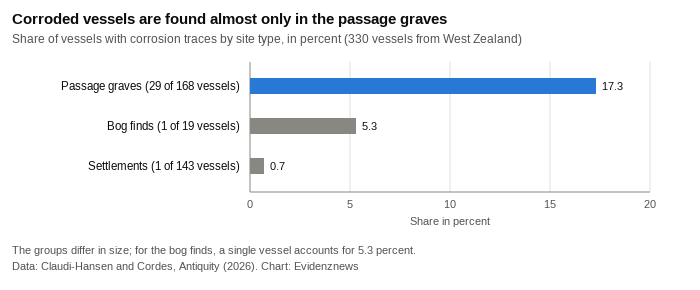
- Of 168 vessels from five Danish Neolithic passage graves, 29 (17.3 percent) show corrosion traces on the inner wall, all from the burial chambers; for vessels from settlements it is 1 of 143, for bog finds 1 of 19.
- In the experiment with nine replicas, a single vessel with milk that became heavily moldy in it came closest to the ancient traces; beer, mead, vinegar and water produced no comparable corrosion, kefir and whey a different picture.
- The main part of the study names no chemical proof of the contents; the authors themselves write that no specific substance can be reliably identified from surface traces alone.
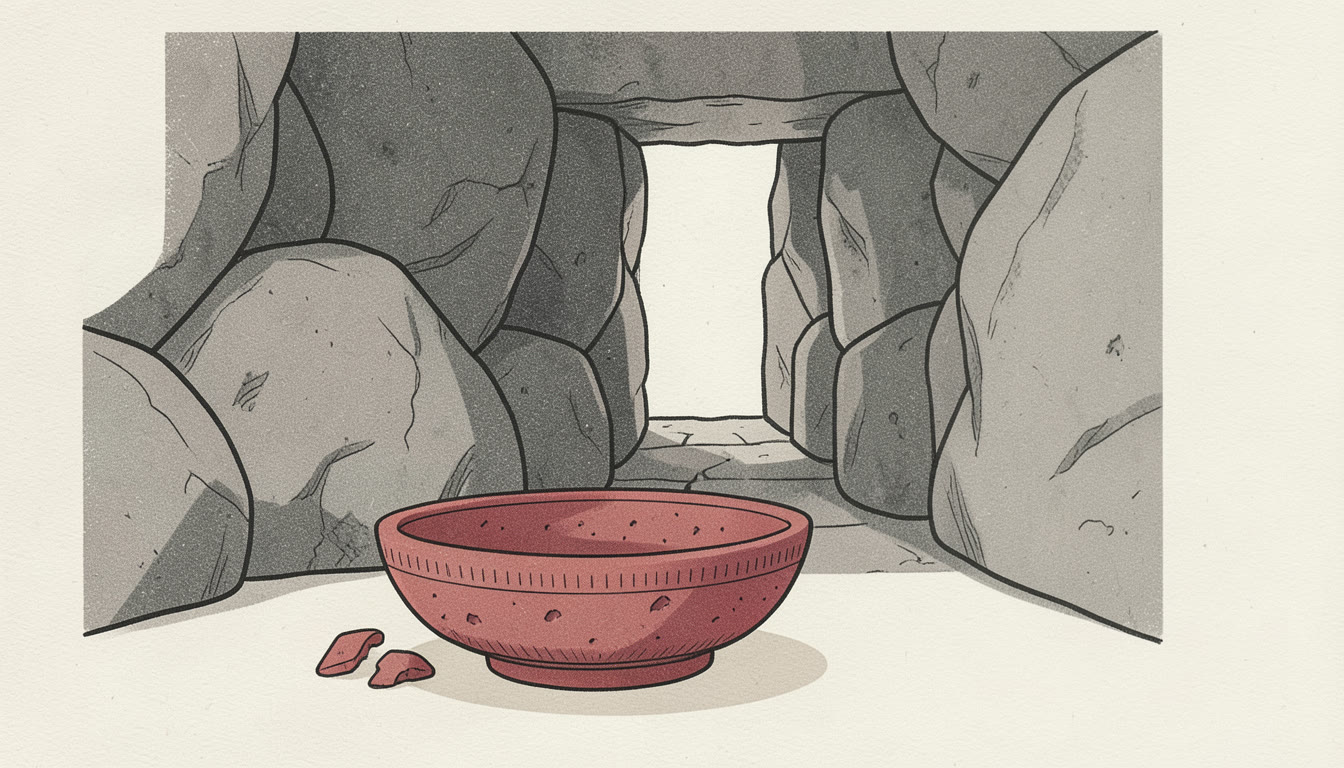
In the chambers of Danish Neolithic passage graves stood clay vessels whose inner walls are damaged: covered with small holes, flaked off or corroded over large areas. Vessels from settlements of the same period almost never show such damage. Archaeologist Lone Claudi-Hansen and archaeologist Adam Cordes examined 330 vessels from western Zealand for this and then tested in an experiment which liquids change clay in this way. Closest to the ancient traces came a vessel with milk that had been transformed by microbes over several weeks. Beer and mead left nothing comparable.
The study was published on November 26, 2026 in the journal Antiquity and is peer-reviewed. It names the University of Copenhagen, Museum Vestsjælland, Aarhus University and the National Museum of Denmark as institutions. Important for putting it in context is the method: the two compared traces on the surface of the vessels, with the naked eye and under the microscope. The main part of the paper names no chemical proof of the contents. What was in the pots therefore remains a conclusion from circumstantial evidence.
What passage graves are and what lay in their chambers
A passage grave, in Danish jættestue, is a burial structure made of large stones under an earth mound: a chamber reached by a passage. The passage can be up to 11 meters long, as at Kong Asgers Høj on Møn. In northern Europe, passage graves belong to the Funnel Beaker culture; around 3300 BC they replaced an older grave form, the dolmen. According to the Danish encyclopedia Lex, almost 700 passage graves are still preserved in Denmark, most built shortly before or after 3300 BC.
The graves were used for centuries, some for millennia. In some lay the bones of up to around 100 people, rarely complete skeletons. In addition there are numerous vessel sherds in the chambers and around the entrances. They are interpreted as offerings within a cult of the dead.
That does not say what was in these vessels. This is where the new study comes in.
How the researchers examined the vessels
Claudi-Hansen and Cordes examined 330 Funnel Beaker culture vessels from 24 sites in West Zealand, made between about 3300 and 2800 BC. 168 come from five passage graves, of which 154 from the chambers and 14 sherds from outside the entrances. 143 come from five settlements, 19 from 14 bog finds.
They looked at each piece with the naked eye and under a stereo microscope at 10x to 40x magnification, supplemented by sketches and photos. The location and shape of three kinds of damage were recorded. The authors call pitting small round depressions of about 1 to 3 millimeters in diameter. Spalling is larger areal detachment. The third stage is large-area corrosion; in the extreme case only a 20 to 50 millimeter wide band below the rim remains intact on the inside.
31 of the 330 vessels, or 9.4 percent, show such damage. 29 of them come from passage graves, all from the chambers: that is 29 of 168 or 17.3 percent. For the settlements it is 1 of 143 vessels (0.7 percent), for the bog finds 1 of 19 (5.3 percent). Affected vessels occur in all five passage graves, but none among the sherds from outside the entrances.
Almost all affected vessels are decorated: 29 of 31, and 28 bear all-over patterns. They are 19 bowls, 7 hanging or lugged vessels, 4 shoulder vessels and a funnel beaker from the bog. In time they fall into the years from about 3200 to 2900 BC. According to the authors, this corresponds to the main phases in which vessels were deposited in passage grave chambers in eastern Denmark. A lugged vessel from the chamber of the Korshøj passage grave additionally bears white deposits on the inside that reach up to the former liquid line. The authors regard such deposits as a comparative indication, not as reliable proof of milk products.
What the experiment with nine replicas showed
For the comparison, the two used nine replicas that a potter had built by hand at Sagnlandet Lejre. The walls are about 8 to 12 millimeters thick, heated granite grit and sand are mixed into the clay, no lime, and firing was at about 650 degrees Celsius. For the vessels of the period studied, the authors give about 600 to 700 degrees.
Each vessel received a liquid: fresh, unpasteurized milk, whey, kefir, vinegar, mead or water as a control; three vessels contained beer. Seven vessels stood for ten weeks, from September 23 to December 2, 2024. Two vessels treated on the outside with beeswax served for two short fermentation phases each of seven to nine days.
The vessels with milk products changed most clearly. The milk vessel developed pitting, spalling and merging corroded areas on the outside, comparable to the traces on the finds; on the inside, something flaked off only where dried-on residues fell off. Whey and kefir left a different picture: on the outside a slightly raised surface with altered texture, without pronounced pitting. Beer, mead and the other liquids produced no comparable corrosion. Two of the three beer vessels instead developed cracks at the neck.
The milk in the experiment was not a deliberately produced soured milk product. It was filled in fresh and became heavily moldy over the ten weeks. The authors conclude from this that it underwent a secondary microbial transformation in the vessel, and speak of microbially altered milk. The University of Copenhagen press release compares the presumed contents with skyr or kefir. In the experiment, however, it was precisely the kefir that did not produce the trace pattern of the finds, and skyr does not appear in the study.
For beer there were indications from earlier work: use-wear studies on pottery from Ethiopia and Senegal had shown that fermenting and storing beer can leave traces on the inner wall of vessels. In the Danish experiment this could not be reproduced for beer. The authors rule out another explanation: dissolution by acid, as described for pottery with added lime. The clay of the finds and of the replicas is granite-rich and sandy.
What is known about milk in the Neolithic
That Funnel Beaker culture vessels contained milk is known from chemical analyses. Fat analyses of 34 bog vessels from Denmark from the period of about 3900 to 2350 BC, of which residue data were available for 20, found fats from aquatic animals, ruminants and milk as well as plant waxes, mostly mixed. Milk fats were accordingly present from the beginning of the Funnel Beaker culture. An evaluation of around 7000 fat residues from pottery from more than 550 sites, published in 2022 in the journal Nature, concludes that milk was widely used in Europe since the Neolithic, to varying degrees in space and time. For Denmark it cites evidence from 4000 BC.
Most people of the early Neolithic, however, could digest milk sugar poorly as adults. According to the same Nature paper, ancient DNA shows that the ability to do so, lactase persistence, only became notably frequent in the Bronze and Iron Ages. Processing can reduce the milk sugar: fermentation consumes it, and when milk curdles into curd or cheese, most of it remains in the whey. Cheesemaking has therefore been proposed as a way to make milk products tolerable even without lactase persistence. The press release writes that the farmers who immigrated to Denmark about 6000 years ago were lactose intolerant; the study itself does not say this.
Whether milk was in the pot raw, fermented or as cheese, chemistry cannot yet say reliably. A team that examined Funnel Beaker culture vessels from Sławęcinek in Poland detected milk proteins from cattle and from sheep or goat in four vessels. It notes, however, that there are no reliable criteria for fat residues to distinguish raw milk from fermented milk products. Claudi-Hansen and Cordes also describe the detection of fermentation in archaeological material as difficult. Their approach therefore reads not the residues but the damage to the clay.
What remains open
The authors themselves write that no specific substance can be reliably identified from surface traces alone. Their experiment is, they say, a "comparative reference rather than a one-to-one key", a basis for comparison and not a key that assigns a content to every trace pattern. The press release sounds more certain: it says the surface of the replicas changed "in exactly the same way" as that of the ancient vessels.
Against this stand three things from the experiment itself. Milk was in exactly one vessel. The traces arose there mainly on the outside, whereas on the finds they sit on the inside; the authors explain this by seepage through the unsealed walls and call it speculative whether sealed vessels would have developed similar traces on the inside. And according to them, corrosion depends on many factors, including clay, firing temperature, liquid, fermentation stage and duration of use.
Also open is what the concentration in the burial chambers means. If the long standing time alone were decisive, then by the authors' argument settlement vessels should also be affected more often; they read the distribution as an indication of deliberate selection and deposition. As an alternative they name that vessels in the chambers retained their contents longer, but do not consider this sufficient alone. Whether the contents were an offering for the dead, provisions for the journey or part of a communal meal, the study does not determine. Its conclusion remains cautious: the taste, texture and durability of the altered contents could have contributed to their social and symbolic significance.
The study's supplementary material was not read for this text. The research found no assessment of the new paper by independent experts.
Questions about this article
Comments
Sources
- Primary source Claudi-Hansen L, Cordes A: Food transformation and ritualised deposition in Middle Neolithic passage tombs: ceramic use-wear evidence from Denmark. Antiquity, First View, S. 1–19 (2026). doi:10.15184/aqy.2026.10483
- Context Evershed RP et al.: Dairying, diseases and the evolution of lactase persistence in Europe. Nature 608, 336–345 (2022). doi:10.1038/s41586-022-05010-7
- Context Evans M et al.: Detection of dairy products from multiple taxa in Late Neolithic pottery from Poland: an integrated biomolecular approach. Royal Society Open Science 10 (3), 230124 (2023). doi:10.1098/rsos.230124
- Context Robson HK et al.: Organic Residue Analysis of Early Neolithic 'Bog Pots' from Denmark Demonstrates the Processing of Wild and Domestic Foodstuffs. Journal of Archaeological Science: Reports 36, 102829; nur Zusammenfassung gelesen (2021). doi:10.1016/j.jasrep.2021.102829
- Context Kaul F, Johannsen JW: jættestue. Lex (lex.dk), dänisches Lexikon, Stand 29.10.2026 (2026). https://lex.dk/j%C3%A6ttestue