Corroded pots from Stone Age tombs: in an experiment, milk fits best
Evidence level 2 of 5 · Single study, peer-reviewed
Key points
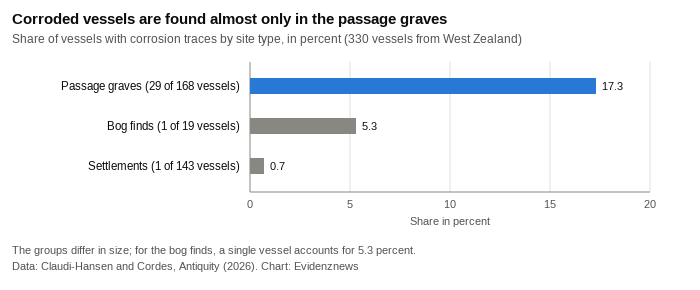
- Of 168 vessels from five Danish Neolithic passage graves, 29 (17.3 percent) show traces of corrosion on the inner wall, all of them from the burial chambers; among vessels from settlements it is 1 of 143, among bog finds 1 of 19.
- In the experiment with nine replicas, a single vessel with milk that became heavily moldy in it came closest to the ancient traces; beer, mead, vinegar and water produced no comparable corrosion, and kefir and whey produced a different picture.
- The main part of the study does not report a chemical identification of the contents; the authors themselves write that no particular substance can be reliably determined from surface traces alone.
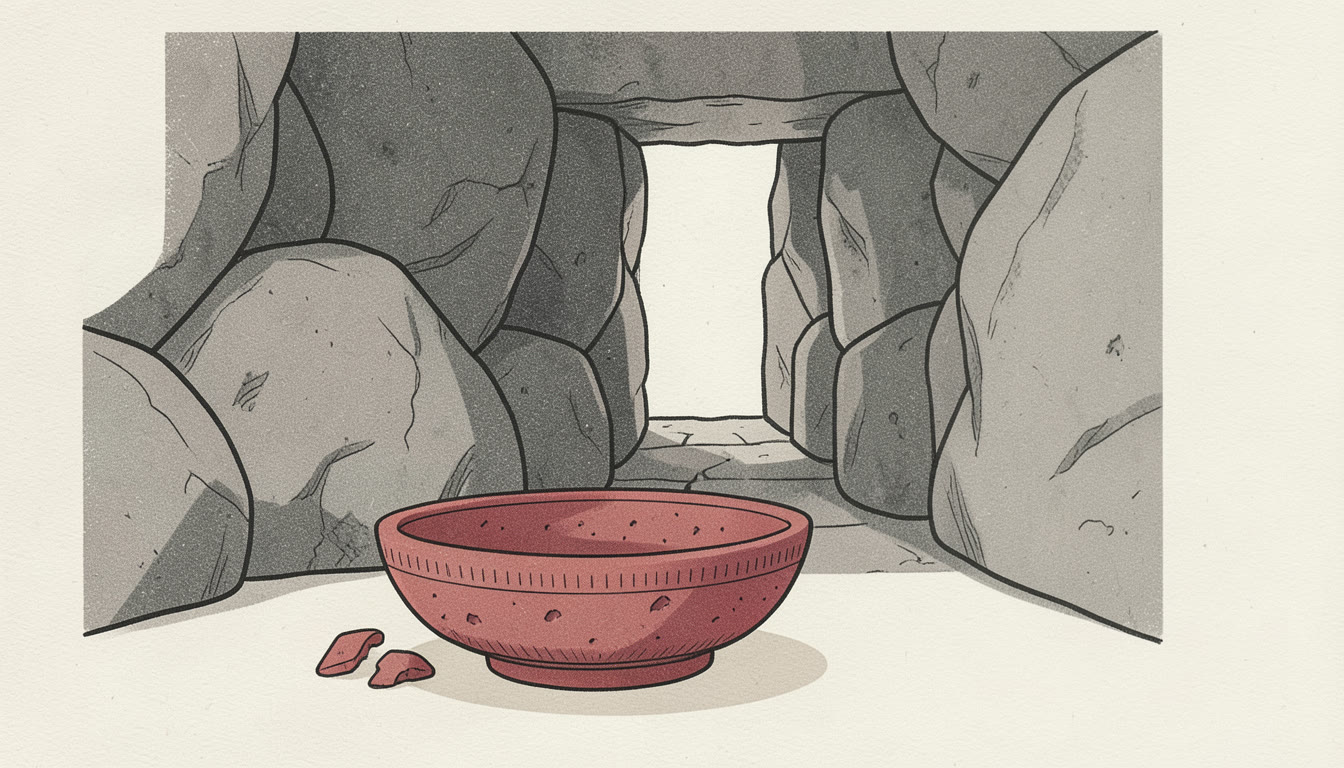
In the burial chambers of Danish passage graves from the Neolithic stood clay vessels whose inner walls are damaged: covered with small holes, flaked off or corroded over large areas. Such damage almost never occurs on vessels from settlements of the same period. Archaeologist Lone Claudi-Hansen and archaeologist Adam Cordes examined 330 vessels from western Zealand for this and then tested in an experiment which liquids change clay in this way. Closest to the ancient traces came a vessel with milk that had been transformed by microbes in it over several weeks. Beer and mead left nothing comparable.
The study was published on November 26, 2026 in the journal Antiquity and is peer-reviewed. It names the University of Copenhagen, the Museum Vestsjælland, Aarhus University and the National Museum of Denmark as institutions. The method is important for putting it in context: the two compared traces on the surface of the vessels, with the naked eye and under the microscope. The main part of the paper does not report a chemical identification of the contents. What was in the pots therefore remains a conclusion drawn from indirect evidence.
What passage graves are and what lay in their chambers
A passage grave, in Danish jættestue, is a burial structure made of large stones under an earth mound: a chamber reached by a passage. The passage can be up to 11 meters long, as at Kong Asgers Høj on Møn. In northern Europe the passage graves belong to the Funnel Beaker culture; around 3300 BCE they replaced an older burial form, the dolmen. According to the Danish encyclopedia Lex, almost 700 passage graves are still preserved in Denmark, most of them built shortly before or after 3300 BCE.
The graves were used for centuries, some for millennia. In some lay bones of up to around 100 people, rarely complete skeletons. In addition there are numerous sherds of vessels in the chambers and around the entrances. They are interpreted as offerings within a cult of the dead.
This does not say what was in these vessels. This is where the new study comes in.
How the researchers examined the vessels
Claudi-Hansen and Cordes examined 330 vessels of the Funnel Beaker culture from 24 sites in western Zealand, made between about 3300 and 2800 BCE. 168 come from five passage graves, of which 154 are from the chambers and 14 are sherds from outside the entrances. 143 come from five settlements, 19 from 14 bog finds.
They looked at each piece with the naked eye and under a stereo microscope at 10x to 40x magnification, and added sketches and photos. They recorded the position and form of three kinds of damage. The authors call small round depressions of about 1 to 3 millimeters in diameter pitting. Spalling is larger flat detachments. The third stage is large-area corrosion; in the extreme case only a band 20 to 50 millimeters wide below the rim is preserved on the inside.
31 of the 330 vessels, or 9.4 percent, show such damage. 29 of them come from passage graves, all from the chambers: that is 29 of 168 or 17.3 percent. Among the settlements it is 1 of 143 vessels (0.7 percent), among the bog finds 1 of 19 (5.3 percent). Affected vessels exist in all five passage graves, but none among the sherds from outside the entrances.
Almost all affected vessels are decorated: 29 of 31, and 28 bear all-over patterns. They are 19 bowls, 7 hanging or lugged vessels, 4 shoulder vessels and one funnel beaker from the bog. In time they fall in the years from about 3200 to 2900 BCE. According to the authors, this corresponds to the main phases in which vessels were deposited in East Danish passage grave chambers. A lugged vessel from the chamber of the passage grave Korshøj also bears white deposits on the inside, reaching up to the former liquid line. The authors regard such deposits as comparative evidence, not as reliable proof of dairy products.
What the experiment with nine replicas showed
For the comparison the two used nine replicas that a potter in Sagnlandet Lejre had built by hand. The walls are about 8 to 12 millimeters thick, heated granite grit and sand are mixed into the clay, no lime, and firing was at about 650 degrees Celsius. For the vessels of the period examined, the authors give about 600 to 700 degrees.
Each vessel received a liquid: fresh, unpasteurized milk, whey, kefir, vinegar, mead or water as a control; three vessels contained beer. Seven vessels stood for ten weeks, from September 23 to December 2, 2024. Two vessels treated on the outside with beeswax were used for two short fermentation phases of seven to nine days each.
The vessels with dairy products changed most clearly. The milk vessel developed pitting, spalling and merging corroded areas on the outside, comparable to the traces on the finds; on the inside something flaked off only where dried residues fell off. Whey and kefir left a different picture: on the outside a slightly raised surface with altered texture, without pronounced pitting. Beer, mead and the other liquids produced no comparable corrosion. Two of the three beer vessels instead developed cracks at the neck.
The milk in the experiment was not a deliberately produced soured milk product. It was filled in fresh and became heavily moldy in the ten weeks. The authors conclude from this that it underwent a secondary microbial transformation in the vessel, and speak of microbially altered milk. The press release of the University of Copenhagen compares the presumed contents with skyr or kefir. In the experiment, however, kefir in particular did not produce the pattern of traces seen on the finds, and skyr does not appear in the study.
For beer there were indications from earlier work: use-wear studies on pottery from Ethiopia and Senegal had shown that fermenting and storing beer can leave traces on the inner wall of vessels. In the Danish experiment this could not be reproduced for beer. The authors rule out another explanation: dissolution by acid, as described for pottery with added lime. The clay of the finds and of the replicas is rich in granite and sandy.
What is known about milk in the Neolithic
That vessels of the Funnel Beaker culture contained milk is known from chemical analyses. Fat analyses on 34 bog vessels from Denmark from the period of about 3900 to 2350 BCE, of which residue data were available for 20, found fats from aquatic animals, ruminants and milk as well as plant waxes, mostly mixed. According to this, milk fats were present from the beginning of the Funnel Beaker culture. An evaluation of around 7,000 fat residues from pottery from more than 550 sites, published in 2022 in the journal Nature, concludes that milk was widely used in Europe since the Neolithic, to varying degrees in space and time. For Denmark it cites evidence from 4000 BCE.
Most people of the early Neolithic, however, could digest milk sugar poorly as adults. According to the same Nature paper, ancient DNA shows that the ability to do so, lactase persistence, became notably common only in the Bronze and Iron Ages. Processing can reduce milk sugar: fermentation consumes it, and when milk curdles into curd or cheese, most of it remains in the whey. Cheese making has therefore been proposed as a way to make dairy products tolerable even without lactase persistence. The press release writes that the farmers who immigrated to Denmark some 6000 years ago were lactose intolerant; the study itself does not say this.
Whether milk in the pot was raw, fermented or cheese cannot yet be reliably stated by chemistry. A team that examined Funnel Beaker culture vessels from Sławęcinek in Poland detected milk proteins from cattle and from sheep or goat in four vessels. It notes, however, that there are no reliable criteria for distinguishing raw milk from fermented dairy products in fat residues. Claudi-Hansen and Cordes also call the detection of fermentation in archaeological material difficult. Their approach therefore reads not the residues but the damage to the clay.
What remains open
The authors themselves write that no particular substance can be reliably determined from surface traces alone. Their experiment is a "comparative reference rather than a one-to-one key", a basis for comparison and not a key that assigns a content to every pattern of traces. The press release sounds more certain: it says the surface of the replicas changed "in exactly the same way" as that of the ancient vessels.
Three things from the experiment itself speak against this. Milk was in exactly one vessel. The traces there arose predominantly on the outside, while on the finds they are on the inside; the authors explain this by seepage through the unsealed walls and call it speculative whether sealed vessels would have developed similar traces on the inside. And corrosion depends, according to them, on many factors, including clay, firing temperature, liquid, fermentation stage and duration of use.
It is also open what the concentration in the burial chambers means. If the long standing time alone were decisive, then by the authors' argument settlement vessels should also be affected more often; they read the distribution as an indication of deliberate selection and deposition. As an alternative they mention that vessels in the chambers retained their contents longer, but do not consider this alone sufficient. Whether the contents were an offering for the dead, provisions for the journey or part of a shared meal, the study does not determine. Its conclusion remains cautious: the taste, texture and durability of the altered contents could have contributed to their social and symbolic significance.
Questions about this article
Comments
Sources
- Primary source Claudi-Hansen L, Cordes A: Food transformation and ritualised deposition in Middle Neolithic passage tombs: ceramic use-wear evidence from Denmark. Antiquity, First View, S. 1–19 (2026). doi:10.15184/aqy.2026.10483
- Context Evershed RP et al.: Dairying, diseases and the evolution of lactase persistence in Europe. Nature 608, 336–345 (2022). doi:10.1038/s41586-022-05010-7
- Context Evans M et al.: Detection of dairy products from multiple taxa in Late Neolithic pottery from Poland: an integrated biomolecular approach. Royal Society Open Science 10 (3), 230124 (2023). doi:10.1098/rsos.230124
- Context Robson HK et al.: Organic Residue Analysis of Early Neolithic 'Bog Pots' from Denmark Demonstrates the Processing of Wild and Domestic Foodstuffs. Journal of Archaeological Science: Reports 36, 102829; nur Zusammenfassung gelesen (2021). doi:10.1016/j.jasrep.2021.102829
- Context Kaul F, Johannsen JW: jættestue. Lex (lex.dk), dänisches Lexikon, Stand 29.10.2026 (2026). https://lex.dk/j%C3%A6ttestue