Giant Deer from Irish Cave: Bones Show Possible Butchery Marks
Evidence level 2 of 5 · Single study, peer-reviewed
Key points
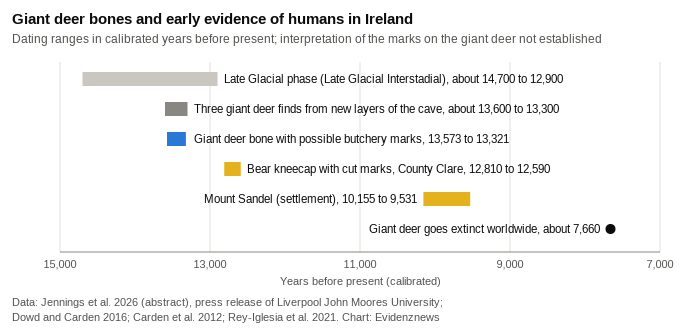
- In a re-examination of animal bones from excavations in the late 19th century in Ballynamintra Cave (County Waterford), a team led by Richard P. Jennings found two giant deer bones with possible marks of butchery by humans; one is dated to 13,500 to 13,300 years before present.
- The authors themselves speak only of possible marks: according to the university, weathering has destroyed fine tool marks, stone tools or bone points that could confirm such an early human presence are so far missing, and one of the bones also bears gnaw marks from a wolf.
- The earliest evidence of humans in Ireland to date is a bear kneecap with cut marks, dated to 12,810 to 12,590 years before present; if the new interpretation is confirmed, the evidence would be a good 500 to just under 1,000 years earlier.
Two giant deer bones, excavated in the 19th century and now in the National Museum of Ireland, raise an old question anew: when the first humans came to Ireland. A team led by Richard P. Jennings of Liverpool John Moores University has re-examined the bones from Ballynamintra Cave in County Waterford and describes marks on them that could result from butchery by humans. One of the two bones is dated to 13,500 to 13,300 years before present. The earliest evidence of humans on the island to date is younger.
The work was published in the Proceedings of the Royal Irish Academy, a peer-reviewed journal. It analyzes finds: animal bones, their surfaces and their age. The authors themselves write only of "possible signs of human butchery". Stone tools or worked bone points that would demonstrate a human presence are so far missing, according to a press release from the university.
What the Team Found in the Cave and in the Museum
The study has two parts. In the entrance area of the cave, the team excavated anew and came across layers from the late Ice Age that had escaped the extensive excavations of the late 19th century. They contained three finds of giant deer, scientifically Megaloceros giganteus. Radiocarbon dating places them in the period from about 13,600 to 13,300 years ago.
In the second part, the team took another look at the animal bones from the old excavations. According to a report by the Irish broadcaster RTÉ, they were recovered between 1878 and 1882 and are held in the National Museum of Ireland. Two giant deer bones stood out: a humerus and a metatarsal.
The details are not in the freely accessible abstract of the study but in a press release from the university. According to it, the humerus shows an even chopping surface at the elbow joint, of the kind that fits a heavy stone tool with an edge; the authors classify it as a probable chop mark. On the metatarsal they see a possible impact point of a stone tool and fine fractures of the kind that can arise when a bone is broken open to get at the marrow.
One of the two bones was dated, according to the reports the metatarsal. According to the press release, the measurement at the University of Oxford gave an age of 13,573 to 13,321 years; this refers to calibrated radiocarbon years before present. The abstract of the study gives the rounded figure of 13,500 to 13,300 years.
Why Marks on Bones Are Hard to Read
There are reasons why the authors remain cautious, and according to the university they name them themselves. Weathering has attacked the surfaces and destroyed fine tool marks that are visible only under the microscope. The humerus also bears gnaw marks that the team attributes to a wolf. Carnivores thus used the carcass later, according to this account. The reports also mention the possibility that animals carried the bones into the cave.
There is also a basic problem of the field. Several processes produce marks on bones that can resemble cut marks: rodents, the trampling of hoofed animals, or rockfall in caves. A methods paper from 2026 that has nothing to do with the Irish find distinguishes four kinds of marks: cut marks from stone tools, percussion marks from breaking the bones open, tooth marks from carnivores, and trampling marks. In experiments with 946 such marks, statistical models classified 74 to 83 percent correctly, depending on the comparison. The authors of that paper stress that after millennia further processes alter the surfaces, which makes transfer to fossils harder.
The dating, too, says less than it seems to. The radiocarbon method measures the age of the bone, not the time at which the marks were made. That the animal died and was butchered right afterward is an inference.
Co-author Cóilín Ó Drisceoil says, according to the press release, that further artifacts are needed to demonstrate the presence of humans beyond doubt. The abstract of the study ends accordingly: the work shows the potential to find larger quantities of butchered animal remains and further archaeological evidence.
What Is Known About the First Humans in Ireland
Hunter-gatherers of the late Paleolithic migrated to Britain from about 15,000 years before present, as archaeological finds show. For Ireland, there is no such evidence from the period into which the new dates fall: the phase from about 14,700 to 12,900 years ago, in which the environment in northwestern Europe changed markedly.
Until about 2009, according to a report by the excavation project, there was not a single stone tool or worked bone in Ireland that securely demonstrated a human presence earlier than 10,000 years ago. A paper from 2012 named the site of Mount Sandel in County Derry, dated to 10,155 to 9,531 years before present, as the beginning of settlement.
In 2016 this limit shifted. A brown bear kneecap from Alice and Gwendoline Cave in County Clare, excavated in 1903, bears cut marks and was dated to 12,810 to 12,590 years before present. According to the authors, this was up to 2,500 years older than the evidence accepted until then. Two independent radiocarbon dates agreed, and three external experts examined the cut marks without knowing the date.
If the interpretation of the giant deer bones is correct, the earliest evidence would be earlier still. Between the two dating ranges lie a good 500 to just under 1,000 years; the university's press release speaks of almost 1,000 years. The reports reviewed do not mention a comparable independent assessment for the new finds, as there was for the bear bone.
The history of research counsels patience. In Kilgreany Cave, which like Ballynamintra lies in the Dungarvan Valley, a human skeleton was found together with giant deer bones. Sean Ó Riordáin called the find at the time the first secure evidence of Paleolithic humans in Ireland. Later radiocarbon dating showed that the bones date from the Neolithic.
What Kind of Animal the Giant Deer Was
The giant deer stood about 2 meters tall at the shoulder, and its antlers spanned up to 3.5 meters. It is known as the "Irish elk"; it was not an elk but a deer. The "Irish" in the name comes from the fact that particularly many finds were made in Ireland. According to DNA studies reported by the Irish Times in 2005, it is more closely related to the fallow deer than to the red deer.
In the late Ice Age its range extended from western Europe to central Asia, and later it contracted to eastern Europe and western Siberia. Worldwide, the species did not go extinct until about 7,660 years ago. A study of 35 mitochondrial genomes sees a decline in genetic diversity that accelerated at the Last Glacial Maximum, and considers climate a main driver. In Ireland, giant deer and reindeer disappeared in the Late Glacial or early Holocene according to the 2012 paper, before humans arrived according to that paper.
Bones of Ice Age animals are known in Ireland from only a few caves. Of around 700 recorded caves, according to the excavation project's report, only 14 are known to have yielded securely identified bones of the Ice Age fauna; five of them are in the Dungarvan Valley, including Ballynamintra. Between about 1860 and 1935, remains of mammoth, giant deer, reindeer, brown bear and spotted hyena, among others, came to light there. The authors of the report suspect a connection with the fact that the area lies south of the limit of the last glaciation.
What Remains Open
First and foremost, the main point is open: whether humans worked the two bones, or whether wolves, trampling, rockfall or other processes in the ground produced the marks. It is also unclear whether the humerus with the chop mark is itself dated, and who brought the bones into the cave.
The research found no statements from independent experts; in the reports reviewed, only authors of the study and a representative of the funders comment. The full text is not freely accessible. This article relies on the abstract of the study and, for the details, on the university's press release and press reports; method and measurement data could not be checked against them in detail.
Questions about this article
Comments
Sources
- Primary source Jennings RP, Fitzgibbon B, Ó Drisceoil C et al.: Ballynamintra Cave, Co. Waterford: A Window into Late Glacial Ireland and Possible Upper Palaeolithic Human Butchery at c. 13.5 ka cal BP. Proceedings of the Royal Irish Academy: Archaeology, Culture, History, Literature (2026). doi:10.1353/ria.0.a1009058
- Context Keevil et al.: A comparative bone surface modification database for revealing the origins and evolution of human carnivory. Frontiers in Ecology and Evolution 14, 1681814 (2026). doi:10.3389/fevo.2026.1681814
- Context Dowd M, Carden RF: First evidence of a Late Upper Palaeolithic human presence in Ireland. Quaternary Science Reviews 139, 158–163; Zusammenfassung gelesen (2016). doi:10.1016/j.quascirev.2016.02.029
- Context Bericht von thejournal.ie zur Bärenkniescheibe aus der Alice-and-Gwendoline-Höhle, 20.03.2016. thejournal.ie (Nachrichtenbericht, für die Begutachtung der Schnittspuren durch externe Fachleute) (2016). https://www.thejournal.ie/?p=2667644&utm_source=shortlink
- Context Ó Drisceoil C, Jennings R: The Dungarvan Valley Caves Project: Second Interim Report. Decies 65 (Projektbericht zweier Autoren der neuen Studie). https://researchonline.ljmu.ac.uk/id/eprint/14937/1/The%20Dungarvan%2…
- Context Carden RF et al.: Phylogeographic, ancient DNA, fossil and morphometric analyses reveal ancient and modern introductions of a large mammal: the complex case of red deer (Cervus elaphus) in Ireland. Quaternary Science Reviews 42, 74–84 (2012). https://www.npws.ie/sites/default/files/general/Quaternary%20Science%…
- Context Rey-Iglesia A et al.: Exploring the phylogeography and population dynamics of the giant deer (Megaloceros giganteus) using Late Quaternary mitogenomes. Proceedings of the Royal Society B 288, 20201864; Zusammenfassung gelesen (2021). https://europepmc.org/article/MED/33977786
- Context Ahlstrom D: Great Irish elk was really an old deer. Irish Times, 22.09.2005 (Zeitungsbericht, für Größe und Namen des Riesenhirschs) (2005). https://www.irishtimes.com/news/great-iris-elk-was-really-an-old-deer…