Euclid Finding: Quasar Shone Just 630 Million Years After the Big Bang
Evidence level 2 of 5 · Single study, peer-reviewed
Key points
- The quasar J1504+6252 was selected in images from the Euclid survey and confirmed spectroscopically with Keck, Hubble, the Large Binocular Telescope and the James Webb Space Telescope; its redshift is 8.129 ± 0.005, which according to the paper corresponds to 630 million years after the Big Bang.
- The team puts the mass of its black hole at a reference value of roughly 360 million solar masses, with a total uncertainty of about a factor of 2.7 up and down; it is currently growing at about 12 to 44 percent of the Eddington limit, a theoretical upper bound.
- The authors call it the first quasar beyond redshift 8 in the sense of a luminous, unobscured quasar; fainter, more heavily enshrouded or disputed active galactic nuclei are known at higher redshifts, and the research found no statements from uninvolved experts one day after publication.
The quasar J1504+6252 was already shining when the universe was 630 million years old. A team from the Euclid Consortium selected it in images from the Euclid mission and confirmed it with four other telescopes; the authors call it the first quasar beyond redshift 8. How heavy the black hole at its center is, by contrast, can only be estimated indirectly: the paper's reference value, roughly 360 million solar masses, is uncertain by about a factor of 2.7 up and down.
The paper was published on November 24, 2026, in the journal Astronomy & Astrophysics, one day after the preprint on the arXiv server. The first author is Julien Wolf of the Max Planck Institute for Astronomy in Heidelberg and the European Southern Observatory in Garching; the arXiv page lists 198 authors writing on behalf of the Euclid Consortium. The journal received the manuscript on July 24, 2026, and accepted it on October 8. In the acknowledgments, the team thanks an anonymous referee.
A quasar is a luminous active galactic nucleus in which a black hole is growing. The paper is based on the observation of a single such object. What was measured is its spectrum and, from that, the redshift. The mass and growth rate of the black hole are derived from the spectrum using calibration formulas, and the considerations on its formation rest on simplified computational models, which the authors themselves describe as illustrative.
What the redshift of 8.129 indicates
The redshift, abbreviated z, indicates from which epoch the light of a distant object originates: the larger the value, the earlier in cosmic history it was emitted. For J1504+6252, the paper gives z = 8.129 ± 0.005; the statistical uncertainty is 0.001 and the systematic one 0.005. With the cosmological parameters the team uses (Planck 2018), this corresponds to 630 million years after the Big Bang.
The previous record was held by a quasar at z = 7.77, which also comes from Euclid data. It was presented in a paper by Yang and colleagues from the same consortium, published in July 2026. According to the new paper, its light dates from 660 million years after the Big Bang. The authors put the lead of J1504+6252 at about 39 million years, or roughly 6 percent of the age of the universe at that time. The two age figures are rounded; their difference therefore does not exactly give this value.
Of the earlier paper, only the abstract was read for this article. According to it, the consortium found 31 new quasars with redshifts between 6.6 and 7.8, over roughly 3,000 square degrees of sky from the first one and a half years of the survey. Twelve of them lie at a redshift of at least 7; according to the abstract, the number of known quasars in this range has thus more than doubled.
Three search methods, four telescopes
The team searched the images of the Euclid Wide Survey. The data status of August 2025 was analyzed, a sky area of 3,644 square degrees. The full survey is to cover about 14,000 square degrees.
Three mutually independent methods selected the candidates: a statistical model called XDHZQSO, a classifier based on the XGBoost method, and a fit of templates with LePhare. All three rated J1504+6252 as a promising candidate. Their redshift estimates from the image data were 8.20, 8.21 and 7.98, averaging 8.13 ± 0.10. The source was not detectable in Euclid's optical band, but it was in the Y, J and H bands.
Only a spectrum, that is, the light of the source split by wavelength, provides proof. The confirmation took four steps between January and June 2026. On January 18, the MOSFIRE instrument at the Keck Telescope showed, after an exposure of 4,800 seconds, i.e. 80 minutes, a blue continuum, but not the break in the spectrum that mattered. This break, a sharp edge in the continuum that the team interprets as a Lyman-alpha break, was shown on May 12 by a spectrum from the Hubble Space Telescope (2,206 seconds of exposure) at a wavelength of about 1,120 nanometers; this yielded a redshift of about 8.1 ± 0.1. On May 15 and 16, the Large Binocular Telescope with the LUCI instrument confirmed the break independently, with exposure times of roughly 21,400 to 23,500 seconds, equivalent to roughly six to six and a half hours. On June 26, the James Webb Space Telescope with the NIRSpec instrument recorded the high-quality spectrum from which the team measures the redshift.
In a footnote, the team gives the quasar a nickname: "Dún Aonghasa," after a prehistoric cliff fort on the Irish island of Inis Mór.
A spectrum like those of later quasars
The spectrum from the James Webb Space Telescope shows the typical features of quasars at lower redshift: a luminous blue continuum and broad emission lines, including the magnesium II and H-beta lines. According to the paper, such lines point to a classical broad-line region, that is, gas whose velocity shows up in the width of the lines. For comparison, the team picked out the five most similar among the so-called SDSS quasars; they lie at redshifts of about 2.7 to 3.2 and have comparable spectra.
The team derives the precise redshift from a narrow component of the H-beta line, because another line, [O III], is not significantly detectable in the spectrum. For this, the authors assume a systematic uncertainty of 150 kilometers per second.
The broad components of the two lines have, measured as full width at half maximum, widths of 3,160 ± 270 kilometers per second (H-beta) and 3,740 kilometers per second (magnesium II, uncertainty plus 160 and minus 170). These widths feed into the mass estimate.
The paper also describes features that it only touches on: a strongly damped Lyman-alpha profile with absorption by metals, a carbon line (C IV) blueshifted by about 3,500 kilometers per second, which the authors interpret as a sign of outflows, and the absence of significant [O III] emission. The team announces detailed analyses for separate papers.
The mass: a reference value and a range
The mass of the black hole is determined indirectly. The team uses two quantities from the spectrum: the width of the broad lines as a measure of the gas velocity and the luminosity of the continuum at 5,100 angstroms as a measure of the radius of the broad-line region. Calibration formulas, so-called single-epoch calibrations, turn these into a mass. They were calibrated on quasars at lower redshift.
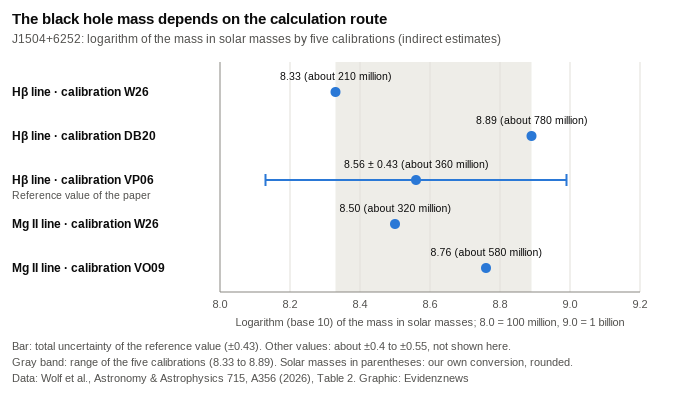
As a reference value, the paper gives 8.56 for the logarithm of the mass in solar masses; that is roughly 360 million solar masses, the figure from the title. The total uncertainty is ± 0.43 in the logarithm, i.e. about a factor of 2.7 up as well as down. The statistical part of it is small (plus 0.07, minus 0.08). The value is based on the H-beta line and a calibration by Vestergaard and Peterson from 2006.
Other calibrations yield other values. For H-beta they range from 8.33 to 8.89, and for the magnesium II line, which the team evaluates independently, from 8.50 to 8.76. Converted, the range extends from roughly 210 to roughly 780 million solar masses. Each individual value has a total uncertainty of about ± 0.4 to ± 0.55 in the logarithm. According to the authors, all estimates agree within their uncertainties, and the largest uncertainty lies in the choice of calibration.
As typical masses of quasars, the paper cites, referring to a 2023 review, one hundred million to ten billion solar masses.
Growth below the theoretical upper limit
From the brightness of the quasar, the team derives its bolometric luminosity, which involves a correction calculation. Its logarithm, in ergs per second, is 46.08 ± 0.02; the uncertainty of the correction is not included in this range.
The Eddington ratio follows from luminosity and mass. It indicates what fraction of the Eddington limit, a theoretical upper bound, a black hole is growing at. For J1504+6252, it lies between 0.12 and 0.44 depending on the mass calibration; with the reference value of the mass it is 0.26 (plus 0.05, minus 0.04). The black hole is thus currently growing at about 12 to 44 percent of the upper limit. Among the known quasars at redshifts above 6, according to the paper this is at the lower end, but not unprecedented.
From this, the authors conclude that for the same black hole mass there could be significantly more luminous quasars that have not yet been discovered. As an alternative, they note that some of the black holes with billions of solar masses have already passed their fastest growth phase. Both are hypotheses, not measurement results.
Formed early: heavy seed or rapid growth
A black hole of several hundred million solar masses, a few hundred million years after the Big Bang: in the authors' view, this requires either a massive seed, that is, a black hole that was already heavy at the start and from which the present one grew, or sustained, very efficient early growth. This holds despite the currently low growth rate.
How heavy the seed would have to be is worked out in the paper using simple models. In one example, it forms at redshift 20 and then grows without interruption at the Eddington limit, with a radiative efficiency of 0.10, a parameter of the model. A seed of about 100,000 solar masses would then be needed. That is well above the masses expected for so-called Population III remnants, about 100 solar masses; these would need extremely rapid, nearly uninterrupted growth. If the black hole was active for less than about half the time, the seed masses considered are not sufficient according to the calculation. So-called super-critical accretion, that is, growth above the Eddington limit, would relax the condition.
The authors call these calculations illustrative. The discovery does not allow a clear distinction between the formation pathways of the first massive black holes.
The question is older than this find. A 2023 review by Fan, Bañados and Simcoe noted that black holes of around one billion solar masses already exist at redshifts above 7.5 and must therefore have formed in less than 700 million years, presumably via massive seeds and very efficient, sustained growth. Two of its authors, Fan and Bañados, are also co-authors of the new paper. Independent of this is an overview by Inayoshi, Visbal and Haiman from 2020. It describes formation pathways for seeds and their growth and stresses that the very massive black holes are only the tip of a continuum that begins at masses of about ten solar masses. Of both reviews, only the abstract was read for this article. They do not address the new quasar.
The press release from INAF, one of the participating institutions, interprets the low growth rate as a sign of earlier phases of stronger growth. The paper itself leaves both pathways open. The release could be evaluated for this article only as a summary, not verbatim.
What "first quasar" means here
The designation as the first quasar beyond redshift 8 applies to luminous, unobscured quasars with the typical spectral features of lower redshifts. Active galactic nuclei are known from even earlier epochs: the James Webb Space Telescope has found some at redshifts above 8.5, for example the object UHZ1 at 10.073. According to the paper, however, they are either significantly fainter, more heavily enshrouded or disputed in their nature; it names the so-called Little Red Dots as disputed.
On rarity, the paper gives an order of magnitude. At a redshift around 7, there is on the order of one quasar per cubic gigaparsec, a volume measure in cosmology, brighter than an ultraviolet absolute magnitude of about −25; this corresponds to roughly one quasar per 130 square degrees of sky. At −24.08 ± 0.06, J1504+6252 is fainter than this threshold, because on this scale more negative numbers stand for brighter objects. Before the new find, according to the paper, only seven quasars at redshifts above 7.5 were spectroscopically confirmed, including the two Euclid quasars from the July paper.
A forecast by Barnett and colleagues from 2019 had predicted for Euclid about 8 to 23 quasars beyond redshift 8 over roughly 14,000 square degrees. Scaled to the 3,644 square degrees searched so far, the authors expect about two to six; so far one has been found. The effort of the follow-up observations also shows, they say, how hard such quasars are to find. The forecast is reproduced here as cited in the new paper and was not read directly.
What remains open
The redshift and the quasar nature rest on observations with four telescopes. Mass and growth rate are indirect estimates with large uncertainty. Whether the formulas calibrated on later quasars hold at redshifts above 8 is uncertain, according to the authors. How the black hole formed is not decided by the data.
The authors consider strong gravitational lensing unlikely. A small, unresolved magnification, however, they cannot rule out with the Euclid images. The host galaxy, the quasar's environment, the damped Lyman-alpha profile and the outflows are not analyzed in this paper.
The research found no statements from uninvolved experts on November 25, 2026, one day after publication; the classification as a record rests so far on the authors themselves. Independent follow-up observations, for example on the mass, are not yet available. The record is also a snapshot: the authors expect further quasars beyond redshift 8 as Euclid's sky coverage grows.
This article is based on the version of the paper deposited at arXiv, a journal proof. Deviations from the final published version are possible.
Questions about this article
Comments
Sources
- Primary source J. Wolf, S. Belladitta, D. Yang, et al. (im Namen des Euclid-Konsortiums): Euclid: Discovery of a quasar at z = 8.13 hosting a 360-million-solar-mass black hole. Astronomy & Astrophysics 715, A356; gelesen in der Fassung arXiv:2611.31385, Version 1 (2026). doi:10.1051/0004-6361/202662243
- Context Yang et al.: Euclid: Discovery of 31 new quasars at 6.6 < z < 7.8. Astronomy & Astrophysics 711, A104; Vorgängerarbeit aus demselben Konsortium, nur Abstract gelesen (2026). doi:10.1051/0004-6361/202658883
- Context Inayoshi, Visbal, Haiman: The Assembly of the First Massive Black Holes. Annual Review of Astronomy and Astrophysics 58; Übersichtsartikel, nur Abstract gelesen (arXiv:1911.05791) (2020). https://arxiv.org/abs/1911.05791
- Context Fan, Bañados, Simcoe: Quasars and the Intergalactic Medium at Cosmic Dawn. Annual Review of Astronomy and Astrophysics 61; Übersichtsartikel, nur Abstract gelesen (arXiv:2212.06907); zwei der Autoren sind Mitautoren der Primärquelle (2023). https://arxiv.org/abs/2212.06907
- Context Record per Euclid: scopre il quasar più lontano. Media INAF, Pressemitteilung einer beteiligten Einrichtung vom 24. November 2026; nicht unabhängig, nur als Zusammenfassung ausgewertet (2026). https://www.media.inaf.it/2026/11/24/nuovo-record-euclid-scopre-quasa…