Flu Vaccine: Protection Against Doctor Visits Was Around 40 Percent Across 18 US Seasons
Evidence level 4 of 5 · Systematic review or meta-analysis
Key points
- Across 18 flu seasons from 2004/05 to 2023/24, vaccine effectiveness against medically attended influenza in the US was a pooled 41.3 percent (95 percent confidence interval 35.6 to 46.5 percent).
- In 9 of the 18 seasons the value was below 40 percent, and in none was it above 60 percent; for a single future season, the prediction interval ranges from 15.6 to 59.3 percent.
- The analysis is based on observational studies from a single US network, covers only medically attended illness and gives no absolute risk.
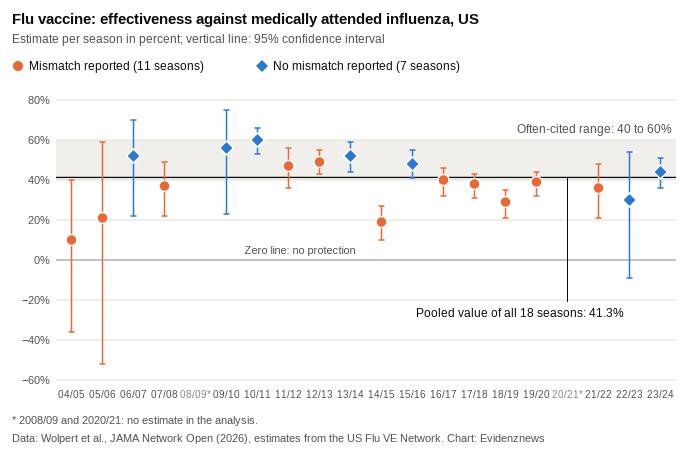
The effectiveness of the flu vaccine is often given as 40 to 60 percent. A meta-analysis from the University of Maryland in Baltimore shows for the US that the typical value is at the lower end of this range: Across 18 flu seasons, effectiveness against medically attended influenza was a pooled 41.3 percent (95 percent confidence interval 35.6 to 46.5 percent). The median of the seasonal values was 39.5 percent.
Observational data from a single network
The team led by Matthew D. Wolpert pooled, for the journal "JAMA Network Open," all published end-of-season estimates from the Flu VE Network, a network of the US agency CDC for observational studies of vaccine effectiveness. The data cover the seasons 2004/05 to 2023/24 with 96,335 participants of all age groups; for 2008/09 and 2020/21 the analysis contains no estimate.
These are observational studies in humans, not experiments with random assignment. The network uses the test-negative design: People with illness who test positive for influenza count as cases, and people with illness who test negative count as controls; effectiveness is calculated from the odds ratio. Only medically attended influenza was recorded, not hospital admission or death.
All of the following values are therefore relative figures that compare vaccinated with unvaccinated people. The absolute risk – how many doctor visits were avoided per 1,000 vaccinated people – is given neither by the meta-analysis nor by any of the comparison sources; it depends on how widely influenza circulates in a season. 40 percent effectiveness does not mean that 60 percent of vaccinated people fall ill.
Between 10 and 60 percent
The seasonal values ranged from 10 percent in the 2004/05 season (confidence interval −36 to 40 percent) to 60 percent in the 2010/11 season (53 to 66 percent). In 9 of the 18 seasons, effectiveness was between 40 and 60 percent, in 9 below that, and in none above. In three seasons, the confidence interval did not rule out a lack of protection.
For a single future season, the team gives a prediction interval of 15.6 to 59.3 percent. This range describes where the value of a single season can be expected; the narrower confidence interval indicates only the uncertainty of the average.
Values were lower in seasons with reported antigenic mismatch, in which at least one vaccine component did not match the circulating virus. This applied to 11 of the 18 seasons. In these, the pooled effectiveness was 36.2 percent (29.9 to 42.0 percent), in the remaining ones 50.4 percent (44.2 to 56.0 percent). This is an association, not proof of a cause: According to the paper, the seasons also differed in population immunity and in previous vaccinations.
What other data show
The CDC itself cites the range of 40 to 60 percent only for seasons with well-matched vaccine viruses. The paper's criticism therefore concerns reading it as a general benchmark, not an incorrect number.
A meta-analysis of 56 test-negative studies found different values in 2016 depending on virus type: 33 percent against the H3N2 subtype (confidence interval 26 to 39 percent), 61 percent against H1N1pdm09 (57 to 65 percent). The Robert Koch Institute determined for Germany in the 2023/24 season among outpatients 39 percent (17 to 56 percent) against influenza A(H1N1)pdm09.
Severe illness is a separate endpoint that the meta-analysis does not examine. A systematic review of 69 studies in "JAMA" found in 2026 across several seasons an association between vaccination and a lower risk of hospital admission and death, likewise with varying effectiveness. The team led by Wolpert describes vaccination, despite the variation, as the best means of preventing flu illness.
What remains open
It remains open whether values from a single US network can be transferred to Europe – and whether the mismatch causes the lower values.
Questions about this article
Comments
Sources
- Primary source Wolpert MD, Liang Y, Fitzpatrick MC, Ortiz JR: Testing the 40% to 60% Influenza Vaccine Effectiveness Heuristic: A Meta-Analysis. JAMA Network Open 9(11), e2642906 (2026). doi:10.1001/jamanetworkopen.2026.42906
- Context Centers for Disease Control and Prevention (CDC): Benefits of Flu Vaccination (2026). https://www.cdc.gov/flu-vaccines-work/benefits/index.html
- Context Belongia EA et al.: Variable influenza vaccine effectiveness by subtype: a systematic review and meta-analysis of test-negative design studies. The Lancet Infectious Diseases 16(8), 942–951 (2016). doi:10.1016/S1473-3099(16)00129-8
- Context Robert Koch-Institut: Gute Wirksamkeit der Impfung zum Schutz gegen Influenza bei ambulant oder stationär wegen einer akuten Atemwegsinfektion behandelten Patientinnen und Patienten in der Saison 2023/24. Epidemiologisches Bulletin 42/2024 (2024). https://www.rki.de/DE/Aktuelles/Publikationen/Epidemiologisches-Bulle…
- Context Senerth E et al.: Influenza Vaccine Effectiveness and Safety for the 2026-2027 Respiratory Season. JAMA, online vorab (2026). doi:10.1001/jama.2026.18126