How precisely can time be measured?
Best optical clocks up to 100 times more accurate than cesium clocks, new second still open
Evidence level 3 of 5 · Several independent studies pointing the same way
Key points
- Since 1967 the second has been based on the cesium-133 atom; according to a roadmap from the responsible expert body, cesium fountains realize it with relative uncertainties in the low range of 10 to the power of minus 16, and the uncertainties of optical clocks are said to lie about two orders of magnitude below that.
- In a comparison campaign with ten optical clocks in six countries, the strontium clocks of two institutes showed in 2022 a relative frequency difference of 1.46 times 10 to the power of minus 16, with an uncertainty of 0.21 in the same unit; according to a 2025 recommendation of the committee, a comparison uncertainty below 5 times 10 to the power of minus 18 between clocks of the same type in different laboratories has not yet been reached.
- Whether a single atomic transition or an ensemble of several transitions will define the second in future has not been decided in the field; the General Conference is to decide in 2030, provided there is consensus and the mandatory criteria are met.
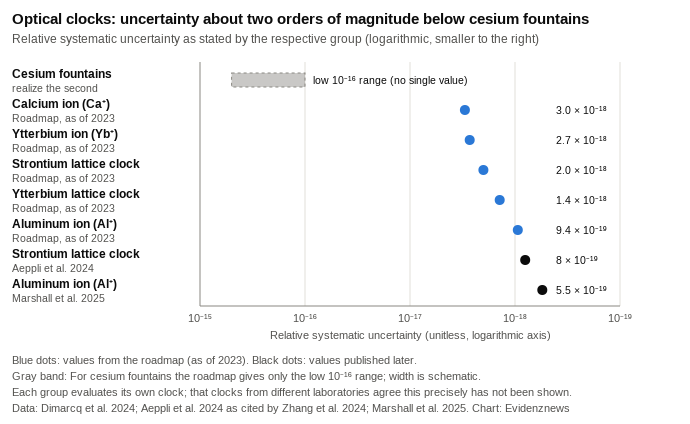
The best optical atomic clocks are so accurate that their operators state the remaining systematic uncertainty as around 10 to the power of minus 18, one part in a quintillion. That is about two orders of magnitude, that is, roughly a hundred times, smaller than for the cesium clocks on which the second is based today. This lead is documented for individual clocks in their own laboratories. That clocks from different institutes agree at this level has not yet been shown, and in October 2026 the General Conference on Weights and Measures did not decide on a new definition of the second.
The main source of this text is a roadmap for the redefinition of the second. It was written by N. Dimarcq and other members of a working group of the Consultative Committee for Time and Frequency, CCTF for short, 37 authors from 21 institutions in all; it appeared in January 2024 in the journal Metrologia. The roadmap is peer-reviewed, but it is neither a systematic review nor a measurement of its own: It summarizes original papers, evaluates a user survey and estimates how far the prerequisites for a new definition are met. All figures on the clocks come from laboratory experiments on atoms and ions, not from simulations.
The roadmap describes the state of 2022 and 2023. For the period after that, this text relies on a resolution of the General Conference from October 2026, a recommendation of the committee from 2025, a questions-and-answers page of the organization BIPM and several original papers.
The roadmap, resolution, recommendation and questions page come from the same procedure and the same research community. The authors of the roadmap work predominantly at national metrology institutes that operate optical clocks and would later implement a new definition. These documents are not an outside review.
From the solar day to the cesium atom
Until 1967 the second depended on astronomy. First it was the 86,400th part of the mean solar day, from 1960 a fixed fraction of the tropical year 1900. The change of 1960 followed the observation that Earth's rotation fluctuates unpredictably.
Since 1967 the second has been based on the cesium-133 atom: It corresponded to 9,192,631,770 periods of the radiation belonging to a particular transition of this atom, the hyperfine transition in the ground state. Since the revision of the International System of Units SI in 2018, the second has been defined via the fixed numerical value of this frequency: 9,192,631,770 hertz.
The clocks that put this definition into practice are cesium fountains. According to the roadmap, they realize the second with relative frequency uncertainties in the low range of 10 to the power of minus 16. Relative means: in relation to the frequency itself.
For context, by our own calculation: An error of one part in 10 to the power of 16 corresponds to one second in about 320 million years, one of one part in 10 to the power of 18 to one second in about 32 billion years. This is a conversion for illustration, not a measurement.
What has been measured: clocks in the range of 10 to the power of minus 18
Optical clocks use different transitions than the cesium clock. For the strontium-87 transition, the recommended frequency value is around 429 trillion hertz, by our own calculation about 46,700 times the cesium frequency. The sources name two designs: clocks with ions and so-called lattice clocks, for example with strontium atoms in an optical lattice.
According to the roadmap, such optical frequency standards have surpassed the cesium fountains over the past two decades; their uncertainties are said to be about two orders of magnitude lower. In its 2026 resolution, the General Conference states that the best devices exceed the accuracy achievable with the current definition by up to a factor of 100.
What is meant here is the systematic uncertainty: how precisely the operators can quantify the known disturbing influences on their clock. The list of these influences is called an uncertainty budget.
The roadmap gives as best values, as of 2023: 9.4 times 10 to the power of minus 19 for an aluminum ion clock, 1.4 times 10 to the power of minus 18 for an ytterbium lattice clock, 2.0 times 10 to the power of minus 18 for a strontium lattice clock, 2.7 times 10 to the power of minus 18 for an ytterbium ion clock and 3.0 times 10 to the power of minus 18 for a calcium ion clock.
Since then, lower values have been published. A paper by Marshall and colleagues from NIST and JILA in Physical Review Letters gives, in 2025, a relative systematic uncertainty of 5.5 times 10 to the power of minus 19 for a clock with a single aluminum ion. This is the lowest value in the sources evaluated for this text. For the strontium lattice clock at JILA, Zhang and colleagues give the value 8 times 10 to the power of minus 19 in a 2024 paper and refer for it to a publication by Aeppli and colleagues from the same year.
A second quantity is the instability. It is stated for a particular averaging time; in the figures given here it falls with the square root of the averaging time. For the 2025 aluminum clock it is, according to the abstract of the paper, 3.5 times 10 to the power of minus 16, divided by the square root of the averaging time in seconds; the full text was not read for this text. Systematic uncertainty and instability are different quantities.
There is also a third series of figures. Ten optical transitions and one microwave transition of rubidium-87 have been recommended since March 2021 as so-called secondary representations of the second. The uncertainties recommended for them lie in the range of 10 to the power of minus 16 to 10 to the power of minus 15, for example 1.9 times 10 to the power of minus 16 for strontium-87 and for ytterbium-171. According to the roadmap, they are largely determined by the uncertainty of the cesium realization; they say nothing about the quality of the optical clocks themselves.
Gravity becomes measurable at the centimeter scale
How finely optical clocks resolve is shown by two experiments on gravitational redshift. Behind it is an effect of the theory of relativity: How fast a clock runs depends on the gravitational potential at its location, near Earth's surface thus on its height.
A group around X. Zheng at the University of Wisconsin-Madison arranged five ensembles of strontium atoms in a vertical optical lattice over a height of one centimeter. It measured a frequency gradient of minus 12.4 times 10 to the power of minus 19 per centimeter, with a statistical uncertainty of 0.7 and a systematic one of 2.5 in the same unit. This is compatible with the value that general relativity leads one to expect: minus 10.9 times 10 to the power of minus 19 per centimeter. The paper appeared in 2023 in Nature Communications.
A group from JILA around T. Bothwell reported in 2022 in Nature a frequency gradient within a single, millimeter-sized sample of ultracold strontium that is compatible with gravitational redshift. The relative frequency uncertainty of this measurement was 7.6 times 10 to the power of minus 21. The authors write that this marks the start of an operation of clocks in which disturbances caused by gravity within the sample must be corrected. Only the abstract of this paper was read.
Where the accuracy ends: comparison between laboratories
The uncertainty that a laboratory attributes to its own clock is initially a statement by that laboratory. It can be checked by comparing clocks. The roadmap states on this: The ratio of the frequencies of two undisturbed atomic transitions is a number given by nature, without a unit. Two independent measurements of the same ratio should therefore agree within their uncertainties.
Here the figures are higher than for the individual clocks. According to the roadmap, the most accurate optical frequency ratio measured had a relative uncertainty of 6 times 10 to the power of minus 18, measured between two laboratories about two kilometers apart. Comparisons of clocks with the same transition from different institutes were at the level of 5 times 10 to the power of minus 17.
The roadmap contains a catalog of eight mandatory criteria for a redefinition and estimates for the year 2022 how far they are met. One criterion requires at least three clocks with the same transition at different institutes, each with an evaluated uncertainty of at most about 2 times 10 to the power of minus 18; the authors saw this as 20 to 40 percent fulfilled. Another requires at least three comparisons between institutes with an uncertainty of at most about 5 times 10 to the power of minus 18; here the estimate was 0 to 20 percent. Overall, the authors saw the confirmation of the uncertainty budgets through frequency ratios as less than 30 percent achieved. For continuity with the cesium definition, by contrast, they saw 90 to 100 percent. These are estimates by the authors.
What such comparisons show in practice is documented by a measurement campaign reported in 2025 in the journal Optica by T. Lindvall, M. Pizzocaro, R. M. Godun and colleagues. Starting on February 20, 2022, ten optical clocks in six countries were compared simultaneously for 45 days: in Finland, France, Germany, Italy and the United Kingdom via fiber, satellites and on site, with Japan only via satellite. The paper presents 38 frequency ratios, four of them measured directly for the first time. The preprint at arXiv was read for this text; the figures of the published version were not checked.
The smallest uncertainties of individual clocks in this campaign were a few times 10 to the power of minus 18. For on-site comparisons, the smallest uncertainties of the ratios were 4.4, 5.1 and 5.4 times 10 to the power of minus 18. Via satellite, several ratios reached total uncertainties below 1.8 times 10 to the power of minus 16; according to the authors, this is the smallest uncertainty in a satellite comparison to date. According to them, satellite links can introduce uncertainties up to a hundred times larger than the clocks themselves.
The campaign also revealed inconsistencies. Compared via fiber, the strontium clocks of the institutes PTB and SYRTE showed a relative frequency difference of 1.46 times 10 to the power of minus 16, with an uncertainty of 0.21 in the same unit. Satellite comparisons with the ytterbium clock of the Italian institute INRIM deviated by 4 times 10 to the power of minus 16 from the fiber results; the authors suspect an unfound problem in the signal distribution at the institute and regard these results as unreliable. All ratios involving a clock based on strontium ions lay slightly more than 2 times 10 to the power of minus 15 away from the recommended value, about twice the uncertainty of 1.3 times 10 to the power of minus 15 assigned to it. The authors consider this recommended value suspicious.
Whether deviations lie in the new measurements or in the reference values cannot, according to the authors, be decided from this campaign alone in some cases; they consider further campaigns necessary. Some contributors to the campaign are also authors of the roadmap.
The official documents record the same state. The committee's 2025 recommendation states that a comparison uncertainty below 5 times 10 to the power of minus 18 between clocks of the same type from different laboratories has not yet been reached. The General Conference's 2026 resolution speaks of noticeable inconsistencies in some comparisons of optical frequency standards and in the worldwide set of measured frequency ratios.
Transfer, height and time scale
Three further hurdles lie outside the clock.
The first is transfer. According to the roadmap, fiber links over 100 to 1,000 kilometers reach, for averaging times above 100 seconds, an Allan deviation, the measure of fluctuation used there, of below 10 to the power of minus 18, without a systematic frequency shift at this level having been reported so far. A link that compares optical clocks between continents without loss of quality did not yet exist, according to the roadmap. The BIPM questions page writes that time transfer via navigation satellites is sufficient for the best microwave clocks at practical averaging times of one day, but does not suit optical clocks that are ten to a hundred times more accurate. Fiber links have been demonstrated at the continental scale of about 1,000 kilometers. Intercontinental links are more difficult and a subject of research; two-way methods, optical links in space and transportable optical clocks are named.
The second hurdle is height. Atomic clocks deliver their proper time, and their rate depends on the gravitational potential at the location. International Atomic Time, TAI for short, is tied to a reference potential; every calibration therefore needs the potential at the clock's location. From the expected value of 10.9 times 10 to the power of minus 19 per centimeter follows, extrapolated linearly and not taken from the source, a shift of about 1.1 times 10 to the power of minus 16 per meter of height difference near Earth's surface. That lies in the range of the uncertainty of the cesium fountains. For a comparison at the level of 10 to the power of minus 18, the height above the reference potential would have to be known to about one centimeter by the same calculation.
According to the roadmap, satellite data provide the potential only with a spatial resolution of 200 kilometers or worse. Combining gravity measurements with leveling, that is, height surveying, the gravitational shifts of optical clocks can now be determined in some metrology laboratories with uncertainties in the mid range of 10 to the power of minus 18 or better.
The third hurdle is the step from the clock to the time scale. Optical clocks already steer International Atomic Time: Since mid-2021, according to the roadmap, at least one secondary frequency standard has calibrated it every month, and eight standards have contributed. The uncertainties of these contributions stated by the laboratories ranged, however, from 1.9 times 10 to the power of minus 16 to 3.3 times 10 to the power of minus 15, limited mainly by dead times and by uncertainties of the links. As of the roadmap, all calibrations were compatible with those of the primary standards.
Operating times add to this. Over measurement durations of more than ten days, typical operating times ranged, according to the roadmap, from a few percent to 90 percent; individual groups reported 80.3 percent over six months and 93.8 percent over ten days. As of the roadmap, there were no commercial optical frequency standards.
What is forecast: no fundamental limit, and the nuclear clock
How far accuracy can still be increased has not been measured. According to the assessment of the roadmap's authors, there is no fundamental limit to the accuracy of the optical clocks under development; most of the proposed transitions could get below 10 to the power of minus 18. This is a forecast.
As a possible future candidate, the roadmap names, besides highly charged ions and lutetium ions, the thorium-229 nuclear clock. It uses a transition in the atomic nucleus of thorium-229. According to the roadmap, such systems could be among the main candidates for clocks whose performance reaches the 19th and 20th digit. In the roadmap this is an outlook, not one of the options for the redefinition.
The following has been measured. A group from JILA around C. Zhang reported in 2024 in Nature that it had directly excited the nuclear transition of thorium-229 in a calcium fluoride crystal at 150 kelvin, with an uncertainty of 1 kelvin, with a frequency comb in the vacuum ultraviolet, at a wavelength of about 148.3 nanometers. The comb was locked to the institute's strontium clock. As the frequency ratio between the nuclear transition and the strontium-87 clock, the authors give 4.707072615078, with an uncertainty of 5 in the last digit. The precision of the nuclear transition frequency was thereby improved by about six orders of magnitude.
This is not an evaluated frequency standard. According to the authors, the systematic uncertainty of the ratio is to be investigated in future studies.
A follow-up paper by T. Ooi and colleagues from JILA and the Vienna University of Technology appeared in 2026 in Nature. According to it, the nuclear transition frequency at 195 kelvin agrees between two differently doped crystals over seven months to 220 hertz, relatively 1.1 times 10 to the power of minus 13. This reproducibility is a different quantity from the systematic uncertainty of a clock; the figure lies five orders of magnitude above the 10 to the power of minus 18 of the best optical clocks. At an operating temperature of 196 kelvin, with an uncertainty of 5 kelvin, the first-order temperature sensitivity vanishes, according to the authors. This would make a temperature shift below 10 to the power of minus 18 possible, they write, in the subjunctive ("would enable"). Only the abstract of this paper was read, too.
Two further sources are preprints. The first is not peer-reviewed; for the second, the peer-review status was not determined. B. Huang and colleagues report, according to the abstract of their preprint, submitted in June 2026 and revised in October 2026, that they stabilized a continuously operating laser at 148.4 nanometers to the nuclear transition. They give a relative frequency instability of 5 times 10 to the power of minus 13, divided by the square root of the averaging time in seconds, and speak of a nuclear clock. The value is more than a thousand times what is given for the aluminum clock; these are different systems, and the comparison shows only the order of magnitude.
The second preprint is a review article by A. Derevianko, R. Elwell and E. R. Hudson. It distinguishes two platforms: trapped thorium ions and thorium-containing solids. Solid-state clocks offer, according to it, the better stability because many nuclei contribute at once, but tend toward broadened lines and toward shifts that depend on the environment. Ion clocks offer the better accuracy but need long measurement times. So far, according to this article, the frequency of the nuclear transition has been measured only in solids, not yet in trapped ions.
An explanatory page of NIST, which by its own account was involved in the 2024 measurement, puts the state into perspective: The accuracy and precision of nuclear clocks still lag behind optical clocks and cesium fountains, and a nuclear clock that surpasses the best optical clocks is still years away. This page was available for this text only as an automatic summary.
What the field is arguing about
That optical clocks surpass the cesium clock is disputed by no one in the sources read. The argument is about the type and timing of the redefinition.
The roadmap describes three options. The first fixes the frequency of a single optical transition. The second forms a new defining constant from several transitions, as a weighted geometric mean; the weights can be fixed or adjusted according to fixed rules. The third fixes a different natural constant, such as the mass of the electron.
The third option is currently regarded as not practicable, and the reason is a question of accuracy: According to the roadmap, the electron mass is known with an uncertainty of 3.0 parts in 10 to the power of 10. The current realization of the second is at a few parts in 10 to the power of 16.
Between the first two options there is no agreement. A survey in the research community from 2022, which the roadmap evaluates, names as a weakness of the single-transition solution that consensus is hard to reach without a clearly preferred transition, and as a risk that the definition could quickly become outdated. The BIPM questions page adds that a better candidate would require a further redefinition. It assesses the risk that a systematic shift is discovered later as low and practically without consequences.
In the survey, the ensemble solution is regarded as flexible and more likely to find consensus. Its weaknesses according to the survey: It is harder to communicate and hard for one institute alone to realize, and the defining constant has no physical meaning. According to the BIPM questions page, there would then be no primary frequency standard anymore, and no procedure has yet been fixed for adjusting the weights. J. Lodewyck, among others, argues for the ensemble solution; he is a co-author of the roadmap; of his papers on it, only abstracts were available. Named advocates of a particular single transition were not found in the sources read.
The General Conference's 2026 resolution states that, despite an active scientific debate, there is no consensus, neither between a single atomic species and an ensemble nor on the respectively preferred atomic species. Some mandatory criteria are not yet met but could realistically be met by 2030.
On the schedule: The roadmap considered a redefinition in 2026 unrealistic and named 2030 as the preferred scenario, otherwise 2034. In October 2026 the General Conference asked the CIPM committee to work toward a proposal for the new definition, including an introduction date, to be available for its 29th meeting in 2030. It did not itself decide on a new definition. According to the BIPM questions page, the committee evaluates the criteria in 2028 and 2029 and commits to one possibility; the General Conference decides in 2030, provided there is consensus and the mandatory criteria are met.
It is also open who needs the additional accuracy. According to the roadmap, today's applications do not need the accuracy of optical clocks. Critical infrastructure such as telecommunications, energy supply and finance depends, according to the roadmap, on time synchronization below one microsecond; the most demanding requirements for relative frequency accuracy in the user survey were around 10 to the power of minus 14. The authors expect benefits first for science, among other things for tests of whether natural constants change over time, for the search for dark matter and for monitoring Earth's gravitational potential with centimeter resolution.
Cesium clocks would not be replaced by a redefinition. According to the 2025 recommendation, the cesium fountains are to contribute until the redefinition and in a transition period afterward. According to the BIPM questions page, cesium standards would then receive an additional uncertainty of about 1 times 10 to the power of minus 16, which matters only for the best ones, the fountains.
What measurements cannot decide
Three things lie outside what a clock can measure.
First, a definition is set, not measured. Even today the cesium frequency is not a measured value but a fixed number. The same follows from the roadmap and questions page for the time after a redefinition: The frequency of the chosen transition or ensemble would then be exact by definition. Measurements can only check how well clocks match this value and whether the ratios between transitions are stable. Which transition or ensemble is chosen is decided by a resolution on the basis of criteria and agreement.
Second, every atomic clock shows its proper time, which depends on the gravitational potential at its location. A common time arises only through reference to a reference potential, and how precisely the potential at the clock's location can be determined limits comparability.
Third, every definition based on atoms contains an assumption. The roadmap names it explicitly: According to the Standard Model, atomic resonance frequencies are universal and constant in time as well as in space. Ratio measurements can test this assumption only within their uncertainty.
What remains open
Whether optical clocks from different laboratories agree in the range of 10 to the power of minus 18 has not been shown; the inconsistencies from the 2022 campaign are explained only in part in the sources read. Which transition or ensemble will define the second in future has not been decided. And whether a thorium-229 nuclear clock will surpass the best optical clocks cannot be read from the papers available.
For this text, several papers were read only as a preprint or abstract, among them the papers on the aluminum clock and on the reproducibility of the thorium crystals. The discussion portal PubPeer was not checked.
Questions about this article
Comments
Sources
- Primary source Dimarcq N, Gertsvolf M, Mileti G, et al. (37 Autorinnen und Autoren der CCTF Task Force): Roadmap towards the redefinition of the second. Metrologia 61, 012001; gelesen als arXiv-Fassung arXiv:2307.14141 (2024). doi:10.1088/1681-7575/ad17d2
- Context Resolution 4 (2026) of the 28th CGPM: On the future definition of the second. Beschluss der Generalkonferenz für Maß und Gewicht, 13. bis 15. Oktober 2026; verbindlich ist der französische Text (2026). doi:10.59161/CGPM2026RES4E
- Context Recommendation CCTF 24-3 (2025): On the actions to progress on the roadmap for the redefinition of the second. Empfehlung des Beratenden Ausschusses für Zeit und Frequenz, 24. Sitzung (2025). https://www.bipm.org/documents/20126/284624643/CCTF+Recommendation+24…
- Context Frequently Asked Questions concerning the Redefinition of the Second. BIPM, Erläuterungsseite, Version 2.2 vom 13. Oktober 2026 (2026). https://www.bipm.org/en/FAQ-redefinition-second
- Context Lindvall T, Pizzocaro M, Godun RM, et al.: Coordinated international comparisons between optical clocks connected via fiber and satellite links. Optica 12(6), 843; gelesen als arXiv-Fassung arXiv:2505.06763v1 (2025). doi:10.1364/OPTICA.561754
- Context Zheng X, Dolde J, Cambria MC, Lim HM, Kolkowitz S: A lab-based test of the gravitational redshift with a miniature clock network. Nature Communications 14, 4886; gelesen als arXiv-Fassung arXiv:2207.07145v2 (2023). doi:10.1038/s41467-023-40629-8
- Context Bothwell T, Kennedy CJ, Aeppli A, et al.: Resolving the gravitational redshift across a millimetre-scale atomic sample. Nature 602, 420–424; nur Abstract gelesen (2022). doi:10.1038/s41586-021-04349-7
- Context Marshall MC, et al.: High-Stability Single-Ion Clock with 5.5×10^-19 Systematic Uncertainty. Physical Review Letters 135, 033201; nur Abstract-Seite der arXiv-Fassung gelesen (2025). https://arxiv.org/abs/2504.13071
- Context Zhang C, Ooi T, Higgins JS, et al.: Frequency ratio of the 229mTh nuclear isomeric transition and the 87Sr atomic clock. Nature 633, 63–70; gelesen als arXiv-Fassung arXiv:2406.18719, Seiten 1 bis 10 (2024). doi:10.1038/s41586-024-07839-6
- Context Ooi T, Doyle JF, Zhang C, Higgins JS, Ye J, Beeks K, Sikorsky T, Schumm T: Frequency reproducibility of solid-state thorium-229 nuclear clocks. Nature 650, 72–78; nur Abstract gelesen (2026). doi:10.1038/s41586-025-09999-5
- Context Huang B, Yan G, Xiao Q, et al.: A nuclear clock synchronized to 229Th. arXiv:2606.08870v2, Preprint vom 7. Oktober 2026, nicht begutachtet; nur Zusammenfassung (2026). https://arxiv.org/abs/2606.08870
- Context Derevianko A, Elwell R, Hudson ER: Colloquium: Nuclear clocks. arXiv:2606.11048v2, Übersichtsartikel als Preprint vom 24. Oktober 2026, Begutachtungsstatus nicht festgestellt; in Teilen gelesen (2026). https://arxiv.org/abs/2606.11048
- Context Nuclear clocks. NIST, Erläuterungsseite; Seitentitel nicht festgestellt, nur über eine automatische Zusammenfassung gelesen (2026). https://www.nist.gov/atomic-clocks/nuclear-clocks-clock-rule-them-all
- Context Lodewyck J, Ido T: Properties of a definition of the SI second based on several optical transitions. arXiv:2503.13278, Preprint vom 17. März 2025; dazu Lodewyck J, Metrologia 56, 055009 (2019); jeweils nur Zusammenfassung (2025). https://arxiv.org/abs/2503.13278