Riemann Hypothesis: Formal Proof Checked by Machine, but Not Reviewed
Evidence level 1 of 5 · Single finding, not peer-reviewed
Preprint: This work has not yet been reviewed by independent experts. The results may change.

Key points
- On November 20, 2026, Levent Alpöge published a four-page note and an archive of 175,187 modules in the proof language Lean; according to the checkers' reports, the Lean kernel and several other checking programs accept the proof of the Riemann Hypothesis and of a generalization for Dirichlet L-functions.
- The machine check concerns logical correctness, measured against Lean and the library Mathlib; it assumes that the checking programs are correct and that the definitions capture what is meant, and it replaces neither peer review nor an understanding of the argument.
- Alpöge works at Anthropic and, by his own account, found the proof with the company's AI model Claude, according to Terence Tao with an internal model; the model's role has not been independently verified, and no version readable by humans exists as of November 24, 2026.
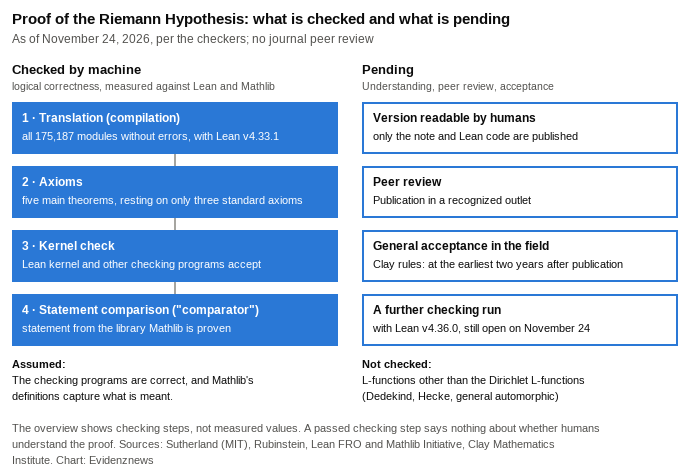
Since November 20, 2026, there has been a proof of the Riemann Hypothesis, a question in mathematics open since 1859, in a form that computer programs can check step by step. Several such programs have accepted it. It was presented by the mathematician Levent Alpöge, an employee of the AI company Anthropic. The work has not been peer-reviewed, and Alpöge has not published a version that humans could read: What is online is a four-page note and an archive of program code. This text reflects the state of affairs as of November 24, 2026.
Two things must be kept apart here. What has been checked is whether the chain of reasoning holds logically, measured against the proof language Lean and its library Mathlib. What has not been done is what makes up peer review in the field: that mathematicians understand, place and accept the argument.
A conflict of interest adds to this. In his note, Alpöge writes that he found the proof in collaboration with Claude, an AI model from his employer. According to the mathematician Terence Tao, he used an internal model. The model's share is documented only by his own account; this has not been independently verified.
What the hypothesis says
The hypothesis concerns the Riemann zeta function. This function is linked to the distribution of the prime numbers, that is, the natural numbers greater than 1 that are divisible only by 1 and themselves. Riemann put forward the hypothesis in 1859.
It is about the zeros of the function, the points at which it takes the value zero. According to the description by the Clay Mathematics Institute, the hypothesis states: All zeros that are not obvious are complex numbers with real part 1/2. Pictorially, they all lie on a single straight line.
This has been checked numerically for a very large number of zeros. The Clay Institute cites the first 10 trillion, a commentary by the mathematician Melissa Lee of Monash University speaks of more than 12 trillion. According to the institute, a general proof would settle many questions about the distribution of the primes. The magazine "Quanta" calls the hypothesis the most prominent open question in mathematics.
Besides the original hypothesis, there is a generalized one. According to "Quanta," it transfers the statement to a broader family of functions, the L-functions. Precision is needed here, because media reports name sometimes one version, sometimes the other. Alpöge's archive contains the Riemann Hypothesis and the generalization for a particular family, the Dirichlet L-functions. The original hypothesis is a special case of it. Other families, those named after Dedekind and Hecke and the general automorphic L-functions, were not checked, according to the checkers. A version that goes further still, the extended Riemann Hypothesis, is something Alpöge, in his own words, expects only with more time.
A note and a great deal of code
Alpöge published the proof on his own website, not in a journal; the research also found no version on the preprint server arXiv. In the note he writes that he believes he has found a proof of the Riemann Hypothesis with Claude, and that the two formalized the arguments without additional assumptions, that is, translated them into the proof language. According to a report by "Quanta," he had the result on November 16; he waited a few days before publishing.
Alpöge names his caveats himself. The argument is very long at the moment, and he wants to explain it later; he expects that it can be greatly simplified. He built many strange, non-optimal choices into the argument. One of the fields involved, automorphic forms of higher rank, he himself knows only a little.
On the idea of the proof, the note gives brief details that no one has reviewed. Alpöge describes it as a further development of an argument by Stepanov for so-called function fields; new ideas led to chained theta lifts, and the length of such a chain was suggested by Claude. What these terms mean and whether the sketch hits the core cannot be reliably explained without a checked presentation.
Two figures describe the scale, and they are easily confused. The archive consists of 175,187 modules, that is, individual files. Together they contain about 17 million lines of code. The proof exported from it is 61,570,595,788 bytes in size, about 61.6 gigabytes.
Reports also circulate the figure of 250,000 pages. It goes back to a footnote in the note. According to "Quanta," Alpöge later called it a joke; it is not suitable as a statement of the proof's length.
How programs check a proof
A formal proof is written in a language in which a program mechanically checks every single step for logical validity. In Lean, a small core program, the kernel, does this. The computer determines whether the asserted statement follows from the axioms, the basic assumptions that hold without proof. It does not thereby determine whether the statement is the one that was meant.
The checks were carried out by people who do not belong to Alpöge's team. Andrew Sutherland of MIT and another checker, Rubinstein, document their runs on their own pages. According to them, all 175,187 modules could be translated without errors, with Lean in version 4.33.1 and Mathlib. Five main theorems, among them the statement called "RiemannHypothesis" in Mathlib, and the statements for Dirichlet L-functions, depend according to them on only three standard axioms. The markers "sorry" and "native_decide," which the checkers specifically looked for, do not occur.
Then came the kernel checks of the exported proof. According to Sutherland, Lean's standard kernel needed 48 hours on a single processor core, a variant described as "paranoid" 72 hours and 20 minutes. The program nanoda, written in the programming language Rust, finished in about 28 minutes on 80 parallel threads. The checking programs lean4lean, con-leche and con-ron also accepted the proof. The checking programs are independent of one another.
A further step addresses the question of what was actually proven. The program "comparator" checks that exactly the given statement is proven and that no symbols were redefined along the way. After 64 hours and 8 minutes, it reported, according to Sutherland: "Your solution is okay!"
On November 21, Lean FRO and Mathlib Initiative declared jointly on the Lean community's blog that the statement and proof of the Riemann Hypothesis were correct; they had "full confidence." They name four criteria. The statement is the definition from Mathlib that experts have reviewed. The library can be translated without errors, and dozens of volunteers had produced the same export. Two programs confirmed that the proven theorem corresponds to the statement from Mathlib. And the Lean kernel and several third-party checking programs accepted the proof. According to this statement, what was checked was an export that itself executes nothing, as protection against malicious code in the source files.
Those who want to check for themselves will find a community-tidied copy of the archive on the platform GitHub. One file there proves the five theorems, a second states the same theorems without proof and relies only on Mathlib. The first publication of November 20 is preserved in a separate branch. The code carries no license. The instructions advise an isolated environment, because third-party code is executed during translation. Sutherland names as requirements about 100 gigabytes of memory and 70 gigabytes of storage.
What the check does not show
The checkers name their assumptions themselves. A passed run shows that the formal statements follow from the three standard axioms in the judgment of the kernels used. It is assumed that these kernels work correctly and that Mathlib's definitions of the zeta function and the Dirichlet L-functions capture what is meant. Whether the result is mathematically new and whether the note's further claims are correct is not assessed by the runs.
Kevin Buzzard of Imperial College aimed at the second point. According to a report by "Scientific American," he asked whether the statement in Lean corresponds to the real Riemann Hypothesis, and first waited for the run of the "comparator," which has since been completed.
The computer scientist Scott Aaronson addresses the first point in his blog. After the check with con-leche, he considers the proof correct; this program is itself formally verified, all the way down to the axioms of set theory. He concedes, however, that Lean kernels have had errors in the past, one of which allowed a proof of the false statement 0 = 1, and that the consistency of the underlying type theory has not been settled beyond all doubt. He is not completely sure, but he bets that the proof will stand. No AI result with a Lean certificate has been withdrawn so far.
In her commentary for "The Conversation," Melissa Lee notes that a formalization in Lean alone is not enough for many in the field, because problems can arise in formalizing itself.
A run with the newer Lean version 4.36.0 was still open on November 24. The research for this text found no concrete mathematical objection to the correctness. The doubts concern comprehensibility, the fidelity of the formal statement and Lean itself, not an error that has been found.
Two circumstances belong in the assessment of independence. Sutherland and Rubinstein state that they worked with computing time from their universities and with the tool Claude Code. And the statement by Lean FRO and Mathlib Initiative certifies formal correctness; it is not an expert peer review of the kind a journal initiates.
What experts say
Sutherland told "Scientific American" that the probability of a problem was "approximately zero." At the same time, much work was still needed to understand the mathematical details of the proof.
Terence Tao calls the result, in his blog, the least digested of the results he discusses there. According to a first, preliminary analysis, the proof appears to make full use of recent developments in the Langlands program and in arithmetic geometry. Understanding it will take some time; at least there is a human author who can help with that. Aaronson expects that mathematicians will not be satisfied with 17 million lines of Lean and that it will probably take years to work out the ideas. According to "The Conversation," Daniel Litt considers the proof very likely correct, but also says that so far nobody understands it.
Sharp criticism is directed at the note. Maksym Radziwiłł of New York University told "Quanta" that it contains "nonsensical statements" and that the proof does not answer the question of why. An expert whom the magazine does not name judged the accompanying text even more harshly; it is to be taken seriously solely because of the formalization in Lean.
Others reacted enthusiastically, according to "Scientific American" for example Hector Pasten and Carlo Pagano, according to "Quanta" Filippo Nuccio of Jean Monnet University.
What the rules for the Millennium Prize require
The Riemann Hypothesis is among the problems for which the Clay Mathematics Institute provides a Millennium Prize. The rules require three things: The solution must have appeared in a recognized outlet, at least two years must have passed since publication, and the solution must be generally accepted in the mathematical community worldwide. The institute does not accept submissions.
So far, there is a note and program code on Alpöge's own website. A statement from the institute on Alpöge's work was not on the pages read for this purpose.
Background and possible consequences
The result has a short prehistory. On October 6, 2026, according to a report by "Quanta," the company OpenAI presented proofs of a weaker statement, the quasi-Riemann Hypothesis. It does not require the zeros to lie exactly on the line, but only in a strip around it that is narrower than the region between 0 and 1. A version of September 30 with the strip from 1/8 to 7/8 comprised 199 pages and was verified in Lean; a version of October 5 with the strip from 1/12 to 11/12 comprised 49 pages and was not formally verified.
Even then, the issue was the relationship between machine checking and human understanding. According to "Quanta," Peter Sarnak wanted to treat the result as a theorem only once humans had checked all the details. Radziwiłł pointed out that most consequences of the Riemann Hypothesis already followed from the weaker statement. Will Sawin suspected that the full hypothesis might be as far away as before. Four weeks later, Alpöge's note appeared.
Another case is to be kept separate from this. "The Conversation" mentions a 940-page proof of the generalized hypothesis, written by a human, by Alessandro Maria Masullo of Stanford University. Problems emerged in it within hours; whether they can be fixed is unresolved. This work has nothing to do with Alpöge's archive.
A widespread assumption is that a proof of the Riemann Hypothesis would break common encryption. "Scientific American" traces it to a CBS television series from 2005 and names as the actual consequence: not much. The connection is narrower. The generalized hypothesis concerns primality tests that help find large primes for methods such as RSA. According to the report, an original test by Gary Miller that does without randomness now officially works; but hardly anyone will switch. Tests with random elements are already fast and reliable; Carl Pomerance of Dartmouth College considers such a test quite sufficient and moreover faster. Eric Bach of the University of Wisconsin-Madison told the magazine, in essence, that the hypothesis had been believed true anyway. An example of an internal mathematical consequence is given by Jeremy Rouse of Wake Forest University: Which numbers can be written as certain sums with squares is known only via the generalized hypothesis.
What remains open
What is open above all is whether humans will understand the proof. Only the code has been published; Alpöge has announced an explanation, Aaronson expects years.
Peer review and publication in a recognized outlet are open, and with them everything that the Clay Institute's rules presuppose.
The role the AI model played is open. The source for this is Alpöge's note, which also includes a timeline created by Claude. According to Tao, the model is an internal one, and the author works for the company that develops it. As of the "Quanta" report, there was no official announcement from Anthropic.
Finally, the scope is open. The Riemann Hypothesis and its generalization for Dirichlet L-functions have been checked, measured against Lean and Mathlib. For other families of L-functions and for the extended hypothesis, no check exists.
Questions about this article
Comments
Sources
- Primary source Levent Alpöge: Remark. Selbstveröffentlichung auf alpo.ge, unbegutachtet (2026). https://alpo.ge/remark.pdf
- Context leanprover-community/riemann-hypothesis. GitHub, README (2026). https://github.com/leanprover-community/riemann-hypothesis
- Context Lean FRO / Mathlib Initiative: Statement zu Alpöges Beweis. Blog der Lean-Gemeinschaft, Erklärung vom 21. November 2026 (2026). https://leanprover-community.github.io/blog/posts/riemann-hypothesis/
- Context Andrew Sutherland: RH Lean proof: verification files. Website am MIT, Stand 24. November 2026 (2026). https://math.mit.edu/~drew/grh/
- Context Rubinstein: GRH Lean verification. eigene Website des Prüfers (2026). https://mrubinst.github.io/grh-lean-verification/
- Context Riemann Hypothesis. Clay Mathematics Institute, Beschreibung des Problems. https://www.claymath.org/millennium/riemann-hypothesis/
- Context Rules for the Millennium Prize. Clay Mathematics Institute. https://www.claymath.org/millennium-problems/rules/
- Context Terence Tao: Unforced Euler singularity, unforced Navier-Stokes singularity, and the generalized Riemann hypothesis. Blogeintrag vom 20. November 2026 (2026). https://terrytao.wordpress.com/2026/11/20/unforced-euler-singularity-…
- Context Scott Aaronson: Shtetl-Optimized, Beitrag mit Update vom 21. November 2026. Fachblog (2026). https://scottaaronson.blog/?p=10344
- Context Update zu Alpöges Beweis. Quanta Magazine, Nachrichtenbeitrag mit Aktualisierung vom 24. November 2026 (2026). https://www.quantamagazine.org/update/169569/
- Context AI proved the quasi-Riemann hypothesis. Quanta Magazine, 19. Oktober 2026 (2026). https://quantamagazine.org/ai-proved-the-quasi-riemann-hypothesis-wha…
- Context Anthropic mathematician proves Riemann hypothesis, most famous problem in all of math. Scientific American, Nachrichtenbeitrag (2026). https://www.scientificamerican.com/article/anthropic-mathematician-cl…
- Context The AI Riemann hypothesis proof is almost certainly true, independent mathematicians attest. Scientific American, Nachrichtenbeitrag, aktualisiert am 21. November 2026 (2026). https://www.scientificamerican.com/article/the-ai-riemann-hypothesis-…
- Context Why solving the Riemann hypothesis won't break encryption. Scientific American. https://www.scientificamerican.com/article/why-solving-the-riemann-hy…
- Context Melissa Lee: The sacred object in mathematics: the Riemann hypothesis, AI and a proof no human can read. The Conversation, Kommentar (2026). https://theconversation.com/the-sacred-object-in-mathematics-the-riem…