Can trees communicate with each other?
Trees: Flow of Substances and Scent Signals Measured, Help for Offspring Lacks Field Evidence
Evidence level 3 of 5 · Several independent studies pointing the same way
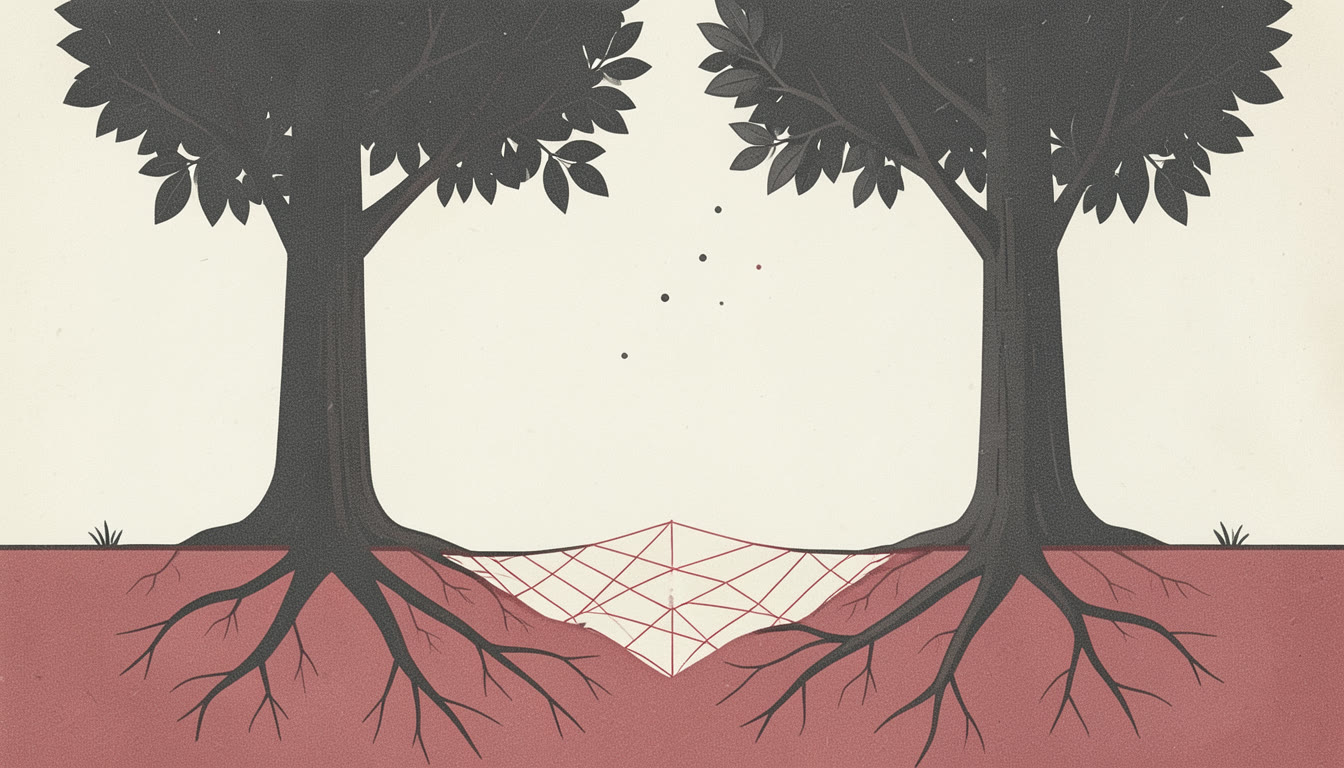
Key points
- In the laboratory, according to a 2023 review, it is shown beyond doubt that carbon travels through a shared fungal network from one tree seedling to the mycorrhizal roots of another; the authors Karst, Jones and Hoeksema consider it insufficiently supported that such networks are widespread in forests and benefit seedlings.
- For the claim that old trees preferentially send resources and defense signals to their offspring, the three authors found no peer-reviewed, published evidence; Klein and colleagues consider carbon transfer through fungal networks to be solidly supported, but concede that the amounts are generally small and a direct growth effect is therefore less likely.
- Through the air, plants in experiments respond to scent compounds from damaged neighbors, in a 2025 study also seedlings of densely growing tree species; in wild lima beans the effect reached about 50 centimeters, and whether the findings in seedlings apply to old trees in the forest is unknown.
Trees in the forest are said to be connected by fungal threads in the soil, and old trees are said to supply their offspring through them and send them defense signals: Books, newspapers, magazines, films and podcasts spread such claims. Part of this has been measured. In experiments, carbon passed through fungal threads from one tree seedling to the fungus-colonized roots of another, and plants responded to scent compounds from damaged neighbors. For the claim that old trees preferentially send resources and defense signals to their offspring, however, a 2023 review found no peer-reviewed evidence.
This work is by Justine Karst of the University of Alberta, Melanie Jones of the University of British Columbia and Jason Hoeksema of the University of Mississippi. It appeared in February 2023 in the journal Nature Ecology & Evolution and is peer-reviewed, but contains no measurements of its own. The three assessed published studies, mainly 26 field studies from forests, predominantly from western North America, and analyzed how 18 influential field studies are cited in the scientific literature. Other experts have since disagreed with the assessment in parts.
What is meant by a fungal network
Mycorrhizal fungi colonize the roots of plants. The review speaks of a common mycorrhizal network when the fungal threads, technically hyphae, of one and the same genetic fungal individual continuously connect the roots of at least two plants. The term "network" is also used differently in research, for example for the mere fungal mesh at a single root; the review examines only the first meaning.
Demonstrating such a network is difficult. Fungal threads of neighboring trees can hardly be made visible in the field; the authors regard determining the genetic makeup of the fungal individuals and their tree partners as the strongest method. By their count, this has been done in five studies in two forest types. Of an estimated 73,300 tree species worldwide, two have been mapped in this way, along with three fungi from the group of ectomycorrhizal fungi. Only two studies actually showed continuous fungal connections between trees.
The authors nevertheless consider connections plausible, because neighboring roots are often colonized by the same fungal species. Whether the connections last long enough to be useful is unknown, they say: Fungal threads and mycorrhizal roots turn over quickly, are eaten and break off, so that a network in nature can constantly fall apart and re-form.
What was measured in the soil
That carbon can pass from plant to plant through fungal threads is also settled for Karst and her co-authors. In the laboratory, it is shown beyond doubt that carbon travels through a shared fungal network from one tree seedling to the mycorrhizal roots of another. They also regard mycoheterotrophic plants as strong evidence. These obtain their carbon from fungi that sit on the roots of other plants, and according to the three authors' assessment they show that common fungal networks exist and transfer resources between plants in the forest. Klein and colleagues cite orchids as clear examples.
For the field, the review names as the strongest single piece of evidence an experiment in which dye passed from a freshly cut tree stump to an experimental seedling; according to the authors, this can only have happened through an intact fungal network or a root graft. That this helped the seedling grow was not shown by this experiment.
The debate is old. In 1997, a team led by Simard published in Nature a study on the net transfer of carbon between tree species in the field. Karst and her co-authors call it pioneering because it was the first replicated, controlled field study on resource transfer.
A more recent measurement comes from Audisio, Muhr and Polle from 2024. They labeled beech and Douglas fir seedlings in pots with carbon dioxide containing the carbon isotope 13C. In the recipient, only the fungus-containing root tissue was significantly enriched in 13C, not the plant tissue. The authors conclude that freshly fixed carbon is shared between the fungi on the tree roots, not between the trees.
What the critics doubt
Karst, Jones and Hoeksema examined three widespread claims. The first is that common fungal networks are widespread in forests. According to the second, resources flow through them that help tree seedlings thrive. The authors consider both insufficiently supported: The results of the field studies varied too much, allowed other explanations or were too limited for generalizations. For the third claim, that old trees preferentially send resources and defense signals to their offspring, they found no peer-reviewed, published evidence.
18 of the field studies worked with mesh barriers, which let fungal threads through and keep roots out. Only two of these, according to the review, showed that a common fungal network probably existed between the experimental plants. In 13 studies that also included a treatment without a mesh barrier, the authors counted 28 experiments; five of them, that is 18 percent, showed significant positive effects of the fungal network that were not offset by negative root effects. Overall, there is about as much evidence that connection to a presumed fungal network benefits seedlings as that it harms them; neutral effects were the most common.
Other routes add to this. According to the authors, carbon can travel through the soil solution instead of through fungal threads, and fine meshes can at the same time change the soil volume available to fungi and roots, as well as the fungal community and the pathogens in the soil. A second group led by Henriksson reached a similar result for ectomycorrhizal networks in 2023 in the journal New Phytologist: The evidence for a significant net transfer of carbon that benefits the recipients is still lacking, and very small differences in isotopes could lead to false conclusions.
On warning signals between forest tree species after insect damage, the review knows of a single peer-reviewed study, a pot experiment in a greenhouse. There, the signals disappeared when the roots of the neighbors were allowed to touch. The authors found no peer-reviewed field study that supports the third claim.
A 2010 experiment on warning signals through fungal threads worked with tomatoes, not with trees. Song and colleagues placed two plants per pot, separated by sieves with a mesh width of 25 micrometers, which keep roots out and let fungal threads through, and infected one of the two with the fungus Alternaria solani. In neighboring plants that were connected to infected plants by a mycorrhizal network, the activity of the enzyme peroxidase after 65 hours was 81.0 percent above the control without mycorrhiza, and the disease rate was 31.5 instead of 63.3 percent, so it was 50.2 percent lower. The authors consider further experiments necessary; the signaling substances were not identified, and only one cultivar was examined.
Finally, Karst and her co-authors analyzed how scientific articles cite the influential field studies. Unsupported claims have doubled in 25 years, they write.
What the defenders reply
Objection came in 2023 from Klein, Rog, Livne-Luzon, van der Heijden and Körner in an open letter in the journal Open Research Europe. The five acknowledge the work of Karst and colleagues as a valuable critical overview and concede that overinterpretation occurs. They nevertheless consider carbon transfer through common fungal networks to be solidly supported, with a growing body of evidence. The carbon flow through the fungal mesh is much more efficient than through the surrounding soil, they say. They point to a 2022 study that found the carbon isotope 13C in the DNA of certain mycorrhizal fungi of donor and recipient seedlings.
At the same time, they make concessions. Other routes would probably never be completely ruled out. The transfer is generally small compared with the carbon that a tree fixes itself, so a direct effect on growth is less likely. More experiments are needed that show that a single fungal mesh connects different trees. The letter contains no data of its own. Hoeksema, co-author of the criticized review, reviewed it openly and disagreed with the assessment that the evidence is solid.
Simard, Ryan and Perry replied in January 2025 with an opinion piece in the journal Frontiers in Forests and Global Change. They attack the citation analysis: The criteria for selecting the 18 studies classed as influential are unclear, counting per publication year inflated the sample, and the growth of the literature alone can produce citation trends. The restriction to field studies also excludes useful work from the laboratory and greenhouse. They too add qualifications: The results depended on place and circumstances, and further tests in different forest biomes are needed. The term "mother tree" comes from a metaphor in a book by Simard.
Both sides are also judging their own work here. Karst and her co-authors concede that unsupported citations partly stem from their own earlier publications; Simard, Ryan and Perry defend their own studies. A group led by Merckx argued in 2024 in Nature Plants using mycoheterotrophic plants: Because they depend on carbon from mycorrhizal fungi, they are natural evidence that the networks exist and work, and, given their wide distribution and the diversity of their fungal partners, an indication of widespread networks, especially in forests.
What is known about scent compounds in the air
Separate from this is the route through the air. That plants affect one another through scent compounds was discovered in the early 1980s. According to a review by Brosset and Blande, this triggered an extensive debate that raised doubts about the conclusions and temporarily slowed the research field; later work put the assumption on a solid foundation. The review deals mainly with herbaceous and crop plants and names some tree examples: Hybrid aspens increased the nectar release at the leaves after the scent of infested conspecifics, and in black alders defoliation influenced the feeding on undamaged neighbors.
According to the review, there are comparatively few field studies on costs and benefits. Some found greater resistance over one season in plants that had received scent signals from damaged neighbors.
How far such signals reach was investigated by Heil and Adame-Álvarez in 2010 in wild lima beans in Mexico. The defense signals from the air acted up to about 50 centimeters from the sender, and no longer at 100 centimeters and more. In the undisturbed stand, over 80 percent of the leaves within 50 centimeters belonged to the same plant. The authors conclude that signaling via scent compounds is predominantly signaling within a plant. One species was examined, not a tree species, and the senders were treated with jasmonic acid or the substance BTH, not exposed to natural feeding.
On trees, a team led by Yamawo, published in 2025, took measurements. Seedlings of nine tree species, 30 exposed to the scent and 30 control plants each, stood for ten days at a distance of 30 centimeters from mechanically damaged conspecifics and were then placed in the field. Densely growing species had less feeding damage after the scent exposure, loosely growing species did not; in the pine Pinus densiflora there was no significant difference. The authors name as limitations, among others, the artificial damage and the restriction to nine species; the seedlings also stood in pots, and observation lasted two months.
What remains open
Karst, Jones and Hoeksema stress that their finding does not mean that effects of common fungal networks do not occur, but that they have not been clearly demonstrated in the field. Knowledge is currently too thin and too uncertain to base forest management on it, they say. What is open is how often continuous fungal threads form between adult trees, whether substances in the field travel through these threads or through soil and root grafts, and whether the transfer benefits, harms or is neutral for the recipients.
Pot experiments necessarily use seedlings. Their results cannot simply be transferred to old trees; old trees are not large seedlings, write Karst and her co-authors. For the route through the air as well, it is unknown whether the findings in seedlings apply to old trees in the forest.
One limit lies in the question itself. The experiments measure where carbon ends up, how active an enzyme is or how heavily leaves are eaten. What of this should be called communication is not decided by any experiment: It can mean a signal that benefits sender and recipient, mere eavesdropping on cues, or a flow of substances without a signaling function. Whether a tree does something intentionally cannot be decided by such measurements. Karst and her co-authors call for rethinking anthropomorphism in science communication.
Questions about this article
Comments
Sources
- Primary source Karst J, Jones MD, Hoeksema JD: Positive citation bias and overinterpreted results lead to misinformation on common mycorrhizal networks in forests. Nature Ecology & Evolution 7(4), 501–511; Perspective (2023). doi:10.1038/s41559-023-01986-1
- Context Klein T, Rog I, Livne-Luzon S, van der Heijden MGA, Körner C: Belowground carbon transfer across mycorrhizal networks among trees: Facts, not fantasy. Open Research Europe 3, 168; offener Brief mit offener Begutachtung (2023). doi:10.12688/openreseurope.16594.1
- Context Simard SW, Ryan TSL, Perry DA: Opinion: Response to questions about common mycorrhizal networks. Frontiers in Forests and Global Change 7; Meinungsbeitrag (2025). doi:10.3389/ffgc.2024.1512518
- Context Henriksson N, Marshall J, Högberg MN, Högberg P, Polle A, Franklin O, Näsholm T: Re-examining the evidence for the mother tree hypothesis – resource sharing among trees via ectomycorrhizal networks. New Phytologist 239, 19–28; Übersichtsarbeit (2023). doi:10.1111/nph.18935
- Context Audisio M, Muhr J, Polle A: Ectomycorrhizal fungi of Douglas-fir retain newly assimilated carbon derived from neighboring European beech. New Phytologist 243(5), 1980–1990; Topfversuch (2024). doi:10.1111/nph.19943
- Context Merckx VSFT, Gomes SIF, Wang D, et al.: Mycoheterotrophy in the wood-wide web. Nature Plants 10(5), 710–718 (2024). doi:10.1038/s41477-024-01677-0
- Context Song YY, Zeng RS, Xu JF, Li J, Shen X, Yihdego WG: Interplant Communication of Tomato Plants through Underground Common Mycorrhizal Networks. PLOS ONE 5(10); Topfversuch mit Tomaten (2010). https://journals.plos.org/plosone/article?id=10.1371/journal.pone.0013324
- Context Heil M, Adame-Álvarez RM: Short signalling distances make plant communication a soliloquy. Biology Letters 6(6), 843–845; Freilandversuch an der wilden Limabohne (2010). doi:10.1098/rsbl.2010.0440
- Context Brosset A, Blande JD: Volatile-mediated plant–plant interactions: volatile organic compounds as modulators of receiver plant defence, growth, and reproduction. Journal of Experimental Botany 73(2), 511–528; Übersichtsarbeit (2022). doi:10.1093/jxb/erab487
- Context Yamawo A, Hagiwara T, Yoshida S, et al.: Interspecific Variations in Interplant Communication and Ecological Characteristics in Trees. Ecology and Evolution 15(1), e70876 (2025). doi:10.1002/ece3.70876
- Context Simard SW et al.: Net transfer of carbon between ectomycorrhizal tree species in the field. Nature 388, 579–582 (1997). doi:10.1038/41557