Reanalyzed 1978 probe data suggest iron sulfate in Venus clouds
Evidence level 2 of 5 · Single study, peer-reviewed

Key points
- A team led by Rakesh Mogul has reanalyzed data from the mass spectrometer of the 1978 Pioneer Venus Large Probe and interprets signals from the descent as decomposition products of cloud particles that had accidentally entered the inlets; this is not a new measurement.
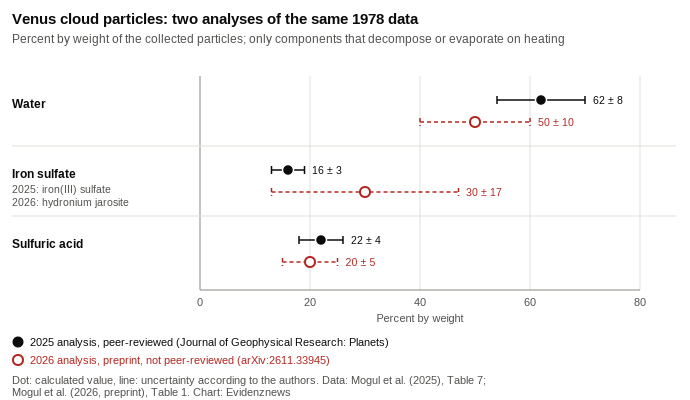
- According to the peer-reviewed calculation from 2025, the part of the collected particles that decomposes or evaporates on heating consisted of 62 ± 8 percent by weight water, 16 ± 3 percent by weight iron(III) sulfate and 22 ± 4 percent by weight sulfuric acid, at a mass loading of 6.8 ± 0.5 milligrams per cubic meter; according to the authors, the fractions are upper limits.
- An unreviewed preprint by the same authors dated November 25, 2026, with a new analysis of the iron signals, arrives at 50 ± 10 percent by weight water, 30 ± 17 percent by weight of an iron sulfate mineral and 20 ± 5 percent by weight sulfuric acid; in what form the iron sulfate exists in the unaltered cloud particles remains undetermined, according to the authors.
According to several measurement methods, the cloud droplets of Venus consist predominantly of concentrated sulfuric acid, at least 75 percent by mass. A team led by Rakesh Mogul of California State Polytechnic University in Pomona now reads old measurement data differently. According to the four authors' calculation, water, an iron sulfate and sulfuric acid were the main components of the cloud particles that the Pioneer Venus Large Probe collected in 1978 during its descent through the atmosphere.
The work appeared peer-reviewed in September 2025 in the Journal of Geophysical Research: Planets. It is not a new measurement but a reanalysis of archived data from one descent, combined with model calculations: the composition of the particles is inferred indirectly from gases released in the instrument. On November 25, 2026, the same authors published a preprint that recalculates the iron fraction; it has not yet been peer-reviewed.
How cloud particles got into the instrument
The large probe launched in 1978 together with other probes. The mission's goals included clarifying the structure and composition of the atmosphere down to the ground and the nature of the clouds. On December 9, 1978, the probe descended through the atmosphere and reached the surface. On board was a mass spectrometer. It did not measure continuously but at 232 preselected mass positions; some masses were skipped.
During the descent, something unplanned happened. At an altitude of 51.3 kilometers, the density of carbon dioxide in the instrument was still in the expected range; at 50.3 kilometers it had fallen by about 70 percent, and at 48.4 kilometers by at least 95 percent. The inlet was clogged. The authors assume that the probe had accidentally collected cloud particles in the cloud layer.
After that it got hotter. At an altitude of 51 kilometers the temperature is about 69 degrees Celsius, at the surface about 462 degrees. According to the authors' reconstruction, the inlets heated up by about 5 to 19 degrees per minute as the probe descended. According to the team's interpretation, the collected particles decomposed in the process, and the released gases appeared as peaks in the measurement signal. This is the core assumption of the analysis, not a directly observed process.
The principle behind it: a sample is heated step by step, and one determines which gases are released at which temperature. The authors see their analysis as parallel to the experiments SAM on the Mars rover Curiosity and TEGA on the Phoenix lander. On Venus, however, the heating was not planned. The original analysts in 1980 had already explained part of the signals, sulfur dioxide and water from an altitude of about 50 to 25 kilometers, with the breakdown of sulfuric acid from collected particles. What is new is above all the interpretation of the signals below about 25 kilometers and the quantitative calculation.
What the peer-reviewed analysis found
The impetus was a mismatch. If the signals after the collection are converted as though they came from gases in the atmosphere, the result for water at about 37 and at about 10 kilometers altitude is about 200 and 515 times what spectroscopic measurements give for water vapor. The authors conclude that these signals do not reflect gas contents of the atmosphere but are decomposition products of at least two compounds that contain sulfate and bound water. They reject the original analysts' explanation that the water at about 10 kilometers was a terrestrial contamination.
In this work, a weak signal points to iron. At inlet temperatures of about 300 to 460 degrees Celsius, the data show, according to the authors, a signal of at most 50 counts, which they assign to an ion made of iron and oxygen. The team interprets it as a fragment of iron(III) oxide that came from the decomposition of iron(III) sulfate.
From the signals, the authors calculate what the collected particles consisted of: 62 ± 8 percent by weight water, 16 ± 3 percent by weight iron(III) sulfate and 22 ± 4 percent by weight sulfuric acid. The fractions refer only to components that decompose or evaporate on heating. According to the authors, they are upper limits, because components that do not release such gases are not captured. They give the total mass loading as 6.8 ± 0.5 milligrams per cubic meter.
According to the analysis, most of the water comes from hydrates, that is, compounds with bound water: 59 ± 8 percent by weight versus 0.2 ± 0.1 percent by weight from liquid solution. The hydrates probably formed only in the inlet, after the particles had been captured and evaporated, and need not correspond to the original minerals. According to the authors, this does not contradict the previous picture: for the liquid fraction alone they arrive at 86 ± 17 percent by weight sulfuric acid and 14 ± 4 percent by weight water, which they say fits the earlier measurements of at least 75 percent sulfuric acid.
What the unreviewed preprint adds on iron
The preprint of November 25, 2026, published on the arXiv server and marked there as "in review", evaluates the iron signals quantitatively. Below an altitude of about 23 kilometers, the authors report several iron ion signals, together with decomposition gases. They again interpret them as fragments of iron(III) oxide that formed in the inlet when the collected particles decomposed.
The preprint itself names limitations of the data basis. The main mass for iron was never measured, because its mass position was skipped in the measurement program. The authors classify one of the assignments as tentative because only 1 count was measured. A factor for fragmentation, that is, breaking into fragments, carries 47 percent uncertainty. And a ratio of two iron signals, at 4.6 ± 3.0, initially came out much lower than the expected value of 15.7; the authors attribute this to chlorine ions of the same mass and subtract them out.
For the molar ratio of iron to sulfate they obtain 2.0 ± 1.1. According to the authors, this fits hydronium jarosite, an iron sulfate mineral with a ratio of 1.5; four other iron sulfate minerals that the preprint names for comparison lie outside the uncertainty. The jarosite, too, probably formed only in the inlet. In what form the iron sulfate exists in the unaltered cloud particles, whether dissolved or as solid particles, remains undetermined, according to the authors.
The numbers shift compared with 2025. The preprint gives 50 ± 10 percent by weight water, 30 ± 17 percent by weight hydronium jarosite and 20 ± 5 percent by weight sulfuric acid, at a mass loading of 7.4 ± 1.3 milligrams per cubic meter. Its table puts the total iron at 0.8 ± 0.5 milligrams per cubic meter, after 0.3 ± 0.1 in the peer-reviewed work. The iron value has thus roughly tripled from one analysis to the next; the error ranges overlap. Assuming a different iron sulfate mineral, mikasaite, the appendix of the preprint gives 35 ± 20 percent by weight.
The authors write that their result corrects the notion that the composition of the cloud particles is dominated by sulfuric acid. This applies to the total mass of the collected, thermally decomposed particles. Considering only the liquid fraction, the preprint, too, stays at 86 ± 17 percent by weight sulfuric acid.
Where the iron could come from
Iron in the Venus clouds is not a new claim. X-ray measurements by the probes Venera 12 and Vega 2 had provided preliminary indications of iron and chlorine in the cloud particles, with about 0.2 ± 0.1 milligrams of iron per cubic meter. The preprint's value is higher; because of the error ranges, the authors consider both possibly comparable.
As a source of the iron, the authors consider cosmic dust plausible. The 2025 work had already calculated that the input of cosmic dust would reach the entire aerosol mass in 3 ± 2 million years. The preprint estimates the iron mass in the cloud layer between 47 and 51 kilometers at 3.5 ± 1.0 trillion kilograms. With an input of 1.5 ± 0.9 million kilograms of iron per year from cosmic dust, a literature value, this amount would accumulate in 2.4 ± 1.5 or 2.6 ± 1.7 million years, depending on the passage in the preprint. The authors consider it unlikely, based on equilibrium calculations, that the iron reaches the clouds from the surface via gaseous iron compounds; according to them, an origin from the surface via dust particles has not been ruled out.
Work by other groups touches on these questions with model calculations and laboratory experiments. A model by a group around Karyu, published in Nature Astronomy in 2026, shows that a steady influx of cosmic dust can sustain the lower haze layer of Venus with the measured size distribution. Laboratory experiments from 2024 found that iron(III) reacts with sulfuric acid to form iron sulfates, which together with dissolved iron(III) can explain features of the unknown UV absorber; this is not a detection in the clouds. This is the name for a substance in the Venus clouds that absorbs ultraviolet light unevenly and whose identity has long been open.
A laboratory study from 2025 arrives at a different candidate: iron(III) chloride in sulfuric acid fits the observations well. Its authors also warn that iron sulfate could be misinterpreted as sulfur dioxide in Venus spectra. Whether iron sulfate, iron chloride or something else explains the absorber is open.
What remains open
The analysis infers the cloud particles only indirectly, from decomposition products in the inlet. Which minerals they contained before capture, evaporation and decomposition remains to be clarified, according to the authors. The percentages come from one descent in December 1978 and capture only the fraction that decomposes on heating; other water-releasing substances such as kieserite, kaolinite, opal or organic material are not included in the mass percentages, according to the preprint.
The iron value roughly tripled between two papers by the same group from the same data, with overlapping error ranges. The numbers depend on assumptions in the analysis, such as the assumed mineral formula, fragmentation factors and the fitting of the curves. The inlet temperatures are reconstructed from project reports from 1977 and 1978. The decomposition also occurred at lower temperatures than in laboratory experiments on Earth, which the authors explain by the very low pressure in the instrument, small grains and surface chemistry in the inlet. NASA's data archive put the original mass spectrometer data online in 2021; an independent analysis would be the test for the numbers.
The debate about phosphine showed how strongly weak signals in Venus data can depend on the analysis. A team led by Greaves reported in 2020 a probable phosphine line in the Venus clouds from radio observations; an independent reanalysis found no evidence for it in 2021. That concerned different data and says nothing about the iron sulfate interpretation.
A review from 2025 states that the properties of the Venus clouds are largely unknown because of few in situ measurements and the limits of remote sensing; it points out that ESA and NASA have approved three new Venus missions. Among those planned is DAVINCI: the NASA mission is to measure the chemistry, temperature, pressure and wind of the Venus atmosphere with a descent probe, with launch at the end of 2031 according to a NASA publication from May 2026 and landing in mid-2034. Mogul and his co-authors name it as an opportunity to clarify the water values in the middle and lower clouds.
Questions about this article
Comments
Sources
- Primary source Mogul R, Zolotov MY, Way MJ, Limaye SS: Re-Analysis of Pioneer Venus Data: Water, Iron Sulfate, and Sulfuric Acid are Major Components in Venus' Aerosols. Journal of Geophysical Research: Planets 130(9), e2024JE008582 (2025). doi:10.1029/2024JE008582
- Context Mogul R, Zolotov MY, Way MJ, Limaye SS: Mass Spectral Evidence for Iron Sulfate in Venus' Cloud Aerosols. arXiv:2611.33945, Version 1 vom 25.11.2026; unbegutachteter Preprint derselben Autoren, Vermerk „in review“ (2026). https://arxiv.org/abs/2611.33945
- Context Dai et al.: Venus cloud research: Progress and perspectives. Space Science Reviews 221, 51; Übersichtsarbeit (arXiv:2506.06164) (2025). https://arxiv.org/abs/2506.06164
- Context Jiang et al.: Iron-sulfur chemistry can explain the ultraviolet absorber in the clouds of Venus. Science Advances 10, eadg8826; Laborstudie (2024). doi:10.1126/sciadv.adg8826
- Context Egan, James, Plane: Laboratory measurements of ferric chloride (FeCl3) under Venusian conditions. ACS Earth and Space Chemistry 9(8), 2127–2136; Laborstudie (2025). https://eprints.whiterose.ac.uk/id/eprint/229310
- Context Karyu et al.: A cosmic origin of Venus' lower haze. Nature Astronomy; Modellstudie (2026). doi:10.1038/s41550-026-02843-4
- Context Villanueva et al.: No evidence of phosphine in the atmosphere of Venus by independent analyses. Nature Astronomy 5, 631–635 (arXiv:2010.14305) (2021). doi:10.1038/s41550-021-01422-z
- Context Greaves et al.: Phosphine Gas in the Cloud Decks of Venus. arXiv:2009.06593 (2020). https://arxiv.org/abs/2009.06593
- Context Pioneer Venus Probe Bus (1978-078A). NASA Space Science Data Coordinated Archive, Missionsbeschreibung. https://nssdc.gsfc.nasa.gov/nmc/spacecraft/display.action?id=1978-078A
- Context DAVINCI. NASA Science, Missionsseite (Stand 14.07.2026). https://science.nasa.gov/mission/davinci/
- Context Dutta, Andreini, Williams, Queen: Modeling the Big Plunge: Davinci Entry, Descent, and Landing. NASA Technical Reports Server, Dokument 20260004755 (Eingang 26.05.2026) (2026). https://ntrs.nasa.gov/citations/20260004755