Jupiter's Moon Europa: Sodium Cloud More Stable Than Earlier Models Expected
Evidence level 2 of 5 · Single study, peer-reviewed
Key points
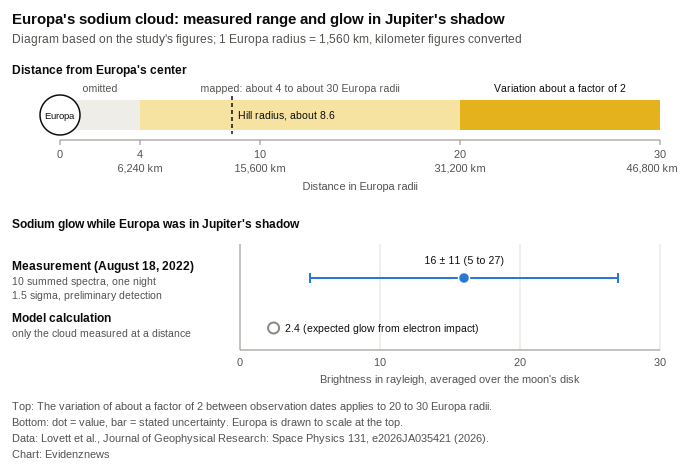
- A team led by Emma Lovett of Boston University compared seven nights of observation with the HIRES spectrograph at the Keck I telescope (1999 and 2018 through 2025). At a distance of 20 to 30 Europa radii, the amount of sodium varied by about a factor of 2 between observation dates, less than the range of about a factor of 5 in earlier observations.
- While Europa was in Jupiter's shadow, the team found a faint sodium glow of 16 ± 11 rayleigh; at 1.5 sigma, this is only a preliminary detection from a single night, which the authors interpret as a sign of a sodium layer bound to the moon near its surface.
- The study did not measure whether the sodium comes from Europa's ocean; it appears there as a cautiously worded assumption from earlier work, whereas the observatory's press release puts it in the headline.
The wispy sodium cloud around Jupiter's moon Europa changes less than earlier models and measurements led scientists to expect. At a distance of 20 to 30 Europa radii, far out, the amount of sodium varied by about a factor of 2 between observation dates. This is reported by a team led by Emma Lovett of Boston University after comparing seven nights of observation at the Keck I telescope: one from 1999 and six from 2018 through 2025.
The paper was published on October 10, 2026, in the "Journal of Geophysical Research: Space Physics" and has been peer-reviewed. It lists the Center for Space Physics at Boston University, Queen's University Belfast, the California Institute of Technology and Princeton University as the institutions of its five authors.
These are ground-based observations, supplemented by a simple model calculation. What the paper does not contain is a measurement of the ocean that Europa harbors beneath its ice. That the sodium comes from there is an interpretation. The Keck Observatory's press release puts it in the headline; the paper itself is considerably more cautious on this point.
Why sodium in particular
Europe is surrounded by a thin envelope of gas, the exosphere. Sodium is easy to track in it because it glows in sunlight: the atoms scatter the light in a very narrow yellow color, the so-called D lines at 5890 and 5896 ångströms (converted, 589.0 and 589.6 nanometers). Experts call the process resonance scattering. This is why the method is so sensitive for sodium. Oxygen, for example, does not scatter visible sunlight in this way.
The sodium envelope around Europa was discovered in 1996 by Brown and Hill. According to the paper, the main source is bombardment: particles from the Io plasma torus, a plasma ring that co-rotates with Jupiter, sweep over Europa at almost 100 kilometers per second and knock sodium out of the ice.
Seven nights, one large gap
The team used the HIRES spectrograph at the Keck I telescope. Its long slit, 28 arcseconds long, scanned the moon's surroundings in strips; maps were built from these. They show the sodium column density, that is, the number of atoms in an imaginary tube with a cross-section of one square centimeter along the line of sight.
The seven nights are December 28, 1999, May 26, 2018, September 29, 2022, August 25 and October 16, 2023, February 5, 2024, and November 29, 2025. They cover Europa's leading and trailing hemispheres and various positions in its orbit around Jupiter. The team newly analyzed the six maps from 2018 onward; the 1999 data come from an earlier paper.
The press release speaks of more than two decades. That is true for the span between the first and the last night. In between, however, there is a gap: from 1999 to 2018 there are no maps. The authors themselves call their dataset small in scope, yet say it is the largest of its kind.
Close to the moon, the method sees nothing. Europa's bright surface reflects so much sunlight that the data within 4 Europa radii were omitted. One Europa radius measures 1,560 kilometers. The cloud was mapped from about 4 to about 30 Europa radii; converted, that is roughly 6,200 to just under 47,000 kilometers from the center of the moon (our own calculation, 4 and 30 times 1,560 kilometers). The kilometer figures do not appear in the paper in this form; they describe how far the maps reach.
Oval, without a ring and barely in step with Jupiter
The factor of 2 between dates is smaller than the range of earlier data. Earlier observations, which two other papers had compiled for simulations, differed by about a factor of 5.
On average, the cloud is oval. In the east-west direction, that is, along the orbital plane, it is more stretched and more variable than in the north-south direction. It does not form a ring along the orbit. There was an exception to the east-west stretching on May 26, 2018, when the north-south component was brighter at all heights.
The brightness and shape of the cloud barely depend on where Europa is in its orbit. The moon's position relative to the plasma sheet in Jupiter's magnetosphere also leaves no clear trace. The authors have a conjecture for this: the atoms travel for about as long as Jupiter takes to complete one rotation, about ten hours. Differences would be smeared out at great height. This is an explanation by the authors, not a measurement result.
With distance, the sodium density falls off roughly as one over the distance. This is how a cloud of atoms that escape completely behaves. The authors conclude from this that almost all atoms of the distant envelope start out at at least 2 kilometers per second, also a model-based interpretation.
Two of the six radial profiles, that is, of the curves of density against distance, fall off more shallowly, the one from October 16, 2023, and the one from November 29, 2025. On both dates Io and Europa were near a conjunction in their orbits, and both nights yielded the lowest column densities in the dataset. Sodium from Io's extended clouds may contribute there. According to the authors, a remainder of it cannot be removed entirely from the data; the cause remains open.
When the team extrapolates its profiles to the edge of the moon's disk, the result is on average 32 billion sodium atoms per square centimeter (3.2 × 10¹⁰ in the paper). Compared with a hydrogen value from Hubble observations in another paper, this corresponds to a sodium-to-hydrogen ratio of 0.7 percent. The figure is an extrapolation into the region that the maps do not cover. For individual nights, the authors advise against such an extrapolation.
A faint glow in Jupiter's shadow
The second part of the paper uses an eclipse. When Europa is in Jupiter's shadow, sunlight is missing and sodium can no longer glow by scattering. If a glow remains anyway, it must arise differently: through collisions with electrons that excite the atoms. Such a residual glow indicates gas near the surface.
Only a single night was analyzed for this, August 18, 2022, with ten summed spectra. Other opportunities were ruled out because sodium from Io in the foreground disturbs the measurement; on this night, Europa was far from Io.
The result: a glow of 16 rayleigh, averaged over the moon's disk, with an uncertainty of plus/minus 11 rayleigh. The rayleigh is the unit in which the paper gives the brightness. The measured value is thus only about one and a half times as large as its own uncertainty. The authors put the significance at 1.5 sigma and speak of a preliminary detection.
For comparison, a model calculation was used with plasma data from the Juno spacecraft, which flew past Europa on September 29, 2022, while the Keck telescope was observing the moon. The calculation asks how brightly the cloud measured at a distance would glow through electron impact alone, and arrives at 2.4 rayleigh. About six times that was measured. From this the authors conclude that Europa has a sodium layer near the surface that is held by the moon's gravity. At a significance of 1.5 sigma, this remains a preliminary conclusion.
A comparison from the paper shows how weak the signal is: in a measurement on September 12, 2024, Io glowed in Jupiter's shadow at 29.16 kilorayleigh. Europa's value is thus roughly 1,800 times lower (our own calculation from both figures; because of the large uncertainty, to be read only as an order of magnitude).
The group corrects its own earlier paper
The paper also contains an error correction. The same group had reported in 2025 in the "Planetary Science Journal" on Europa's sodium and potassium during the Juno flyby. Because of a conversion error, the column densities there were stated too high by exactly a factor of 10.
The correction changes the interpretation given at the time. A particularly energetic release of the atoms, which the group had suspected then, is no longer needed with the correct values, and Europa's sodium values now fit the rest of the literature. In the earlier paper's entry in the Crossref registry, no reference to a correction was recorded on November 25, 2026; so far it appears only in the new paper.
What is said about the ocean and what is not
The Keck Observatory's press release is titled "Astronomers Reveal the Oceanic Origin of Europa's Sodium Cloud". Co-author Carl Schmidt is quoted there with the sentence: "What we observe originates in Europa's saltwater and not in Io's volcanoes".
The paper's title is different: Europa's sodium envelope is quasi-stable over decades. Its abstract deals with this stability and with bound sodium, not with the ocean. The ocean origin appears in the introduction as an argument from earlier work. According to it, sodium chloride, that is, table salt, was observed on Europa's surface with the Hubble Space Telescope, above all in geologically young terrain. In addition, the ratio of sodium to potassium in Europa's cloud differs from that at Io and in meteorites. The authors regard this as a strong indication that the sodium comes from Europa itself. Salty water from the depths would be one source; the paper words it as a condition: if sodium chloride rises with seawater. Its plain-language summary says that the composition of the ocean is unknown; it is suspected that sodium chloride contributes to its salinity.
The question is not new. As early as 2002, a modeling paper by Leblanc, Johnson and Brown was titled "Europa's Sodium Atmosphere: An Ocean Source?". The 2019 Hubble study speaks in its abstract of indications of sodium chloride in material that probably comes from Europa's interior.
On the moon Io, too, the paper is more restrained than the quote. It concedes that sodium from Io contributes to the observations, especially at orbital conjunctions of the two moons.
What remains open
The research found no independent expert comment on the work, nor a second series of observations that confirms or refutes the stability. The comparison papers were read for this text only as abstracts or via their metadata.
The stability applies to large heights. According to the paper, fluctuations near the ground may not reach the observable heights at all; the finding therefore says little about what happens near the surface. Whether a bound sodium layer lies there depends on the one faint signal from Jupiter's shadow. According to the authors, it is also unclear what would hold such a layer in place: the speeds at which the atoms leave the ice, collisions with the dense oxygen, or both. The shadow measurement also does not rule out that sunlight itself releases sodium from the surface and is a significant source.
Finally, it remains open which salt shapes the ocean. The paper points to a 2001 paper that considers magnesium sulfate possibly predominant. Measurements from close range are to be supplied by NASA's Europa Clipper and ESA's JUICE spacecraft; according to the paper, both are on their way to the Jupiter system.
Questions about this article
Comments
Sources
- Primary source Lovett EL, Schmidt CA, Milby Z, Ellis SP, Szalay JR: Europa's Neutral Sodium Exosphere Is Quasi-Stable Over Decades. Journal of Geophysical Research: Space Physics 131 (10), e2026JA035421 (2026). doi:10.1029/2026JA035421
- Context Lovett, Schmidt, Lierle: Europa's Sodium and Potassium Exosphere during Juno's Flyby. Planetary Science Journal 6 (7), 178; Vorgängerarbeit derselben Gruppe, nicht unabhängig; gelesen als Kurzfassung (2025). doi:10.3847/PSJ/adeb52
- Context Trumbo, Brown, Hand: Sodium chloride on the surface of Europa. Science Advances 5 (6); gelesen als Kurzfassung (2019). doi:10.1126/sciadv.aaw7123
- Context Leblanc, Johnson, Brown: Europa's Sodium Atmosphere: An Ocean Source?. Icarus 159; nur Titel und Metadaten gelesen (2002). doi:10.1006/icar.2002.6934
- Context Brown, Hill: Discovery of an extended sodium atmosphere around Europa. Nature 380; nur Titel und Metadaten gelesen (1996). doi:10.1038/380229a0
- Context W. M. Keck Observatory: Astronomers Reveal the Oceanic Origin of Europa's Sodium Cloud. Pressemitteilung des Observatoriums vom 19. November 2026, nicht unabhängig (2026). https://keckobservatory.org/europa-sodium-cloud/