Blind mole rats drum with their heads preferentially toward unfamiliar members of their species
Evidence level 2 of 5 · Single study, peer-reviewed
Key points
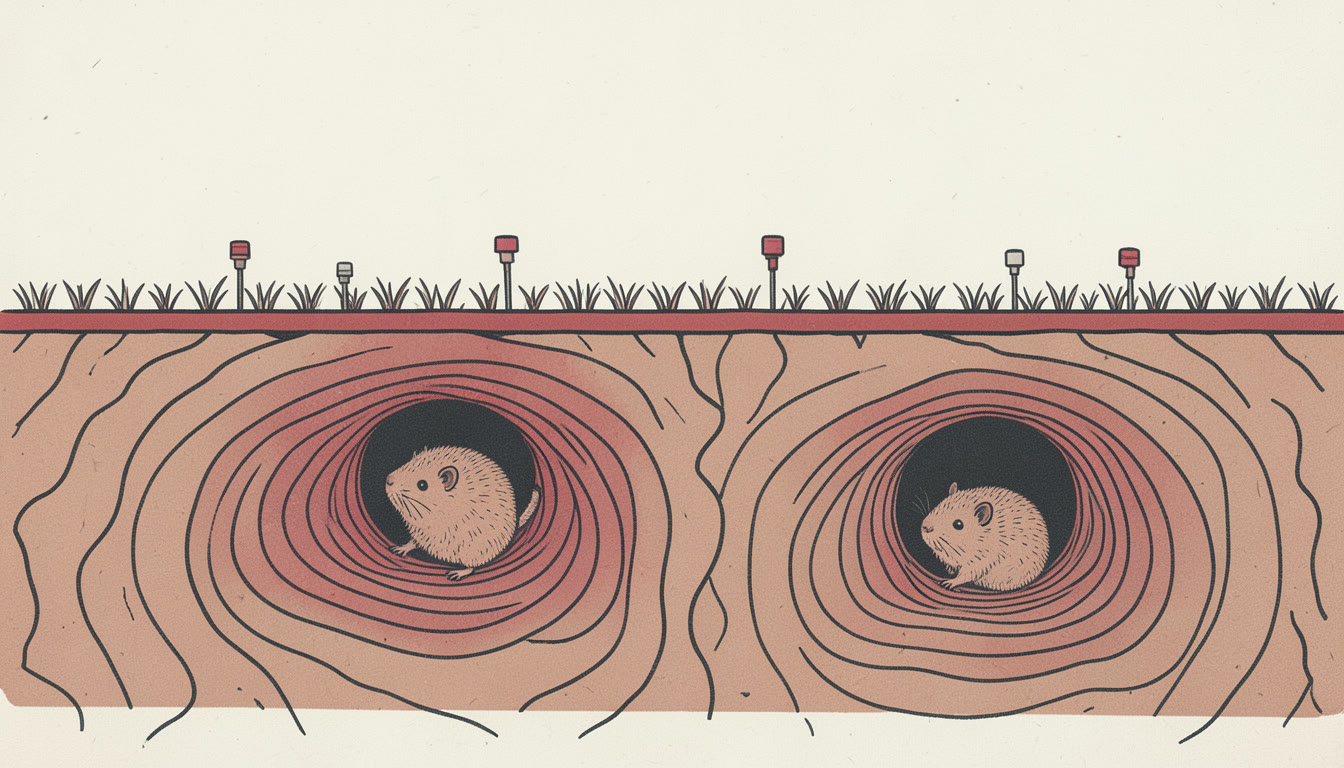
- In a semi-natural outdoor facility with more than 30 geophones, the head-drumming signals of the blind mole rat Nannospalax galili were not distributed evenly in the ground but were shifted toward the location of an intruding conspecific; the radiation pattern is broad, not sharply focused.
- The animals drummed more often during encounters with the opposite sex than with the same sex; the Weizmann Institute press release gives about 6.5 versus about 3.5 drumming bouts per minute, while the study's abstract gives no figures.
- A machine-learning method assigned individual strikes and drumming sequences to individual animals correctly more often than would be expected by chance; the study's abstract does not show that blind mole rats recognize one another by this.
Blind mole rats communicate through the ground. They strike their heads against the wall of their tunnel, and the vibration spreads through the soil. A study from Israel now shows that these signals do not go evenly in all directions: they are shifted toward the spot where an unfamiliar conspecific is located. In addition, the animals drummed more often when the visitor was of the opposite sex.
The work was published on November 25, 2026, in the journal Current Biology and is peer-reviewed. The first author is Ragad Hamade; the Weizmann Institute of Science in Rehovot and Tel Aviv University are involved. It is an animal experiment in a semi-natural outdoor facility, not an observation of free-living animals. The full text is not freely accessible. This article is based on the study's abstract and the press release of the Weizmann Institute; neither states how many animals were studied.
How a blind mole rat lives
Blind mole rats are rodents that live underground. A 2022 review, co-written by four authors of the new study, describes them as follows: weighing 100 to 250 grams, solitary animals in self-dug tunnel systems that they rarely leave, and 20 years old or older. The tunnels can be up to 100 meters long. The review lists the animals under the name Spalax ehrenbergi, while the new study names its species Nannospalax galili. The statements therefore apply to blind mole rats of this group and not necessarily in every detail to the species studied.
The eyes of the blind mole rat lie hidden under the fur and are smaller than 1 millimeter. Their retina contains fewer than 900 ganglion cells; in the rat there are more than 50,000. The eyes serve as light meters for the day-night rhythm, not for seeing.
According to the review, blind mole rats are extremely territorial and aggressive toward conspecifics. Encounters often end in injury or in the death of one or both animals. Apart from brief mating and nursing phases in winter, both sexes live alone all year round. The review assumes that the drumming allows contact over a distance without the animals having to meet: to locate neighbors and maintain territorial boundaries.
Why the ground is better than the air
Airborne sound travels poorly in a tunnel, because the walls dampen high frequencies. According to behavioral tests, blind mole rats hear from about 54 hertz to 5.6 kilohertz, best at 1 kilohertz; the house mouse is most sensitive at 16 kilohertz. Blind mole rats have no external ear, and they locate sound poorly.
In head drumming, according to the review, the animal strikes the flattened part of its head against the tunnel ceiling, in series of about two to four strikes lasting around 0.3 seconds. The signal can propagate through the ground for 10 meters or farther. It is picked up via the lower jaw at the tunnel wall, from where the vibration travels through the bones to the inner ear, and via sensory cells for mechanical stimuli on the paws.
This route of reception has been disputed. In 1991, Nevo, Heth and Pratt described head knocking as low-frequency, patterned and effective over long distances underground; they considered it a signal picked up through the body's sense of touch and independently of hearing. A 1998 study came to the opposite conclusion: processing runs through the auditory system. The 2022 review names both routes, the lower jaw with bone conduction to the inner ear and sensory cells on the paws, and considers it most likely that the auditory system and the sense of touch are both involved.
According to the review, blind mole rats also use their vibrations for orientation. In field experiments they detected an obstacle, a trench dug by researchers, and dug a tunnel around or over it. The review presents as a hypothesis that they drum for this and perceive the waves reflected from the obstacle.
How the team measured the signals
For the new study, the team used a semi-natural outdoor facility with more than 30 geophones, sensors for vibrations in the ground. According to the press release of the Weizmann Institute, it is a lattice cage buried outdoors, in which one animal digs its own tunnels. A second animal, the intruder, is introduced so that the two can sense each other but cannot touch. The team deliberately varied the position and sex of the intruder.
The first result concerns direction. The drumming signals were not distributed evenly in the ground but were shifted toward the location of the intruder. The abstract speaks of a "broad directional radiation pattern." This is not sharp focusing.
The second concerns sex. In encounters with an animal of the opposite sex, the blind mole rats drummed more often than in same-sex ones, and the time course over the encounter also depended on sex. The abstract gives no figures for this. The press release gives about 3.5 drumming bouts per minute for the residents toward same-sex intruders and about 6.5 toward intruders of the opposite sex; these values have not been checked against the full text, and neither their reference quantity nor any spread is known.
The third concerns the individual animal. A machine-learning method found individual patterns, both in the waveform of single strikes and in the timing of the drumming sequences. Assignment to individual animals succeeded more often than would be expected by chance, also across different recording sessions and across the roles of resident and intruder. The abstract gives no hit rate. According to the press release, several thousand head strikes were analyzed.
The authors conclude from this that seismic communication is a receiver-directed, information-rich signaling system that at the same time carries information about location, individual and social circumstances.
What was known about the drumming before
The question was open. The 2022 review noted that it is not well understood what information is contained in head drumming, such as dominance, sex, age or individual.
Among rodents, the blind mole rat with its way of life is not a special case. Of 19 known genera of subterranean rodents, 14 live as solitary animals. A 2023 paper lists at least 140 subterranean species in 20 genera and 8 families, about half of them solitary. Among 23 species studied, 74 percent produced their vibrations with the feet, 13 percent with the incisors and 13 percent with the head, snout or chest.
This paper also supplies a comparison case from the Qinghai-Tibet Plateau. Plateau zokors, also solitary, subterranean rodents, occupied an artificially created empty neighboring tunnel within 48 hours in 7 of 8 cases. Before and after, they produced seismic signals, the number of which rose significantly upon discovering and occupying it (p = 0.024). That case concerned the exploration of empty tunnels, not sex or individual, and the sample of eight cases was small.
What remains open
According to its abstract, the study shows that an algorithm can distinguish the patterns of individual animals. That blind mole rats themselves do this and recognize one another by the drumming is not shown by the abstract. That the drumming serves territorial defense or the search for a mate is also an assumption and not a measured value of the new work.
The accessible texts do not reveal how many animals, sessions and encounters were analyzed, whether the animals come from the wild, and how large the effects are. How the animals influence the direction of the signal is not stated in the abstract. It is also open whether the findings from the facility hold in undisturbed natural habitat, where tunnel course, soil type and neighbors play a role.
There is no replication by another research group. The research found no assessment by independent experts one day after the study's publication.
Questions about this article
Comments
Sources
- Primary source Hamade R, Smarsh G, Goder N et al.: Directional seismic signals encode socially relevant information in a solitary rodent. Current Biology, online vorab (2026). doi:10.1016/j.cub.2026.10.081
- Context Kashash Y, Smarsh G, Zilkha N, Yovel Y, Kimchi T: Alone, in the dark: The extraordinary neuroethology of the solitary blind mole rat. eLife 11, e78295 (Übersichtsarbeit; vier Autoren der neuen Studie sind beteiligt) (2022). doi:10.7554/eLife.78295
- Context Dong et al.: Seismic Signaling for Detection of Empty Tunnels in the Plateau Zokor, Eospalax baileyi. Animals 13 (2), 240 (2023). doi:10.3390/ani13020240
- Context Nevo E, Heth G, Pratt H: Seismic communication in a blind subterranean mammal: a major somatosensory mechanism in adaptive evolution underground. Proceedings of the National Academy of Sciences; Zusammenfassung gelesen (1991). https://pmc.ncbi.nlm.nih.gov/articles/PMC50996/