Can extinct species be brought back?
Extinct Species: Substitute Animals Have Been Created, Not Faithful Copies
Evidence level 3 of 5 · Several independent studies pointing the same way
Key points
- In 2016, the IUCN Species Survival Commission stated that none of the approaches known at the time yields a faithful copy of an extinct species; as a legitimate goal it named a substitute, a so-called proxy, intended to take over ecological functions.
- In 2003, a clone of the extinct Pyrenean ibex was born and died after a few minutes; in 2025, the company Colossal presented three wolves that, according to its statements, were cloned from gray wolf cells with 20 changes to 14 genes. A specialist group of the IUCN does not regard these animals as dire wolves.
- Whether lineage, appearance or ecological role counts when speaking of the same species is a stipulation and not a measurement; species concepts are diverse and contested, according to a 2026 piece in Biology Letters.
According to a 2016 guidelines report, bringing back an extinct species as a faithful copy was not possible with any of the approaches known at the time. The Species Survival Commission of the conservation union IUCN started from this basic assumption. As a legitimate goal, the report names a substitute, which it calls a proxy: an animal intended to take over ecological functions that were lost with the extinction. The report therefore calls the term "de-extinction" misleading.
On November 11, 2026, Andrew Davinack and Charlotte Daniels of Wheaton College in the US state of Massachusetts took up the question again in the journal Biology Letters. Their peer-reviewed opinion piece examines the claims using the example of wolves that a company presented as dire wolves in 2025. Both texts are position reports without their own measurements. The cases at issue involve animals: a wild goat, wolves and mice.
Which three approaches exist
The IUCN report distinguishes three approaches. The first is back-breeding: living relatives are deliberately bred for traits of the extinct form. In this way, domestic cattle were bred for the size and coloring of the aurochs, and plains zebras for the striping of the quagga. The result usually resembles the model only in outward appearance; how similar the genome is often remains unknown, according to the report, and is probably limited. The quagga project has been running since 1987. According to a 2018 overview, its animals carry the striping of the extinct form, but not its coloring.
The second approach is cloning. Here the nucleus of a body cell is transferred into an egg cell. The first mammal cloned from a non-embryonic cell was the sheep Dolly in 1996; by early 2015, according to the report, almost 20 mammal species had been cloned. For extinct animals, cloning requires intact, properly stored body cells and is therefore only an option for recently extinct species. Several clones from a single source also do not provide a basis for a population.
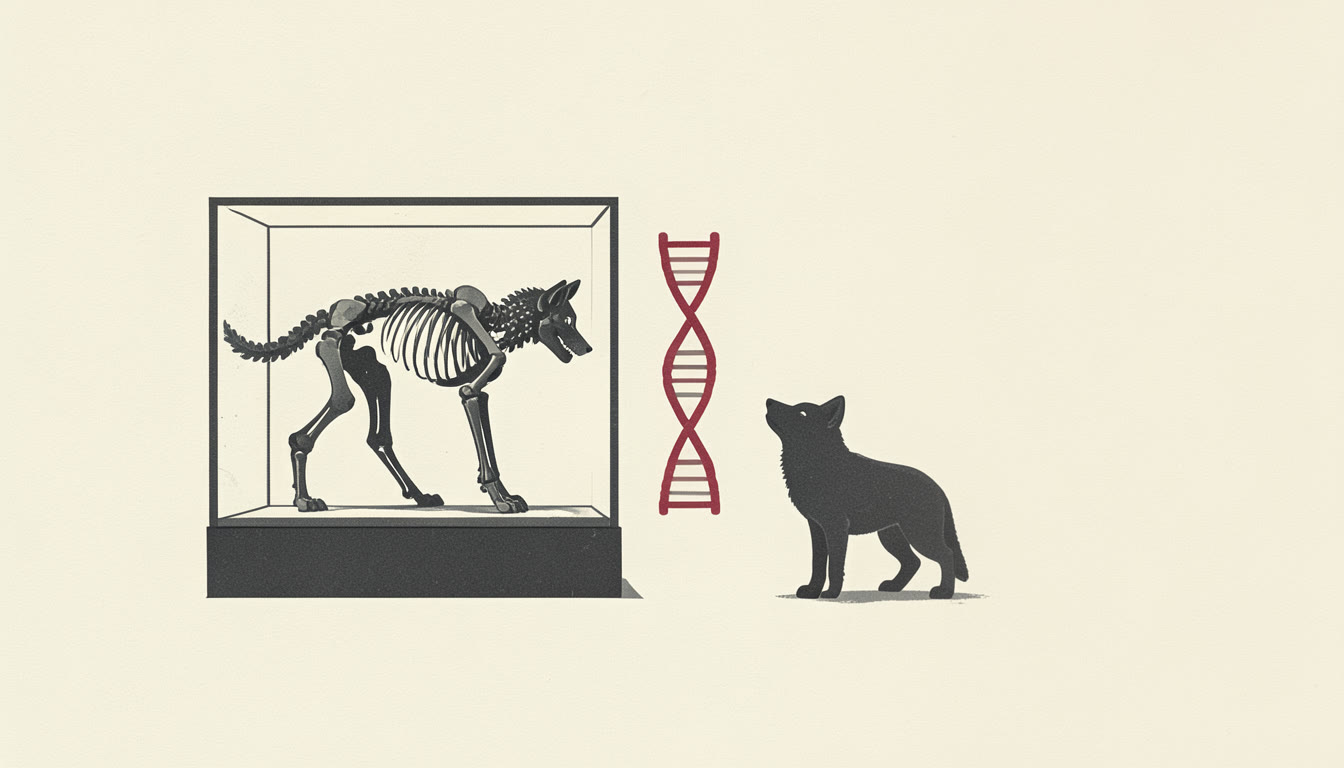
The third approach is genome editing. The genome of the extinct species is read from museum material, gaps are filled with the genome of the closest living relative, and its cells are modified accordingly. According to the report, the animals created this way are not genetically identical to the extinct form, and how their traits develop can be unpredictable. The method reaches back in time to species that died out hundreds of thousands of years ago, but not millions of years ago, because old genetic material degrades.
What happened with the Pyrenean ibex
The report calls the only case up to 2016 in which an extinct animal was cloned "partially successful." It concerned the bucardo, the Pyrenean ibex, an extinct subspecies. Skin cells from the last living female had been frozen in 1999; the animal died in 2000.
A team led by Folch transferred nuclei of these cells into egg cells of domestic goats. Spanish ibexes or their crosses with domestic goats served as surrogate mothers. In two attempts, a total of 208 embryos were transferred to 57 recipients. Seven became pregnant, and one carried to term. The female, delivered by cesarean section in 2003, looked normal and died a few minutes after birth from lung malformations. Its nuclear DNA was identical to that of the donor animal.
What the company Colossal presented in 2025
On April 7, 2025, the company Colossal Biosciences announced three animals that it calls dire wolves: the males Romulus and Remus, born in October 2024, and the female Khaleesi, born in January 2025. The dire wolf is an extinct canid from North America. According to a 2021 genome study that analyzed five genomes from bones 13,000 to more than 50,000 years old, its lineage split about 5.7 million years ago from the ancestors of today's wolf-like canids. The study found no evidence of later admixture with gray wolves or coyotes.
According to the company, 20 targeted changes to 14 genes were made in gray wolf cells. Clones arose from the nuclei of these cells and were carried to term by female dogs as surrogate mothers. According to a report by MIT Technology Review, four pups were born; one died after ten days of an intestinal infection, which the report says was classified as not caused by the cloning. For the white coat, according to the report, the company silenced two genes instead of adopting dire wolf variants.
A good month earlier, on March 4, 2025, the same company had presented a "woolly mouse." According to the news agency AP, seven genes related to hair structure and fat metabolism were altered simultaneously in mouse embryos. According to the company, each of the variants already occurs in some living mice. This does not create a mammoth, and at the time of the report the result had not appeared in a journal.
Why experts do not see a dire wolf in this
The canid specialist group of the IUCN Species Survival Commission issued a statement on April 18, 2025. It acknowledges the technical achievement but does not regard the three animals as dire wolves. The two species differed in thousands of genes, and only a handful had been changed. The environment of the dire wolf, with prey such as mammoths and giant ground sloths, no longer exists.
Davinack and Daniels base their rejection on more fundamental grounds. With extinction, an evolutionary lineage ends; more than genetic information is lost. A reconstructed genome is at most a partial image of an individual; the earlier diversity of a population and its history cannot be recreated from it. The wolf project did not begin with viable cells of the extinct population but with old sequence data. The animals therefore remain descendants of the gray wolf in terms of lineage, cells and development.
The authors distinguish between the approaches. Back-breeding and genome editing lead to animals that descend from the living lineage. A clone from preserved living cells of a recently extinct animal, by contrast, retains a direct biological connection but may capture only a small part of the former diversity. They see the strongest case of continuity in frozen embryos.
What is disputed
Colossal defends the designation. The company's chief scientist, Beth Shapiro, says, according to a report in Scientific American, that the name stands for the appearance and for key traits identified in the genome. At the same time, the company concedes in its own document that no project can completely reconstitute an extinct species. The animals live in a secured area, and a release is not planned. Shapiro herself had written in 2017 that even species with a cloned nuclear genome are not exact copies of the extinct species.
The dispute thus also concerns the question of what makes a species. According to Davinack and Daniels, species concepts are diverse and contested. Under an ecological species concept, a modified population that shows the adaptations and plays a comparable role could count as a functional substitute. But that is not the same as restoring the lineage.
How difficult classification is even for living species is shown by an example from the IUCN report. A banteng cloned in 2003 is regarded by the US Fish and Wildlife Service as a hybrid and not as part of the banteng population. The American Zoo and Aquarium Association lists the same animal as a banteng.
What de-extinction would mean for conservation
The IUCN report places a principle at the start of its guiding principles: the creation and release of a proxy must not be considered conservation-neutral and requires an ecological justification in advance. It also warns that the prospect of de-extinction could create the impression that extinction is reversible and thus weaken support for protecting present-day species. As possible drawbacks it names, among others, costs, the suffering of clones and surrogate mothers, new disease vectors and the risk that the proxy goes extinct again. For many of these benefits and drawbacks, there is little or no published evidence.
Davinack and Daniels see the immediate value of the technology elsewhere: in living species. Genomes from museums could show which genetic variants living species lost in bottlenecks, and these could be reintroduced. The canid specialist group also considers this possible in the future, but calls genome editing as a solution premature. In October 2025, the IUCN General Assembly in Abu Dhabi adopted a policy on synthetic biology in conservation, which provides for case-by-case decisions.
What research cannot decide
Whether a substitute animal is the same species cannot be measured. Davinack and Daniels name five different things that restoration can mean: the lineage, the genetic diversity, the appearance, the ecological function and the historical community. Success in one respect does not mean success in the others. Which one counts is a stipulation.
According to the IUCN report, it is also open whether a proxy can be attributed to the original species on the Red List and how close it would have to come to it for that. Whether the wolves created would take over a function of the dire wolf in the wild has not been tested; according to the company, they live in a secured area. The IUCN report, by its own statement, does not treat ethical questions exhaustively.
Questions about this article
Comments
Sources
- Primary source IUCN SSC De-extinction Task Force (Vorsitz Philip Seddon): IUCN SSC Guiding Principles on Creating Proxies of Extinct Species for Conservation Benefit, Version 1.0. Bericht der IUCN Species Survival Commission (Rep-2016-009) (2016). https://portals.iucn.org/library/efiles/documents/Rep-2016-009.pdf
- Context Davinack, Daniels: Reconstructing traits, not restoring lineages: the biological limits of de-extinction. Biology Letters 22(11), 20260315; begutachteter Meinungsbeitrag (2026). doi:10.1098/rsbl.2026.0315
- Context Folch et al.: First birth of an animal from an extinct subspecies (Capra pyrenaica pyrenaica) by cloning. Theriogenology 71, 1026–1034 (2009). doi:10.1016/j.theriogenology.2008.11.005
- Context Perri et al.: Dire wolves were the last of an ancient New World canid lineage. Nature 591, 87–91 (2021). doi:10.1038/s41586-020-03082-x
- Context IUCN SSC Canid Specialist Group, Taxonomic Review Task Force: Conservation perspectives on gene editing in wild canids. Stellungnahme vom 18.04.2025, wiedergegeben vom International Wolf Center (2025). https://wolf.org/headlines/conservation-perspectives-on-gene-editing-…
- Context Colossal Biosciences: Alignment of Colossal’s Dire Wolf De-Extinction Project with IUCN SSC Guiding Principles. Dokument der Firma, Selbstdarstellung. https://colossal.com/wp-content/themes/colossal/IUCN_SSC_Alignment.pdf
- Context Antonio Regalado: Game of clones: Colossal’s new wolves are cute, but are they dire?. MIT Technology Review, 08.04.2025 (2025). https://www.technologyreview.com/2025/04/08/1114371/game-of-clones-co…
- Context This Company Claimed to ‘De-extinct’ Dire Wolves. Then the Fighting Started. Scientific American, 15.08.2025 (Wiederabdruck eines Nature-News-Beitrags) (2025). https://www.scientificamerican.com/article/the-scientific-debate-over…
- Context Scientists genetically engineer mice with thick hair like the extinct woolly mammoth. Associated Press über PBS NewsHour, 04.03.2025 (2025). https://www.pbs.org/newshour/science/scientists-genetically-engineer-…
- Context Robert et al.: De-extinction and evolution. Functional Ecology 31, 1021–1031 (2017). doi:10.1111/1365-2435.12723
- Context Shapiro: Pathways to de-extinction: how close can we get to resurrection of an extinct species?. Functional Ecology 31, 996–1002 (2017). doi:10.1111/1365-2435.12705
- Context Novak: De-Extinction. Genes 9(11), 548; Übersichtsartikel eines Befürworters (2018). doi:10.3390/genes9110548
- Context IUCN agrees first global policy on synthetic biology. IUCN, Meldung vom 15.10.2025 (2025). https://iucn.org/news/202510/iucn-agrees-first-global-policy-syntheti…