Talon marks on baboon skeletons in Chad point to eagles as hunters
Evidence level 2 of 5 · Single study, peer-reviewed
Key points
- On the Ennedi Plateau in Chad, researchers found skeletal remains of nine olive baboons. In three adult males, the skulls or shoulder blades show punctures and scratch marks that the authors interpret as probable eagle talon marks.
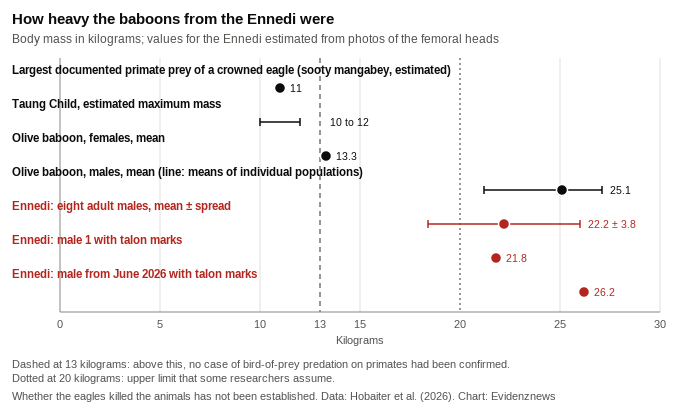
- The authors estimate the body mass of the eight adult males from photos of the femoral heads at 22.2 ± 3.8 kilograms on average. The two animals with talon marks for which an estimate exists come to 21.8 and 26.2 kilograms. Until now, no case of a bird of prey taking a primate heavier than 13 kilograms had been confirmed.
- No attack was observed. The authors cannot conclusively rule out that the eagles fed on animals that were already dead, and they themselves call their reasoning about early hominins speculative.
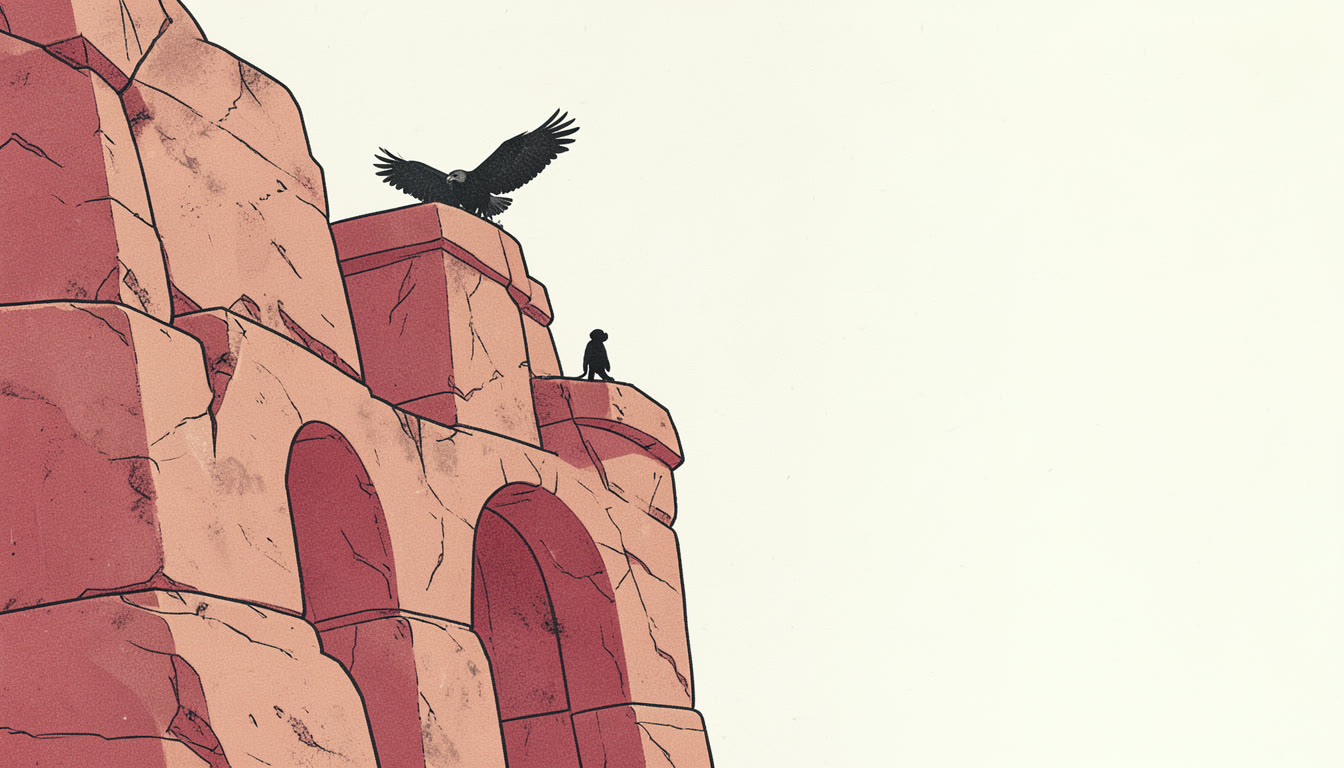
Below the sandstone cliffs of the Ennedi Plateau in Chad, researchers have recovered skeletal remains of nine olive baboons. In three adult males, the eye sockets are punctured or the shoulder blades scratched, a pattern of damage that fits the talons of large eagles. According to the authors' estimates, two of these animals weighed 21.8 and 26.2 kilograms. Until now, no case had been confirmed in which a bird of prey took a primate of more than 13 kilograms.
The team led by Catherine Hobaiter of the University of St Andrews in Scotland and Nathaniel Dominy of Dartmouth College in the USA published the finds on November 18, 2026, in the American Journal of Biological Anthropology as a brief communication. The study is based on bones of wild animals; no one observed an attack. According to the authors, they cannot conclusively decide whether the eagles killed the baboons or fed on dead animals.
How the researchers found and measured the bones
The Ennedi lies in the Sahara: about 60 000 square kilometers of sandstone, up to 1,450 meters high, with rock arches, pillars and waterholes, the gueltas. Annual precipitation is 50 to 150 millimeters. Remnant populations of patas monkeys and olive baboons have survived in the area. The baboons drink at the gueltas and eat mainly the fruit of the doum palm.
Between February 18 and March 4, 2025, the team searched the ground below the cliffs at three sites in the Réserve Naturelle et Culturelle d'Ennedi protected area. The walls are up to 150 meters high, and the baboons climb on them. In June 2026, further finds were added, which the authors describe in an addendum.
The researchers estimated how heavy the animals were from the femurs. They photographed the joint heads with a scale, measured their width with the image program ImageJ, and converted it into body mass with a formula for cercopithecine monkeys. The sample comprises nine individuals, including eight adult males with a mean estimated mass of 22.2 ± 3.8 kilograms; the study does not state what kind of spread the second value indicates. The ninth animal comes to 13.7 kilograms and, in the authors' assessment, is an unusually large female or a subadult male.
For comparison: according to a review that the study cites, adult male olive baboons weigh 25.1 kilograms on average and females 13.3 kilograms. The authors say that the males in the Ennedi being on the light side could be due to the barren habitat; the same explanation has already been given for similarly light male baboons in the Awash Valley in Ethiopia.
What the skulls and shoulder blades show
Two skulls of adult males, found in 2025 at two different gueltas, each have a hole in the wall of the eye socket. The authors interpret it as a probable puncture by a talon. Neither hole shows signs of healing; they therefore arose around the time of death. The researchers found no other damage on the skulls.
The first of the two males, estimated at 21.8 kilograms, also has punctures and scratch marks on the right shoulder blade. According to the authors, such scratch marks arise when an eagle opens the body cavity to pull out the heart and lungs. In June 2026, the team found the partial skeleton of another adult male, estimated at 26.2 kilograms: with a puncture at the left rear wall of the eye socket and at the right shoulder blade, as well as scratch marks on both shoulder blades. This animal had a bony callus on the left shinbone, indicating a displaced, crookedly healed fracture; the hind leg was shortened as a result.
The pattern is known from crowned eagles. Among 16 crowned eagle nests in the Taï Forest in Côte d'Ivoire, a 2006 study found a total of 1,200 bones, 669 of them from primates. The skulls typically showed punctures around the eye, the shoulder blades scratch fractures. The new study compares the finds from the Ennedi with this picture.
The authors reject other explanations for the holes. A gunshot would have caused considerable additional damage to the skull, and bites with the canine teeth in fights among males would have left bruising and further tooth marks. Both are absent.
Which eagle comes into question
Two eagle species live in the Ennedi, the golden eagle and the Verreaux's eagle. The authors consider the damage compatible with the Verreaux's eagle; this is inferred from the circumstances, not from an observation. The Verreaux's eagle is a large, dark eagle of the rocky regions of Africa. Males weigh about 3 to 4.2 kilograms, females up to about 6 to 7 kilograms, and the wingspan is about 1.81 to 2.3 meters. Its main prey is rock hyraxes, which in some populations make up over 90 percent of prey.
According to the authors, the species' feet are about 20 percent wider than those of the golden eagle, with a gripping span of up to 40 centimeters. That is more than twice as wide as the skull of a male baboon. As a possible hunting technique, the authors describe a low flight with a sustained grip, as is known from golden eagles: the eagle lands on the back or neck and rides the animal until it collapses.
On June 19, 2026, the researchers observed a group of baboons on a rock face. When a pair of Verreaux's eagles flew toward them, several animals gave alarm calls, and the least protected animals quickly fled into cover. Other birds of prey, snake eagles, triggered no such reaction. No attack followed.
The authors explain why males in particular might be affected with a hypothesis. Adult males defend the group by barking at eagles and charging them. That could put them at risk, especially on vertical walls, where the baboons in the Ennedi spend a long time because the valley floor offers little shade.
Why the 20-kilogram limit occupies researchers
Some researchers assume that birds of prey take primates only up to a body mass of 20 kilograms. The largest known primate victim of a crowned eagle was an adult male sooty mangabey of an estimated 11 kilograms.
The question touches on a fossil find from South Africa. The Taung Child, the skull of an Australopithecus africanus, was discovered in 1924 in a quarry near Taung in South Africa and described by Raymond Dart in 1925. The child died at about three to four years of age. In 1995, Lee Berger and Ron Clarke put forward the thesis that a large bird of prey could have caused its death. Its body mass is estimated at no more than 10 to 12 kilograms; according to the new study, that corresponds to the mass of young monkeys from the same site. An earlier objection to the thesis was that an eagle could not carry such a mass.
The new study contains no hominin fossils. The authors formulate their conclusion as a condition: if Verreaux's eagles regularly took adult male baboons of more than 20 kilograms, individual early hominins would also be conceivable as prey. They themselves call this discussion speculative. W. Scott McGraw of Ohio State University, author of the Taï Forest study and not involved in the new work, considers it possible, according to the magazine Live Science, that early hominins were especially attractive targets because of their small body size, above all infants and juveniles.
The authors show with a compilation from the literature that eagles occasionally attack animals far larger than their own weight would lead one to expect: a bushbuck weighing 30 kilograms is prey for crowned eagles, and golden eagles killed domestic calves weighing 100 kilograms. An attack by a harpy eagle on an adult woman weighing 52 kilograms is also documented.
What remains open
Above all, it remains open whether the eagles killed the baboons. For the killing, the authors cite the severity of the punctures and the distribution of the sexes: scavengers would not select by sex. The eagle researcher Jesús Bautista-Rodríguez of the Desert Golden Eagles Project, not involved in the study, remains cautious, according to Live Science. He said it is quite possible that some or all of the animals were already dead, dying or severely weakened. The holes and scratches are compatible with eagle talons and feeding, he said, but do not prove that the eagle killed the animal.
Robert Simmons of the University of Cape Town, likewise not involved, calls eagles opportunistic, according to Live Science: an old or a young male baboon traveling alone between two troops could become prey. This is surely rare, he said. The male with talon marks, estimated at 26.2 kilograms, had a crookedly healed leg fracture; whether this made it easier prey, the study does not discuss.
The sample is small: nine individuals, three of them with talon marks. The body masses are estimates from photos, and the study does not state an uncertainty for the individual values. Which of the two eagle species left the marks has not been established.
Questions about this article
Comments
Sources
- Primary source Hobaiter C, Akpona TJD, Kopp GH, Dominy NJ: Signs of Eagle Predation on a 22-kg Adult Primate. American Journal of Biological Anthropology 191(3), e70377 (2026). doi:10.1002/ajpa.70377
- Context Owen Jarus: Eagles hunt baboons weighing up to 60 pounds, raising questions about whether birds of prey hunted ancient humans. Live Science, 18.11.2026; Bericht mit Einschätzungen unbeteiligter Forscher (2026). https://www.livescience.com/archaeology/human-evolution/eagles-hunt-b…
- Context McGraw, Cooke, Shultz: Primate remains from African crowned eagle (Stephanoaetus coronatus) nests in Ivory Coast's Tai Forest. American Journal of Physical Anthropology 131, 151–165 (2006). doi:10.1002/ajpa.20420
- Context Taung Child. Wikipedia (englisch), Lexikoneintrag. https://en.wikipedia.org/wiki/Taung_Child
- Context Verreaux's eagle. Wikipedia (englisch), Lexikoneintrag. https://en.wikipedia.org/wiki/Verreaux%27s_eagle
- Context Klippenadler. Wikipedia (deutsch), Lexikoneintrag. https://de.wikipedia.org/wiki/Klippenadler