Model world without marine biology: 35 to 65 percent more CO2 in 2100, depending on pathway
Evidence level 2 of 5 · Single study, peer-reviewed
Key points
- A press release about a paper for the UN climate summit COP31 cites 35 to 65 percent more CO2 in 2100 without biological carbon transport in the ocean; the same range results arithmetically from a 2025 modeling study in Nature Communications, and the paper itself could not be found.
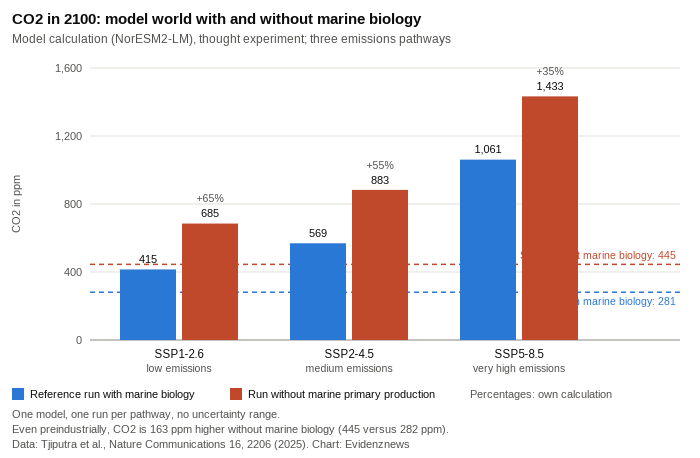
- The study switches off all marine primary production in a single Earth system model (NorESM2-LM); even in the preindustrial equilibrium, CO2 is then 445 instead of 282 ppm, that is, 163 ppm higher.
- The highest percentage, 65 percent, belongs to the lowest emissions pathway; in absolute numbers the gap is largest for the highest pathway, 372 ppm.
Without marine life, atmospheric CO2 at the end of the century would be 35 to 65 percent higher: that figure is cited in a press release about a paper for the UN climate summit COP31 in Turkey. The range can be reconstructed. It results arithmetically from a modeling study published in Nature Communications in March 2025. There it is the result of a thought experiment in a single Earth system model, and a large part of the gap, the larger part under low and medium emissions, already exists in the calculation before industrialization.
The study is by Jerry Tjiputra, Damien Couespel and Richard Sanders of the research institute NORCE and the Bjerknes Centre for Climate Research in Bergen, Norway. It is peer-reviewed and openly accessible. What it compares are two computer worlds: one with normal marine biology and one in which marine primary production is switched off entirely. The authors themselves call this an "extreme hypothetical case". It is not a prediction of what would happen if marine life were lost.
Where the figure in the report comes from
The press release comes from UAB, an institution involved in the paper, and appeared on November 25, 2026, via the EurekAlert service. It announces a paper by the EU project OceanICU for the climate conference and says that without the biological transport of carbon into the deep sea, CO2 in 2100 would be "between 35% and 65% higher than projected". Which model, which emissions pathway and which calculation lie behind it, the report does not say.
The paper itself could not be found for this article; neither the release nor the news site Phys.org gives an address. The attribution to the study by Tjiputra and colleagues is therefore an inference by this editorial team, not evidence: calculating with the study's figures yields exactly the range of 35 to 65 percent. The study was also funded by the same EU project, and co-author Sanders is its coordinator according to the EU's project page. Whether the paper actually obtained its figures this way remains open.
The thought experiment
The authors work with NorESM2-LM, the second generation of the Norwegian Earth System Model, which was also run for the IPCC's AR6 assessment report. An Earth system model here calculates not only the climate but also the carbon cycle between air, ocean and land; the CO2 content of the air is a result of the calculation, not a prescribed input.
The study contains two versions of this model. The reference includes marine biology as usual. In the second version, primary production in the ocean is switched off. This removes the biological carbon pump, that is, the transport of carbon by living organisms from the surface water into the depths. The model does not consider fish or marine mammals individually; it removes the basis of the pump as a whole.
The sequence matters. The version without biology first runs for 2,000 model years under preindustrial conditions until a new equilibrium is established. Only then do the years 1850 to 2014 follow, along with three future pathways to 2100: one with low emissions (called SSP1-2.6 in the field), one with medium emissions (SSP2-4.5) and one with very high emissions (SSP5-8.5). The calculation thus does not describe a world that is losing its marine life today, but one that has settled into equilibrium over 2,000 model years without marine biology.
A gap of 163 ppm even before 1850
In the preindustrial equilibrium, the CO2 content in the world without marine biology is 445 ppm, compared with 282 ppm in the reference. The unit ppm stands for parts per million. The gap is 163 ppm, by our own calculation about 58 percent; the authors speak of more than 50 percent.
That the gap is not even larger is due to the land. About half of the carbon that the ocean loses without biology is taken up in the calculation by the land biosphere, 345 billion tonnes of carbon, mainly because plants grow more strongly with more CO2. In a guest article for the portal Carbon Brief, the researchers write that earlier studies had estimated an increase of 150 to 240 ppm; their value is at the lower end because those works neglected the interaction between ocean and land. This is a statement by the authors; the earlier studies were not read for this article.
What the result is for 2100
For the year 2100, the study gives these values, in each case the reference against the world without marine biology:
- low emissions: 415 versus 685 ppm
- medium emissions: 569 versus 883 ppm
- very high emissions: 1,061 versus 1,433 ppm
The percentages in the report do not appear in the study. They result from setting the values in relation to each other: 65 percent more for the low pathway, 55 percent for the medium one, 35 percent for the very high one (our own calculation).
In a headline that cites only the maximum of 65 percent, two things get lost. First, the highest percentage belongs to the lowest emissions pathway, because the comparison value is smallest there. In absolute numbers it is the other way around: the gap is 270 ppm for the low pathway and 372 ppm for the very high one.
Second, these gaps contain a difference that already exists in the calculation before 1850: the runs start at 281 and 445 ppm, that is, 164 ppm apart. In the world without marine biology, CO2 rises from the starting value to 2100 by 240, 438 and 988 ppm, in the reference by 134, 288 and 780 ppm. What is added by 2100 is 106, 150 and 208 ppm; only for the very high pathway does this exceed the initial difference (our own calculation from the start and end values). The report's wording that CO2 would be higher "than projected" leaves open what is being compared with. If the range comes from this study, the benchmark is the reference run of the same model.
Why the ocean without biology takes up less CO2
The study gives three reasons why the ocean without biology takes up less human-made CO2. The climate of this world is warmer. At the sea surface, the CO2 deficit that biology otherwise creates, which draws CO2 from the air into the water, is missing. And the so-called Revelle factor is higher, which means that the ocean buffers additional CO2 less well.
The consequence is shown by a second metric, the share of emissions that remains in the air by 2100. In the reference it is 37, 50 and 65 percent depending on the pathway, in the world without marine biology 68, 76 and 83 percent. The 65 percent in this series is a different quantity from the 65 percent in the headline and should not be confused with it.
A more realistic benchmark comes from an additional test in the study: if primary production falls by 10 percent instead of 100, preindustrial CO2 rises by about 10 ppm.
How robust this is
The calculation comes from a single model with one run each. There is no range across multiple models. The authors themselves note that models represent marine biology imperfectly; this needs to be improved above all in the important sink regions of the North Atlantic and the Southern Ocean. They left out some feedbacks, such as fewer cooling aerosols from the sea and methane from permafrost; their estimated climate consequences are therefore probably at the lower end of what can be expected.
How uncertain biology is in such models is shown by an independent model comparison by Wilson and colleagues, published in 2022 in the journal PNAS. According to it, the biological pump stores more carbon in the 21st century in all the CMIP6 models compared there: an additional 10 to 34 billion tonnes under the SSP1-2.6 pathway and 19 to 48 billion tonnes under a high-emissions pathway (SSP3-7.0). That is about 5 to 17 percent of the increase that the models project for total carbon storage in the ocean by 2100. At the same time, the models vary widely. According to this work, the greatest uncertainty is the so-called transfer efficiency, a measure of how much of the sinking carbon reaches the depths: preindustrially it ranges from 3 percent in one model to 25 percent in another; sediment traps give about 20 percent.
The thought experiment thus says how much the biological pump contributes in total in this one model. It does not say how well the model captures the pump.
The press release for its part notes that the IPCC's Earth system models simplify carbon in the ocean and leave out fish, marine mammals and the migration of animals between water depths. The study to which the figure fits itself uses such a model. The release comes from an institution that is involved in the paper.
What remains open
Whether the paper for the climate summit draws its range from this study has not been settled. Whether other Earth system models yield similar values is open; our research found no such calculation. And how strongly a partial decline of marine biology would act, which in reality is more likely to be expected than a total loss, has not been calculated in the study apart from the one additional test. Our research found no expert criticism of the study; that does not mean there is none.
Questions about this article
Comments
Sources
- Primary source Tjiputra JF, Couespel D, Sanders R: Marine ecosystem role in setting up preindustrial and future climate. Nature Communications 16, 2206 (2025). doi:10.1038/s41467-025-57371-y
- Context Wilson et al.: The biological carbon pump in CMIP6 models: 21st century trends and uncertainties. PNAS 119 (29), e2204369119 (2022). doi:10.1073/pnas.2204369119
- Context Guest post: How marine life provides climate benefits worth billions of dollars. Carbon Brief, 28. Mai 2025; Gastbeitrag der Studienautoren, nicht unabhängig (2025). https://www.carbonbrief.org/guest-post-how-marine-life-provides-clima…
- Context Pressemitteilung der UAB zum Policy Brief für die COP31. EurekAlert, 25. November 2026; Pressemitteilung einer beteiligten Einrichtung, nicht unabhängig (2026). https://www.eurekalert.org/news-releases/1153419