How much sleep does a person need?
Sleep: US consensus recommends seven hours or more, individual need remains open
Evidence level 3 of 5 · Several independent studies pointing the same way
Key points
- The American Academy of Sleep Medicine and the Sleep Research Society recommend that adults aged 18 to 60 regularly sleep seven or more hours per night; the two-page consensus paper from 2015 describes associations, not proven causes, and gives no risk figures.
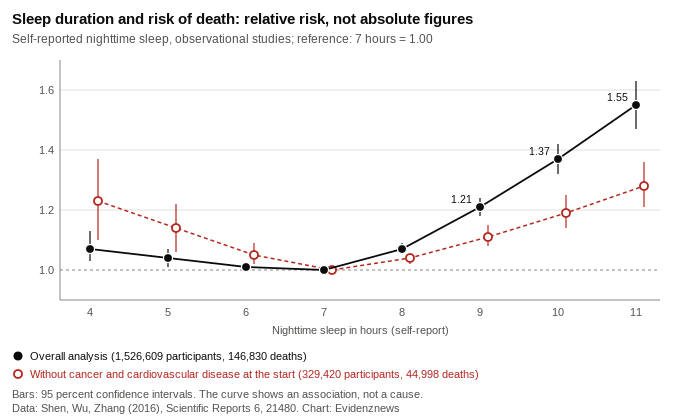
- In a 2016 meta-analysis, the relative risk of death compared with seven hours of nightly sleep was 1.01 (95 percent confidence interval 1.00 to 1.02) at six hours, 1.07 (1.03 to 1.13) at four hours and 1.21 (1.18 to 1.24) at nine hours; sleep duration is based on self-report, and the study does not give absolute risks for each sleep duration.
- The German Society for Sleep Research and Sleep Medicine advises adjusting sleep duration to individual need rather than a fixed target of seven hours; how much sleep an individual needs cannot be read from group means.
Seven hours or more per night: this is the figure that the American Academy of Sleep Medicine and the Sleep Research Society, two professional societies from the USA, have given since 2015 as a recommendation for adults aged 18 to 60. The recommendation is an expert consensus after review of the literature on human sleep, not a measurement result. What is established is a statistical association: in large analyses of long-term studies, the risk of death was higher among people who reported very short or long sleep than among those who reported about seven hours.
Whether sleep duration is the cause of this is not shown by these data. And how much sleep an individual person needs cannot be read from them. The German Society for Sleep Research and Sleep Medicine, or DGSM for short, advises people to go by their own sleep need rather than a fixed number.
What the professional societies' recommendation is based on
The consensus paper appeared in 2015 in the journal SLEEP and is two pages long. A panel of 15 experts in sleep medicine and sleep research, moderated by Nathaniel Watson, reviewed evidence, discussed it and voted in several rounds. The literature search had yielded 5,314 scientific articles on nine health areas, including cardiovascular health, metabolism, mental health, cancer and mortality. The process took twelve months and ended with a meeting in Chicago in February 2015.
According to the paper, regularly sleeping less than seven hours is associated with weight gain and obesity, diabetes, high blood pressure, heart disease and stroke, depression, and an increased risk of death. The paper describes associations, not proven causes, and it gives no figures on the risks. More than nine hours may, according to the paper, be appropriate for young adults, for people recovering from sleep debt, and for people who are ill. For others, it is unclear whether such long sleep is associated with a health risk.
The authors themselves qualify their recommendation. Individual sleep need is influenced by genetic, behavioral, medical and environmental factors, they say, and the biological mechanisms behind it require further research. Studies that directly examine the effect of sleep duration on health could change the recommendation in the future. According to the paper, healthy sleep also involves more than duration: quality, appropriate timing over the course of the day, regularity and the absence of sleep disorders. Duration is the focus because it is the most frequently studied measure of sleep.
For children and adolescents, the American Academy of Sleep Medicine published separate values in 2016 that decrease with age: from 12 to 16 hours per 24 hours at ages 4 to 12 months to 8 to 10 hours for 13- to 18-year-olds. For infants under four months, the panel made no recommendation because normal variation is too large and the evidence too thin.
What the large analyses of mortality show
The figures behind the debate come from meta-analyses, that is, analyses that combine many individual studies. A group around Cappuccio analyzed a total of 16 long-term studies from 8 countries in 2010, with 1,382,999 participants and 112,566 deaths; follow-up lasted 4 to 25 years. People who slept little had a relative risk of death of 1.12, that is, a risk 12 percent higher than the comparison group sleeping seven to eight hours (95 percent confidence interval 1.06 to 1.18). For long sleep, the value was 1.30 (1.22 to 1.38). The authors describe a U-shaped pattern.
A 2016 meta-analysis by Shen, Wu and Zhang broke the association down by hours. For nighttime sleep, 1,526,609 participants and 146,830 deaths were included. Compared with seven hours, the relative risk of death was 1.07 (1.03 to 1.13) at four hours, 1.04 (1.01 to 1.07) at five hours and 1.01 (1.00 to 1.02) at six hours. At eight hours it was 1.07 (1.06 to 1.09), at nine 1.21 (1.18 to 1.24), at ten 1.37 (1.32 to 1.42) and at eleven hours 1.55 (1.47 to 1.63).
Two things stand out in these figures. Six hours barely differ from seven in the overall analysis, and the risk rises more steeply with long sleep than with short sleep. Seven hours is, moreover, the reference group the authors chose for their analysis, not a measurement result of its own.
How many additional deaths lie behind the relative risks cannot be said: neither of the two studies gives absolute risks for each sleep duration. Only the overall proportion is known. In Cappuccio, roughly 8 percent of all participants died over the very differently long follow-up, in Shen roughly 10 percent.
Among people who had neither cancer nor cardiovascular disease at the start, the curve in Shen looked different. In this subanalysis of six studies with 329,420 participants and 44,998 deaths, the relative risk was 1.23 (1.10 to 1.37) at four hours and 1.05 (1.02 to 1.09) at six hours, but 1.11 (1.08 to 1.15) at nine hours and 1.28 (1.21 to 1.36) at eleven hours.
Why the curve does not demonstrate a cause
All of these data come from observational studies. Shen and colleagues themselves name several conceivable ways in which short sleep and mortality could be connected: short sleep could directly cause harm; it could result from social, physical or environmental changes that in turn increase mortality; or an illness changes sleep, so that cause and effect are reversed. Short and long sleep could accordingly also be merely signs of a poor state of health. The authors nevertheless consider both to be independent predictors; that is their assessment.
The objection applies especially to long sleep. A 2016 report by the US health agency CDC says there is little empirical evidence that long sleep causes harmful consequences in healthy people; chronically ill people may sleep longer. Cappuccio and colleagues also point to sleep apnea, nighttime pauses in breathing, which they say affects about 4 percent of middle-aged men and 2 percent of middle-aged women and was presumably not excluded in the studies.
A recent example of such an observational study comes from Finland: a 2026 study with two cohorts of 70,339 and 6,071 people. It estimated how many years people between 50 and 68 are expected to spend in working life. With short sleep of under seven hours and with intermediate sleep it was 13.2 years each (95 percent confidence interval 13.1 to 13.2 in each case), with long sleep of nine hours or more 12.4 years (12.3 to 12.6). The difference thus appeared among long sleepers, and here too sleep duration is based on self-report.
How reliable the figures on sleep duration are
In the studies of the Cappuccio meta-analysis, sleep duration was recorded by questionnaire. According to the authors, the questionnaires often did not make it possible to distinguish between sleep time and time in bed or to capture the number and duration of naps. How far self-report and measurement can diverge was shown in 2008 by a study of 669 middle-aged adults in Chicago. They wore a motion sensor on the wrist for three days. On average, 6 hours of sleep were measured; by their own account it was 6.8 hours. The correlation between the two values was 0.47. Cappuccio and colleagues, by contrast, point to high correlations in other studies; the evidence is not consistent.
A 2024 study of 60,977 participants in the UK Biobank who wore an accelerometer on the wrist draws attention to a different measure. In follow-up there were 1,859 deaths, which is 4.84 per 1,000 person-years. In the four fifths with the more regular sleep and wake times, the risk of death was 20 to 48 percent lower than in the most irregular fifth. The authors call regularity a stronger predictor than duration: when they added sleep duration to their models in addition to regularity, it did not demonstrably improve the prediction of mortality (p-values 0.14 to 0.20).
What experiments and measurements without electric light show
That sleep deprivation reduces performance has been shown experimentally. A 2003 laboratory trial involved 48 healthy adults between 21 and 38 years old. After random assignment, they spent four, six or eight hours per night in bed for 14 days; another group stayed completely without sleep for three nights. At four and six hours, the deficits in attention and cognitive tasks increased from day to day. After 14 days with six hours or less, they corresponded, according to the authors, to up to two nights of total sleep deprivation. Self-rated sleepiness, by contrast, rose only a little at the beginning and on the following days. The trial lasted two weeks and measured performance, not illnesses.
A 2022 randomized trial tested the opposite route. 80 adults with overweight who usually slept less than 6.5 hours took part; one group received counseling aimed at extending time in bed to 8.5 hours. Their sleep lengthened by about 1.2 hours per night compared with the control group (95 percent confidence interval 1.0 to 1.4), and energy intake fell by 270 kilocalories per day (147 to 393). The study says nothing about mortality or long-term consequences.
A different kind of comparison is provided by measurements in three preindustrial societies. According to a 2015 study using motion sensors, people there slept 5.7 to 7.1 hours, which the authors describe as close to the lower end of values from industrialized societies. Between summer and winter there was a difference of about one hour.
Where the German professional society disagrees
In 2022, in a statement on a study published at the time, the DGSM put forward a different interpretation. Adults should adjust sleep duration to individual sleep need, not to a fixed target of seven hours. Need varies and is genetically determined; most adults sleep about six to eight hours on average. A statistical mean must not be applied to individuals.
On the data, the DGSM is not far from the US societies. It, too, names chronic sleep deficiency and regularly very long sleep of more than nine hours as associated with an increased risk of cardiovascular disease, depression and other conditions. Sleep that is too short or too long could also point to underlying illnesses. For how restorative sleep is, quality counts alongside duration.
What research cannot decide
Cohort studies provide group means and risk curves, not a figure for the individual case. How much sleep a particular person needs, they cannot answer in principle. Nor do they separate whether too little or too much sleep causes illness and death or merely indicates it.
It also remains open how many deaths lie behind the relative risks and whether the seven-hour threshold is a biological value or a convention of statistics. The consensus paper applies only to 18- to 60-year-olds. For people who are worried about too little or too much sleep, it refers them to their doctor.
Questions about this article
Comments
Sources
- Primary source Watson NF et al. (Consensus Conference Panel): Recommended Amount of Sleep for a Healthy Adult: A Joint Consensus Statement of the American Academy of Sleep Medicine and Sleep Research Society. SLEEP 38(6), 843–844 (2015). doi:10.5665/sleep.4716
- Context Cappuccio, D'Elia, Strazzullo, Miller: Sleep duration and all-cause mortality: a systematic review and meta-analysis of prospective studies. SLEEP 33(5), 585–592 (2010). doi:10.1093/sleep/33.5.585
- Context Shen, Wu, Zhang: Nighttime sleep duration, 24-hour sleep duration and risk of all-cause mortality among adults: a meta-analysis of prospective cohort studies. Scientific Reports 6, 21480 (2016). doi:10.1038/srep21480
- Context Lauderdale et al.: Self-reported and measured sleep duration: how similar are they?. Epidemiology 19(6), 838–845 (2008). doi:10.1097/EDE.0b013e318187a7b0
- Context Stellungnahme der Deutschen Gesellschaft für Schlafforschung und Schlafmedizin (DGSM) vom 10.05.2022. Pressemitteilung über den Informationsdienst Wissenschaft (idw) (2022). https://idw-online.de/de/news793384
- Context Van Dongen, Maislin, Mullington, Dinges: The cumulative cost of additional wakefulness: dose-response effects on neurobehavioral functions and sleep physiology from chronic sleep restriction and total sleep deprivation. SLEEP 26(2), 117–126; Laborexperiment (2003). doi:10.1093/sleep/26.2.117
- Context Tasali et al.: Effect of sleep extension on objectively assessed energy intake among adults with overweight in real-life settings: a randomized clinical trial. JAMA Internal Medicine 182(4), 365–374 (2022). doi:10.1001/jamainternmed.2021.8098
- Context Windred et al.: Sleep regularity is a stronger predictor of mortality risk than sleep duration: a prospective cohort study. SLEEP 47(1), zsad253 (2024). doi:10.1093/sleep/zsad253
- Context Yetish et al.: Natural sleep and its seasonal variations in three pre-industrial societies. Current Biology 25(21), 2862–2868 (2015). doi:10.1016/j.cub.2015.09.046
- Context Myllyntausta et al.: Sleep disturbances and sleep duration as predictors of working life expectancy among adults aged 50 years and older in Finland. Occupational and Environmental Medicine, online 18.08.2026 (2026). doi:10.1136/oemed-2025-110766
- Context Paruthi et al.: Recommended amount of sleep for pediatric populations: a consensus statement of the American Academy of Sleep Medicine. Journal of Clinical Sleep Medicine 12(6), 785–786 (2016). doi:10.5664/jcsm.5866
- Context Liu et al.: Prevalence of healthy sleep duration among adults — United States, 2014. Morbidity and Mortality Weekly Report 65(6), 137–141; Bericht der US-Gesundheitsbehörde CDC (2016). doi:10.15585/mmwr.mm6506a1